
2026 Master Guide: International Dimensional Weight
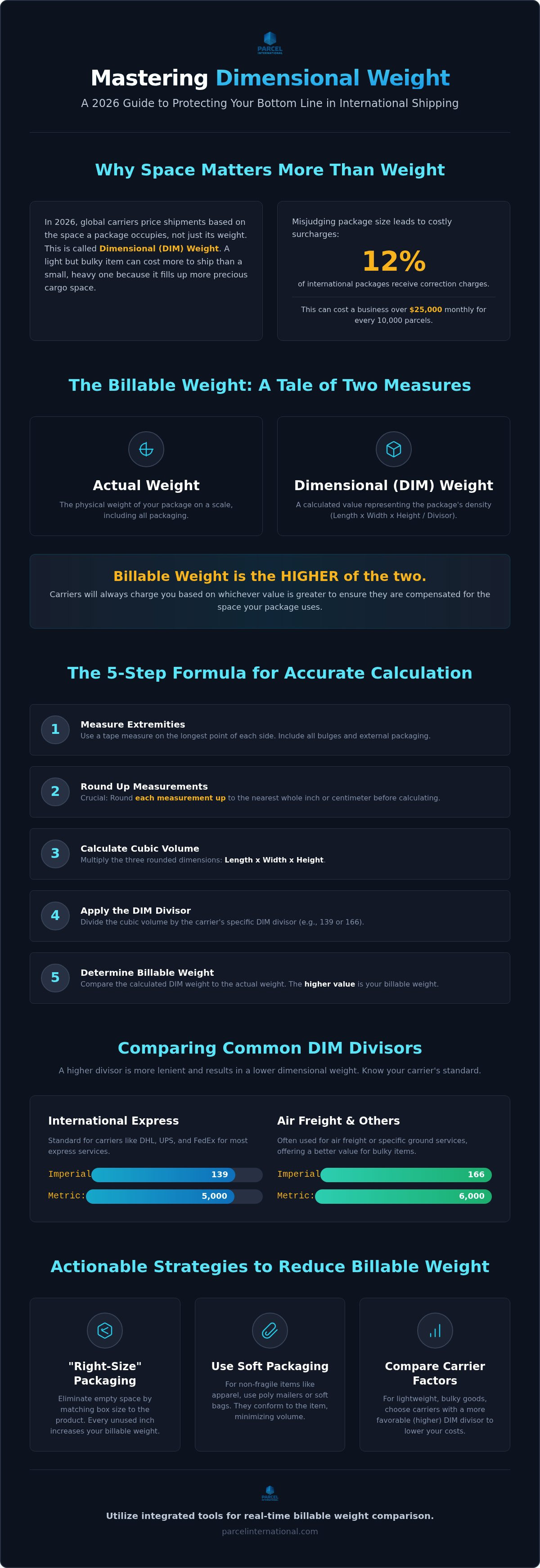
Did you know that up to 12% of international packages receive a correction charge simply because the shipper misjudged the size of the box? For a business moving 10,000 parcels a month, these minor errors can bleed over $25,000 in avoidable monthly costs. The reality of global logistics in 2026 is that carriers care more about the space your cargo occupies than its actual weight. Mastering the art of calculating dimensional weight for international shipping is no longer just a warehouse task; it's a vital financial strategy to protect your bottom line.
It's frustrating to open a shipping invoice only to find billable weight figures that don't match what you saw on your scale. We understand that unpredictable costs make it nearly impossible to protect your margins or provide accurate quotes to your global customers. This guide will show you how to eliminate that friction by mastering the 139 divisor and the new rounding rules recently adopted by major international carriers. You'll learn the exact formulas to predict costs, strategies to pack more efficiently, and a simple way to compare carrier DIM factors so you never pay for empty space again.
Table of Contents
What is Dimensional Weight and Why Does It Rule International Shipping?
Most shippers assume their costs are tied strictly to the number on a scale. This is a costly misconception. Dimensional weight, or DIM weight, is a pricing technique used by global carriers to account for the physical space a package occupies. By 2026, calculating dimensional weight for international shipping has become the primary driver of logistics costs. Carriers have shifted toward these density-based models to meet strict fuel efficiency targets and optimize their carbon footprints. You aren't just paying for mass; you're paying for a specific portion of a plane or truck's finite capacity.
The logic is simple: a box of feathers takes up significantly more room than a small box of lead weights, even if the lead is heavier. In a cargo hold, volume is a limited resource. If a carrier fills an entire aircraft with lightweight, bulky boxes, the plane will reach its volume limit long before it reaches its weight capacity. This creates wasted lifting power. To solve this, industry leaders like DHL and UPS use DIM weight to ensure that every cubic inch of their fleet generates appropriate revenue. If you ship light items in large boxes, you're paying for the space that a heavier item could have occupied.
Actual Weight vs. Volumetric Weight
Actual weight is the physical measurement of your parcel on a scale, including all packaging materials and pallets. Volumetric weight is a calculated figure representing the package’s density, determined by its dimensions and a carrier-specific divisor. Billable weight is the industry standard for final invoicing, representing whichever value is higher between the actual weight and the volumetric weight.
The Economics of the Cargo Hold
Optimizing cargo holds is a high-stakes game for Express Shipping and Air Freight providers. The 2026 logistics landscape is dominated by automated 3D scanning technology that catches even a half-inch bulge in a cardboard box. Because e-commerce often relies on oversized packaging for small items, the global network has become increasingly congested. This makes shipping air a luxury no business can afford. Every unnecessary inch of packaging adds to the billable weight. This is why calculating dimensional weight for international shipping accurately before your goods leave the warehouse is the only way to prevent invoice shock and ensure your logistics strategy remains lean.
The 2026 Step-by-Step Formula for Calculating Dimensional Weight
Understanding the theory is only half the battle. To protect your margins, you need a repeatable process for calculating dimensional weight for international shipping. Carriers have tightened their tolerances significantly, meaning even a small error in measurement can trigger expensive surcharges. Follow these five steps to ensure your data matches the carrier's automated scans.
Step 1: Measure the extremities. Use a sturdy tape measure to find the longest point of each side. You must include any bulges, handles, or protective wrapping that extends beyond the box walls.
Step 2: Round up. As of 2026, industry standards require you to round every measurement up to the nearest whole inch or centimeter before doing any math.
Step 3: Calculate volume. Multiply the rounded Length x Width x Height. This gives you the total cubic volume of the package.
Step 4: Apply the divisor. Divide the total volume by the carrier-specific DIM divisor (e.g., 139 for most express services).
Step 5: Determine billable weight. Compare this result to the actual weight on your scale. The higher of the two is what you will be invoiced for.
Metric vs. Imperial Calculations
Most US-based shippers use inches and pounds, while the rest of the world operates in centimeters and kilograms. If you're using imperial units, you'll typically divide your total cubic inches by 139 for international express shipments. For metric shipments, you'll divide total cubic centimeters by 5,000. A common mistake is forgetting that these divisors change based on the mode of transport. While Express Shipping often uses 139, Air Freight might use a 166 divisor, which is more lenient. Always verify the external dimensions of shipping crates, as pallets and wooden frames add significant volume that scales don't fully capture.
The Role of the DIM Divisor
The divisor is the mathematical pivot point of your invoice. It represents the amount of space a carrier allocates per unit of weight. A lower divisor, such as 139, results in a higher billable weight and higher costs. This shift in industry standards has a massive impact of dimensional weight pricing on internal operations, forcing warehouses to rethink their box inventories. By 2026, the 139 divisor has become the global benchmark for international express because it maximizes carrier revenue in high-demand lanes. Managing these different factors manually is a recipe for error. You can simplify this by using our international shipping rate comparison tool to automate the math across different carriers instantly.
Comparing DIM Factors: UPS, DHL, FedEx, and Freight Modes
The math behind your shipping invoice changes the moment your package crosses a border. While domestic ground shipments sometimes enjoy more lenient divisors, calculating dimensional weight for international shipping requires a stricter 139 factor. This difference exists because air cargo space is far more expensive to operate than a ground delivery van. By July 2026, major carriers like USPS aligned their divisors with UPS and FedEx at 139, effectively standardizing the industry. This convergence simplifies the math but increases the billable weight for many lightweight parcels.
Carrier-Specific Standards
Standardizing your workflow starts with knowing the specific divisors for the primary global carriers. While the numbers look similar, the application rules vary based on your account type and service level.
UPS International: Most daily account holders are billed using a 139 divisor. However, if you are using retail rates at a walk-in location, you might still see a 166 divisor for domestic legs of the journey.
DHL Express: As a metric-first carrier, DHL uses a global standard of 5,000 cubic centimeters per kilogram. This is roughly equivalent to the 139 divisor used in the imperial system and is applied consistently across their 220+ country network.
FedEx International: FedEx applies the 139 DIM weight factor to all Express packages regardless of size. For FedEx Ground International shipments to Canada or Mexico, the rules only apply DIM weight to packages exceeding 1,728 cubic inches.
Freight vs. Parcel: When the Formula Shifts
When your shipment moves from a single box to a pallet, the terminology and the math evolve. Air freight uses a "chargeable weight" concept where the ratio is typically 1:6000. This means one cubic meter is expected to weigh at least 167 kilograms. If your pallet is lighter than that, you'll be billed based on the volume rather than the scale weight. In 2026, identifying which mode is cheaper for high-volume, low-weight goods requires a side-by-side comparison. This is where calculating dimensional weight for international shipping across different modes becomes a competitive advantage.
For those moving goods within the continent, understanding international road freight rates Europe is essential. Road transport often uses a different volumetric calculation based on "loading meters" or cubic meters (CBM). Air freight is often the most sensitive to density, while sea freight is the most forgiving. If your goods are bulky but light, switching from air to road or sea can often reduce your billable weight by 20% or more. Check your service guides for trade-lane specific factors, as some carriers adjust divisors for specific emerging markets to manage capacity.
Actionable Strategies to Reduce Your Billable Weight
Stop shipping air. If you've already mastered calculating dimensional weight for international shipping, you know that every cubic inch of empty space is a drain on your profits. Real savings come from physical optimization and strategic packaging choices. If your billable weight is consistently higher than the actual weight on your scale, your current workflow is inefficient. You can fix this by focusing on density and minimizing the external footprint of every parcel.
Right-sizing: Move away from standard box sizes. Custom-fit packaging ensures that you aren't paying to ship bubble wrap or air.
The 'Box-in-Bag' technique: For soft goods like apparel, use poly mailers instead of rigid boxes. If a box is required for protection, placing the item in a bag first allows you to use a smaller, tighter-fitting outer container.
Material optimization: Swap heavy, double-walled corrugated cardboard for high-strength, thin-wall alternatives. These modern materials provide the same protection with a smaller external volume.
Consolidation: Grouping multiple items into a single, dense container reduces the total "dead space" that occurs when shipping several smaller, half-empty boxes.
Packaging Audits for E-commerce
Start by analyzing your top 10 SKUs to identify where the gap between actual and billable weight is largest. Many businesses find that a single product line is responsible for the majority of their dimensional surcharges. Consider investing in automated box-making technology that creates a custom-sized container for every order, effectively eliminating the need for void fill. This data-driven approach is a pillar of successful international shipping for ecommerce, allowing you to maintain competitive pricing in global markets.
Negotiating DIM Factors
Don't assume the standard 139 divisor is your only option. For high-volume shippers, calculating dimensional weight for international shipping is a point of negotiation. If you can prove through shipping data that your packages are consistently dense and stackable, carriers may grant you a higher divisor like 166 or 194. This adjustment can lower your billable weight by nearly 20% without changing your packaging at all. Keep in mind that precise dimensions are also critical for international shipping customs documentation, as inaccurate data can lead to delays or valuation disputes at the border.
Ready to see how much you could save by optimizing your dimensions? Compare international shipping rates and carrier DIM factors in one transparent view.
How Parcel International Simplifies Dimensional Calculations
Manual math is a liability in a high-stakes logistics environment. While the formulas for calculating dimensional weight for international shipping are straightforward, applying them across different carriers, currencies, and trade lanes creates room for error. Parcel International acts as your stable intermediary, stripping away the procedural friction of global shipping. Our platform integrates a sophisticated shipping cost calculator that handles the complex math for you. Instead of juggling spreadsheets, you simply enter your dimensions once and see the results instantly.
Transparency is a central pillar of our identity. You don't have to worry about hidden requirements or fine-print traps that lead to unexpected costs. Our interface provides a real-time comparison, allowing you to see the billable weight across DHL, UPS, and FedEx in a single, unified view. This side-by-side analysis reveals which carrier offers the most favorable DIM factor for your specific parcel. By using our wholesale rates, small and medium-sized businesses can access pre-negotiated divisors typically reserved for high-volume corporations. There are no subscription requirements or volume minimums, making professional-grade logistics accessible to everyone.
The Advantage of a Logistics Broker
We bridge the gap between your warehouse and global carrier giants. One of the most significant risks in international shipping is "back-billing," where a carrier corrects your dimensions and adds surcharges to your final invoice. Our system reduces this risk by automating the "divisor choice" based on your destination and the weight of your goods. We ensure your quote is based on the same 2026 standards the carriers use, providing relief from the anxiety of unpredictable invoices. If you move goods via Air Freight or Road Freight, we adapt the calculations to match those specific industry ratios automatically.
Getting Started with Accurate Quotes
Accuracy begins at the point of entry. When you use the Parcel International platform, ensure you include every bulge and handle in your measurements to match the carrier's 3D automated scans. Once your dimensions are set, our automated customs support tools help you generate the necessary paperwork to prevent border delays. This end-to-end efficiency moves you from inquiry to action as quickly as possible. You shouldn't have to be a math expert to ship globally; you just need the right tools to make the process orderly. Compare international rates and calculate your billable weight now.
Optimize Your Global Logistics Strategy for 2026
Mastering the math of density is the only way to protect your margins in a market where carriers prioritize space over physical weight. By accurately calculating dimensional weight for international shipping and adopting "right-sizing" strategies, you turn a potential hidden cost into a predictable part of your operations. Precision in your warehouse leads directly to punctuality and profit in your global logistics.
You don't have to navigate complex carrier divisors or fragmented workflows alone. Parcel International offers a singular, unified solution to compare rates and manage your strategy without the burden of subscription fees or volume minimums. You get immediate access to wholesale rates from DHL, FedEx, and UPS; along with automated customs documentation to keep your shipments moving smoothly. Take control of your billable weight and stop paying for empty space. Start comparing real-time international shipping rates today and experience the relief of a transparent, orderly shipping process. Your global expansion is within reach.
Frequently Asked Questions
What is the most common divisor for international shipping in 2026?
The standard divisor for international express shipping in 2026 is 139 for imperial measurements. This factor is used by major carriers like UPS, FedEx, and USPS for their global services. If you operate in the metric system, the industry standard is 5,000 cubic centimeters per kilogram. Using these specific divisors ensures your billable weight aligns with the automated 3D scanning technology used in modern carrier hubs.
Does dimensional weight apply to sea freight shipments?
Yes, but sea freight uses a different density ratio known as Weight or Measure. Instead of the 139 divisor, sea freight is typically calculated based on cubic meters. Carriers compare the total volume of your cargo against its actual weight. Since sea freight is less sensitive to space than air freight, the thresholds are much higher, making it the most cost-effective mode for bulky, low-density goods.
How do I calculate dimensional weight in kilograms and centimeters?
To calculate volumetric weight in the metric system, multiply the length, width, and height of your package in centimeters. Divide the resulting total cubic volume by 5,000. The result is your volumetric weight in kilograms. When calculating dimensional weight for international shipping, always remember to round every individual dimension up to the nearest whole centimeter before multiplying to avoid discrepancies between your quote and the final carrier invoice.
Can I avoid dimensional weight by using my own packaging?
No, using your own packaging does not exempt you from dimensional weight rules. Carriers apply DIM weight to every parcel regardless of whether it is a carrier-branded box or your own custom container. The only way to reduce the impact of these charges is to minimize the external volume of your package. Switch to poly mailers for soft goods or use custom-sized boxes to eliminate shipping air and lower your billable weight.
What happens if I enter the wrong dimensions on my shipping label?
If you enter incorrect dimensions, the carrier's automated sorting systems will detect the discrepancy and trigger a shipping correction. This often results in back-billing, where the price difference is charged to your account after the shipment has been delivered. These adjustments can also include administrative fees. Accurate calculating dimensional weight for international shipping at the warehouse level is essential to maintain radical transparency in your logistics costs and avoid these penalties.
Is billable weight the same for all international carriers?
Billable weight is not identical across all carriers because divisors and service levels differ. While 139 is the 2026 benchmark for express services, some Economy options or Air Freight modes may use a more lenient 166 divisor. Additionally, rounding rules for fractions of an inch vary. Using a logistics broker allows you to compare these specific factors side-by-side in real-time, ensuring you select the most efficient carrier for your package's density.
Do flat-rate boxes have dimensional weight limits?
Standard flat-rate boxes typically bypass dimensional weight calculations because the price is based on the specific container size rather than volume. However, they still have strict physical weight limits, often capped at 70 pounds for international routes. If your items are extremely dense or exceed the container's physical capacity, you'll need to switch to standard packaging where DIM weight rules will apply. Always check the carrier's specific weight cap for the destination country.
How does dimensional weight affect customs duties and taxes?
Dimensional weight primarily affects your shipping cost, but it can indirectly impact customs duties in countries that use the Cost, Insurance, and Freight valuation method. In these regions, duties are calculated based on the total landed cost of the goods, including the shipping fee. If your billable weight increases your freight cost, the total taxable value of your shipment rises. Accurate volume data ensures you provide correct documentation to prevent valuation disputes.


