
Air Freight vs Sea Freight Cost Analysis 2026: The Definitive Business Guide
- Alex
- 3 hours ago
- 13 min read
In 2026, the most expensive way to move your cargo isn't always the one with the highest initial quote. It's often the mode that hides its true cost in forty day transit delays and unexpected port surcharges. You're likely struggling to balance the immediate need for speed with the reality of eroding margins and complex chargeable weight calculations. It's a high stakes game where unpredictable fuel surcharges can turn a profitable quarter into a logistical nightmare overnight. We understand that the pressure to stay agile while cutting costs has never been higher.
This air freight vs sea freight cost analysis 2026 gives you a definitive framework to master these financial trade-offs. We'll provide the exact math based thresholds you need to decide between modes, especially as Red Sea disruptions and the July 2026 expiration of Section 122 tariffs shift traditional break-even points. You'll learn how to identify hidden fees before they hit your invoice and discover a streamlined way to compare real-time rates without the corporate jargon. We're breaking down the specific shift where shipments in the 300 to 400 kg range are becoming more viable for air, ensuring your supply chain remains both orderly and cost-effective.
Table of Contents
The 2026 Global Shipping Landscape: Air vs Sea Freight Overview
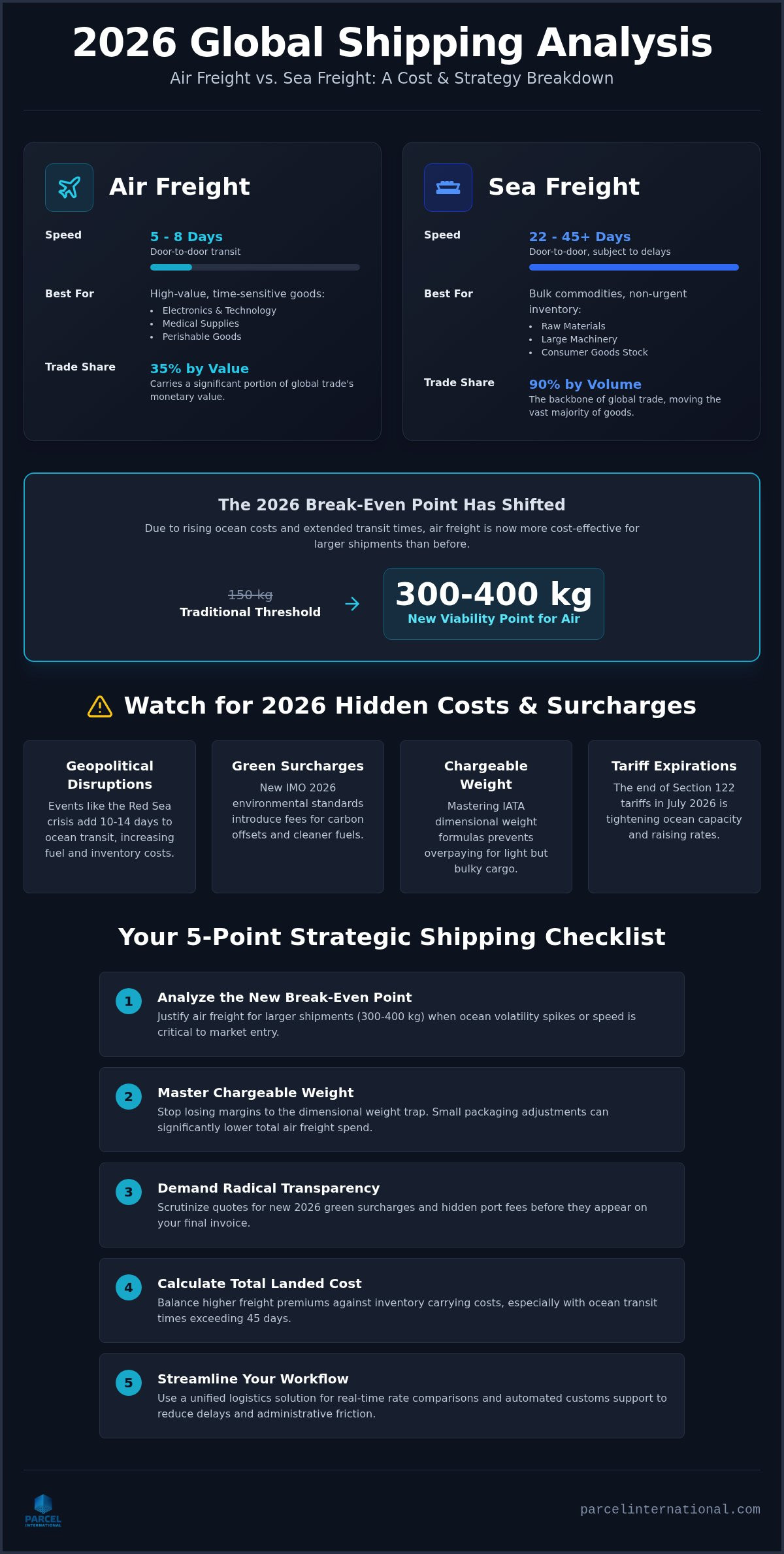
The global logistics market has shifted. In previous years, the choice between air and ocean was a simple binary of "fast but expensive" versus "slow but cheap." Today, an accurate air freight vs sea freight cost analysis 2026 requires a deeper look at market volatility and systemic disruptions. While ocean shipping still moves roughly 90% of global trade volume, air cargo now carries over 35% of trade by value. This disparity highlights a growing trend: businesses are prioritizing security and velocity over sheer volume to protect their market share. You don't have to deal with the old limitations of fragmented workflows when modern platforms offer a unified way to compare these modes instantly.
Strategic logistics management now centers on "Total Landed Cost." This metric accounts for more than just the base quote; it includes inventory carrying costs, insurance, and the risk of stockouts. Logistics aggregators have become essential for SMBs because they provide a single solution to compare these complex variables in real-time. By utilizing wholesale rates and automated documentation, these platforms remove the traditional barriers that once made global shipping a stressful, multi-platform headache. It's about finding relief in transparency and reliability rather than getting lost in corporate jargon.
Understanding the Core Differences in 2026
The fundamental Overview of Freight Transport remains consistent, but the operational context has changed. Air freight is the primary choice for high-velocity supply chains. If you're moving electronics, medical supplies, or perishable goods, the five to eight day door-to-door window is non-negotiable. It offers a level of punctuality that sea freight currently struggles to match.
Sea freight remains the backbone for bulk commodities and non-urgent inventory replenishment. However, door-to-door timelines now range from 22 to 45 days. To bridge this gap, multimodal solutions are evolving. Shippers often use a hybrid approach: launching new products via air to capture immediate demand and replenishing stock through more economical ocean routes. This flexibility allows you to scale without being locked into a single, rigid shipping method.
Market Volatility and Your 2026 Shipping Budget
Geopolitical tensions continue to redefine trade lanes. Ongoing disruptions in the Red Sea have forced many carriers to route around the Cape of Good Hope, adding 10 to 14 days to ocean transit times. This delay isn't just a scheduling issue; it's a financial one. It ties up capital in "floating inventory" and increases fuel surcharges. Additionally, the expiration of Section 122 tariffs in July 2026 is driving a massive front-loading of orders, which tightens ocean capacity and further narrows the price gap between modes.
Environmental regulations are also reaching a critical point. The IMO 2026 standards require carriers to integrate carbon offsets and cleaner fuel technologies, leading to new "Green Surcharges" on ocean quotes. These fees can erode margins if they aren't factored into your initial budget. Due to these rising ocean costs and extended transit times, the pivot point where air freight becomes more cost-effective than LCL sea freight has shifted to shipments weighing between 300 and 400 kg.
Cost Analysis: Calculating Rates and Chargeable Weight
You're likely looking at your logistics budget and wondering why the final invoice rarely matches the initial quote. The discrepancy often starts with how carriers price their space. In 2026, air freight is priced by weight or volume, while sea freight is typically calculated by the container or cubic meter. To benchmark your current quotes effectively, consult a detailed guide on international shipping rates. This transparency is the first step toward reclaiming your margins.
The choice between Less than Container Load (LCL) and Full Container Load (FCL) adds another layer to your air freight vs sea freight cost analysis 2026. LCL is ideal for smaller shipments but involves more handling and higher per-unit costs. FCL offers better security and a lower effective rate per kilogram if you can fill the space. Understanding these distinctions helps you avoid the hidden friction that erodes profit in fragmented shipping workflows.
The Math of Chargeable Weight
The "Chargeable Weight" trap is where many businesses lose money. Carriers bill you for whichever is greater: the actual weight or the volumetric weight. For air freight, the 2026 IATA standard formula is (Length x Width x Height in cm) / 6000. If you ship 100kg of high-volume goods, like pillows, the box size will likely dictate the price. Conversely, if you ship 100kg of high-density steel, the actual weight will be the billing metric. Sea freight typically uses a 1:1000 ratio, where one cubic meter (CBM) is equivalent to 1,000kg. Always calculate both figures before booking to ensure you aren't paying for air.
Air vs Sea: Cost per Kilogram Benchmarks
Current 2026 data shows air freight generally runs between $3.50 and $7.50 per kg for standard service. Sea freight is significantly lower, averaging $0.15 to $0.80 per kg equivalent. However, these base rates don't tell the whole story. A common industry benchmark is the 15-20% rule. If your total shipping cost exceeds 20% of the product's value, air freight might be unsustainable unless the speed to market provides a massive competitive advantage.
Small businesses often feel priced out of these markets, but you don't have to accept retail rates. You can access wholesale prices through a real-time logistics broker that aggregates volume from thousands of shippers. This approach slashes benchmarks and provides a unified platform for managing your entire supply chain. By removing volume minimums and subscription requirements, you gain the flexibility to choose the most cost-effective mode for every single shipment.
Transit Times and Reliability: The 'Time is Money' Factor
In 2026, speed isn't just a luxury; it's a financial strategy. When you conduct an air freight vs sea freight cost analysis 2026, you'll find that the door-to-door timeline for air freight remains a steady five to eight days. In contrast, sea freight now stretches between 22 and 45 days. Ongoing disruptions in the Red Sea have forced carriers to use longer routes, adding ten to fourteen days to major lanes. For e-commerce businesses, this delay represents a massive opportunity cost. If your product isn't in the warehouse, you can't fulfill orders, and customers won't wait for a month-long ocean voyage.
Reliability is where air freight justifies its premium. Air cargo maintains a reliability rate of over 95%, whereas sea freight is increasingly vulnerable to blank sailings and port congestion. When a vessel skips a port or sits at anchor for a week, your entire supply chain stalls. This unpredictability creates transit anxiety, a friction point that modern logistics platforms aim to eliminate. By offering a singular, unified solution for tracking and management, these platforms provide the relief of knowing exactly where your cargo is at any given moment.
Inventory Carrying Costs in 2026
Longer transit times don't just delay sales; they increase your inventory carrying costs. When goods are in transit for 45 days, you're paying for products you can't yet sell. This forces many sea freight users to maintain "safety stock," which is extra inventory held to prevent stockouts during delays. This extra stock requires more capital and more space. Working with an experienced freight forwarder is essential for navigating these timelines. They help you balance the higher upfront cost of air against the hidden drain of safety stock and tied-up cash flow.
Reliability and Risk Management
Risk management in 2026 requires a proactive stance against weather disruptions and seasonal peaks. The July 2026 front-loading of orders has created a ripple effect of congestion that lasts well into the autumn peak season. While cargo insurance is a non-negotiable tool for mitigating sea freight risks like damage or loss, it doesn't solve the problem of lost time. Using an aggregator platform provides relief by offering real-time tracking across multiple carriers. You get a clear, transparent view of your shipment's progress, allowing you to manage customer expectations with precision rather than guesswork.
Hidden Costs and 2026 Surcharges: Beyond the Base Quote
The base rate on your quote is rarely the final amount you'll pay. In fact, industry professionals report that hidden fees can account for up to 40% of total landed costs if they aren't managed proactively. When performing an air freight vs sea freight cost analysis 2026, you must look beyond the initial price per kilogram. Sea freight is particularly prone to "silent killers" like terminal handling charges (THC) and port fees. Additionally, the new 2026 "Green Surcharge" has become a standard line item as carriers integrate carbon offset costs required by updated environmental regulations. These fees can quickly erode your margins if you don't have a transparent view of the total cost before you book.
Demurrage and detention fees are perhaps the most damaging hidden costs in ocean shipping. Demurrage is charged when your container stays in the port longer than the allotted "free days," while detention applies when you keep the equipment outside the port for too long. In 2026, port congestion caused by front-loading orders has made these fees more common. Air freight avoids these specific equipment-related penalties, but it carries its own set of administrative surcharges. To ensure you aren't overpaying, it's essential to compare real-time quotes from a stable intermediary that lists all fees upfront.
Navigating 2026 Customs Complexity
Incorrect paperwork is the primary cause of delivery delays and unexpected inspection fees. Ensuring your international shipping customs documentation is accurate is the best way to protect your budget. One of the most common errors involves using incorrect Harmonized Tariff Schedule (HTS) codes. If customs authorities flag a discrepancy, you could face heavy fines or long storage delays. Modern logistics platforms now offer automated customs tools that pre-verify your data, providing the relief of a streamlined workflow while reducing the risk of human error.
Fuel and Peak Season Surcharges
Fuel price volatility remains a significant factor for both modes in 2026. Ocean carriers use a Bunker Adjustment Factor (BAF) to pass fuel cost fluctuations on to the shipper. For air freight, fuel surcharges are often more reactive and can change weekly in a high-inflation environment. You also need to plan for the 2026 peak season, which runs from August through October. Due to the expiration of Section 122 tariffs in July 2026, many shippers are front-loading their orders, causing a projected 20 to 35% spike in ocean rates during this window. Booking early and using a unified platform to monitor these shifts helps you avoid the worst of these seasonal price hikes.
Strategic Decision: Choosing the Right Mode for Your Business
Making the final call between air and ocean requires more than a glance at a rate sheet. It demands a strategic look at your entire supply chain health. By now, your air freight vs sea freight cost analysis 2026 should reflect the reality that transit time is a capital expense. If your goods are stuck in a 45 day ocean transit during a high demand cycle, the "savings" of sea freight are quickly swallowed by lost sales and customer dissatisfaction. You need a decision framework that prioritizes agility and radical transparency over rigid, outdated shipping habits.
Before booking your next shipment, run through this 5 question checklist to ensure you've picked the optimal mode for the 2026 landscape:
Is the shipment under the 400kg pivot point? As established, current market volatility often makes air more cost-effective than LCL for mid-weight cargo.
Does the cargo value justify a 20% shipping premium? High value electronics or medical supplies often require the security and speed of air.
Will a potential 14 day delay cause a stockout? Account for the Cape of Good Hope routing that currently impacts major ocean lanes.
Are you facing a tariff deadline? With the July 2026 expiration of Section 122, speed is essential to beat peak season price hikes.
What is the total landed cost? Include port fees, "Green Surcharges," and inventory carrying costs in your final math.
When you choose air, you must also decide between 'Express' and 'Standard' services. Express shipping typically delivers in two to three days and is ideal for urgent contracts or critical replacements. Standard air freight takes five to eight days but offers a significant price reduction while still maintaining a 95% reliability rate. Real-time rate comparison gives SMBs the same pricing power as global conglomerates without the need for high-volume contracts.
Scenario Planning for 2026
Consider a scenario where a business ships 350kg of seasonal retail goods. While sea freight looks cheaper on paper, a combination of Red Sea disruptions and unexpected demurrage fees at a congested port can make air freight the cheaper, safer option. Conversely, if you're scaling volume for a stable product line, moving to Full Container Load (FCL) sea freight is the best way to maximize your margins. The key is having the flexibility to switch modes as market conditions change.
Optimizing Your Logistics with Parcel International
You don't have to manage these complexities alone. Parcel International acts as a stable intermediary, providing a single unified solution for your global logistics. You can compare rates from DHL, FedEx, and UPS in seconds, ensuring you always get the best wholesale price regardless of your shipment size. We strip away the procedural friction by automating your customs documentation and removing the need for broker fees or long term subscriptions. Accessing the global market on your terms has never been more straightforward or transparent.
Master Your 2026 Logistics Strategy
Your business strategy in 2026 depends on more than just picking a carrier. It requires a deep understanding of how global disruptions and new environmental surcharges shift the balance between speed and economy. We've shown that the pivot point for choosing air has moved toward the 400kg range for dense cargo. This air freight vs sea freight cost analysis 2026 proves that total landed cost is the only metric that truly protects your margins. By automating your customs documentation and accounting for inventory carrying costs, you move from a reactive shipping model to a proactive, orderly workflow.
You don't have to deal with the anxiety of hidden port fees or fragmented platforms. It's time to take control of your supply chain with a partner that values radical transparency and reliability. Access wholesale rates from major carriers like DHL, FedEx, and UPS while ensuring your paperwork is generated automatically for over 220 countries. Compare real-time air and sea freight rates for 2026 now. We're here to help you optimize every shipment with confidence.
Frequently Asked Questions
Is air freight or sea freight cheaper for small businesses in 2026?
Sea freight remains the cheaper option for large, heavy volumes, but air freight is often more cost-effective for small shipments of high-value goods. Small businesses must look at the total landed cost rather than just the base rate. Air freight reduces the capital tied up in inventory and eliminates the need for expensive safety stock. By using a logistics broker, you can access wholesale rates that make air shipping a competitive choice for smaller payloads.
What is the weight threshold where sea freight becomes more economical than air?
The economical break-even point in 2026 typically falls between 300 and 400 kg for dense cargo. If your shipment weighs less than this threshold, the fixed costs and port fees associated with ocean transport often make it more expensive than air. This threshold has shifted higher recently due to rising maritime surcharges and extended transit times. Always run a side-by-side comparison to see which mode protects your margins for your specific weight.
How do 2026 fuel surcharges affect the cost of air vs sea freight?
Fuel surcharges are variable fees that carriers use to offset energy price volatility. In sea freight, the Bunker Adjustment Factor (BAF) can spike during geopolitical instability, significantly raising your final invoice. Air freight fuel surcharges are even more reactive and can change on a weekly basis. This volatility makes a consistent air freight vs sea freight cost analysis 2026 essential for any business trying to maintain a predictable shipping budget.
Can I track my air and sea freight shipments on the same platform?
Yes, you can manage and track all your shipments through a single, unified logistics dashboard. This eliminates the frustration of fragmented workflows and jumping between different carrier websites. A centralized platform provides real-time updates for express, air, and sea freight in one place. This transparency offers immediate relief from transit anxiety and allows you to provide your customers with accurate delivery windows without any extra administrative effort.
What are the most common hidden fees in international sea freight?
Terminal Handling Charges (THC), documentation fees, and the 2026 "Green Surcharge" are the most frequent hidden costs. You also need to be aware of demurrage and detention fees, which apply if your cargo stays at the port or with the equipment too long. These "silent killers" can account for a large portion of your total spend. Choosing a partner that prioritizes radical transparency ensures these fees are listed upfront rather than hidden in fine print.
How does chargeable weight differ between air and ocean transport?
Air freight uses a 1:6000 ratio to calculate volumetric weight, while sea freight typically uses a 1:1000 ratio per cubic meter. This means air carriers are much more sensitive to the physical size of your boxes. If you ship light but bulky items, you will likely be billed based on dimensions rather than actual weight. Always optimize your packaging to match these specific ratios so you don't pay for empty space or unnecessary volume.
Why is sea freight reliability lower than air freight in 2026?
Sea freight reliability is currently impacted by Red Sea disruptions and major port congestion caused by front-loading orders. These maritime bottlenecks lead to frequent blank sailings and force vessels onto longer routes around the Cape of Good Hope. Air freight bypasses these issues entirely, maintaining a punctuality rate of over 95%. For urgent contracts or time-sensitive inventory, the reliability of air cargo justifies the higher upfront cost compared to unpredictable ocean schedules.
Does air freight require different customs documentation than sea freight?
The primary commercial documents are similar, but the transport-specific paperwork is different. Air shipments require an Air Waybill (AWB), while sea freight requires a Bill of Lading (B/L) to serve as the contract of carriage. Both modes require accurate HTS codes and commercial invoices to avoid inspection delays. Using automated customs tools helps you generate the correct paperwork for either mode, ensuring your cargo moves through 220 plus countries without procedural friction.