
Air vs. Sea Freight: 2026 International Cold Chain Guide
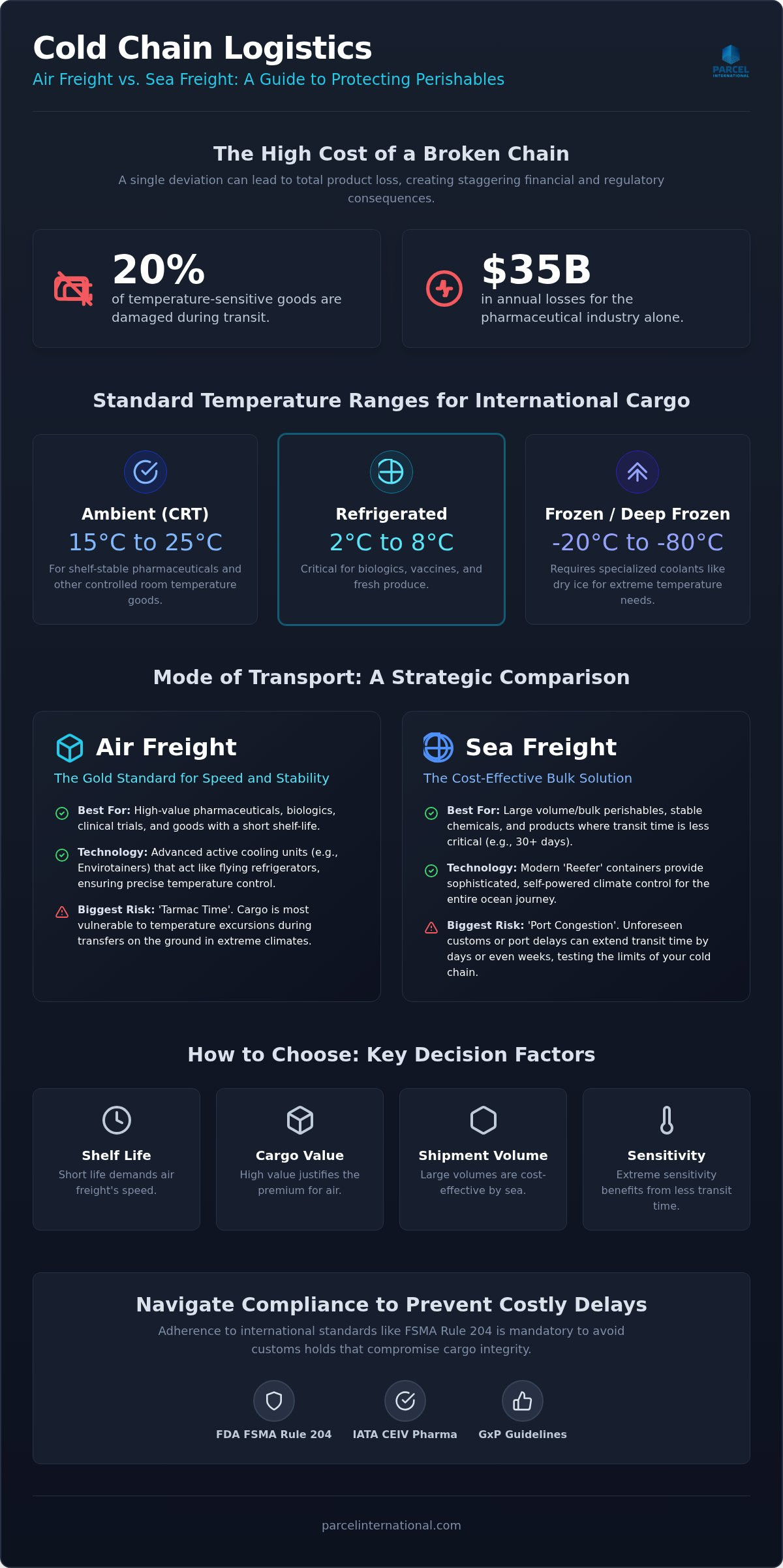
Approximately 20% of all temperature-sensitive goods are damaged during transit, leading to a staggering $35 billion in annual losses for the pharmaceutical industry alone. If you're managing a cold chain, you know that a single degree of deviation or a 24-hour customs delay can mean the difference between a successful delivery and a total loss. Choosing between air freight vs sea freight for international shipping isn't just about finding the lowest price. It's a high-stakes balancing act between speed, cost, and cargo integrity.
You deserve a logistics strategy that eliminates guesswork and administrative friction. This 2026 guide provides a clear framework to help you decide which transport mode fits your specific product requirements while ensuring you meet new mandates like the FDA's FSMA Rule 204. We'll compare real-time transit trade-offs and show you how automated documentation can prevent costly port delays. You'll learn how to compare specialized carrier rates side-by-side to secure your supply chain against unpredictable variables and ensure your perishables arrive in perfect condition.
Table of Contents
Understanding Temperature-Controlled Logistics and the Cold Chain
Temperature-controlled shipping is a highly specialized segment of the global supply chain designed to protect goods that are sensitive to environmental conditions. For a deeper look at the foundational principles, Understanding Temperature-Controlled Logistics and the Cold Chain provides an essential overview of how these systems function. The "Cold Chain" represents a series of uninterrupted storage and distribution activities which maintain a given temperature range. It's a fragile ecosystem where a single break, whether a power failure in a reefer container or a delay on a hot tarmac, often results in a total loss of product efficacy or safety.
This process is the lifeline for several critical industries. Pharmaceutical companies rely on it for vaccines and biologics, while life sciences and specialty chemical firms use it for volatile reagents. In the food sector, it's the only way to move perishables across borders without catastrophic spoilage. Cold Chain Integrity is the maintenance of a specific temperature range from the initial point of origin to the final destination.
Standard Temperature Ranges for International Cargo
Most cold chain shipments fall into three distinct categories based on their thermal requirements. Ambient or Controlled Room Temperature (CRT) typically stays between 15°C and 25°C, which is standard for many shelf-stable pharmaceuticals. Refrigerated or "Cool" shipments require a tighter window of 2°C to 8°C, a range common for biologics and fresh produce. For more extreme needs, Frozen and Deep Frozen cargo can range from -20°C down to -80°C. These shipments often require specialized cooling agents like dry ice or liquid nitrogen. Your choice between air freight vs sea freight for international shipping will largely depend on how long your specific cooling method can remain stable during transit.
The True Cost of Temperature Excursions
Temperature excursions aren't just logistical hiccups; they're financial disasters. When cargo goes "out of range," you face total product destruction and potential regulatory fines. International standards like IATA’s CEIV Pharma and GxP (Good Practice) guidelines mandate strict adherence to these protocols to ensure patient safety and product quality. This is where the choice between air freight vs sea freight for international shipping becomes a strategic risk management decision. A professional freight forwarder acts as your stabilizer here, coordinating the hand-offs between carriers to ensure no link in the chain is left exposed to the elements. They help you bridge the gap between complex regulations and practical transport, turning a high-risk journey into a predictable, transparent process.
Air Freight vs. Sea Freight for International Shipping of Sensitive Cargo
Choosing between air freight vs sea freight for international shipping involves more than just looking at a price tag. It’s a strategic choice based on your cargo's sensitivity and the financial impact of a delay. Air freight offers unmatched speed, making it the default for high-priority shipments. However, sea freight has become increasingly sophisticated for those moving large volumes of stable goods. You must weigh the specific risks of each mode to protect your bottom line. The biggest threat in air freight is often 'tarmac time' during transfers in extreme climates, while sea freight users must plan for 'port congestion' that can extend transit by days or weeks.
Air Freight: Speed and Stability for High-Value Goods
Air transport remains the gold standard for high-value pharmaceuticals, biologics, and clinical trials. These goods often have a short shelf-life that makes a 30-day ocean voyage impossible. Carriers utilize advanced active RKN units and Envirotainers, which are essentially high-tech, battery-powered refrigerators that fit into an aircraft’s hold. These units provide a level of stability that passive packaging can't match over long distances. If you’re managing smaller volumes or samples, you might find that international shipping for ecommerce strategies offer a more flexible path for parcel-sized cold chain needs. Speed isn't just a luxury here; it's a preservation tool that minimizes the window for potential temperature excursions.
Sea Freight: Cost-Effective Bulk Cold Chain Solutions
For bulk perishables or stable chemicals, sea freight provides a cost-effective alternative without sacrificing safety. Modern 'Reefer' containers are equipped with atmosphere control technology. This tech manages temperature, humidity, and gas levels to keep products in a suspended state, effectively slowing down the biological clock of fruits or vegetables. When you transition from air to sea for pharmaceutical bulk, you gain significant economies of scale. The challenge lies in the duration of the voyage. You need a robust monitoring strategy to ensure the container stays powered throughout the journey. Because sea shipments are prone to administrative holdups, reviewing government data on Navigating Customs and Compliance for Cold Chain Goods is essential for preventing spoilage at the dock.
Managing these variables shouldn't be a manual process. You can compare multiple carrier rates instantly to see which mode offers the best protection for your specific route. By viewing all your options in one place, you remove the procedural friction that often leads to logistics errors and ensure your cold chain remains unbroken from start to finish.
Comparing Packaging Systems: Active vs. Passive Cooling
Your choice of packaging isn't just a technical detail; it's a financial decision that dictates your transport mode. When you evaluate air freight vs sea freight for international shipping, the packaging system you select often determines which mode is even viable. Active Packaging is a system using mechanical cooling powered by an external source. These systems act like mobile refrigerators, providing a level of security that allows for longer transit times or exposure to extreme climates. However, these units add weight and complexity, which directly influences your total international shipping rates. You must balance the cost of the packaging against the value of the cargo and the risk of the route.
Passive vs. Active Packaging Systems
Passive systems are the most common choice for shorter durations or less sensitive goods. They rely on gel packs and vacuum-insulated panels (VIP) to maintain a specific temperature for approximately 72 to 96 hours. While cost-effective and light, they have a "ticking clock" that makes them risky for sea freight or routes with frequent customs delays. Active systems, conversely, use battery-powered or plug-in units to provide indefinite cooling as long as power is available. If your cargo requires a hybrid approach, Phase Change Materials (PCM) offer a middle ground. PCMs absorb or release thermal energy to maintain stability for longer than standard gel packs without the weight of mechanical cooling units.
Evaluating Carrier Performance for Sensitive Cargo
Not all carriers handle cold chain cargo with the same level of precision. When you compare global leaders like DHL, FedEx, and UPS, you need to look beyond the base price. Focus on their specialized infrastructure, such as 24/7 monitoring stations and re-icing capabilities at major hubs. In 2026, end-to-end IoT tracking has become a standard requirement rather than a premium add-on. This technology allows you to monitor temperature and humidity in real-time, providing an immediate alert if an excursion occurs.
Select a partner that offers transparent data and specialized handling at every node. By using a platform that allows you to compare these specialized service levels side-by-side, you remove the procedural friction of jumping between different carrier portals. This unified approach ensures you choose a mode and a packaging system that work in tandem to protect your cargo's integrity. Don't settle for a generic shipping solution when your product requires a high-stakes environment. Orderly logistics start with a clear comparison of the tools available for your specific cold chain needs.
Navigating Customs and Compliance for Cold Chain Goods
Customs delays are the single greatest threat to an unbroken cold chain. When a shipment is flagged for a documentation error, it doesn't just sit in a warehouse; it sits in a race against time. If your cooling system is passive, every hour spent on a loading dock brings your cargo closer to a total loss. This administrative friction is a universal risk regardless of your choice between air freight vs sea freight for international shipping. You must ensure "Perfect Paperwork" is attached to your cargo before it leaves the origin facility to prevent these avoidable excursions.
For a comprehensive understanding of the forms required for global trade, consult our guide on international shipping customs documentation. Mastering these requirements is the only way to move sensitive cargo without procedural bottlenecks.
Essential Documentation for Sensitive International Cargo
Specific goods require specialized declarations that go beyond a standard commercial invoice. Biologics and specialty chemicals must feature precise HS codes to avoid misclassification and unnecessary inspections. If you ship perishables like fresh produce or seafood, you'll need Health and Phytosanitary certificates to prove compliance with the destination country's safety standards. Additionally, many cold chain shipments utilize dry ice for cooling. Because dry ice is classified as a dangerous good (UN1845, Class 9), you must include proper hazard labels and declarations to meet international aviation and maritime regulations.
Automating Compliance with Parcel International
Manual data entry is the primary source of documentation errors for small and medium businesses. Our platform eliminates this risk by generating customs-compliant labels and invoices automatically based on your shipment details. This system ensures that all required fields are populated correctly every time. We also prioritize pre-clearance strategies. By submitting digital documentation to customs authorities while your cargo is still in transit, you can often secure clearance before the vessel or aircraft even arrives. This proactive approach reduces the administrative burden on your team and keeps your temperature-sensitive cargo moving. You can access these automated customs tools today to streamline your compliance and protect your shipments from costly port delays.
How to Book Temperature-Controlled Shipping on Parcel International
Booking a temperature-controlled shipment shouldn't be the most difficult part of your supply chain. We've built a platform that removes the traditional barriers to entry, such as mandatory volume minimums or restrictive monthly subscriptions. Instead of managing multiple carrier accounts or waiting days for a sales representative to call you back, you can access a unified system designed for speed and transparency. This approach makes us the primary tool for international parcel shipping optimization, especially when your cargo requires high-stakes environmental control. Whether you have decided on air freight vs sea freight for international shipping, the next step is execution without the procedural friction.
The 3-Step Comparison and Booking Process
Our interface is designed to move you from inquiry to action as quickly as possible. Follow this logical progression to secure your cargo:
Step 1: Enter your cargo's dimensions, total weight, and the specific temperature range required for the journey. Be as precise as possible to ensure the carrier assigns the correct equipment.
Step 2: Compare real-time rates and transit times from global leaders like DHL, FedEx, and UPS side-by-side. This view allows you to weigh the speed of air against the cost-efficiency of sea freight instantly.
Step 3: Generate your automated customs documentation and book the shipment. The system handles the complex paperwork discussed in the previous section, ensuring your labels are compliant before the courier arrives.
This streamlined workflow ensures that your choice between air freight vs sea freight for international shipping is backed by real-time data. You don't have to guess which mode is more cost-effective for your specific route; the numbers are right in front of you.
Support and Monitoring for Peace of Mind
Choosing a logistics broker gives you a distinct advantage: a single point of contact for all your shipments. If a carrier experiences a delay or a technical issue with a reefer unit, you don't have to navigate their complex phone trees. We act as your intermediary, resolving issues directly with the carrier on your behalf. Our dashboard integrates real-time tracking for all your sensitive shipments in one place, providing the relief of a singular, unified solution. You get the stability of a long-standing industry partner combined with the flexibility of modern, on-demand logistics.
Our philosophy of radical transparency means you see the full cost upfront. We make the absence of hidden fees a central pillar of our identity. By removing the need for a subscription, we make professional-grade cold chain logistics accessible to both small-scale projects and large commercial operations. You only pay for what you ship, with access to wholesale rates that were previously reserved for high-volume enterprises. Compare temperature-controlled shipping rates today on Parcel International and experience a transparent, efficient way to manage your international cold chain.
Secure Your International Cold Chain Strategy
Managing temperature-sensitive cargo requires a balance of speed and precision. You've learned how air freight provides rapid transit for high-value pharma, while sea freight offers a bulk solution for stable perishables. Success in 2026 depends on choosing the right packaging and ensuring your documentation is perfect before the cargo leaves your facility. By comparing air freight vs sea freight for international shipping on a unified platform, you remove the guesswork from your logistics and protect your cargo from costly excursions.
Move away from fragmented workflows and hidden requirements. It's time to simplify your process. Get a real-time quote for your temperature-sensitive cargo and see how easy it is to compare global leaders like DHL, FedEx, and UPS side-by-side. Our platform includes automated customs support to prevent delays and operates with no monthly subscriptions or hidden fees. You deserve a logistics partner that prioritizes transparency and reliability at every node. Take control of your global delivery today and enjoy the relief of a streamlined, secure cold chain.
Frequently Asked Questions
What is the best way to ship small quantities of temperature-sensitive samples?
Express parcel shipping using specialized passive packaging like gel packs or vacuum-insulated panels via air freight is the most efficient method for small samples. This ensures the goods reach the destination within the 72 to 96 hour stability window of the packaging. Our platform allows you to compare express rates from global carriers to find the fastest route for these small but critical volumes, ensuring your samples arrive in perfect condition.
How long can dry ice keep cargo frozen during international transit?
Dry ice typically maintains frozen temperatures for 48 to 96 hours, depending on the quantity and the quality of the container. For longer journeys, shipments may require re-icing at carrier hubs. When evaluating air freight vs sea freight for international shipping, remember that dry ice is classified as a dangerous good, UN1845. This requires specific declarations and hazard labeling for air transport to ensure compliance with safety regulations.
Can I ship temperature-controlled cargo to remote international locations?
You can reach remote destinations, but these routes often require active cooling systems or hybrid packaging to account for extended transit times. We provide access to carriers with extensive global networks covering over 220 countries and territories. It's essential to plan for last-mile logistics in these regions, as local infrastructure may not always support specialized cold chain equipment throughout the final delivery leg to the end recipient.
What happens if my temperature-controlled shipment is delayed at customs?
A customs delay can lead to a temperature excursion and total product loss. This is why we emphasize automated documentation to reduce the risk of administrative flags. If a delay occurs, the carrier's specialized cold chain stations may offer temporary refrigerated storage or re-icing services. Proactive pre-clearance strategies are your best defense against these bottlenecks, allowing your cargo to move through ports without being held for paperwork errors.
Do I need special insurance for cold chain international shipping?
Standard carrier liability often doesn't cover the full value of sensitive pharmaceuticals or perishables, especially in cases of temperature deviation. We recommend securing specialized all-risk cargo insurance that explicitly includes coverage for temperature excursions and mechanical failure of reefer units. This protection is vital because even a minor delay can render high-value biologics or vaccines completely unusable and financially worthless, leaving your business exposed to significant losses.
How much more expensive is temperature-controlled freight compared to standard freight?
Temperature-controlled shipping is more expensive due to specialized equipment, energy costs, and monitoring requirements. Air freight for sensitive cargo can be 4 to 8 times more expensive than sea freight per kilogram. When choosing between air freight vs sea freight for international shipping, the total cost depends on whether you utilize active mechanical units or passive packaging. Our platform provides transparent, real-time rate comparisons to help you optimize these high-stakes logistics expenses.
Can Parcel International help with GxP compliant pharmaceutical shipping?
We act as a specialized intermediary that connects you with GxP-compliant carriers like DHL, FedEx, and UPS. While we don't own the physical fleet, our platform enables you to select service levels that meet Good Distribution Practice (GDP) standards. You can manage all your compliance documentation through our automated tools, ensuring that every shipment meets the high-stakes regulatory requirements of the pharmaceutical and life sciences industries without the need for a subscription.
Is sea freight safe for vaccines and other high-value biologics?
Sea freight is increasingly safe for biologics due to advanced reefer technology and atmosphere control. However, it's generally reserved for bulk shipments of stable products rather than urgent vaccines. The longer transit time increases the window for potential equipment failure or power loss. Most high-value biologics still travel via air freight to minimize risk. You should evaluate your product's stability data and shelf life before choosing sea freight for these items.


