
Best International Shipping: 2026 Small Business Guide
- Alex
- Aug 14
- 11 min read
Updated: 6 days ago
The best international shipping for small business in 2026 isn't a single carrier; it's a strategic platform that aggregates wholesale rates and automates compliance. If you've ever watched your hard-earned profit margins vanish into unexpected carrier surcharges or felt the sting of a package stuck in customs for weeks, you aren't alone. Managing a growing business is hard enough without the headache of balancing five different carrier logins and manual paperwork. You deserve a logistics partner that simplifies the chaos rather than adding to it.
In this guide, we'll show you how to secure deep discounts from major carriers like DHL, FedEx, and UPS without needing high shipping volumes. You'll learn how to automate customs documentation to keep your global shipments moving and move your entire workflow into a single, transparent dashboard. We'll explore the most reliable options for express, sea, and air freight, ensuring your business is ready to scale across more than 220 countries with total confidence and zero hidden fees. By the end of this article, you'll have a clear roadmap to faster deliveries and higher margins.
Table of Contents
Defining the Best International Shipping for Small Businesses in 2026
In 2026, the best international shipping for small business isn't defined by a single carrier's logo. It's defined by a strategic balance between speed, compliance, and cost predictability. For a growing brand, global logistics is a high-stakes extension of your identity. If a customer in Tokyo receives a damaged package or faces unexpected "hidden" fees, they don't blame the courier; they blame your business. Reliability has become a core component of customer retention. You need a partner that strips away the anxieties of global expansion, allowing you to focus on product development rather than paperwork. Balancing rapid transit times with healthy profit margins requires a deep dive into Understanding International Trade and how it affects your bottom line.
The Core Components of Modern Global Logistics
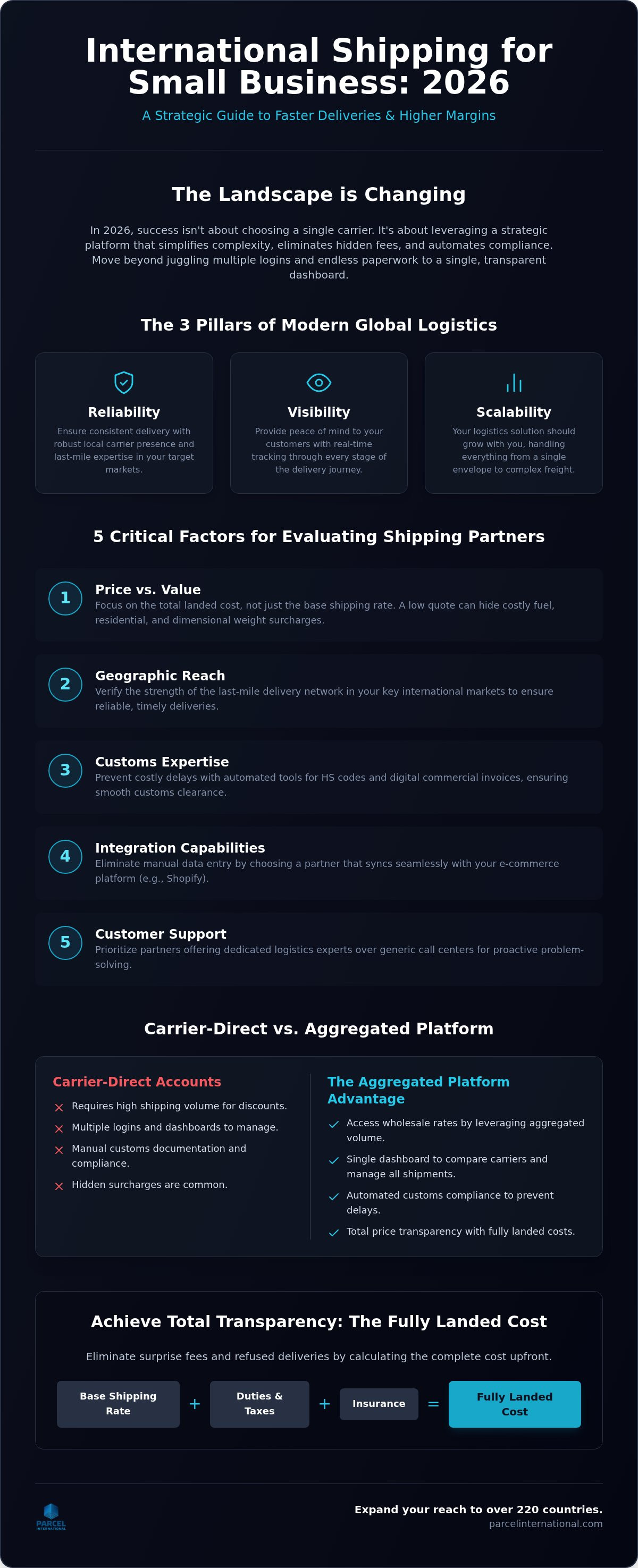
Success in international markets rests on three non-negotiable pillars. First, reliability requires a carrier with a robust local presence in your target regions. This ensures that the "last mile" of delivery is handled by professionals who know the local terrain and customs. Second, visibility is now a standard expectation. Real-time tracking isn't just about knowing where a box is; it's about providing peace of mind to your customer through every milestone. Finally, your logistics solution must offer scalability. Whether you're sending a single express envelope or coordinating complex sea freight, your partner should provide a unified solution that grows alongside your order volume without requiring new accounts or complex setups.
Why 2026 Demands More Than Just a Tracking Number
5 Critical Factors for Evaluating Global Shipping Partners
Finding the best international shipping for small business requires a move away from surface-level price comparisons. A low baseline rate often masks a mountain of surcharges that eat your profits. You need a partner that offers more than just a label; they must offer a bridge to new markets. Reliability is about who picks up the phone when a package is flagged at a border. A dedicated partner proactively manages these friction points before they impact your customer. Before committing to a carrier, evaluate these five core pillars:
Price vs. Value: Analyze the total cost, not just the starting quote.
Geographic Reach: Verify the strength of the "last-mile" network in your target countries.
Customs Expertise: Ensure the provider offers automated tools to handle complex documentation.
Integration Capabilities: Look for seamless syncing with platforms like Shopify to eliminate manual entry.
Customer Support: Prioritize partners that offer dedicated logistics experts over generic call centers.
If your shipping software doesn't sync with your e-commerce platform, you're wasting hours on administrative tasks. This inefficiency prevents you from scaling. A true logistics ally provides a single dashboard to manage every lane, ensuring you don't have to juggle multiple accounts just to send a parcel to France or Australia.
Analyzing Total Cost of Delivery
Hidden surcharges like fuel adjustments and residential delivery fees can turn a profitable sale into a loss. Understanding international shipping rates requires looking closely at dimensional weight. Carriers calculate costs based on the space a package occupies. This means a large, light box might cost more than a small, heavy one. Use SBA Trade Tools to prepare your business for these financial variables and specific export requirements. If you're unsure about your current pricing strategy, you can access discounted wholesale rates to protect your margins immediately.
Infrastructure and Last-Mile Reliability
A global reach of 220+ countries is the industry baseline, but local infrastructure is what actually delivers the goods. In many European markets, local locker pickups are the preferred standard for reliability and speed. These lockers reduce the risk of theft and eliminate the frustration of missed deliveries. Ask your provider how they handle failed delivery attempts in specific regions. Reliable carriers have established networks that ensure your brand remains professional even when the customer isn't home. Choosing a partner with a strong last-mile presence ensures your business grows without the friction of lost or returned parcels. This level of detail is what separates the best international shipping for small business from generic, unreliable alternatives.
Carrier Direct vs. Logistics Brokers: Finding Your Ideal Match
Choosing between a direct carrier account and a logistics broker is a pivotal decision for your bottom line. While a direct relationship with a major carrier feels like the traditional route, it often leaves smaller players paying premium retail prices. Brokers change this dynamic by acting as an aggregator. They combine the volume of thousands of small businesses to negotiate wholesale rates that would otherwise be reserved for massive corporations. This egalitarian approach ensures you don't have to be a global giant to access the best international shipping for small business.
Beyond price, the support model differs significantly. When you have a direct account with a global carrier, your business is one of millions. If a package is delayed, you're often relegated to a generic call center. An intermediary, however, views your success as their own. They provide a dedicated layer of expertise, acting as your advocate when logistics friction occurs. This personalized support moves you from being a number in a database to a valued partner in a unified network.
When to Go Direct with a Global Carrier
Direct accounts make sense if your business has highly specialized requirements. If you're shipping hazardous materials or require strict cold-chain logistics for pharmaceuticals, working directly with a carrier's specialized division is often necessary. Enterprises with massive, predictable volumes may also benefit from custom-tailored contracts. However, the primary drawback is the lack of agility. You're effectively "locked in" to a single carrier's network. If that carrier faces a regional strike, a data outage, or a sudden rate hike in a specific lane, your entire supply chain remains vulnerable with no immediate alternative.
The Strategic Advantage of a Shipping Platform
Modern shipping platforms offer a more flexible path to global growth. You get immediate access to international shipping for ecommerce discounts without the pressure of meeting strict monthly volume minimums. Instead of managing five different carrier logins, you compare real-time rates from DHL, FedEx, and UPS within a single, transparent dashboard. This setup allows you to pick the fastest or cheapest option for every individual shipment based on current market data.
Platforms like Parcel International act as a stabilizing bridge in volatile markets. When fuel surcharges spike or regional logistics face friction, you have the power to switch carriers instantly. This ensures your global shipments remain punctual and your costs stay predictable. You gain the bargaining power of a massive corporation while maintaining the lean, adaptable nature of an SMB. This flexibility is what truly defines the best international shipping for small business in a competitive 2026 landscape.
Optimizing Costs and Customs Compliance for Global Growth
Scaling globally requires more than just finding a carrier. It requires a system that removes manual errors from your workflow. Automating your commercial invoice is the first step toward a friction-free border crossing. When you generate documentation digitally, you eliminate the handwriting mistakes that often lead to packages being held at the border. Accuracy in your HS codes is equally vital. These codes dictate your import duties and tax obligations; get them wrong, and you face unexpected fines or lengthy delays that damage your customer relationships. The best international shipping for small business integrates these compliance checks directly into the booking process.
Managing international returns is another area where costs can spiral. Instead of paying for individual return labels at retail prices, use a platform that offers consolidated return solutions. This keeps your margins healthy even when a customer needs a different size or color. Better packaging also plays a role in cost control. By reducing the physical footprint of your parcels, you lower the dimensional weight and protect your profit per item.
Navigating the 2026 Customs Landscape
The 2026 logistics environment is defined by mandatory digital pre-clearance for all exports. This shift means your shipment data must arrive at the destination country's customs office before the physical package even leaves the warehouse. Utilizing international shipping customs documentation tools ensures your data is compliant with the latest EU and US trade lane regulations. These tools pre-empt common delays by flagging missing tax IDs or incomplete descriptions before you print the label. This proactive approach turns a complex administrative hurdle into a simple, automated task.
Cost Reduction Tactics for SMBs
Efficiency is the enemy of high margins. Consolidating multiple orders into a single bulk shipment for the first leg of the journey can significantly lower your per-unit transport costs. For regional European deliveries, road freight often provides a much more economical alternative to air freight without a drastic sacrifice in speed. You should also use a shipping calculator to forecast your quarterly logistics spend accurately. This data allows you to adjust your product pricing to reflect real-world shipping costs. To see how much you can save on your next global shipment, get a real-time wholesale quote today and stop overpaying for international reach. This level of financial control is essential for the best international shipping for small business.
Scaling Your SMB with Parcel International’s Aggregated Platform
Parcel International transforms the way growing brands view global trade. Moving from local sales to a global footprint often feels like navigating a maze of carrier contracts and complex regulations. We replace that fragmented workflow with a unified solution. Instead of managing multiple accounts, you get a single login that connects you to over 220 countries. This represents the best international shipping for small business because it removes the traditional barriers to entry. You don't have to worry about monthly subscription fees or strict volume requirements. You simply access wholesale rates for express shipping, air freight, and sea freight from the moment you sign up.
Our platform acts as an optimizer for your logistics. We strip away the procedural friction that usually slows down growing brands. By aggregating volume from thousands of users, we secure the same discounted rates that enterprise-level corporations enjoy. This egalitarian approach ensures that your profit margins remain protected as you scale into new markets. You gain the bargaining power of a global giant while maintaining the lean, adaptable nature of an SMB.
A Single Interface for Global Operations
Our expertise is rooted in our strategic hubs in Rotterdam and the US. This allows us to provide specialized support for exporters targeting high-stakes European and American trade lanes. Within our interface, you can perform a real-time rate comparison in seconds. This allows you to choose between speed and cost based on your specific customer needs. We operate with radical transparency. You won't encounter hidden fees or unexpected surcharges. This honest, direct approach builds the trust necessary for a long-term logistics partnership, moving you from anxiety to relief.
From Parcel to Freight: Growing Without Changing Partners
Many businesses struggle when they outgrow simple parcel services and need more robust transport options. With Parcel International, you don't need to find a new partner when your volume increases. You can transition seamlessly from express parcels to bulk freight forwarder services within the same dashboard. Our automated compliance tools scale with you. This ensures that even as your shipments become more complex, your administrative burden stays light. This continuity is vital for maintaining a stable supply chain. Compare rates and start shipping globally with Parcel International today. This is the most efficient way to secure the best international shipping for small business while keeping your operations lean and profitable.
Take Control of Your Global Growth Today
It's time to stop overpaying for logistics and start scaling with confidence. You can gain immediate access to wholesale rates from DHL, FedEx, and UPS with no subscription fees or volume minimums required. Generate accurate customs paperwork in seconds and manage every shipment from a single, transparent dashboard. Compare international shipping rates and save on your first shipment. The world is waiting for your brand, and with the right logistics partner, there are no limits to how far you can grow.
Frequently Asked Questions
What is the cheapest way to ship internationally for a small business in 2026?
The cheapest way is using a logistics broker to access wholesale rates rather than paying retail prices at a carrier counter. Brokers aggregate the volume of thousands of businesses to secure deep discounts from major couriers. This approach provides the best international shipping for small business by removing the need for high-volume contracts. You get the same low rates as enterprise companies without the overhead or subscription fees. It's the most efficient way to protect your margins.
How do I calculate the fully landed cost for my international customers?
You calculate the fully landed cost by totaling the shipping rate, import duties, local taxes, and any administrative fees. It's essential to use an automated calculator that accounts for regional tax laws and specific HS codes. Providing this total at checkout prevents sticker shock for your customers when the package arrives. This transparency reduces refused deliveries and protects your brand's global reputation while ensuring your pricing stays accurate.
Do I need a high shipping volume to get discounted rates from DHL or UPS?
No, you don't need high volume if you use an aggregated shipping platform. These platforms leverage their total network volume to unlock enterprise-level discounts for every user regardless of their size. This egalitarian model allows you to ship one parcel or one hundred while still enjoying significantly reduced rates. It's an ideal solution for businesses that are just starting to explore global markets and don't want to commit to minimums.
How can I automate customs documentation for my e-commerce shop?
You can automate customs documentation by integrating your shop with a platform that generates digital commercial invoices. These tools pull order data directly from your store to populate required fields, reducing manual entry errors. Digital pre-clearance ensures that customs offices receive your data before the parcel arrives. This automation keeps your shipments moving through borders without unnecessary human intervention or the risk of missing paperwork that causes lengthy delays.
What is the difference between an international courier and a freight forwarder?
An international courier specializes in door-to-door delivery of individual parcels and express documents. A freight forwarder manages the complex logistics of bulk shipments via sea, air, or road freight. While couriers handle the physical transport themselves, forwarders act as intermediaries to coordinate multiple transport modes. The best international shipping for small business often involves a partner that offers both services in one dashboard, allowing you to scale your shipping methods as needed.
How do I handle international returns for my small business?
Handling international returns efficiently requires a consolidated return solution that avoids retail-priced labels. Use a platform that allows customers to generate their own return documents through a localized portal. By grouping return shipments, you can lower the transport costs and manage the inventory more effectively. Clear return policies and automated labels provide the relief your customers need during a potentially stressful process, which helps build long-term brand loyalty and trust.
Can I ship to over 200 countries using a single platform?
Yes, you can manage shipments to over 220 countries through a single, unified interface. A modern logistics dashboard removes the need to maintain separate carrier accounts for different regions. You simply log in, compare rates for your destination, and print the label. This centralized approach simplifies your global operations and ensures you have a stable bridge to every major international market without the headache of managing fragmented, multi-platform workflows.
What are the common causes of customs delays in 2026?
Common causes include missing digital pre-clearance data and incorrect HS code classifications. In 2026, most major trade lanes require electronic data to be submitted before the physical shipment leaves the warehouse. Incomplete descriptions or missing tax identification numbers also trigger manual inspections. Using automated compliance tools helps you pre-empt these issues by flagging errors before the package is even shipped. This ensures your global customers receive their orders on time and without hidden fees.


Comments