
Cheapest Way to Ship Documents Internationally: 2026 Cost-Saving Guide
- Alex
- Jun 29
- 11 min read
The retail counter at your local post office might actually be the most expensive place to send your urgent paperwork. Many people assume walking into a branch is the cheapest way to ship documents internationally, but standard retail rates have climbed significantly following the 5.9% general rate increases implemented by major carriers in early 2026. You're likely feeling the sting of these price hikes, along with the anxiety of sending sensitive papers across borders without guaranteed tracking or clear delivery timelines.
It's frustrating to pay a premium only to worry if your documents will get stuck in customs or disappear in transit. This guide shows you how to bypass high retail markups and access rates that balance speed and security. We'll break down the latest 2026 carrier surcharges, explain why the EU's new duty-free thresholds matter for your envelopes, and help you distinguish between document and parcel categories to save every possible cent. You'll gain the clarity needed to ensure your papers arrive safely and on time without overpaying for the privilege.
Table of Contents
What Qualifies as a Document for International Shipping?
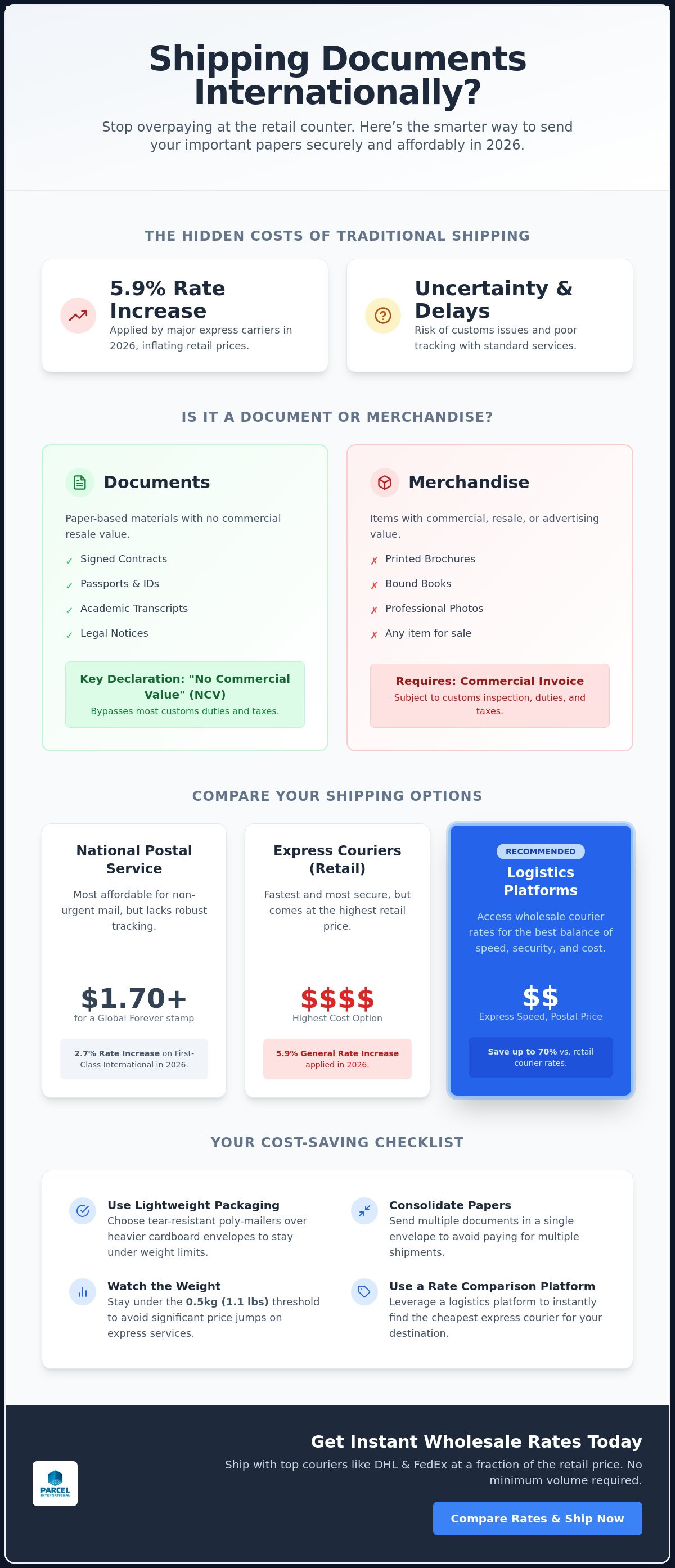
Before you search for the cheapest way to ship documents internationally, you must verify that your items actually fit the "document" category. Carriers define documents as paper-based materials that have no commercial value. This means the contents aren't being sold and don't function as a product. Common examples include signed contracts, original passports, academic transcripts, and legal notices. Because these items don't have an intrinsic market value, they travel under different rules than physical goods.
This classification is vital because documents typically bypass the complex duty and tax assessments required for parcels. Most international shipping standards for letters and documents are influenced by the Universal Postal Union, which helps streamline how these items move across 192 member countries. By correctly identifying your shipment as a document, you avoid the administrative friction of customs inspections that usually apply to merchandise. It is the most effective way to ensure your paperwork moves through the system without stopping for a tax bill.
When you prepare your shipping label, you'll encounter the "Zero Value" rule. Even if a contract is worth millions to your business, its "customs value" is essentially zero for shipping purposes. You should declare it as "Documents, No Commercial Value" or "NCV." This simple phrasing tells customs officials that the envelope contains information rather than taxable goods. Mislabeling a document leads to delays. It might even cause accidental duty charges. This directly contradicts your goal of finding the cheapest way to ship documents internationally.
Documents vs. Merchandise: Avoiding Customs Delays
The line blurs when your paper has a resale or advertising value. A stack of printed brochures, a bound book, or a set of professional photographs is usually classified as merchandise. These items require a Commercial Invoice, which details the value of the materials for tax purposes. Declaring "No Commercial Value" (NCV) prevents customs from applying unnecessary import taxes to your non-taxable paperwork.
Weight and Size Limits for International Envelopes
Most express carriers use standard flat-rate envelopes, typically measuring around 9.5 x 12.5 inches. Efficiency is key here. Weight thresholds often sit at 0.5kg, which is about 1.1 lbs. Crossing this limit triggers a price jump because the carrier shifts your shipment into a higher weight bracket. Opt for flexible poly-mailers instead of rigid cardboard envelopes when possible. These mailers are lighter and more adaptable, helping you stay under strict weight cut-offs and reduce your overall costs.
Comparing the Main Methods: Postal Services vs. Express Couriers
Finding the cheapest way to ship documents internationally requires choosing between three distinct service levels. National postal services remain the traditional baseline for affordability, especially for low-weight letters. However, government mail systems have introduced new pricing structures for 2026, including a 2.7% rate increase for international first-class mail effective July 12. While these services are budget-friendly, they often lack the granular, real-time tracking required for sensitive legal papers or original identification documents.
Global express couriers like DHL, FedEx, and UPS provide the highest level of security and speed. The trade-off is the cost; these carriers implemented a general rate increase of 5.9% in early 2026. If you walk into a retail shipping center, you'll likely pay the highest possible price, which includes the carrier's retail overhead and various surcharges. To understand how these changes impact your budget, consult our guide on international shipping rates for the current year.
Logistics brokers offer the most efficient middle ground for modern shippers. By aggregating volume from thousands of users, these platforms secure wholesale discounts that are usually reserved for high-volume corporate accounts. This model allows you to use premium express networks while paying rates that rival national postal systems. It's the most reliable strategy for securing the cheapest way to ship documents internationally without sacrificing the door-to-door tracking that protects your paperwork.
The Postal Option: When to Use First-Class International
National postal options are ideal for non-urgent, personal correspondence. A Global Forever stamp currently costs $1.70 and is the most economical choice for a 1 oz. letter. The primary drawback is the "black hole" effect, where tracking often stops once the envelope leaves the country of origin. Expect delivery windows of 7 to 21 days. If your documents are easily replaceable and time isn't a factor, the postal route is your baseline for savings.
The Broker Advantage: Express Speed at Postal Prices
Parcel International simplifies the shipping process by providing instant comparisons across top-tier carriers on a single dashboard. You get the reliability of a global courier network but at a fraction of the retail desk price. These platforms also help you navigate Common Export Documents to ensure your envelope clears customs without manual intervention. Before you pay full retail price at a counter, get an instant quote to see the wholesale savings available for your destination.
Key Factors That Influence Your Document Shipping Rates
Finding the cheapest way to ship documents internationally requires looking beyond the base price on a carrier's website. Shipping costs are primarily driven by geographic zones rather than simple mileage. Carriers group countries based on their logistics infrastructure and the volume of traffic they handle. This explains why sending an envelope to a neighboring country with limited flight connections can sometimes cost more than shipping across an ocean to a major global hub. Understanding these zones helps you predict price fluctuations before you reach the checkout page.
Dimensional weight is a common pitfall for document shippers. While your papers might be light, the thickness of your envelope matters. If you stuff a standard envelope until it becomes bulky, carriers may apply "dim weight" pricing, treating your flat mailer like a small box. In 2026, the dimensional weight divisor for many international services remains 139. To keep your shipment in the document category, ensure it stays flat. Using a high-capacity envelope that maintains a low profile is often the cheapest way to ship documents internationally because it avoids these unnecessary volume-based fees.
You must also account for 2026 logistics adjustments, specifically fuel surcharges and "Remote Area" fees. Fuel surcharges are dynamic and can change weekly based on global energy prices. Additionally, if your recipient lives outside a major metropolitan area, you might face a remote area surcharge that adds $30 or more to your bill. Always validate the destination zip code against the carrier's surcharge list to avoid unexpected costs. These hidden fees often negate the savings you found on the initial rate.
Speed vs. Cost: Finding the Sweet Spot
Deciding between standard, priority, and express service is a balance of risk and budget. Standard shipping takes 10 to 15 days and is budget-friendly but risky for time-sensitive papers. Priority usually arrives in 3 to 5 business days. For irreplaceable legal documents, express shipping (1 to 2 days) is often the safest choice. While the upfront cost is higher, the "value of time" and the reduced window for potential loss often justify the premium for business-critical mail.
Tracking and Insurance Requirements
Registered mail provides a basic paper trail but lacks the real-time updates of end-to-end courier tracking. If you're sending original transcripts or signed contracts, the cost of replacing them often exceeds the price of a tracked service. Calculating these replacement costs helps you decide if insurance is necessary. Security is paramount; signature on delivery is the #1 deterrent for document loss because it creates a clear chain of custody from the courier to the recipient.
Practical Strategies to Lower Your International Mailing Expenses
Lowering your costs starts with the physical preparation of your envelope. If you have multiple papers for the same recipient, consolidate them into a single high-capacity mailer rather than sending separate envelopes. Each new tracking number carries its own base fee and fuel surcharge. Switching to lightweight, tear-resistant poly-mailers is a simple win. These mailers weigh almost nothing, which helps you stay under the critical 0.5kg weight threshold. This is often the cheapest way to ship documents internationally because it minimizes the dead weight of the packaging itself.
Avoid the "Retail Surcharge" by booking your shipment online. Physical service points and post office counters often add a premium to cover their overhead costs. By using a digital platform, you strip away these manual processing fees and secure the cheapest way to ship documents internationally. You also gain access to automated customs documentation. Even though documents have no commercial value, a missing or incorrect declaration can trigger a return-to-sender event. This error often results in you paying for the shipping twice. To see how much you can save by skipping the retail desk, compare rates on our dashboard today.
The Digital Alternative: Does it Need to be Physical?
Before you ship, ask if a physical copy is mandatory. Many international business transactions now accept e-signatures via DocuSign or high-resolution digital scans. However, certain documents like apostilles, notarized deeds, and original certificates require physical "wet ink" signatures. If an original isn't required but you need a physical copy delivered, consider a hybrid solution. Email the file to a local printing service in the destination country to eliminate international transit costs entirely.
Address Validation: Preventing Failed Delivery Fees
Inaccurate addresses are a hidden drain on your budget. Carriers often charge "Address Correction" surcharges if they have to fix a zip code or street name mid-transit. Format your label correctly according to local standards; for example, Japanese addresses follow a different hierarchy than German ones. Always include a local recipient phone number. This allows the courier to resolve delivery issues on the spot, preventing a failed delivery that could lead to expensive storage or return fees.
How Parcel International Simplifies Low-Cost Document Delivery
Stop toggling between multiple browser tabs to find a better rate. Parcel International serves as your single point of access to the world’s most reliable courier networks. By consolidating volume from diverse users, we provide the cheapest way to ship documents internationally without requiring any minimum monthly spend or hidden subscription fees. You get the same professional service levels as a multinational corporation, even if you’re only sending one envelope a year. Our dashboard is designed for speed, allowing you to compare DHL, FedEx, and UPS side-by-side in seconds.
Our platform eliminates the guesswork associated with 2026 logistics. We provide automated generation of all necessary labels and document-specific declarations. This ensures your paperwork meets current regulatory standards before it ever leaves your hands. If you are also moving larger items, our experts provide dedicated support for international parcel shipping to help you navigate the specific complexities of the current global market. We act as a stable intermediary, protecting your interests and ensuring your documents remain a priority within the carrier’s network.
Step-by-Step: Booking Your Document Shipment
Start by entering your exact envelope dimensions and weight into our shipping tool. This provides an accurate, real-time quote that accounts for current 2026 fuel surcharges and regional labor costs. Next, select the carrier that balances your specific speed and budget needs; you can filter by delivery date or price point. Once you’ve chosen, print your label and schedule a convenient pickup at your door or find a local drop-off point. This streamlined process moves you from inquiry to action in minutes, removing the need for phone calls or long wait times at a retail counter.
Transparency in Pricing: No Hidden Fees
We believe in radical transparency regarding terms and conditions. Every quote you see on our dashboard includes all surcharges upfront. You won't face surprise residential fees or address correction penalties later in the process. When you compare our rates to direct carrier pricing in real-time, the savings become clear. We strip away the procedural friction that makes global logistics feel daunting, replacing confusion with a singular, unified solution. Find the cheapest rate for your documents today and experience a more efficient way to manage your international mail.
Secure Your Global Document Delivery Today
Sending sensitive paperwork across borders doesn't have to be a high-stakes gamble with your budget. You've learned that the cheapest way to ship documents internationally involves more than just picking the lowest sticker price; it requires smart classification, lightweight packaging, and choosing the right intermediary. By correctly identifying your papers as "No Commercial Value" and consolidating your shipments, you bypass the hidden fees that often surprise unprepared shippers.
Parcel International has served as a trusted global logistics partner since 2007. We strip away the procedural friction of international mail by giving you direct access to DHL, FedEx, and UPS wholesale rates. Our platform includes automated customs support to ensure your envelope clears borders without delay. You don't have to navigate 2026's complex rate hikes alone. Compare real-time document shipping rates on Parcel International to find a solution that balances speed and security perfectly. Take control of your logistics today and enjoy the relief of a streamlined, transparent shipping experience.
Frequently Asked Questions
What is the absolute cheapest way to send a letter internationally?
Using a standard postage stamp is the absolute cheapest way to send a letter internationally. For a 1 oz. envelope, a Global Forever stamp currently costs $1.70. Keep in mind that a price increase for First-Class Mail International is set for July 12, 2026, which will raise the cost of a single-piece postcard to $1.75. This method is ideal for personal mail but lacks tracking or insurance.
Do I need a customs form for sending documents abroad?
You don't need a customs form if your envelope contains only paper documents with no commercial value. Items like contracts, transcripts, and personal letters are exempt from these requirements in most countries. However, if you include a USB drive or any physical object, the shipment becomes merchandise. This change triggers the need for a full customs declaration and potential import duties under the 2026 regulations.
How long does the cheapest international document shipping take?
Standard international document shipping typically takes between 7 and 21 business days. Delivery times vary significantly based on the destination's local postal infrastructure and distance from major global hubs. While this is the cheapest way to ship documents internationally, it is also the slowest. If your paperwork is time-sensitive, choose a priority service to reduce the delivery window to 6 to 10 days.
Can I track a document sent via a standard postal service?
Standard postal services usually don't provide real-time tracking once the envelope leaves its origin country. You might see a departure status, but updates often cease until the item reaches its final destination. For sensitive papers, this lack of visibility creates unnecessary anxiety. Upgrading to a registered mail service or using a logistics broker provides the end-to-end tracking needed for peace of mind and security.
Is it cheaper to use my own envelope or a carrier-provided one?
Using your own lightweight poly-mailer is often cheaper for thin stacks of paper because it minimizes the total weight. Carrier-provided envelopes are usually tied to flat-rate pricing, which is only cost-effective if your documents are heavy or bulky. Always compare the actual weight of your own mailer against the carrier's flat-rate threshold to ensure you're securing the most affordable rate for your specific shipment.
What happens if my international document shipment is lost?
If a standard postal shipment is lost, you rarely have any recourse or financial compensation. This is why signature on delivery is vital for irreplaceable papers. Courier services offer better protection and higher recovery rates due to their closed-loop networks. If loss occurs with a premium carrier, you can file a claim based on the declared value or the insurance coverage included with your booking.
Are there items I cannot include in a document envelope?
You cannot include cash, negotiable checks, or physical goods in a document-only envelope. Items with commercial value, such as jewelry or even promotional brochures, shift the category from "document" to "merchandise." Prohibited items also include hazardous materials or restricted legal papers specific to certain destination countries. Including these items leads to customs delays, fines, or the total destruction of your shipment.
How do I calculate the shipping cost for a heavy stack of documents?
Calculate the cost for heavy documents by weighing the stack and identifying the destination zone. Most carriers use 0.5kg (1.1 lbs) as a primary price threshold that triggers a rate jump. If your stack is thick, use a digital scale to avoid surprises and check the 2026 dimensional weight divisor of 139. Using a logistics dashboard is the cheapest way to ship documents internationally when dealing with weight.


Comments