
DHL vs. FedEx International Shipping for Small Business: 2026 Comparison
Updated: Jul 17
The era of "cheap parcel" importing died the moment de minimis exemptions vanished across the U.S. and Europe. If you're still choosing a carrier based on a 2024 mindset, you're likely overpaying for hidden surcharges and watching packages sit in customs for days. Deciding between dhl vs fedex international shipping for small business in 2026 isn't just about comparing base rates anymore. It's about surviving a landscape where every shipment requires formal entry and both giants have implemented 5.9% price hikes.
You've probably noticed that unpredictable fuel costs and new administrative fees are eating your profits. It's frustrating to feel like you lack the volume to negotiate the deep discounts that larger corporations enjoy. This guide promises to clear the fog. You'll learn which carrier offers the fastest transit times to Europe and Asia, how to avoid the new $40 weight surcharges, and why automated customs support is now your most valuable asset. We'll break down the data so you can lower your shipping margins, speed up your global delivery, and reclaim your peace of mind.
Table of Contents
DHL vs. FedEx: The 2026 International Shipping Landscape for SMBs
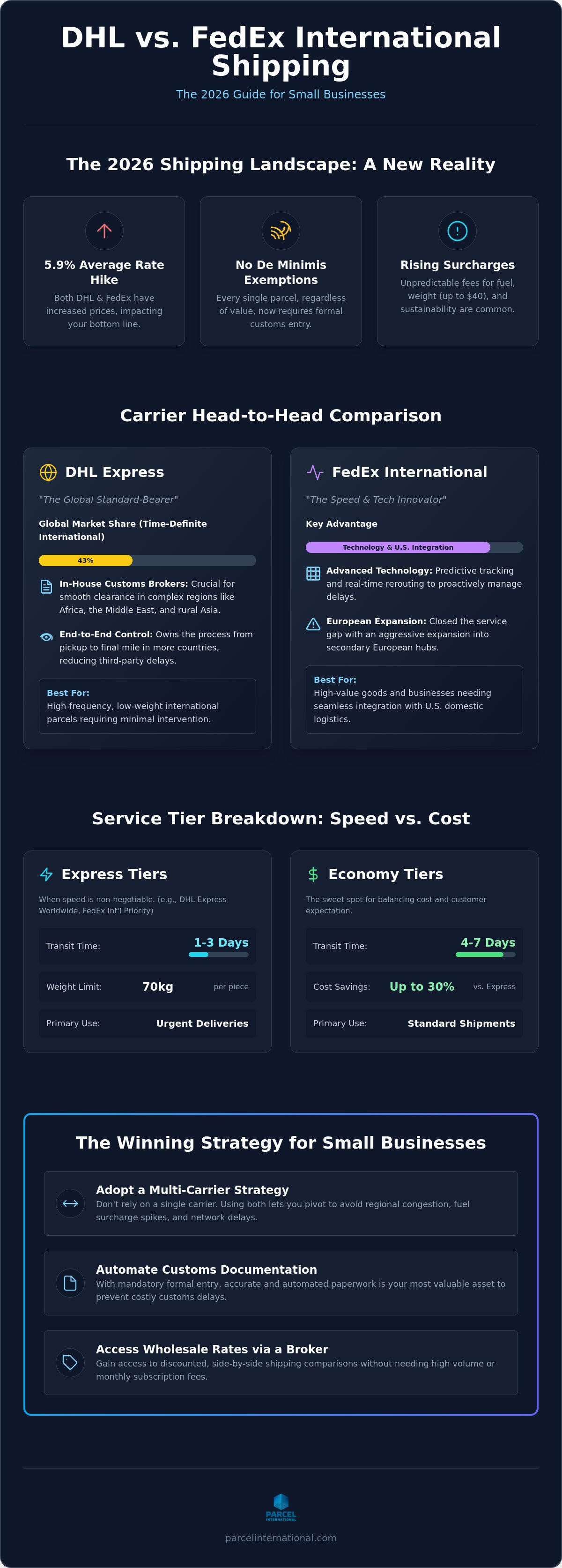
The global shipping environment shifted fundamentally on January 1, 2026. With both DHL and FedEx implementing a 5.9% average rate hike this year, small businesses face a dual challenge: rising costs and stricter customs enforcement. The elimination of de minimis exemptions in the U.S. and the EU means every single parcel now requires formal entry. In this environment, choosing dhl vs fedex international shipping for small business is no longer about brand loyalty. It's about regional efficiency and customs expertise. Relying on a single carrier is a tactical risk. One carrier might see a fuel surcharge spike in Europe while the other remains stable in Asia. Understanding the global freight transport infrastructure allows you to pivot when one network faces congestion or administrative friction.
Today’s small business shipping profile is defined by data accuracy. You aren't just moving physical goods; you're moving documentation. If your paperwork is flawed, your package stays grounded regardless of which giant's logo is on the box. The winner in 2026 is the business that treats these carriers as tools in a broader, multi-carrier toolkit.
DHL Express: The Global Standard-Bearer
DHL remains the undisputed leader in the international market, holding over 43% of the global Time-Definite International share. Their "Yellow Machine" isn't just a fleet of planes; it's a massive network of in-house customs brokers. This is critical for destinations in Africa, the Middle East, and rural Asia where third-party clearance often leads to weeks of delays. DHL owns the process from pickup to final mile in more countries than any competitor. They're best for businesses with high-frequency, low-weight international parcels that need to clear borders with minimal human intervention.
FedEx International: The Speed and Tech Innovator
Don't dismiss FedEx as a domestic-only player. By early 2026, FedEx completed an aggressive expansion into secondary European hubs, closing the service gap with DHL on the continent. They've integrated advanced tracking and real-time rerouting technology that predicts delays before they happen. This tech-first approach makes them an excellent choice for high-value goods that require deep integration with U.S.-based logistics systems. FedEx is often the superior choice for businesses that need a seamless link between their domestic U.S. operations and their international exports, specifically through services like FedEx International Connect Plus.
Service Comparison: Express vs. Economy Performance
Selecting the right tier for dhl vs fedex international shipping for small business requires a cold look at your customer's patience versus your profit margins. Speed is a commodity, but in 2026, it's an expensive one. Dimensional weight is a pricing technique that calculates shipping costs based on a package's volume relative to its actual weight, ensuring carriers are compensated for the space a light but bulky box occupies. If you ship lightweight items in oversized boxes, your bill will skyrocket regardless of the service level you choose.
Express Tiers: When Speed is Non-Negotiable
DHL Express Worldwide and FedEx International Priority are the heavy hitters for 1-3 day delivery. For major trade lanes like New York to London or Shanghai to Los Angeles, both carriers offer nearly identical transit times. However, the divergence starts in "remote areas." DHL maintains a more granular network in developing markets, often avoiding the "out-of-area" surcharges that FedEx might apply when handing off to a local third party.
Express shipments generally cap at 70kg per piece. If your shipment exceeds this or requires a pallet, you'll move into freight categories where lead times and documentation requirements stiffen. In 2026, a "guaranteed" transit time usually refers to the carrier's best effort under normal conditions. It often excludes delays caused by the mandatory customs inspections now required for all values following the 2025 regulatory shifts.
Economy Tiers: Balancing Cost and Customer Expectation
For many businesses, the 4-7 day window offered by economy tiers is the sweet spot. You can often save up to 30% by choosing a deferred service. This is a significant win for your bottom line. This approach works well when you provide clear expectations to your buyers. Our International shipping for ecommerce guide highlights how transparency about delivery times can actually reduce cart abandonment.
Tracking visibility is the main trade-off here. While express tiers provide real-time, door-to-door updates, economy services sometimes rely on milestone tracking. This means your package might "go dark" for 48 hours while it moves through a regional hub. If you want to see how these tiers affect your specific routes, you can compare real-time quotes to find the best balance of speed and cost.
Calculating the Real Cost: 2026 Rates and Hidden Surcharges
Retail rates are vanity metrics. If you only look at the base price when comparing dhl vs fedex international shipping for small business, you're only seeing half the bill. On January 1, 2026, DHL implemented a 5.9% general price increase. FedEx followed suit on January 5 with its own 5.9% hike. These numbers are just the starting point. The real impact on your margins comes from the complex web of surcharges that carriers apply after the package leaves your door. In 2026, these fees are more aggressive than ever, particularly regarding weight and packaging.
Sustainability is no longer a corporate buzzword; it's a line item. Both giants have introduced "Green Shipping" mandates to offset carbon emissions. DHL's GoGreen Plus and FedEx's equivalent sustainability surcharges are now standard. While these initiatives help your brand's environmental image, they directly affect your bottom line. Energy market volatility also means fuel surcharges fluctuate weekly, making it nearly impossible to predict landed costs without a dynamic pricing tool.
Dimensional weight (DIM) continues to punish businesses shipping small, lightweight items in large boxes. If your packaging isn't optimized, you'll pay for the space the box occupies rather than its actual weight. FedEx has also increased its Additional Handling Surcharge for international packages to $40 for weight and $29.50 for packaging. When you add the new disbursement fees, which rose to a minimum of $17.50 in 2026, a "cheap" shipment can quickly become a loss-leader.
Understanding 2026 Surcharge Structures
Peak season is no longer a December phenomenon. In 2026, logistics "Christmas" starts in September as carriers manage early inventory surges. You'll also encounter Emergency Situation Surcharges (ESS), which have persisted long after their initial introduction. These fees are designed to cover "extraordinary" operating costs, but they often feel permanent. A broker platform helps normalize these costs by providing a single, transparent view of all applicable fees before you print a label.
Volume Discounts for the 'Little Guy'
There's a persistent myth that you need massive daily volume to get a discount from DHL or FedEx. That isn't true. While direct negotiation with a carrier representative often requires high minimums, aggregators pool the volume of thousands of small businesses to secure wholesale rates. This allows a startup to ship its first box at the same rate as a mid-sized corporation. You can find more detail on how these tiers work in our guide to International shipping rates. By using a neutral intermediary, you bypass the red tape and gain immediate access to institutional pricing.
Customs and Documentation: The Ultimate Delivery Tie-Breaker
In 2026, transport speed is rarely the reason a package arrives late. The #1 cause of international shipping delays is manual data errors in your customs filings. When comparing dhl vs fedex international shipping for small business, you must evaluate their digital documentation tools as strictly as their flight schedules. Both carriers have moved toward paperless systems to combat the friction created by the end of de minimis exemptions. DHL Paperless Trade and FedEx Electronic Trade Documents (ETD) allow you to transmit commercial invoices and certificates of origin digitally. This prevents the physical loss of paperwork and speeds up the pre-clearance process while the goods are still in the air.
A Commercial Invoice acts as the definitive legal statement of value and origin that customs authorities use to calculate mandatory duties and taxes in the 2026 regulatory environment. Accurate HS Codes and detailed product descriptions are non-negotiable. Mistyping a single digit in a Harmonized System code can trigger an audit or a total seizure of the shipment. Under Executive Order 14411, U.S. Customs now requires even more granular data from foreign exporters, making documentation the true bottleneck of global trade.
Automating the Paperwork Trail
Stop relying on manual data entry for your cross-border shipments. It's a compliance nightmare that leads to abandoned carts and lost inventory. Automated tools reduce customs hold times by up to 40% by ensuring data integrity before the carrier even receives the parcel. These systems validate your HS codes and ensure your commercial invoices meet the specific requirements of the destination country. You can master these requirements using our guide to International shipping customs documentation.
Duties and Taxes: DDU vs. DDP
Choosing between "Delivered Duty Unpaid" (DDU) and "Delivered Duty Paid" (DDP) determines your customer's final impression of your brand. Delivery Duty Paid (DDP) is the gold standard for 2026 customer experience because it eliminates the surprise bill at the doorstep. With the removal of the €150 de minimis exemption in the EU, every commercial shipment now carries a tax burden. Managing the financial risk of these fees requires a platform that provides real-time calculations. Our platform allows you to generate compliant customs paperwork and calculate total landed costs instantly, ensuring your customers never face unexpected charges.
The Strategic Winner: Why SMBs Use Both via a Broker
Locking your business into a single-carrier contract is a tactical error in 2026. Global logistics are too volatile for rigid loyalty. When you commit to one provider, you lose the ability to hedge against regional fuel surcharges or sudden service disruptions in specific trade lanes. A neutral platform transforms this dynamic. It allows you to compare dhl vs fedex international shipping for small business for every individual box you ship. This ensures you always secure the best rate and transit time without the burden of volume minimums. You aren't just buying a label; you're gaining the flexibility to pivot your strategy as global markets shift.
Parcel International provides the high-stakes authority of a global logistics giant while maintaining the accessible, supportive feel of an SMB ally. You gain access to a unified dashboard that manages Express Shipping, Air Freight, and Sea Freight in one place. For businesses with ultra-high-priority cargo that requires more than standard commercial aviation routes, a Private Jet Charter offers the dedicated brokerage authority needed for mission-critical logistics. This strips away the complexity of managing multiple carrier accounts, varied login credentials, and fragmented invoices. You get clear, transparent pricing and the relief of a singular, orderly workflow. By removing traditional barriers like subscription requirements, we make institutional-grade shipping available to every startup.
Diversifying Your Logistics Portfolio
Smart logistics management means playing to each carrier’s strengths. Use DHL for its unmatched infrastructure in Europe and Asia. Switch to FedEx for shipments within North America where their domestic network is most efficient. This multi-carrier approach optimizes your costs and improves delivery reliability for your customers. Our philosophy of radical transparency means there are no subscription fees; you simply pay for what you ship. If you're curious about how these intermediaries operate, read our guide on what is a freight forwarder to understand the mechanics of global logistics. This knowledge helps you move from fragmented shipping to a unified, strategic solution.
Getting Started with Parcel International
You can compare real-time rates in under 60 seconds without navigating corporate jargon or hidden requirements. Our system is designed for speed and clarity, allowing you to move from inquiry to action as quickly as possible. Follow this logical three-step process to book your first shipment:
Enter Shipment Details: Input your package dimensions, weight, and destination country to see live options.
Compare Rates: View side-by-side quotes from DHL and FedEx to see exactly who offers the best value for that specific route.
Finalize and Print: Select your service level, generate your compliant customs paperwork, and print your label instantly.
Compare DHL and FedEx rates on Parcel International today and start optimizing your international margins immediately.
Mastering Your 2026 Global Strategy
The global shipping environment has fundamentally shifted. You can no longer rely on a single-carrier contract if you want to protect your margins against 5.9% rate hikes and aggressive new sustainability surcharges. Success in 2026 requires a multi-carrier approach that prioritizes data-driven customs documentation and regional efficiency. Deciding between dhl vs fedex international shipping for small business is now a shipment-by-shipment choice based on real-time data and regional carrier strengths. By leveraging a neutral platform, you gain the agility to choose the best tool for every destination without being locked into restrictive terms.
Parcel International has been a trusted broker since 2007, helping businesses strip away the friction of global logistics. We provide automated customs documentation and wholesale rates with no subscription fees or volume minimums. You deserve a partner that values your peace of mind and your bottom line. Start comparing international rates and save up to 70% today. Take control of your logistics and watch your small business thrive on the global stage.
Frequently Asked Questions
Is DHL or FedEx cheaper for international shipping in 2026?
Neither carrier is universally cheaper following the 5.9% general rate increases implemented in January 2026. Your final bill depends heavily on specific surcharges, such as FedEx's $40 additional handling fee for weight or DHL’s regional fuel adjustments. Small businesses should use a comparison tool to evaluate the total landed cost for every individual shipment rather than relying on base retail rates.
Which carrier is faster for shipping from the US to Europe?
DHL typically maintains a speed advantage in Europe because it manages 45% of the express market share on the continent. While FedEx has expanded its secondary European hubs in early 2026 to close the gap, DHL’s extensive in-house customs clearance network often results in faster transit times. This is especially true for destinations outside of major metropolitan centers.
Do I need a commercial account to get discounted rates with DHL or FedEx?
You don't need to maintain a direct commercial account or meet high volume minimums to access discounted rates. By using a logistics broker, you benefit from wholesale pricing created by pooling the volume of thousands of small businesses. This allows you to secure institutional-grade discounts on your very first shipment without any subscription fees.
How do I avoid my international parcels getting stuck in customs?
Ensure every HS code and commercial invoice is perfectly accurate and transmitted digitally. Since the elimination of the $800 de minimis exemption, customs authorities now require formal entry for all goods regardless of value. Using automated documentation tools is the most effective way to prevent manual data errors that lead to costly "Customs Holds."
What are the 2026 fuel surcharges for international express shipping?
Fuel surcharges are variable percentages that carriers adjust weekly based on global energy market indices. These charges are applied to the base shipping rate and specific transportation-related surcharges. This volatility is a primary reason why dhl vs fedex international shipping for small business costs can fluctuate even when your package dimensions stay the same.
Can I ship large freight through DHL or FedEx using Parcel International?
Yes, you can manage Express Shipping, Air Freight, and Sea Freight through a single dashboard. Our platform allows you to scale from small parcels to palletized freight without switching providers. You get the same transparent, real-time rate comparison for heavy-weight shipments that you do for standard envelopes.
What is the difference between DHL Express and FedEx International Priority?
Both are premium services designed for 1-3 day delivery to major global trade lanes. DHL Express is often the superior choice for complex destinations in the Middle East or Africa due to their proprietary global network. FedEx International Priority is an excellent fit for businesses that require deep integration with their existing U.S. domestic shipping workflows.
Does Parcel International provide automated customs forms for all carriers?
We provide automated customs support for every carrier available on our platform. This system generates all required commercial invoices and regulatory filings based on the data you provide during booking. It's a core feature designed to ensure your shipments comply with the latest 2026 international trade regulations automatically.


Comments