
Freight Rate Forecasting 2026: A Strategic Guide for Global Logistics
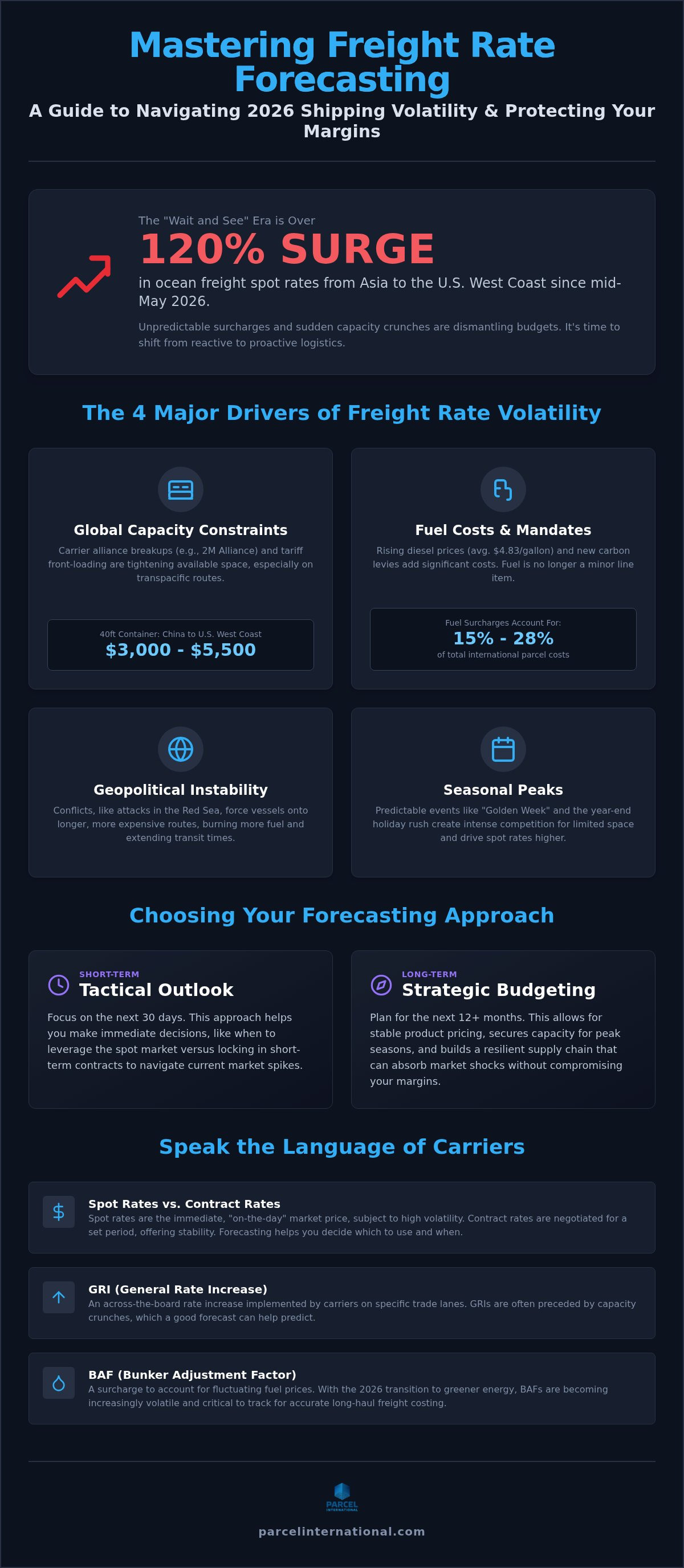
With ocean freight spot rates from Asia to the U.S. West Coast surging 120% since mid-May 2026, the era of "wait and see" logistics is officially over. You're likely feeling the pressure of unpredictable surcharges and sudden capacity crunches that make accurate freight rate forecasting feel nearly impossible. It's exhausting to watch a carefully planned budget get dismantled by a 6.0% general rate increase or shifting transit routes in the Red Sea. You need a reliable way to regain control over your bottom line.
This guide will help you master predictive logistics to protect your margins and handle 2026 shipping volatility with confidence. We'll explore the impact of new regulatory changes, like the removal of the EU de minimis exemption, and show you how to secure stable shipping budgets. By the end of this article, you'll have a clear roadmap to maintain competitive pricing for your customers and reduce the stress of peak shipping seasons. Let's move from fragmented workflows to a unified, predictable shipping strategy.
Table of Contents
What is Freight Rate Forecasting and Why Does It Matter in 2026?
Understanding What is a freight rate is the foundation of any global trade strategy. In 2026, freight rate forecasting isn't just about guessing numbers. It's a sophisticated process that blends historical data, AI modeling, and real-time market signals to predict future shipping costs. While traditional methods often relied on static spreadsheets, modern forecasting accounts for the chaotic variables of the current market. It provides a clear view of where the industry is heading so you can make informed decisions.
The year 2026 marks a turning point for global logistics. We've moved past the extreme peaks of the pandemic era, but we've entered a new phase of regulatory complexity. Environmental mandates, such as stricter carbon emission standards and new fuel surcharges, are baking fresh costs into every quote. Shippers who ignore these shifts will find their margins evaporated by surcharges they didn't see coming. Accurate freight rate forecasting acts as a shield, allowing you to anticipate these changes before they hit your balance sheet.
Being reactive is expensive. When you rely solely on the spot market, you're at the mercy of daily volatility. For e-commerce businesses, a sudden spike in transpacific rates can turn a profitable product line into a loss overnight. Conversely, mastering forecasting allows you to price your products with future logistics costs already factored in. This foresight provides the stability needed for international expansion without the fear of sudden budgeting shortfalls.
The Shift from Intuition to Data-Driven Logistics
Relying on a "gut feeling" is a liability in 2026. Global markets are too interconnected and move too fast for intuition to suffice. Big data has democratized the field. Smaller players now have access to the same market intelligence as enterprise giants. Moving from reactive shipping to proactive management means you aren't just responding to the market; you're anticipating it. This shift reduces the friction of procedural delays and provides the relief of knowing your budget is secure.
Key Terminology Every Shipper Should Know
To forecast effectively, you must speak the language of the carriers. It's about more than just the base price. Focus on these three areas:
Spot rates vs. Contract rates: Spot rates represent the "here and now" price. Forecasting helps you decide when to lock in a contract and when to play the spot market.
GRI (General Rate Increase): Carriers often implement these across specific lanes. Forecasting helps you spot the capacity crunches that usually precede a GRI.
Bunker Adjustment Factors (BAF): These fuel surcharges are increasingly volatile due to 2026 green energy transitions. Understanding BAF trends is vital for long-haul sea freight accuracy.
The 4 Major Drivers of Freight Rate Volatility
Predicting costs requires more than looking at yesterday's invoice. In 2026, the variables are shifting beneath our feet. Effective freight rate forecasting relies on identifying the structural forces that push prices up or pull them down. While macro-economics play a role, specific industry bottlenecks often have a more immediate impact on your shipping budget than general trade volumes.
Global capacity remains a primary concern for every logistics manager. The breakup of major carrier alliances, such as the 2M Alliance between Maersk and MSC, has created significant uncertainty around service networks. Shippers are also front-loading shipments to avoid 2026 tariff deadlines, which puts immense pressure on transpacific routes. According to the Freight Rate & Transportation Forecast, industrial activity and inventory cycles are key indicators of these shifts. When capacity tightens, spot rates for a 40ft container from China to the U.S. West Coast can quickly climb into the $3,000 to $5,500 range, as we observed in the second quarter of 2026.
Fuel costs and sustainability mandates are the next major hurdles. With national average diesel prices reaching $4.83 per gallon, fuel surcharges now constitute between 15% and 28% of total international parcel costs. Geopolitical instability, particularly ongoing attacks in the Red Sea, forces vessels onto longer routes. This adds transit time and burns more fuel, directly inflating the base rate. Finally, seasonal peaks like the 2026 "Golden Week" and the year-end holiday rush create predictable but intense competition for space. If you want to avoid these spikes, it's helpful to use a partner like Parcel International to access real-time rate comparisons across multiple carriers.
Regulatory Impacts and Carbon Levies
New maritime fuel standards and carbon taxes are no longer theoretical. As of January 1, 2026, stricter packaging and stowage requirements under the IMDG Code Amendment 42-24 have entered full force. Carriers are passing these compliance costs directly to shippers through "Green Shipping" surcharges that are now baked into standard quotes. Environmental compliance will be the #1 price driver in 2026 as the industry pivots toward mandatory decarbonization targets.
Technological Disruptions in the Supply Chain
Technology is the primary tool for stabilizing these fluctuations. AI-driven port automation helps reduce congestion, which can lower or at least stabilize local rates. IoT devices provide the real-time data streams necessary for more accurate freight rate forecasting, allowing you to track shipments and anticipate delays before they impact your budget. Digital brokers are also playing a vital role by aggregating capacity, making it easier for smaller businesses to find space when the market is tight.
Strategic vs. Tactical Forecasting: Choosing Your Approach
Logistics managers in 2026 face a constant choice between immediate savings and long-term stability. While some academic models emphasize ten-year econometric trends, these offer little help when you're trying to move a shipment next Tuesday. Effective freight rate forecasting requires a dual-track approach that balances tactical agility with strategic foresight. You need to know both when to jump on a spot rate and when to lock in a year-long agreement to protect your margins.
Tactical forecasting focuses on the immediate 7 to 30-day window. It's the primary tool for optimizing current bookings and avoiding sudden surcharges like the 6.0% FedEx increase implemented in early 2026. Strategic forecasting, by contrast, looks at a 6 to 12-month horizon. This is essential for annual budgeting and high-level contract negotiations. By adopting a hybrid model, you use short-term data to validate your long-term assumptions. This ensures your yearly plan stays grounded in the actual reality of international shipping rates.
Success in 2026 depends on knowing which model to apply to which shipment. High-value express items often require tactical precision to avoid peak-day surcharges. Bulkier sea freight usually benefits from a strategic outlook that accounts for seasonal shifts like the Golden Week rush. Balancing these two methods allows you to maintain a stable budget without missing out on sudden market opportunities.
When to Rely on Spot Market Forecasts
Spot market forecasting is indispensable for businesses moving high-volume, low-margin goods. In these scenarios, even a slight dip in the market can significantly boost your quarterly profit. You should look for "buy" signals, such as a stabilization in global freight indices after a period of volatility. To test your assumptions, use a shipping calculator to compare forecasted spot rates against your current contract benchmarks. This transparency helps you decide if a specific shipment should move now or wait for a predicted rate drop.
Budgeting for Long-Term Freight Contracts
Securing a long-term contract offers the relief of a predictable budget, but it comes with risks. Locking in rates too early in a volatile market can leave you overpaying if capacity suddenly increases in the second half of 2026. Monitor carrier capacity forecasts closely before signing. When negotiating, aim to build "flex-clauses" into your logistics planning. These clauses allow for rate adjustments based on significant shifts in fuel prices or regulatory changes, ensuring your contract remains competitive regardless of market swings.
How to Implement Rate Forecasting in Your Business
Turning data into a functional strategy requires a disciplined, step-by-step approach. You don't need a team of data scientists to begin. Start by auditing your own historical data from 2025 and early 2026 to identify your specific seasonal peaks. Once you understand your internal patterns, monitor global benchmarks like the SCFI or Drewry indices to see how they align with your experience. Using a multi-carrier platform allows you to compare these forecasts against real-time market offers, providing a reality check for your budget.
Diversification is your best defense against volatility. If freight rate forecasting suggests a capacity crunch in sea freight for Q3, proactively shift a portion of your inventory to air freight or road freight. Finally, use these insights to adjust your retail strategy. If you know shipping costs will rise, update your customer-facing shipping tiers or pricing before those costs hit your bottom line. This proactive adjustment protects your margins and prevents the panic of sudden, unbudgeted expenses.
Tools for the Modern Logistics Manager
Relying on a single carrier relationship is a significant forecasting risk. If that carrier experiences a localized disruption or implements a sudden surcharge, your entire strategy collapses. Rate aggregators provide a market-wide view that a single carrier simply cannot offer. This transparency allows you to see how different providers are responding to global shifts. Understanding what is a freight forwarder can help you see how these intermediaries manage multiple carrier relationships to protect your interests and maintain budget stability.
Mitigating the Risk of "Forecast Error"
No forecast is perfect. You should always maintain a 10% "volatility buffer" in your logistics budget to handle the unexpected. Real-time tracking is also essential; it allows you to adjust to mid-transit disruptions before they become expensive failures. Automated customs support is another vital tool, as it prevents hidden administrative costs from inflating your final bill. By removing these procedural frictions, you ensure your forecasted costs remain as accurate as possible. To start building a more resilient shipping strategy today, compare real-time rates from major carriers on our platform.
Executing Your Strategy with Parcel International
Data is just noise if you don't have the tools to act on it. You've mastered the art of freight rate forecasting, identified the upcoming volatility in transpacific routes, and now you need a way to secure those rates before they climb. Parcel International serves as your execution partner by aggregating wholesale rates from major carriers into a single, transparent interface. This allows you to book the best rate the moment your forecast signals a market low. Instead of juggling multiple carrier logins or navigating corporate jargon, you have one point of access to beat the spot market.
Efficiency is the ultimate goal of any modern logistics strategy. Our unified dashboard provides complete control over your costs, tracking, and documentation. You can monitor shipments in real-time across different modes of transport, whether you're using sea freight for bulk inventory or express shipping for urgent orders. This reduces the administrative friction that often slows down global trade and eats into your margins. By centralizing your operations, you move away from fragmented, multi-platform workflows to a singular solution. It's the relief of knowing your logistics are orderly and your budget is protected.
Wholesale Rates for Every Business Size
We believe every business deserves an egalitarian playing field in global logistics. We bridge the gap between small businesses and global carrier giants like DHL, FedEx, and UPS by providing access to wholesale rates typically reserved for enterprise-level shippers. You don't need to commit to high volume minimums or pay expensive monthly fees to get started. Our "No Subscription" advantage ensures you only pay for the shipping you actually use, which is essential for maintaining liquidity. This flexibility is especially vital for managing international shipping for ecommerce, where volumes can fluctuate based on seasonal demand or shifting market trends.
Automated Customs: The Final Piece of the Puzzle
Even the most accurate freight rate forecasting fails if your goods are stuck in a customs warehouse. With the July 2026 removal of the EU de minimis exemption and stricter IATA regulations on lithium-ion batteries, compliance is more complex than ever. Our platform acts as a stable intermediary, generating compliant documentation automatically to prevent delays. This tool ensures that your forecasted costs don't balloon due to unexpected storage fees or administrative penalties. You can focus on your expansion strategy while we handle the procedural friction. Ready to optimize your 2026 shipping? Compare rates now at Parcel International.
Secure Your Margins in a Volatile Market
The landscape of 2026 logistics demands a shift from reactive shipping to a data-driven strategy. By mastering freight rate forecasting, you can navigate capacity crunches and fuel surcharges without compromising your bottom line. You now have the roadmap to balance short-term tactical bookings with long-term contract stability while accounting for new environmental regulations. The relief of a predictable budget is within reach when you replace intuition with actionable data.
The final step is choosing a partner that turns these insights into immediate action. Since 2007, Parcel International has served as a trusted logistics broker. We simplify the complex world of global freight by aggregating wholesale rates from leading carriers. You can manage your entire strategy from a unified dashboard that includes automated customs tools to prevent costly delays at the border. There are no volume minimums and no subscription fees; you only pay for the shipping you actually use. This transparency ensures you remain an agile competitor in the global market.
Don't let market shifts dictate your success. Start comparing real-time international shipping rates today and build a resilient supply chain that thrives in any environment. You have the tools to ship with total confidence.
Frequently Asked Questions
How accurate is freight rate forecasting in 2026?
Short-term tactical forecasts for a 30-day window are highly reliable; they often achieve precision levels above 90% when using high-quality data. Long-term strategic outlooks are more challenging due to unpredictable geopolitical events and shifting trade policies. Most managers use these forecasts to establish a budgetary range rather than a fixed number, allowing for a 10% margin of error.
Which indices are best for tracking international freight rates?
The Shanghai Containerized Freight Index (SCFI) and the Drewry World Container Index are the primary tools for ocean freight. For air and express shipping, you should monitor the TAC Index and the annual General Rate Increase (GRI) reports from major carriers like DHL and FedEx. These indices provide the raw data required for effective freight rate forecasting and budget planning.
How do fuel surcharges affect forecasted shipping costs?
Fuel surcharges act as a floating multiplier that can significantly inflate your total bill. In 2026, these fees typically account for 15% to 28% of the total shipping cost depending on the route and carrier. Because fuel prices are volatile, your forecast must include a variable fuel adjustment factor to ensure your budget remains realistic as diesel prices fluctuate.
Can small businesses benefit from freight forecasting without expensive software?
Yes, small businesses can gain a significant advantage by simply tracking historical seasonal patterns and monitoring public market indices. You don't need enterprise-level AI to spot the typical rate spikes before the holiday season or Golden Week. Using a multi-carrier dashboard provides the market-wide transparency needed to make informed decisions without a heavy software investment.
What is the difference between an ocean freight index and an air freight index?
An ocean freight index tracks the cost of moving 20ft or 40ft containers; it's heavily influenced by vessel capacity and port congestion. An air freight index measures the price per kilogram and is much more sensitive to jet fuel costs and immediate consumer demand. Air rates fluctuate more rapidly than sea rates, making tactical freight rate forecasting even more critical for air shipments.
How often should I update my shipping budget based on new forecasts?
You should review your tactical forecast every 14 days and update your strategic annual budget once per quarter. Frequent reviews allow you to pivot your strategy if a specific transport mode becomes unexpectedly expensive. This rhythm ensures you can adjust your retail pricing or shipping tiers before market volatility begins to erode your profit margins.
Does Parcel International provide real-time rate forecasting?
Parcel International provides real-time rate comparisons that serve as the "ground truth" for your forecasting efforts. While we don't offer speculative long-term predictions, our platform lets you see exactly how current market shifts are impacting wholesale rates across multiple carriers. This transparency allows you to validate your forecasts and book shipments the moment the market aligns with your budget.
What happens if actual freight rates are much higher than the forecast?
If rates exceed your forecast, you should immediately utilize your 10% volatility buffer to cover the gap. It's also wise to check wholesale rates through a broker to see if you can beat the current spot market. If the high rates persist, you may need to switch transport modes or adjust your customer-facing shipping fees to maintain your business's financial health.


Comments