
How Are International Shipping Costs Calculated? The 2026 Comprehensive Guide
Updated: 2 days ago
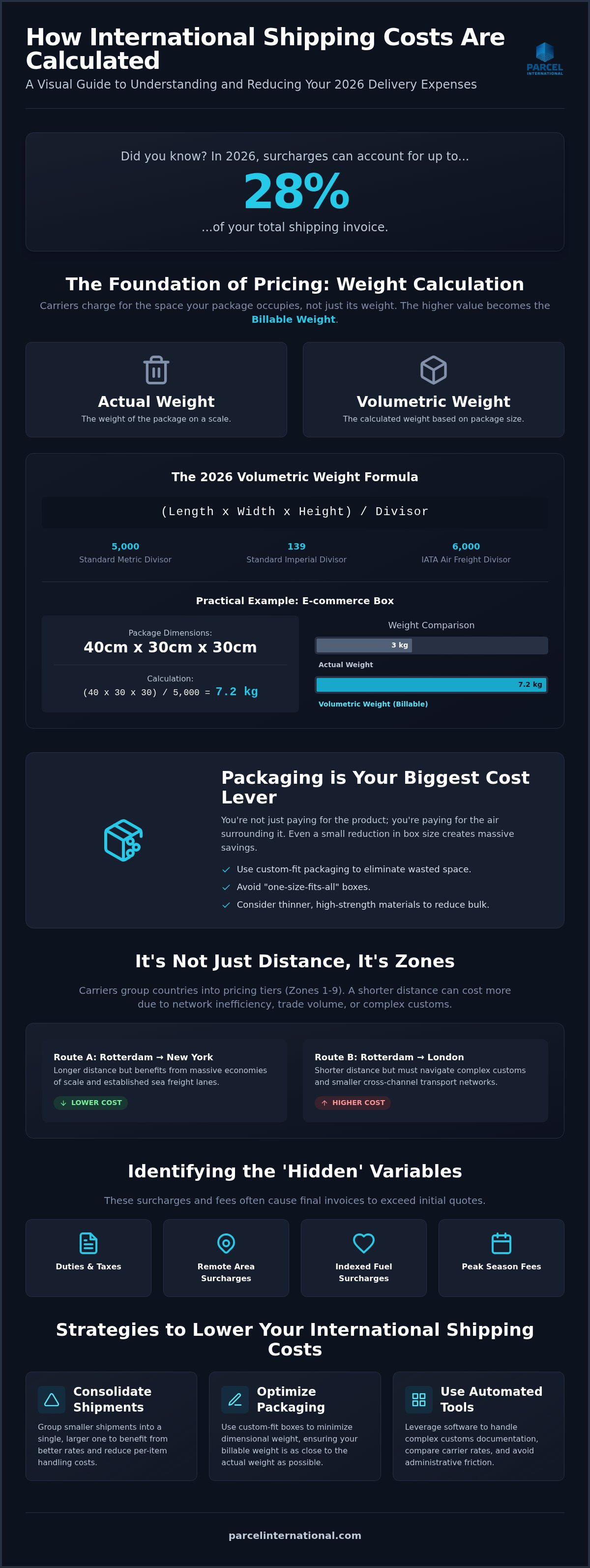
Did you know that in 2026, surcharges can account for up to 28% of your total shipping invoice? It's the primary reason that your final price often looks nothing like your initial quote. If you have ever wondered how are international shipping costs calculated, you must realize that cargo isn't priced by the scale alone; it's priced by the "footprint" your goods leave on a carrier's network. You're probably tired of the confusion surrounding volumetric weight versus actual weight and the anxiety of unpredictable customs delays.
Understanding the math behind global delivery isn't just a helpful skill; it's a requirement for maintaining your margins in a high-stakes market. This comprehensive guide will strip away the typical anxieties of global logistics to help you accurately predict and lower your delivery expenses. We promise to move you from fragmented, multi-platform guesswork to a clear, unified understanding of logistics pricing.
We will break down the 2026 formula for volumetric weight and explain how the recent suspension of the U.S. de minimis exemption affects your bottom line. You will also learn specific packaging strategies to reduce your cargo footprint and gain the confidence to choose between carriers for every shipment.
Table of Contents
Dimensional Weight vs. Actual Weight: The Foundation of Logistics Pricing
Carriers view space as their most valuable asset. A plane, ship, or truck has a finite volume. If you fill a container with light, bulky items, the carrier loses the ability to sell that space to other shippers. This is why "dead weight," the actual mass of your goods, is often less important than "volumetric space," the physical dimensions. To understand how are international shipping costs calculated, you must look at how carriers bridge this gap. They use a metric called "billable weight," which is simply the higher value between the actual weight on a scale and the calculated dimensional weight. This ensures the freight rate accurately reflects the resources your cargo consumes.
Calculating Your Volumetric Weight
The standard 2026 formula for dimensional (DIM) weight is (Length x Width x Height) / Divisor. For metric measurements, most major carriers use a divisor of 5,000. For imperial measurements, the divisor is typically 139. However, the IATA standard for international air freight often utilizes 6,000. This divisor acts as a conversion factor that turns volume into a theoretical weight. It's a critical variable because carriers adjust divisors based on service levels to manage their capacity.
Let's look at a practical example. Imagine you're shipping a standard e-commerce box measuring 40cm x 30cm x 30cm. The total volume is 36,000 cubic centimeters. Dividing this by the 5,000 divisor gives you a volumetric weight of 7.2kg. If your actual product only weighs 3kg, the carrier will still bill you for 7.2kg. This discrepancy is where many businesses lose money without realizing it. You aren't just paying for the product; you're paying for the air surrounding it.
Why Packaging Efficiency is Your Biggest Cost Lever
Your choice of packaging is the most direct way to control your shipping expenses. Even a small reduction in box size creates massive savings over time. Adding just 2cm of unnecessary "air" or padding to each side of a box can significantly increase the DIM weight, potentially pushing your shipment into a more expensive pricing tier. It's a common mistake that inflates budgets unnecessarily.
Don't settle for "one size fits all" boxes. Use custom-fit packaging or adjustable height boxes to eliminate wasted space. You should also consider using thinner, high-strength materials that provide protection without adding bulk. By optimizing your packaging, you ensure that your billable weight stays as close to the actual weight as possible. This removes the hidden "air tax" from your logistics budget and makes your shipping strategy far more efficient.
Shipping Zones and Geographic Distance: Mapping the Global Network
Geographic distance is a deceptive metric in logistics. If you assume a shorter physical distance always translates to a lower price, your budgeting will be inaccurate. Understanding how are international shipping costs calculated requires looking at "zones" rather than just miles. Carriers organize the world into pricing tiers based on their own network efficiency and infrastructure. A shipment from Rotterdam to New York often benefits from massive economies of scale and established sea freight lanes. Conversely, a package from Rotterdam to London must navigate complex customs procedures and smaller cross-channel transport networks, which can drive the price higher despite the proximity. According to the WTO Trade Cost Index, transport and trade policy remain the primary drivers of these geographic pricing variations.
The Logic Behind Pricing Tiers
Carriers like DHL and UPS group countries into tiers, usually numbered 1 through 9. These aren't static maps. Carriers update these zones annually to reflect changes in local infrastructure quality and regional trade volumes. High-traffic routes between major global hubs like Shanghai and Los Angeles remain in lower, more affordable zones. Emerging markets or regions with limited transport links are pushed into higher zones because the carrier's operational risk and cost are greater. When you analyze how are international shipping costs calculated, you'll notice that infrastructure and trade volume dictate these groupings more than simple mileage.
Navigating Remote and Extended Area Surcharges
In 2026, a "remote area" is defined by its distance from a carrier's primary sorting hub or the difficulty of the final delivery leg. Delivering to a rural village or a remote island triggers an "Extended Area" fee. These surcharges are substantial. They often add a flat fee or a per-kilogram cost to your final invoice. Don't wait for the invoice to discover these costs. Verify the destination zip code against the carrier's 2026 list before you finalize your shipment.
To mitigate these costs, try consolidating multiple orders into a single larger shipment to a central hub. This reduces the number of times you trigger the base remote fee. You can compare these geographic variables across multiple carriers simultaneously to find the most efficient route and avoid unnecessary regional markups. This proactive approach ensures your pricing remains transparent and competitive.
Mode of Transport: Air, Sea, and Road Calculation Logic
The vehicle carrying your cargo dictates the mathematical rules applied to your invoice. Each mode of transport prioritizes different constraints, from the volume of a cargo hold to the linear space on a truck bed. To master how are international shipping costs calculated, you must align your shipment size with the most efficient transport logic. While air freight is 4 to 8 times more expensive than ocean freight per kilogram, the speed often justifies the cost for high-value or time-sensitive goods. However, for shipments over 100 kilograms, the calculation logic shifts away from simple parcel rates toward complex freight forwarding structures.
Air freight pricing relies heavily on the weight-to-volume ratio. In 2026, standard air freight rates typically range between $2.50 and $6.00 per kilogram, while express air freight reaches $5.00 to $8.50 per kilogram. These "Express" premiums cover the cost of time-definite delivery and priority handling. In contrast, sea freight calculation focuses on the container. You'll choose between Less than Container Load (LCL), where you pay for the specific volume you occupy, and Full Container Load (FCL). Consolidating LCL shipments into an FCL can cut your per-unit freight costs by 35% to 50%, making it a powerful lever for high-volume shippers.
Freight Forwarding vs. Express Parcels
Deciding when to switch from express parcel services to freight forwarding is a critical financial milestone. Parcel services are optimized for speed and individual tracking but carry high administrative fees per package. Freight forwarding utilizes Cubic Meters (CBM) to price sea and air cargo, offering better economies of scale. While parcel carriers might charge for every individual box, freight forwarders aggregate your goods into a single shipment with one set of administrative fees, significantly lowering your total landed cost.
Choosing the Right Speed for Your Budget
Don't assume the fastest route is the only professional choice. Finding the "sweet spot" on the price-to-speed curve can save your business thousands. For intra-European deliveries, road freight often rivals air freight speed at a fraction of the cost, using pallet-based pricing or linear meters to maximize truck space. If your timeline allows, choosing deferred shipping options can cut your base freight costs by 30% to 50%. This approach lets you maintain reliability without overpaying for unnecessary speed, ensuring your logistics strategy remains both agile and profitable.
The 'Hidden' Variables: Surcharges, Duties, and Taxes
The freight rate you receive in a quote is rarely the final amount you pay. To understand how are international shipping costs calculated in 2026, you must account for the 15% to 28% of the total bill that typically comes from surcharges. Fuel surcharges are the most volatile variable; they are indexed to global energy prices and fluctuate weekly. In 2026, these fuel fees alone can account for up to 28% of your total invoice. Additionally, the Q4 logistics crunch triggers peak season surcharges. Prepare for ocean freight rates to jump by 20% to 40% between August and October as carriers manage capacity.
The gap between your base shipping cost and the "total landed cost" is filled by duties, VAT, and administrative fees. A major shift occurred in June 2026 when the United States suspended the $800 de minimis exemption. This means even low-value goods now face formal entry procedures and potential duties. Similarly, the European Union requires precise declarations for all packages, even those valued under €150. Expect customs brokerage fees to range from $125 to $350 per entry. These administrative costs are the "hidden" friction that slows down your supply chain and inflates your budget.
Understanding Incoterms and Their Cost Impact
Incoterms determine which party is responsible for specific costs and risks. Choosing between DAP (Delivered at Place) and DDP (Delivered Duty Paid) significantly alters your quote. Under DDP, you assume responsibility for all taxes and duties, providing a seamless experience for your customer but increasing your upfront costs. Using the correct Harmonized System (HS) codes is vital to avoid overpaying. Precise international shipping customs documentation prevents costly delays and ensures you don't face daily demurrage fees, which can range from $100 to $350. These fees quickly erode the profit margins of any international project.
Common Carrier Surcharges to Watch For
Carriers penalize shipments that deviate from standard operational patterns. Residential delivery fees apply whenever a driver must navigate non-commercial neighborhoods. Overweight and oversized item penalties are even more severe; they trigger significant surcharges because they require manual handling or specialized equipment. Finally, address correction and redelivery fees are entirely avoidable costs. Data errors in the shipping label can lead to expensive "return to sender" scenarios. You can automate your customs support to eliminate these administrative errors and secure more predictable landed costs for every shipment.
Strategies to Lower Your International Shipping Costs in 2026
Lowering your expenses requires shifting from a reactive approach to a strategic one. Consolidation is your most effective tool. By combining multiple smaller orders into a single Less than Container Load (LCL) or Full Container Load (FCL) shipment, you can cut per-unit freight costs by 35% to 50%. This strategy directly counters the way how are international shipping costs calculated by reducing the number of base fees and administrative charges applied to your account. You're effectively buying space in bulk rather than paying a premium for fragmented deliveries.
Don't ignore the value of wholesale rates. While individual carriers suggest opening a business account for minor discounts, logistics brokers aggregate volume from thousands of shippers to secure much deeper price cuts. Obtaining these volume deals can lead to rates 15% to 30% below the standard spot rates found on major shipping lanes. Additionally, you must audit your invoices. Service failures or billing discrepancies are common; identifying these errors ensures you only pay for the service you actually received. While understanding how are international shipping costs calculated is the foundation, applying these optimization strategies is what actually protects your bottom line.
The Power of Rate Comparison Platforms
Sticking to a single carrier creates a dangerous dependency. Carrier pricing fluctuates based on their current capacity and regional demand. Use a shipping calculator to compare live data across multiple providers instantly. This transparency allows you to react to price changes as they happen. By reviewing the latest international shipping rates, you ensure your business isn't overpaying for a route that a competitor carrier has recently optimized.
Optimizing Your Landed Cost Strategy
Zoning isn't just a carrier's tool; you can use it to your advantage. By choosing a port of entry that sits in a lower-cost zone for your final destination, you reduce the "last-mile" distance and avoid expensive remote area surcharges. You should also automate your documentation process. Removing human error from commercial invoices and HS code selection eliminates the surcharges associated with data corrections and customs delays. Use this final checklist to secure a cost-efficient 2026 shipping strategy:
Consolidate LCL into FCL whenever your inventory levels allow.
Compare at least three carrier quotes for every major route to catch spot rate dips.
Automate customs tools to verify HS codes and recipient address data.
Leverage a broker to access volume discounts without high-volume commitments.
Audit every invoice for service-level agreement (SLA) failures or incorrect surcharges.
Master Your Logistics Margins for 2026
You now have the tools to decode how are international shipping costs calculated, from the volumetric math of your packaging to the regional zoning tiers of global carriers. By optimizing your "cargo footprint" and consolidating shipments, you move from the anxiety of hidden fees to the relief of predictable budgeting. It's clear that the regulatory changes of 2026, such as the new U.S. de minimis rules, no longer need to be a source of procedural friction for your business.
Take the next logical step by moving from fragmented workflows to a singular, unified solution. You can compare real-time international shipping rates and save today through our automated broker platform. Gain immediate access to wholesale rates from DHL, FedEx, and UPS without the burden of subscription fees or volume minimums. Our system generates your customs paperwork automatically, ensuring your goods cross borders without administrative delays. Secure your global supply chain with transparency and start shipping with total confidence today.
Frequently Asked Questions
What is the difference between actual weight and volumetric weight?
Actual weight is the physical mass of your package on a scale. Volumetric weight measures the space your cargo occupies using the 2026 standard formula of (Length x Width x Height) / 5000. Carriers compare these two numbers and bill you for whichever is higher. This "billable weight" ensures that light, bulky items are priced fairly relative to the space they consume in a cargo hold. It's a fundamental step in how are international shipping costs calculated.
How do fuel surcharges affect my international shipping quote?
Fuel surcharges are variable fees tied to global energy markets that fluctuate on a weekly basis. In 2026, these surcharges often represent 15% to 28% of your total shipping invoice. Because they are calculated as a percentage of the base freight rate, any increase in fuel prices directly inflates your final cost. This volatility explains why shipping quotes have a limited validity period and why total expenses can change quickly. This factor is crucial in how are international shipping costs calculated.
Are customs duties included in the shipping price I see online?
Standard shipping quotes usually exclude customs duties and VAT. These taxes are part of the "total landed cost" and are determined by the destination country's laws. Following the June 2026 suspension of the U.S. de minimis exemption, even low-value goods now incur formal entry procedures. You must account for these government fees and potential brokerage costs separately from the freight price to avoid unexpected financial friction at the border.
What is a 'Remote Area Surcharge' and how can I avoid it?
A remote area surcharge is an additional fee for deliveries to locations far from primary transportation hubs. Carriers apply these because the "last-mile" delivery to rural or isolated areas requires more time and fuel. You can avoid these costs by verifying zip codes before booking or by consolidating shipments to a central commercial address. This proactive approach ensures you don't face surprise fees that weren't included in your initial budget.
How does the choice of Incoterms (DAP vs DDP) change my costs?
Incoterms like DAP and DDP define the financial responsibility for duties and taxes. Under DAP, your customer pays the customs fees upon delivery. With DDP, you pay these costs upfront, ensuring the recipient faces no hidden charges. DDP often leads to a higher initial quote but provides a smoother delivery experience. Choosing the right term is a strategic decision that impacts your cash flow and your reputation for transparency.
Why is air freight more expensive than sea freight for heavy items?
Air freight is more expensive because aircraft have limited space and high fuel consumption compared to ocean vessels. In 2026, air freight is typically 4 to 8 times more expensive than sea freight per kilogram. While sea freight offers massive economies of scale for heavy items, air transport is reserved for high-value cargo that requires speed. If your timeline allows, sea freight remains the most cost-effective choice for heavy or bulky shipments.
Can I get a discount on international shipping as a small business?
Small businesses can secure significant discounts by using a logistics broker to access wholesale carrier rates. By aggregating the volume of many smaller shippers, platforms like Parcel International provide access to the same deep discounts usually reserved for large corporations. You get the reliability of major carriers like DHL or FedEx without needing high-volume contracts or monthly subscriptions. This egalitarian approach helps small businesses compete effectively in the global market.
What happens if I provide the wrong dimensions for my parcel?
If your dimensions are inaccurate, the carrier will re-measure the parcel at their sorting facility and issue a billing adjustment. This often results in a higher billable weight and an additional administrative surcharge for the data correction. These adjustments can significantly inflate your final invoice. To maintain a predictable budget, always use a calibrated scale and a tape measure to provide exact dimensions during the quoting process.


