
How Long Does Sea Freight Take from USA to Europe? (2026 Shipping Guide)
Updated: Jul 16
Why does a cargo vessel that spends just 12 days on the Atlantic often take more than a month to actually deliver your goods? You aren't alone if you find the gap between port-to-port estimates and arrival dates confusing. With 2026 green regulations and vessel bunching at hubs like Rotterdam, many shippers feel like they're guessing rather than planning. It's stressful to manage inventory when you don't have a clear answer to the question: how long does sea freight take from usa to europe in the current market?
We believe global logistics should be orderly and transparent. This guide provides a realistic look at transatlantic shipping timelines, from the 10 day sprints out of New York to the 40 day journeys from the West Coast via the Panama Canal. You'll learn how to distinguish between ocean transit and total door to door time. We also explain how automated documentation helps you bypass the latest EU customs hurdles and port congestion. By the end of this article, you'll have a reliable framework for planning your 2026 shipments without the typical anxiety of hidden delays.
Table of Contents
Transatlantic Transit Times: Average Days by Departure Region
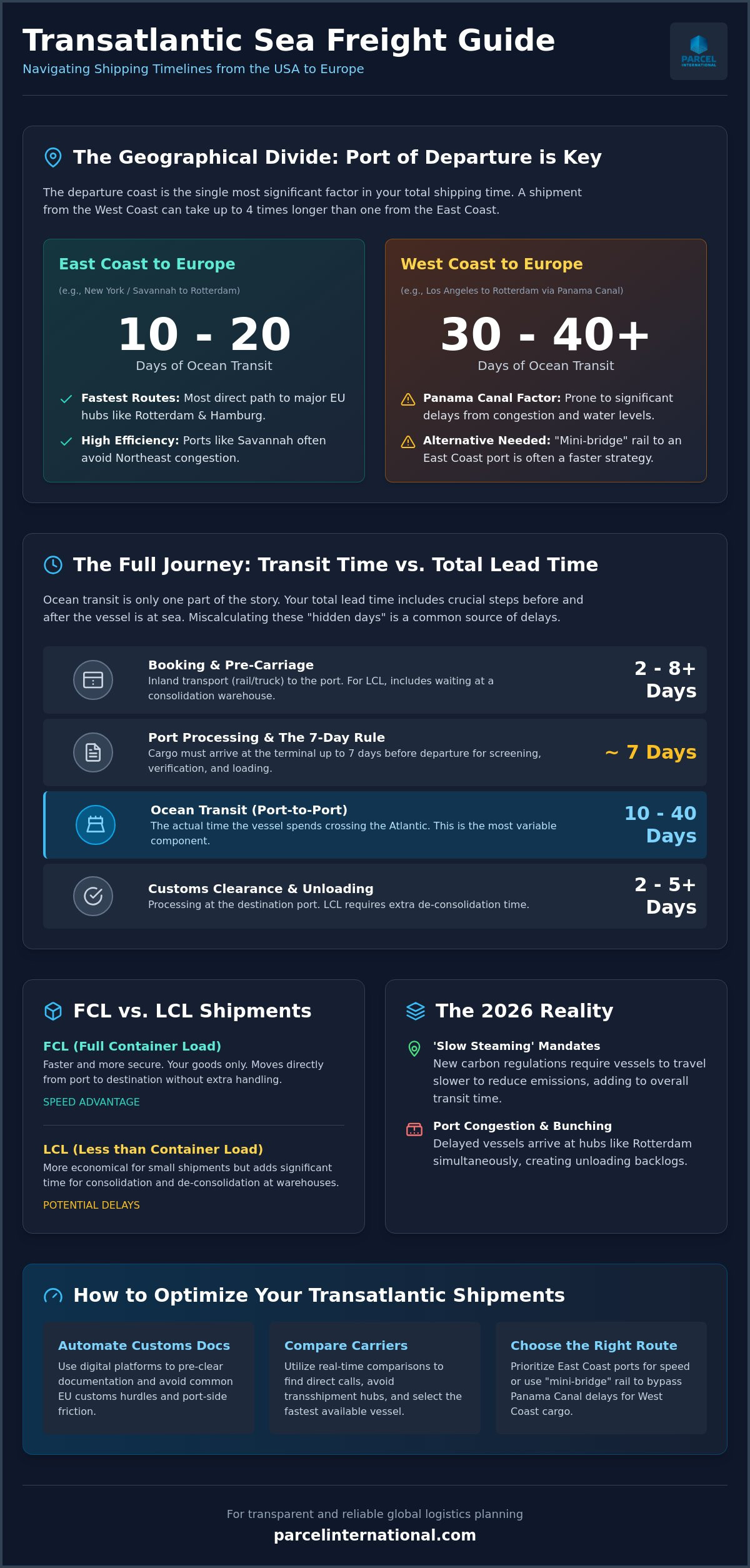
The ocean doesn't move at a single speed. When you're trying to determine how long does sea freight take from usa to europe, the answer depends almost entirely on your departure port. While a vessel leaving New York can reach Rotterdam in just 10 to 12 days, a ship starting in Los Angeles faces a journey of 30 to 40 days. This geographical divide is the most significant factor in your supply chain planning; choosing the wrong coast can triple your transit time before the ship even leaves the dock.
East Coast (New York/Savannah) to Northern Europe
East Coast ports are the fast track for transatlantic trade. New York and Savannah offer the most direct routes to Northern Europe's major hubs like Rotterdam, Antwerp, and Hamburg. Transit times here typically range from 12 to 20 days, though high-speed direct calls from New York can occasionally shave that down to 10 days. Savannah has emerged as a high-efficiency alternative to New York for Southern US shippers because it often avoids the terminal congestion found in the Northeast. However, vessel size plays a hidden role here. While the largest ships carry more cargo, they're often slower to berth and unload. Smaller, more agile vessels can sometimes navigate port entry faster, providing a slight edge in total speed.
West Coast (LA/Long Beach) to Europe
West Coast departures are a marathon, not a sprint. These routes rely on the Panama Canal, where fluctuating water levels and vessel queues can turn a standard 35-day trip into a 50-day ordeal. Because of the 30 to 40 day average, West Coast sea freight is usually reserved for non-urgent bulk commodities. If you're shipping from California but need faster results, consider these factors:
The Panama Factor: Congestion at the canal is a primary driver of delays. If water levels are low, carriers may face weight restrictions or longer wait times. Understanding the historical development of the canal through Panama Ship Service offers shippers a broader perspective on why these modern-day bottlenecks occur.
Mini-Bridge Routes: You can move cargo by rail from the West Coast to an East Coast port. While rail dwell times currently sit at 5 to 8 days, this "mini-bridge" strategy is often faster than the canal route.
Inland Dwell: Remember that West Coast rail dwell times for inland destinations are significantly higher than the 2 to 4 days seen on the East Coast.
Modern maritime transport also has to contend with the North Atlantic's temperament. Winter storms can easily add 48 hours to a standard crossing, forcing captains to take longer, southerly routes to avoid heavy swells. Beyond weather, the choice between a direct call and transshipment is vital. Direct calls are faster but come with a premium price. Transshipment involves moving your container to a second vessel at a hub like Algeciras or Tanger Med. It's often cheaper, but it adds another layer of complexity to the question of how long does sea freight take from usa to europe, as you're then at the mercy of feeder vessel schedules and hub congestion.
Transit Time vs. Lead Time: The Hidden Days of Ocean Freight
When you ask how long does sea freight take from usa to europe, the vessel schedule is only half the story. Most shippers focus on the 10 to 12 days it takes to cross the Atlantic, but your cargo is actually in transit long before the ship pulls away from the pier. You need to account for the total lead time. This includes every administrative and logistical step from your factory floor to the European warehouse. Miscalculating these hidden days is exactly how businesses end up with empty shelves and frustrated customers.
A critical factor is the 7-day rule. Most major carriers require your container to arrive at the port terminal at least one week before the scheduled departure. This window allows for security screening, weight verification, and vessel loading plans. If you miss this cutoff, your shipment sits at the dock until the next vessel arrives; this can add 7 to 14 days to your timeline instantly. Reliability starts with understanding that the "clock" begins when the booking is confirmed, not when the ship leaves the harbor.
Pre-Carriage and Consolidation Phases
Pre-carriage is the inland transport phase before the port of loading. This stage varies wildly depending on your location. If you're shipping from an inland hub like Chicago, you must factor in rail transit to the East Coast, which currently takes about 2 to 4 days for dwell and transit. For Less Than Container Load (LCL) shipments, the timeline extends even further. Your cargo must wait at a consolidation warehouse until the container is full. This consolidation process typically adds 5 to 7 days to your total lead time, as the logistics provider balances multiple shipments into a single unit.
Port Clearance and Documentation
Administrative friction is the most common reason for unpredictable delays. As of July 1, 2026, the EU has removed the customs duty exemption for goods valued at EUR 150 or less, making precise international shipping customs documentation more important than ever. In major hubs like Rotterdam, customs release usually takes 24 to 48 hours, but only if your paperwork is flawless. Incorrect HS codes or missing commercial invoices can trap your cargo in a port-side inspection for weeks. Using automated documentation tools ensures your filing is submitted before the vessel even docks, allowing for pre-clearance that keeps your goods moving. You can compare shipping solutions to see which carriers offer the fastest integrated clearance times for your specific route.
Finally, don't overlook the last mile in Europe. Once your container is offloaded in Antwerp or Hamburg, it still needs to clear the terminal and be loaded onto a truck or train. Port congestion in 2026 has increased terminal dwell times to 3 or 5 days in some regions. Factoring in these extra days ensures your inventory planning remains accurate and your operations stay efficient.
Why Sea Freight is Getting Slower: The 2026 'Slow Steaming' Reality
In 2026, the answer to how long does sea freight take from usa to europe is being rewritten by environmental policy. The International Maritime Organization's (IMO) carbon intensity mandates are now a primary driver of vessel speed. To avoid heavy fines and meet sustainability targets, carriers have adopted a practice known as "slow steaming." This isn't a reaction to fuel prices or port congestion; it's a structural change to the maritime industry. By reducing engine speeds by just 10 percent, a vessel can cut its emissions by nearly 30 percent, which is essential for compliance with the latest green regulations.
Schedule reliability has become the new benchmark for success. In the current market, an "on-time" performance is far more valuable than a "fast" transit that fluctuates. You need predictability. If a carrier promises a 16-day transit and consistently delivers in 16 days, that's better for your planning than a 12-day route that frequently slips to 18. Carriers are now prioritizing these slower, more stable schedules to save on fuel and ensure they stay within their assigned carbon ratings.
The Environmental Impact of Vessel Speed
There's a direct correlation between knots per hour and carbon output. As green corridors between the US and Europe prioritize sustainability over raw speed, captains are under strict orders to maintain lower speeds. A 1-2 knot reduction can add 3-5 days to a transatlantic crossing. This shift means that the fast 10-day crossings from the East Coast are becoming rarer, replaced by more deliberate 13 or 15-day schedules that use significantly less fuel. You must adjust your expectations to account for these environmental realities rather than relying on historical transit data.
Managing Inventory with Slower Timelines
This new reality has forced a shift from Just-in-Time (JIT) to Just-in-Case (JIC) inventory models. You can't operate with zero buffer stock when the baseline transit time is structurally longer. You must perform a cost-benefit analysis. The lower cost of sea freight is still attractive, but you're now tying up capital for an extra week. Parcel International helps you manage this by providing real-time tracking and carrier comparisons. Our platform shows you how long does sea freight take from usa to europe across different lines, allowing you to see which carriers are maintaining the best reliability despite the slower speeds. By having this data, you can adjust your buffer stock levels with confidence rather than guesswork.
LCL vs. FCL: How Shipment Type Impacts Your Arrival Date
If you want the fastest transit possible, you need a Full Container Load (FCL). Think of FCL as a private car service; your goods are sealed at your facility and don't stop until they reach the destination port. In contrast, Less-than-Container Load (LCL) acts like a commuter bus. It makes multiple stops for consolidation and de-consolidation, which fundamentally changes how long does sea freight take from usa to europe. While FCL shipments can clear a port in 48 hours, LCL cargo often waits an additional 3 to 5 days for "de-vanning," the process where the container is unpacked and individual shipments are sorted at a warehouse.
Choosing between these two modes isn't just about volume; it's about your tolerance for variability. In the volatile 2026 market, FCL offers a level of control that LCL simply cannot match. This reliability is a priority for companies like Jealco International, Inc. that distribute critical industrial components, and it's why many businesses are now opting for FCL even when they don't have enough cargo to fill a standard 20-foot box. When you own the entire container, you aren't at the mercy of other shippers' schedules or their administrative mistakes.
The LCL Consolidation Cycle
LCL shipping relies on Container Freight Stations (CFS) to manage the loading of multiple shippers into a single unit. This process adds a significant layer of risk to your timeline. If just one shipper in your shared container has incomplete customs paperwork or a red-flagged commodity, the entire box can be "rolled" to the next vessel. This means your goods sit at the terminal for another week through no fault of your own. Because of this, LCL is best reserved for non-urgent, high-volume replenishment where a 7-day swing in delivery dates won't disrupt your operations.
FCL Priority and Reliability
FCL containers benefit from direct discharge. They move straight from the ship's deck to a waiting truck, bypassing the crowded sorting warehouses that LCL must navigate. Securing this space during the "red hot" 2026 peak season requires strong freight forwarder relationships. These intermediaries have the carrier leverage to ensure your box gets on the vessel when capacity is tight. FCL transit is structurally more predictable because it eliminates the two most time-consuming steps: origin consolidation and destination de-vanning.
Market data suggests that FCL becomes cost-effective once your shipment exceeds 14 or 15 cubic meters. However, if speed is your priority, the "break-even" point is lower. Paying for a full container when you only have 10 cubic meters of goods is a common strategy in 2026 to bypass the 5-day de-vanning delay at ports like Rotterdam or Antwerp. You can compare sea freight rates and times to see if the speed advantage of FCL justifies the cost for your specific volume. This transparency allows you to make an informed decision based on your current inventory needs rather than just the bottom-line price.
Optimizing Transatlantic Speed with Parcel International
Understanding how long does sea freight take from usa to europe is only the first step toward a functional supply chain. The real challenge lies in managing the volatility of the 2026 shipping market. Parcel International acts as your stable intermediary, providing a unified platform to compare transit times across major global carriers. Instead of visiting multiple websites to piece together a schedule, you can see real-time data in one interface. This transparency allows you to choose the most reliable route based on current port conditions rather than outdated historical averages.
For complex supply chains, we recommend a hybrid strategy. Use sea freight for your core bulk inventory to take advantage of lower costs and predictable cycles. When unexpected delays occur or demand spikes, pivot to air freight for urgent restocks. This flexibility ensures your European distribution remains uninterrupted even when transatlantic vessels face slow steaming mandates or seasonal weather disruptions. Our Rotterdam-based expertise is a significant advantage here; as major European hubs face vessel bunching in July 2026, we help you navigate the most efficient terminals for discharge.
Real-Time Tracking and Visibility
Estimated arrival dates are often just guesses that lead to planning errors. Our platform provides active vessel tracking, giving you a clear view of your container’s position on the Atlantic. If a delay occurs due to port congestion or weather, you receive a proactive notification. This allows you to adjust your warehouse labor or notify your customers before the delay becomes a crisis. Relief comes from knowing exactly where your goods are at every stage, removing the anxiety of fragmented, multi-platform workflows.
Streamlining the Customs Process
Automated documentation is the most effective way to protect your lead time. Our platform generates compliant commercial invoices and packing lists automatically, which reduces the risk of manual errors that trigger port inspections. By pre-clearing your cargo while it's still on the water, you can save 48 to 72 hours of dwell time at the destination port. This is essential for navigating the latest EU customs regulations and ensuring your goods move from the ship to the warehouse without unnecessary friction. Start comparing sea freight rates and transit times today to see how we make global logistics orderly and efficient.
Take Control of Your Transatlantic Timeline
Navigating the 2026 ocean freight market requires more than just a vessel schedule; it requires a strategy that accounts for slow steaming and port congestion. You now understand that while geography determines the base transit, your choices regarding FCL versus LCL and automated documentation define your actual delivery date. The answer to how long does sea freight take from usa to europe is no longer a static number. It's a manageable variable in your supply chain that you can optimize with the right data.
Stop guessing and start planning with precision. You don't have to deal with hidden fees, subscription requirements, or volume minimums to access professional logistics. Our platform provides the transparency you need to maintain inventory levels with confidence. You get instant access to rates from major carriers like DHL, FedEx, and UPS alongside automated customs tools that prevent costly administrative delays at the border.
Compare Sea Freight Rates and Transit Times Now
Reliable global trade is within your reach. We're here to help you move from fragmented workflows to a singular, efficient solution that keeps your goods moving across the Atlantic. Build a more resilient supply chain today.
Frequently Asked Questions
How long does sea freight take from New York to Rotterdam?
Port to port transit from New York to Rotterdam typically takes 10 to 12 days. However, you must account for the total lead time, which includes the mandatory 7 day terminal cutoff and administrative processing. In 2026, most shippers find that the full door to door journey requires approximately 20 to 25 days. Direct routes are the fastest but are subject to seasonal weather patterns in the North Atlantic.
Why is my sea freight shipment taking longer than the quoted transit time?
Your shipment likely exceeds the quote because carriers usually provide water only transit times rather than total lead times. This estimate ignores the days your cargo spends in pre-carriage, port side dwell, and customs clearance. Additionally, vessel bunching at major European hubs like Antwerp can add several days to the discharge process. Always factor in a 5 to 7 day buffer to account for these logistical realities.
Is sea freight from the US West Coast faster via the Panama Canal or rail?
Moving cargo by rail to the East Coast is often faster than using the Panama Canal. While the canal route averages 30 to 40 days, it is currently susceptible to congestion and fluctuating water levels. Utilizing a "mini-bridge" rail service to New York or Savannah can save up to two weeks, though it generally comes at a higher price point. This is a common strategy for time sensitive West Coast exports.
Does LCL shipping take longer than FCL shipping?
Yes, LCL shipping typically takes 5 to 7 days longer than FCL. This delay occurs because your cargo must wait at a Container Freight Station for consolidation before departure and de-vanning upon arrival. Full containers move directly from the ship to the truck, bypassing these sorting phases. If you're wondering how long does sea freight take from usa to europe, always add a week for LCL shipments to be safe.
What are the main causes of delays in transatlantic sea freight?
Administrative errors and port congestion are the primary causes of transatlantic delays in 2026. Missing or incorrect customs documentation can trap cargo at the terminal for weeks. Physical factors like vessel bunching in Rotterdam and winter storms in the North Atlantic also play a role. Proactive planning and automated paperwork are your best tools for avoiding these common logistical bottlenecks and ensuring on time delivery.
How can I speed up the customs clearance process in Europe?
You can speed up the process by using automated documentation tools to ensure your paperwork is flawless. Submit your commercial invoices and packing lists digitally to allow for pre-clearance while the vessel is still at sea. This strategy can shave 48 to 72 hours off your port dwell time. Flawless documentation is especially critical now that the EU has removed duty exemptions for low value goods.
What is 'slow steaming' and how does it affect my delivery date?
Slow steaming is a practice where carriers reduce vessel speeds to comply with IMO 2030 carbon intensity mandates. By slowing down, ships significantly lower their emissions and avoid environmental fines. This structural change adds approximately 3 to 5 days to a standard transatlantic crossing. It's a permanent shift in the industry, so you should adjust your inventory buffer stock to account for these slower, more sustainable schedules.
Can I track my sea freight shipment in real-time?
You can track your shipment in real-time by using modern logistics platforms that provide active vessel tracking. Instead of relying on static estimated dates, these tools show you the exact position of your container on the Atlantic. This visibility allows you to receive proactive notifications about potential delays. Knowing exactly how long does sea freight take from usa to europe for your specific shipment helps you manage warehouse labor more efficiently.


