
How to Avoid Hidden Fees in International Shipping: The 2026 Transparency Guide
In 2026, the era of duty-free global trade is officially over. With the U.S. suspension of the $800 de minimis rule and the EU's abolition of the €150 threshold, learning how to avoid hidden fees in international shipping is no longer optional; it's a survival skill for your bottom line. You're likely tired of seeing your profit margins vanish into a black hole of unexpected surcharges and customs penalties. It's exhausting to manage a global business when your final carrier invoice looks nothing like the initial quote you approved.
This guide will help you master the art of landed cost calculation and replace logistics anxiety with total financial clarity. We'll provide a practical checklist to verify every quote before you book, explain how to navigate the new standardized dimensional weight rules, and show you how automated customs tools can slash your administrative overhead. By the end of this article, you'll have a roadmap to predictable, transparent shipping that protects your budget from the volatility of the 2026 logistics landscape.
Table of Contents
The Anatomy of Hidden Fees: Quote vs. Landed Cost
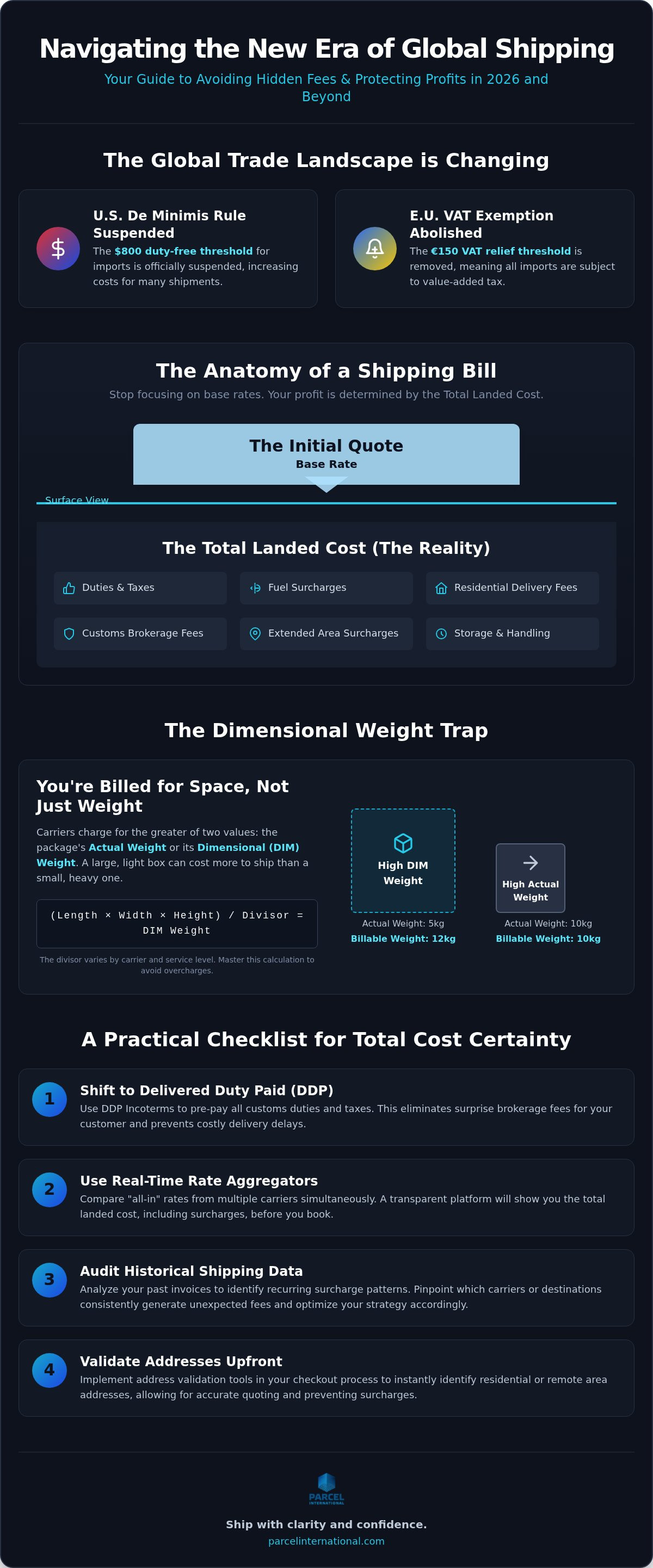
Understanding the structural difference between a carrier's initial quote and the final invoice is the first step in learning how to avoid hidden fees in international shipping. Most shippers start with a "Base Rate." This is the carrier's starting price for moving a box from point A to point B. It sounds straightforward, but this number is often stripped of every variable that determines your final cost. It's essentially a placeholder. Relying on it alone creates a false sense of security that leads to budget overruns.
To run a profitable business, you must focus on the "Landed Cost." This represents the total price of a product once it has arrived at the buyer's door. It includes the base freight, fuel surcharges, duties, taxes, and any administrative fees. When the gap between these two numbers is large, it's usually because critical data points were missing during the initial quoting phase. We recommend using a Logistics Transparency Framework to audit your invoices. This involves comparing your initial quote against the final bill to pinpoint exactly where the "hidden" costs appeared, such as unexpected customs handling or residential delivery fees. Identifying these gaps allows you to adjust your pricing or carrier selection before the next shipment departs.
Why Base Quotes Are Often Misleading
Carrier quotes are frequently incomplete because they exclude destination-side charges. For example, terminal handling fees or storage costs at the port of entry are rarely included in a standard air or sea freight estimate. Additionally, fuel surcharges are not static; carriers update these weekly based on market fluctuations. A quote provided today might be inaccurate by the time your shipment actually moves. Parcel International bridges this data gap by providing real-time rate comparisons that include these variables upfront. By understanding Incoterms, you can clearly define which party is responsible for these specific costs, ensuring no one is surprised when the invoice arrives.
The True Cost of 'Cheap' Shipping
The lowest headline price is often the most expensive option in the long run. Some carriers offer aggressive base rates but hide their profits in administrative fees, such as disbursement fees for paying duties on your behalf. There's also the hidden cost of delivery delays. If your shipping partner doesn't provide robust customs support, your goods could sit in a warehouse for days. This leads to storage penalties and unhappy customers. Real transparency means seeing the full cost before you click "book." It's about reliability and the relief of knowing your margins are protected from the start. Prioritize partners who offer an all-in rate over those who lead with a low-cost teaser.
Common Carrier Surcharges and How to Pre-empt Them
Carriers use surcharges to protect their margins against operational volatility. These aren't random penalties; they're calculated adjustments based on fuel prices, labor density, and seasonal volume. Understanding these triggers is essential for anyone learning how to avoid hidden fees in international shipping. Most surcharges fall into specific categories that you can identify before you click "book."
Fuel Surcharges: These are tied to energy indexes and vary weekly. Effective June 22, 2026, FedEx consolidated its surcharge tables, resulting in a 3.5% increase for export shipments.
Residential Delivery Fees: These apply to any non-commercial address, reflecting the higher cost of low-density, last-mile logistics.
Extended Area Surcharges: These trigger when a destination falls outside a carrier's primary service zone.
Demand Surcharges: Previously known as "peak season" fees, these now apply whenever volume spikes occur throughout the year.
While you can't always negotiate these individual line items, they are entirely predictable if you have the right data. You can compare real-time rates across multiple carriers to see which providers include these fees in their initial quote and which ones add them later as "adjustments."
The Remote Area and Residential Trap
A "Remote Area" is any destination that requires a carrier to deviate from its standard route or hire a third-party contractor for the final leg. To avoid these traps, use address validation tools during your checkout process. These tools identify the address type and geographic zone instantly, allowing you to quote accurately to your customers. Consolidating multiple orders into a single shipment is another effective strategy. By reducing the number of individual parcels, you minimize the frequency of per-package residential fees.
Seasonal and Emergency Variables
In 2026, carriers have largely shifted from "Peak" to "Demand" surcharges. This rebranding gives them the flexibility to apply extra fees in response to volume spikes at any time of year. The 2026 peak season timeline typically begins in early October, but security or "emergency" surcharges can trigger earlier due to global events. These variables are often non-negotiable but entirely predictable with the right data. By planning your high-volume shipments outside these peak windows, you eliminate the highest surcharges from your logistics budget. Transparency starts with knowing the schedule before the carrier applies the fee.
Dimensional Weight: The Mathematical Trap That Inflates Costs
Carriers don't just bill you for how much your package weighs. They bill you for the space it occupies in their vehicles. This concept, known as "Volumetric Weight" or "DIM weight," is often the largest discrepancy between a quote and a final invoice. If you ship a large box filled with lightweight packing peanuts, the carrier will charge you as if that box were filled with heavy equipment. Understanding this calculation is a fundamental step in learning how to avoid hidden fees in international shipping. In 2026, the standard dimensional weight divisor for major carriers like UPS, FedEx, and DHL Express is 139 for shipments billed in pounds and 5,000 for those billed in kilograms. These standards have a direct and significant influence on international shipping rates, especially for businesses moving high-volume, low-density goods.
Calculating Your Billable Weight
To find your billable weight, carriers compare the actual physical weight against the calculated DIM weight. They always bill the higher of the two. Use this simple formula to check your parcels before booking: (Length x Width x Height) / Divisor. Accuracy is critical here because carriers have become increasingly strict with measurements. As of July 12, 2026, even the USPS has aligned its divisor to 139 and now rounds each fractional dimension up to the next whole inch before calculation. This means a package measuring 10.1 inches is billed at 11 inches. This small rounding error can push your parcel into a higher price tier or trigger a "Large Package" surcharge that can effectively double your shipping costs. Always measure from the widest points of the box, including any bulges or irregular edges.
Packaging Optimisation Strategies
Mastering DIM weight is essential for maintaining margins in international shipping for ecommerce. You must eliminate "dead air" space to keep your costs predictable. Switch to right-size packaging that fits your product snugly without requiring excessive filler. If you're shipping soft goods, consider using compression bags or mailer envelopes that don't have a fixed cubic structure. These small adjustments reduce the volumetric footprint of your shipment, often resulting in significant savings. By using high-density packing materials, you can protect your items while keeping the external dimensions of the box as small as possible. Order a variety of box sizes so your team isn't forced to use an oversized container for a small item. This simple operational change is one of the most reliable ways to ensure your final invoice matches your initial quote.
Navigating Customs Duties and Administrative Penalties
In the 2026 logistics landscape, customs is no longer a hurdle to clear; it's a financial variable you must control. With the U.S. suspending the $800 de minimis exemption and the EU abolishing the €150 duty-free threshold on July 1, 2026, nearly every package now attracts government scrutiny. Understanding how to avoid hidden fees in international shipping starts with choosing the right shipping term. Delivering Duty Unpaid (DDU) often leads to "hidden" costs for your customer, such as unexpected brokerage fees or local taxes. Switching to Delivered Duty Paid (DDP) allows you to collect these costs at checkout, providing the transparency that modern global trade requires.
Carriers charge "Customs Brokerage Fees" to act as your intermediary with border authorities. These are separate from the actual duties and taxes. You might also see a "Disbursement Fee" on your invoice. This is a surcharge carriers apply for advancing payment of duties to the government on your behalf. These administrative costs can spiral if your international shipping customs documentation is incomplete. Inaccurate paperwork often leads to "Demurrage" or storage fees, where your goods sit in a bonded warehouse while the carrier waits for corrected data. To eliminate these surprises, automate your customs documentation through a unified platform.
HS Codes and Accurate Valuation
Incorrect Harmonized System (HS) codes remain the primary cause of customs delays and fines. In fiscal year 2025, HTS misclassifications accounted for 42% of all penalty assessments by U.S. Customs and Border Protection. You must ensure every product has a precise code to avoid being overcharged or penalized for trade fraud. Do not attempt to "under-value" goods to save on duties; this strategy frequently results in seized shipments and heavy civil penalties. The Commercial Invoice is the most critical document for fee avoidance and must reflect the true transaction value of your goods.
EORI and VAT Compliance for 2026
Shipping into the European Union, particularly through major hubs like Rotterdam, requires strict adherence to EORI (Economic Operators Registration and Identification) standards. As of July 2026, a temporary flat customs duty of €3 per item applies to B2C shipments in the EU, regardless of value. Automated documentation tools are essential to manage these calculations without manual errors. If your volume is high or your routes are complex, leveraging a freight forwarder can help you maintain compliance across multiple jurisdictions. These experts act as a stable intermediary, ensuring your administrative overhead doesn't eat into your profit margins.
Strategies for Radical Transparency: How to Ship with Certainty
Achieving total financial clarity in global logistics requires a shift from reactive to proactive management. You shouldn't wait for the final invoice to discover your true costs. Instead, you must implement structural changes that make every expense visible before the shipment leaves your facility. Learning how to avoid hidden fees in international shipping is about closing the data gaps that carriers traditionally use to pad their margins. By centralizing your workflow and standardizing your inputs, you move from a state of constant logistics anxiety to one of predictable, orderly growth.
Historical data is your most valuable asset when identifying recurring surcharge patterns. Audit your invoices from the last six months to see which carriers frequently apply "adjustments" for residential deliveries or fuel variances. If you notice a specific carrier consistently adds fees that weren't in the original quote, it's time to re-evaluate that partnership. Use this audit to create a custom "surcharge profile" for your most frequent destinations. This allows you to set more accurate shipping prices for your customers and protects your bottom line from the "death by a thousand cuts" caused by small, repetitive fees.
Standardizing your packaging is another critical step in making your costs a constant rather than a variable. When you use a wide variety of box sizes, you invite measurement errors and unpredictable DIM weight calculations. By limiting your packaging to three or four "right-size" options, you make the volumetric footprint of every shipment identical. This eliminates the risk of a warehouse team member choosing an oversized box that triggers a Large Package surcharge. Consistency in packaging leads directly to consistency in billing.
The Power of Real-Time Comparison
Parcel International provides the radical transparency needed to navigate the 2026 market. Our platform allows you to compare "all-in" rates from DHL, FedEx, and UPS side-by-side, showing you the surcharges *before* you click "Book." You don't have to deal with restrictive volume minimums or expensive subscription requirements to access these wholesale rates. This egalitarian approach gives small and medium businesses the same pricing leverage as large-scale commercial projects. When you can see every fee across 220+ countries in real-time, you build a more honest and reliable relationship with your end customers.
Creating a 'No-Surprise' Shipping Workflow
Establishing a stable shipping routine is the final piece of the transparency puzzle. Follow these three steps to ensure your final invoice always matches your quote:
Step 1: Precision Measurement. Weigh and measure every parcel to the millimeter after it's fully packed. Don't rely on the box manufacturer's stated dimensions; carriers measure the actual exterior bulges.
Step 2: Control the Experience. Select Delivered Duty Paid (DDP) for your international shipments. This allows you to manage the customs costs upfront and prevents your customer from being hit with "hidden" local fees upon delivery.
Step 3: Centralize for Accountability. Use a singular platform that unifies tracking, documentation, and invoicing. Fragmented workflows are where fees hide; a unified solution makes them impossible to miss.
Master Your Logistics Budget for 2026 and Beyond
The 2026 shipping landscape is complex, but it doesn't have to be unpredictable. By shifting your focus from deceptive base rates to total landed costs, you reclaim control over your profit margins. You now have the tools to audit carrier surcharges, optimize your packaging to defeat the dimensional weight trap, and navigate the latest EU and U.S. customs shifts with confidence. Understanding how to avoid hidden fees in international shipping is ultimately about replacing fragmented data with radical transparency. It's the difference between guessing your costs and knowing them.
Stop letting unexpected logistics costs erode your business growth. You can compare transparent international shipping rates on Parcel International today. Our platform provides direct access to wholesale rates from DHL, FedEx, and UPS with no subscription fees or volume minimums. We take the friction out of global trade with automated customs paperwork generation and real-time rate comparisons across 220+ countries. Take the first step toward a more stable, orderly logistics workflow and enjoy the relief of knowing your shipments will arrive on time and on budget.
Frequently Asked Questions
What is a fuel surcharge and why does it change every week?
Fuel surcharges are variable fees that carriers add to base rates to offset fluctuating energy costs. These changes happen weekly because carriers tie their rates to public fuel price indexes, such as the U.S. Gulf Coast kerosene-type jet fuel spot price. By adjusting these weekly, carriers protect themselves from sudden oil price spikes. You can track these on carrier websites or use a platform that automates these updates to anticipate cost shifts.
How can I calculate the volumetric weight of my parcel?
Calculate volumetric weight by multiplying the length, width, and height of your package and dividing the total by a carrier-specific divisor. In 2026, the standard divisor for most international shipments is 139 for inches or 5,000 for centimeters. Always round up each fractional measurement to the next whole number before calculating. Carriers will bill you for the higher value between this result and the actual physical weight of the box.
What is the difference between DDU and DDP shipping?
DDU (Delivered Duty Unpaid) means the buyer is responsible for all customs duties and taxes upon arrival, whereas DDP (Delivered Duty Paid) means the seller handles these costs upfront. Using DDP is a key strategy for how to avoid hidden fees in international shipping because it eliminates surprise charges for the recipient. This proactive approach ensures that the total landed cost is settled before the package reaches the destination border, reducing refused deliveries.
Why did I get an extra 'Residential Surcharge' for a home-based business?
Carriers apply residential surcharges based on the zone's zoning classification rather than the nature of your business. Even if you run a professional commercial operation from home, the carrier's last-mile logistics costs remain higher due to lower delivery density in residential areas. These fees cover the extra time and fuel required to navigate neighborhoods compared to consolidated commercial hubs. Always verify address types using validation tools before booking to ensure your initial quote is accurate.
How do HS codes affect the total cost of my international shipment?
HS codes determine the specific duty and tax rates applied to your goods by customs authorities. An incorrect code can lead to overpayment of taxes or, more commonly, administrative penalties and storage fees due to inspection delays. Accurate classification ensures you pay only what is legally required. It's a critical component of how to avoid hidden fees in international shipping, as misclassification accounted for 42% of all penalty assessments by U.S. Customs in fiscal year 2025.
Can I avoid customs brokerage fees by doing the paperwork myself?
While you can technically act as your own importer of record, most express carriers include their brokerage services as a non-negotiable part of the transport contract. They charge these fees to cover the labor of filing entries and communicating with border agencies. However, you can minimize these costs by using automated documentation tools. These tools ensure your paperwork is perfect on the first attempt, preventing administrative correction surcharges or penalties for missing data points.
What are 'Demurrage' and 'Detention' fees in sea freight?
Demurrage fees apply when your loaded container remains at the port terminal beyond the allotted free time provided by the carrier. Detention fees occur when you hold the carrier's equipment, such as the empty container, outside the port longer than agreed. Both fees act as penalties to keep equipment moving. You can avoid them by ensuring your customs clearance is pre-filed and your inland transport is scheduled to coincide with the vessel's arrival.
Why is the final invoice from my carrier higher than the quote I received?
Discrepancies usually occur because the initial quote only covered the base freight rate and excluded variable surcharges or destination fees. Common culprits include fluctuating fuel surcharges, residential delivery fees, or corrections to the package's weight and dimensions. If your team rounds down measurements or misses a "remote area" tag, the carrier will adjust the price after the shipment is processed. Using an all-in rate aggregator helps prevent these surprises by providing radical transparency.


