
How to Calculate International Shipping Costs Including Duties: The 2026 Total Landed Cost Guide
Imagine your customer's excitement as their package arrives, only for it to be overshadowed by a surprise fifty dollar customs invoice they weren't expecting. This scenario is more than an inconvenience; it kills brand loyalty and erodes your profit margins. Learning how to calculate international shipping costs including duties isn't just about checking a carrier's base rate. It's about seeing the full financial picture before the shipping label is ever printed.
You likely feel the pressure of shifting global logistics. With fuel surcharges now reaching up to 40% of total costs and the 2026 Section 301 forced-labor tariffs adding new layers of complexity, cross-border shipping often feels like a moving target. We're here to strip away that anxiety. This guide will help you master the Total Landed Cost framework, a repeatable formula that accurately predicts every expense from base rates to hidden terminal handling fees. We will preview the latest 2026 regulatory updates, clarify the confusion between DDP and DAP, and show you how to use automated tools to protect your bottom line from unexpected customs friction.
Table of Contents
Understanding Total Landed Cost: Why Your Shipping Quote is Only Half the Story
A shipping quote from a major carrier is rarely the price you actually pay. To run a profitable global business, you must look at the Total Landed Cost. This represents the comprehensive sum of all expenses required to move a product from the factory floor to the buyer's door. Think of your carrier quote as the tip of an iceberg. It is the visible portion of the expense, but the hidden mass of duties, taxes, and fees below the surface can sink your margins if ignored. Learning how to calculate international shipping costs including duties involves looking past the initial estimate to find the real numbers.
Accurate calculations involve balancing four specific pillars:
Freight charges: The base rate for air, sea, or road transport, including fluctuating fuel surcharges.
Duties and Taxes: The customs duty and VAT/GST applied by the destination country based on product classification.
Insurance: Protection against loss or damage during transit, which is essential for high-value goods.
Administrative fees: Costs for customs brokerage, terminal handling, and documentation processing.
Total Landed Cost represents the final financial truth of an international transaction as of 2026.
The Risks of Underestimating Shipping Expenses
Ignoring the hidden side of the logistics iceberg leads to immediate friction. Many businesses face high cart abandonment or refused deliveries when customers are hit with unexpected import fees at their doorstep. If you choose to absorb these uncalculated duties yourself, your profit margins can vanish instantly. Beyond the money, misdeclaring package values to lower costs creates significant legal risks. This can lead to your shipments being seized or your business being blacklisted by customs authorities.
DDP vs. DAP: Who Pays the Final Bill?
Your choice of Incoterm dictates who is responsible for the math. Delivered Duty Paid (DDP) is the gold standard for modern e-commerce. In this model, the seller handles all costs. The customer enjoys a seamless experience with no surprise invoices. Conversely, Delivered At Place (DAP) requires the recipient to pay duties before they can collect their goods. This often leads to delivery delays and frustrated customers. When you master how to calculate international shipping costs including duties, you can confidently offer DDP shipping without fearing for your margins.
Step 1: Calculating Base Freight Rates and Surcharges
The foundation of how to calculate international shipping costs including duties begins with the base freight rate. This is the price a carrier charges to move your cargo from point A to point B. However, this rate is rarely a fixed number. It depends on whether the carrier applies charges based on actual weight or dimensional weight. To get an accurate quote, you must first establish the correct Incoterms for the shipment. These rules dictate which party pays the freight and at what point the financial risk transfers from the seller to the buyer.
Base rates are not set in stone. While major carriers like DHL, FedEx, and UPS have standard list prices, these are highly negotiable. Logistics brokers like Parcel International aggregate volume from thousands of shippers to secure wholesale rates that small businesses cannot access on their own. Comparing these options in a single dashboard allows you to find the most efficient path for your budget.
Dimensional Weight: The Hidden Cost of Large Packages
Carriers don't just care about how much your package weighs on a scale. They care about how much space it takes up in a plane or container. This is known as dimensional (DIM) weight. If you ship a large box filled with feathers, you will be billed for the volume, not the mass. In 2026, the standard DIM divisor for international air freight remains 139 for imperial measurements (inches/lbs) and 5000 for metric (cm/kg).
To calculate DIM weight, use this formula: (Length x Width x Height) / Divisor. The carrier will always bill you for whichever is greater: the actual weight or the DIM weight. You can lower these costs by optimizing your packaging. Use the smallest box possible and avoid oversized filler materials to stay within lower weight brackets.
Fuel Surcharges and Variable Fees
Once you have the base rate, you must account for variable surcharges. These aren't static. Fuel surcharges fluctuate weekly based on global oil indices and can currently account for 20% to 40% of your total shipping cost. Additionally, peak season adjustments often add another 10% to 30% during high-demand months. You should also watch for 'Out of Area' fees if your destination is a remote global location.
It is helpful to review current international shipping rates to see how these surcharges vary by region and carrier. Because these fees change so quickly, using a platform that provides real-time transparency is the only way to avoid losing money on a shipment. You can access these wholesale rates and automated calculations to ensure your initial quote matches the final invoice.
Step 2: Estimating Duties, Taxes, and Customs Fees
After you establish your base freight rates, the next challenge is deciphering government-mandated fees. Understanding how to calculate international shipping costs including duties requires a deep dive into product classification. Every item you ship cross-border is identified by a Harmonized System (HS) code. This 10-digit number acts as a universal language for customs authorities, but misinterpreting it can lead to heavy fines or significant overpayment. For a foundational look at these regulations, you should consult the International Trade Administration's guide to tariffs and fees.
You must also identify the 'De Minimis' threshold for your destination country. This is the specific valuation point below which a shipment can enter a country duty-free. For example, if you ship low-value goods that fall under these limits, you can skip duty calculations entirely. However, for most commercial shipments, you'll need to calculate both Import Duty, which is based on the specific product type, and Value Added Tax (VAT) or Goods and Services Tax (GST).
Finding the Correct HS Code for Your Product
Precision is vital when assigning HS codes. While the first six digits remain consistent globally, the final four digits are country-specific and dictate the exact tariff rate. Misclassifying an item doesn't just delay your package; it can trigger audits. To avoid manual errors, many businesses use automated international shipping customs documentation tools. These systems verify your classification against current 2026 regulations, such as the Section 301 forced-labor tariff, which currently adds a 10% rate for most economies.
VAT, GST, and Sales Tax Variations
Unlike duties, VAT and GST are usually calculated on the 'CIF' value. This stands for Cost, Insurance, and Freight. You must add these three numbers together before applying the tax percentage. In 2026, many regions have specific entry requirements, such as the EU's IOSS system or the UK's unique VAT registration rules for foreign sellers.
Don't forget to account for 'Brokerage Fees.' These are service charges from carriers like DHL or FedEx for acting as your agent with customs. Even if your goods are duty-free, you will likely still pay a fee for the carrier to process the paperwork. For Fiscal Year 2026, you should also factor in the Merchandise Processing Fee (MPF) for US-bound goods, which is currently set at 0.3464% of the customs value.
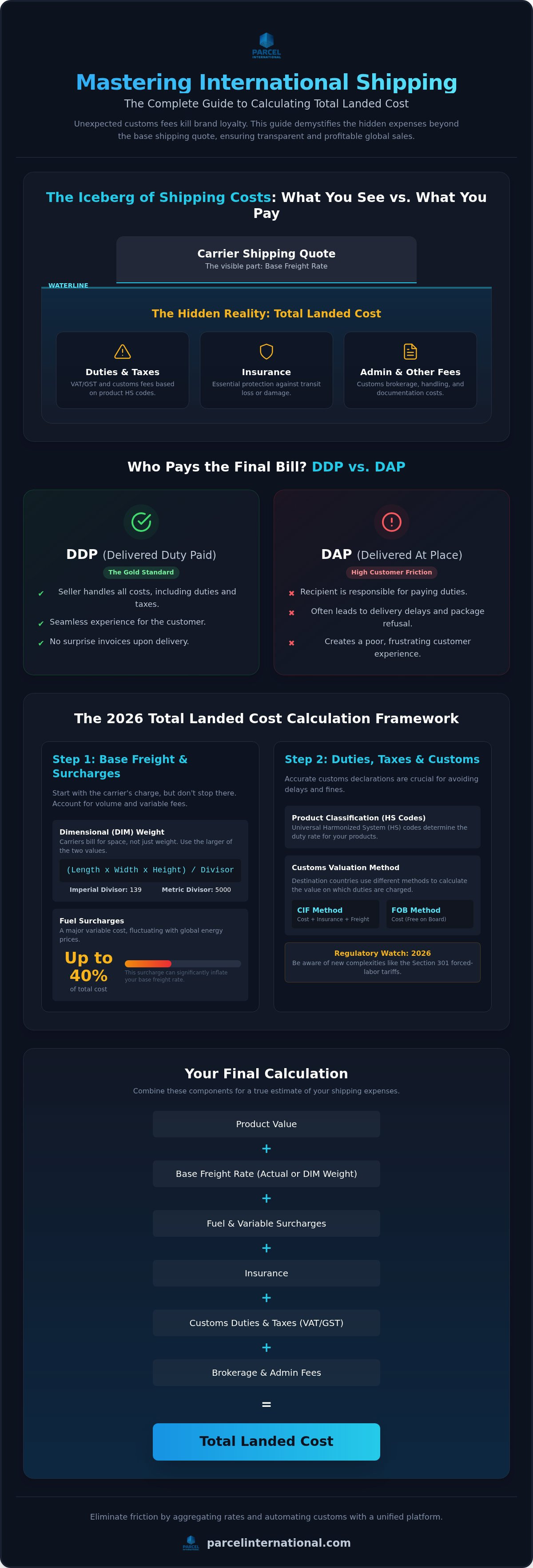
The 2026 Total Landed Cost Calculation Framework
Mastering how to calculate international shipping costs including duties requires a shift from simple quoting to comprehensive financial modeling. You cannot rely on a single carrier's base rate to define your margins. Instead, you need a repeatable framework that accounts for the compounding nature of global trade fees. The 2026 landscape is more complex than ever, but following a logical sequence ensures you never face a surprise invoice after a delivery is completed.
Your calculation must follow these four specific steps:
Step 1: Determine the Valuation Method. Identify if the destination country uses CIF (Cost, Insurance, and Freight) or FOB (Free on Board). Countries like the UK and those in the EU typically require duties calculated on the total CIF value, while others may only tax the product's value.
Step 2: Aggregate Your Costs. Sum the product price, the freight charges, and the insurance premium. This total creates your "Customs Value."
Step 3: Apply the Duty Rate. Multiply your Customs Value by the percentage assigned to your specific HS code.
Step 4: Add VAT/GST and Brokerage Fees. Calculate the local tax based on the duty-paid value and add the carrier's service fee for customs clearance.
To calculate total landed cost in 2026, add the product price, shipping, insurance, duties, and taxes into a single sum.
Example Calculation: Shipping from the USA to the EU
Consider a hypothetical shipment of electronics valued at $200, which includes freight and insurance. If the EU destination applies a 4% duty, your first cost is $8. However, the calculation doesn't stop there. The 21% VAT is then applied to the new total of $208, adding another $43.68. Finally, you must account for the carrier's brokerage fee, which typically ranges from $15 to $25. Your $200 shipment actually costs approximately $271.68 to land at the customer's door. Understanding this compounding effect is the only way to protect your profits.
Using Tools to Automate the Math
Manual spreadsheets are dangerous in high-volume e-commerce. A single error in an HS code or a missed fuel surcharge update can lead to thousands in lost revenue. Modern businesses now use a unified shipping calculator that integrates real-time duty estimates. These tools allow you to show accurate landed costs directly at your checkout page via API. This transparency prevents customer frustration and reduces the administrative burden on your team. You can start automating your shipping math today to ensure every cent is accounted for before you ship.
How Parcel International Simplifies Your Global Shipping Math
Logistics shouldn't be a source of anxiety. While the formulas we've discussed provide the foundation for how to calculate international shipping costs including duties, manual data entry is often where errors occur. Parcel International acts as your stable intermediary, taking the chaotic variables of global trade and making them orderly. By aggregating real-time rates from major global carriers like DHL, FedEx, and UPS, we give you the power to find the lowest base cost instantly. You don't need high-volume shipping history to access these wholesale rates; our platform makes the global market accessible to businesses of every size.
Our philosophy is built on radical transparency. We strip away the typical procedural friction by removing hidden requirements and volume minimums. This allows you to focus on your margins instead of carrier jargon. When you can lower your shipping expenses through better prediction, you gain the flexibility to offer DDP shipping and absorb duties, making your brand more competitive in the international marketplace. We provide the relief of moving from fragmented, multi-platform workflows to a singular, unified solution.
One Dashboard, Multiple Carriers
Stop jumping between different carrier portals to compare quotes. Our unified dashboard allows you to view express shipping and freight options side-by-side. This visibility is crucial when time is a factor, as you can select carriers based on their specific duty-processing speeds in different regions. You get the same reliability and punctuality expected from the world's leading logistics providers, but with the added benefit of a single, streamlined workflow that mirrors the efficiency of your own business.
Automated Compliance and Paperwork
Customs documentation is often the primary cause of delivery delays. Our platform automates the generation of commercial invoices, ensuring they satisfy the strict 2026 customs requirements. By using pre-validated documentation, you significantly reduce the risk of 'customs holds' that frustrate customers and lead to complaints. We handle the administrative logistics so you don't have to deal with the technicalities of every local regulation. Ready to eliminate shipping surprises? Get an accurate international shipping quote today and see the total landed cost before you ship.
Take Control of Your Global Logistics Today
Mastering the Total Landed Cost framework transforms international shipping from a gamble into a predictable business expense. By accounting for the compounding effect of CIF valuations and carrier brokerage fees, you eliminate the surprise invoices that damage customer loyalty. You now have the blueprint for how to calculate international shipping costs including duties using the latest 2026 standards. This knowledge protects your margins and ensures your cross-border operations remain profitable.
Parcel International simplifies this complex math by providing instant access to DHL, FedEx, and UPS rates in a single dashboard. We offer automated customs paperwork for over 220 countries with no subscription fees or volume minimums. This transparency ensures you only pay for the logistics you use, without hidden restrictions or procedural friction. We act as your stable intermediary in a volatile market, giving you the tools to scale with confidence.
Compare real-time international shipping rates and calculate your total landed cost now. Take the guesswork out of your global operations and start shipping with complete financial clarity.
Frequently Asked Questions
What is the difference between duties and taxes in international shipping?
Duties are tariffs imposed by a government on imported goods, primarily to protect local industries and generate revenue. They are calculated based on the product's classification and origin. In contrast, taxes like VAT or GST are consumption taxes applied to the value of the goods. Understanding the distinction is vital for anyone learning how to calculate international shipping costs including duties, as both factors independently contribute to your final landed cost.
How do I find the HS code for my specific product?
You can find your product's HS code through government tariff databases or automated logistics platforms. The first six digits of these codes are standardized across 200 plus countries, while the remaining digits are country-specific. Using the wrong code leads to processing delays or financial penalties. Parcel International simplifies this by providing automated tools that help you identify the correct classification based on your product's material and intended use, ensuring 2026 compliance.
What are Incoterms and why do they matter for my shipping costs?
Incoterms are standardized international rules that define the responsibilities of buyers and sellers in a shipping transaction. They dictate who pays for freight, insurance, and duties at specific points in the journey. Your choice of Incoterm, such as DDP or DAP, fundamentally changes your total expense. Selecting the right term ensures you don't pay for logistics services your partner should cover, providing the transparency needed to maintain healthy profit margins.
Does the shipping cost include customs clearance fees?
A standard shipping quote typically covers only the transportation of the goods. Customs clearance fees, often called brokerage fees, are charged separately by the carrier for processing your paperwork with local authorities. While some express services include basic clearance, additional charges like the Merchandise Processing Fee or Harbor Maintenance Fee are often billed after the shipment arrives. Always check if your broker aggregates these administrative costs into your initial estimate to avoid surprises.
Why is my final shipping bill higher than the initial quote?
Final bills often exceed initial quotes due to variable surcharges and weight discrepancies. Fuel surcharges fluctuate weekly, and carriers may re-measure your package, applying higher rates if the box is larger than stated. Additionally, if you haven't mastered how to calculate international shipping costs including duties, you might miss destination-specific taxes or terminal handling charges. Using a unified dashboard helps you account for these moving parts by providing real-time data from major carriers.
Can I avoid paying duties by marking a package as a 'gift'?
Marking a commercial shipment as a 'gift' to avoid duties is illegal and highly risky. Customs authorities use sophisticated screening to verify the contents and value of every package. If they determine the declaration is fraudulent, your shipment will likely be seized, and your business could face heavy fines or blacklisting. It's much safer to use legitimate 'De Minimis' thresholds or accurate HS code classifications to manage your costs legally and professionally.
What is a 'De Minimis' value and how does it affect my costs?
The 'De Minimis' value is a specific price threshold set by a country's government. If your shipment's total value falls below this amount, it can enter the country duty-free and often tax-free. For example, some markets have high thresholds that allow small e-commerce orders to pass through without additional fees. Knowing these limits for your target markets in 2026 is a strategic way to lower expenses and improve the customer experience.
How does dimensional weight affect my international shipping rate?
Dimensional weight reflects the density of a package. Carriers use this metric because a plane or truck fills up by volume long before it reaches its weight capacity. If your shipment is bulky but light, the carrier bills you for the space it takes up. This is why a large box of pillows often costs more to ship than a small, heavy box of lead. Understanding this helps you select the right packaging for your products.


