
How to Compare International Shipping Rates: The 2026 Business Guide
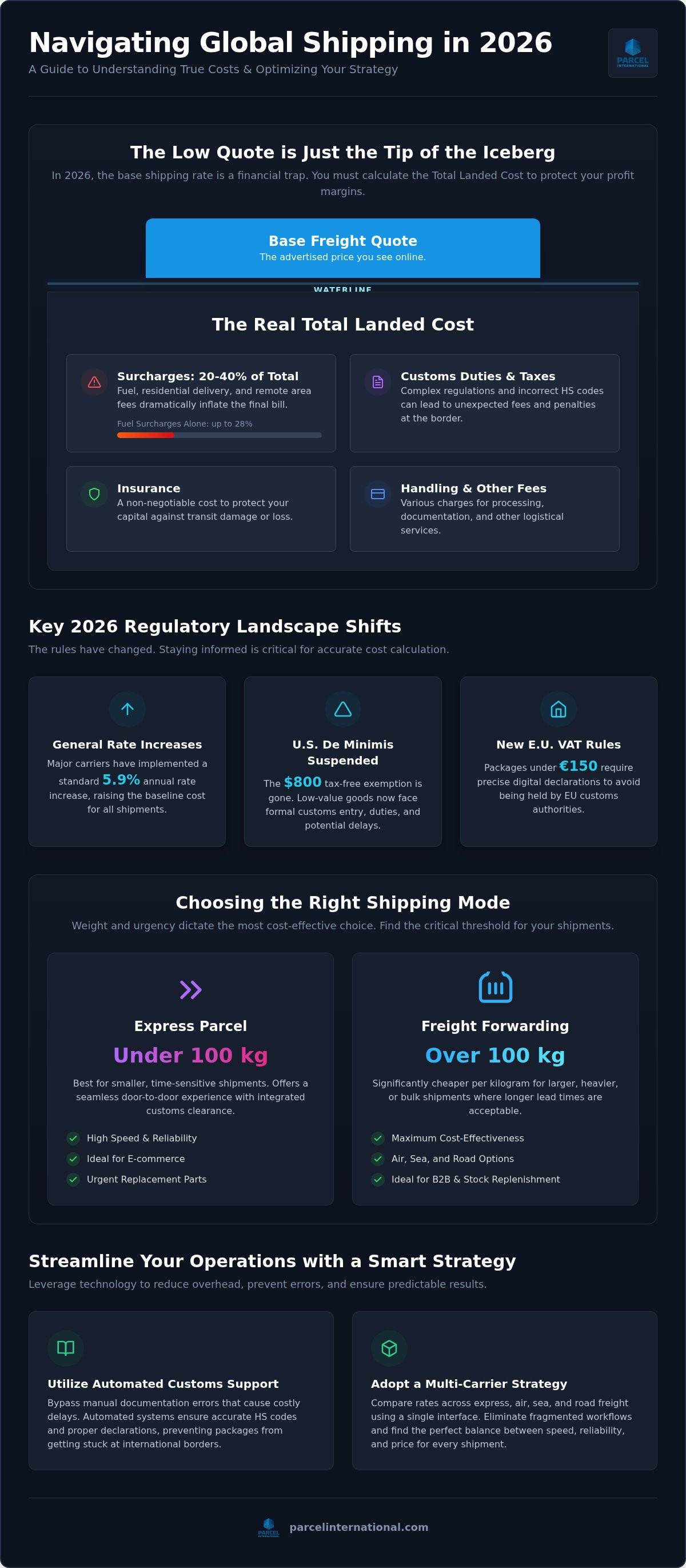
In 2026, the lowest shipping quote you find online is likely a financial trap. Between the standard 5.9% general rate increases from major carriers and the suspension of the $800 de minimis exemption, the base price is rarely what you actually pay. If you want to protect your profit margins, you must learn to compare international shipping rates by calculating the total landed cost instead of just the freight. Hidden fuel surcharges can now account for up to 28% of your total bill, turning a simple shipment into a complex budgetary headache.
We know how exhausting it is to manage packages stuck in customs or to explain inconsistent delivery times to disappointed customers. You need a streamlined process that replaces high-stakes anxiety with predictable results. This guide will help you master the art of comparing global shipping costs to find the perfect balance between speed, reliability, and price. We will walk through the latest 2026 regulatory shifts, show you how to automate customs documentation, and explain how a multi-carrier strategy can lower your overhead while ensuring your goods arrive on time, every time.
Table of Contents
What is Total Landed Cost and Why Does it Matter for Rate Comparison?
Sticker shock is a common ailment for businesses that only look at the base price when they compare international shipping rates. In 2026, the gap between a carrier's initial quote and the final invoice has widened significantly. If you aren't calculating the Total Landed Cost, you're essentially guessing at your profit margins. This metric represents the absolute sum of every expense required to get a product from your door to your customer, including the base freight rate, insurance, customs duties, local taxes, and various handling fees. Total Landed Cost is the only accurate metric for international profitability.
Relying solely on a base rate often leads to unexpected losses because it ignores the heavy weight of surcharges. In the current market, fuel surcharges alone can constitute 15% to 28% of your total shipping bill. Other common "hidden" costs include residential delivery fees for e-commerce orders and remote area surcharges for difficult-to-reach destinations. These additions can account for 20% to 40% of the total landed cost, turning a seemingly cheap shipment into a financial burden. True transparency requires looking past the first number you see.
The Components of a Global Shipping Quote
Understanding your quote requires breaking it down into two distinct categories: the base freight charge and the ancillary surcharges. The base rate covers the transport between hubs, while surcharges account for variables like peak season demand or fluctuating energy costs. You must also pay close attention to Incoterms, specifically the difference between DAP (Delivered at Place) and DDP (Delivered Duty Paid). Under DAP, your customer is responsible for duties, which can lead to refused packages and poor satisfaction. DDP allows you to bake those costs into the initial quote, offering a smoother experience. Don't view insurance as an optional add-on; it's a non-negotiable component of a secure rate comparison strategy that protects your capital against transit damage or loss.
How Customs Duties and Taxes Inflate Shipping Costs
The regulatory environment in 2026 has become increasingly complex, making tax estimation vital. A major shift occurred in June 2026 when the U.S. suspended the $800 de minimis exemption, meaning even low-value goods now face formal entry procedures and potential duties. Similarly, the European Union's July 2026 regulations for packages under €150 require precise declarations to avoid delays. Using incorrect HS codes is a fast way to overpay; even a slight misclassification can trigger higher duty brackets or administrative penalties. Leveraging automated tools to estimate these taxes before you book ensures that your "low" shipping rate doesn't double the moment it hits the border.
Express Parcel vs. Freight Forwarding: Choosing the Right Mode
Size and weight dictate your shipping strategy more than any other factor. To effectively compare international shipping rates, you must first identify the threshold where express parcel services lose their cost-effectiveness. Generally, shipments under 100 kilograms are best suited for express parcel delivery. Once you exceed this weight, the pricing model shifts. Air freight or sea freight becomes significantly cheaper per kilogram, though they require more coordination and longer lead times.
A freight forwarder acts as a vital partner when managing these heavier, more complex loads. They consolidate cargo and negotiate with carriers to find better rates than an individual business could secure alone. Before finalizing your choice, ensure you Know Your Incoterms. These international rules define who pays for insurance, local transport, and duties, which directly impacts the total cost of your chosen mode. If you're unsure which term applies to your shipment, checking these standards is a critical step in protecting your overhead.
When to Choose Express Shipping for Speed
Speed is the primary driver for express shipping. This mode offers a seamless door-to-door experience that's essential for high-value e-commerce items or urgent replacement parts. Express carriers operate integrated networks. They handle the entire journey and the customs clearance internally. This often results in faster border crossings compared to standard freight forwarding. For industries like high-tech or fashion, where inventory turnover is critical, the higher base rate of express is a justified investment in customer satisfaction and market agility.
Evaluating Sea, Air, and Road Freight for Bulk Loads
Sea freight is the logical choice for non-urgent bulk shipments. While air freight can cost up to $8.50 per kilogram in 2026, ocean freight remains the most economical option for large volumes. For growing businesses, LCL (Less than Container Load) allows you to share container space with other shippers. This provides a middle ground between small parcel and full container loads. It's an efficient way to scale without committing to an entire container.
If your supply chain moves through the continent, don't overlook road freight. It's often the most flexible and cost-effective alternative for trans-European routes. You can review the latest international road freight rates Europe to see how regional trucking compares to air alternatives. If you're ready to see the numbers for your specific lane, you can compare real-time quotes across all these modes in one place.
The Impact of Volumetric Weight on Your Shipping Estimates
You can't rely on a scale alone when you compare international shipping rates. Carriers don't just care about how much your package weighs; they care about how much physical space it occupies in a cargo hold. If you ship a large box filled with lightweight pillows, you're taking up room that could have held several heavy car parts. To compensate for this lost opportunity, logistics providers use a metric called volumetric weight, or dimensional (DIM) weight. They will always charge you for whichever number is higher: the actual weight or the volumetric weight.
In 2026, the standard formula for calculating volumetric weight in the metric system is (Length x Width x Height in cm) / 5000. If you prefer imperial measurements, the divisor is typically 139 for inches and pounds. "Dead space" is the enemy of your shipping budget. If your packaging is poorly sized, you're essentially paying to ship air across the globe. In many cases, using a box that's only a few inches too large can double your shipping rates. Selecting the right box sizes isn't just about protection; it's a critical strategy for minimizing volumetric surcharges.
Why Your Shipping Calculator Results Might Vary
You'll notice that different carriers often return different quotes for the same box. This happens because DIM factors aren't universal. While many use 5000 as a divisor, some express carriers or specific lanes might use 4000, which results in a higher billable weight. When you measure irregular items, always measure from the widest points as if the object were inside a rectangular box. Don't try to save money by rounding down your measurements. Carriers use automated laser scanners that catch even half-inch discrepancies. If your measurements are off, you'll face a billing adjustment that wipes out any initial savings. While you optimize your volume, remember that your final invoice still includes customs duties and taxes based on the shipment's value.
Packaging Strategies to Lower International Rates
Stop relying on standard carrier packaging if your items don't fit them perfectly. Custom-fit boxes are a better investment because they eliminate the volume that leads to higher rates. You should also evaluate your dunnage. Heavy packing paper adds actual weight, while oversized bubble wrap can force you into a larger box. Use lightweight materials like air pillows to keep the package compact and light. For more specific tips on optimizing your fulfillment process, check out our guide on international shipping for ecommerce. Small adjustments to your packing routine can lead to significant reductions in your annual logistics spend.
How Technology and Automation Reduce Shipping Overhead
Manual logistics management is a silent profit killer. When you attempt to compare international shipping rates by visiting individual carrier websites, you're not just losing time; you're likely overpaying. Technology has shifted the landscape in 2026, allowing small and medium businesses to access wholesale pricing that was once exclusive to high-volume enterprise shippers. Real-time rate aggregators pull data from multiple carriers instantly, ensuring you see the most competitive options without the administrative burden of fragmented workflows.
The hidden cost of manual entry often manifests as data errors that lead to failed deliveries or billing adjustments. AI-driven platforms now handle quoting and document processing with precision, reducing the manual errors that frequently trigger carrier penalties. Additionally, tracking transparency does more than just reassure the recipient. By providing automated, real-time updates, you significantly reduce the volume of customer support inquiries. This allows your team to focus on growth rather than answering repetitive status questions, effectively lowering your operational overhead.
Automated Customs: The Key to Predictable Rates
Incomplete or inaccurate paperwork is the primary cause of international shipping surcharges and storage fees at the border. Customs officials require specific, standardized data to process entries efficiently. Digital commercial invoices eliminate the risks associated with handwritten or manually typed documents. These automated tools ensure that your HS codes and valuations are correctly formatted before the package even leaves your warehouse. To master these requirements, consult our international shipping customs documentation guide. Transitioning to a digital-first approach ensures your shipments move through clearance without the friction of manual inspections.
Leveraging Multi-Carrier Platforms for Flexibility
Relying on a single carrier is a risky strategy that leads to "carrier lock-in." When a single provider implements a rate hike or experiences regional service disruptions, your business is stuck with the bill. A multi-carrier platform provides the flexibility to pivot between providers based on real-time performance and current pricing. You can choose one carrier for its speed in North America and another for its cost-effectiveness in Europe. This dynamic approach allows you to optimize every lane individually. If you're ready to stop overpaying for logistics, you can start comparing real-time rates across our global network of partners today.
Comparing Global Rates with Parcel International
The logistical landscape of 2026 doesn't have to be a source of constant stress. Parcel International acts as a stable intermediary, providing a reliable bridge between your business and a complex global market. Instead of managing a dozen different carrier logins, you can compare international shipping rates across express parcel, air freight, sea freight, and road freight within a single, unified interface. This centralized approach eliminates the inefficiency of fragmented workflows and ensures you never miss a more cost-effective route simply because it was on a different platform.
Our philosophy centers on radical transparency. We don't believe in subscription fees or hidden volume minimums. You gain access to professional-grade logistics tools whether you're sending a single express parcel or coordinating a massive sea freight project. This egalitarian approach allows small businesses to compete on a global scale without the barrier of high entry costs or restrictive terms. By removing these traditional hurdles, we make the world feel a little smaller and your business feel much more capable.
Why 2026 Shippers Trust our Aggregator Model
The primary advantage of our model is the ability to access wholesale rates from industry leaders like DHL, FedEx, and UPS without the need for individual volume contracts. We consolidate the shipping power of thousands of businesses to negotiate better terms, passing those savings directly to you. Beyond the price, you benefit from centralized tracking and support. If a shipment encounters a delay, you don't have to navigate the automated phone trees of multiple carriers. Our team provides a single point of contact, stripping away the procedural friction that often slows down international trade.
Ready to Compare? Your Next Steps
Getting started is a straightforward process designed for speed. First, input your package dimensions and destination into our shipping cost calculator for an immediate estimate. This tool allows you to compare international shipping rates side-by-side, helping you find the perfect balance between transit time and total landed cost. Before you book, we recommend reviewing our international shipping rates 2026 guide to stay informed about current seasonal trends and market shifts. For more complex freight forwarding projects that require a tailored touch, our Rotterdam-based support team is available to help you navigate specific lane requirements or specialized cargo needs. Book your next shipment today and experience the relief of a simplified global supply chain.
Future-Proof Your Global Logistics Strategy
Mastering international trade in 2026 requires more than just looking for the cheapest quote. You must prioritize the Total Landed Cost and utilize automation to bypass the procedural friction that leads to customs delays. By moving away from fragmented workflows and adopting a multi-carrier approach, you protect your margins against fluctuating fuel surcharges and regulatory changes. Success comes down to visibility; when you can compare international shipping rates across sea, air, and road freight in one place, you gain the agility needed to scale.
Parcel International provides the reliable bridge you need to reach over 220 countries with confidence. We offer wholesale rates from world-class partners like DHL, FedEx, and UPS without requiring restrictive contracts or monthly subscriptions. Our platform includes automated customs support to ensure your documentation is always accurate, all while maintaining a strict policy of no hidden fees. Take control of your overhead and eliminate the anxiety of global shipping today. Compare real-time international shipping rates now and start optimizing your supply chain for speed and reliability.
Frequently Asked Questions
What is the cheapest way to ship a parcel internationally in 2026?
Sea freight remains the most economical method for large, non-urgent shipments. For smaller parcels, using a logistics aggregator is the best way to access wholesale rates from major carriers like DHL or FedEx without a volume contract. You should always check the total landed cost rather than just the base rate. This ensures that duties and taxes don't turn a cheap option into an expensive mistake at the border.
How do I calculate international shipping rates accurately?
To calculate rates accurately, you must provide the exact dimensions, actual weight, and full destination address of your shipment. Most carriers use volumetric weight, so measuring the outer dimensions of your box is vital. An effective shipping calculator will also account for current fuel surcharges and potential customs duties. By using a single interface to compare international shipping rates, you can see these variables side-by-side to ensure your budget remains predictable.
Why are international shipping rates so high right now?
Several factors contribute to current pricing, including the 5.9% general rate increases implemented by major carriers in 2026. Fuel surcharges now represent up to 28% of total costs; meanwhile, new regulations like the suspension of the U.S. de minimis exemption have added administrative fees to previously tax-free shipments. These shifts mean that businesses must be more diligent about optimizing their packaging and choosing the right transport mode to maintain their profitability.
What is the difference between a shipping broker and a carrier?
A carrier is a company that owns the physical infrastructure, such as planes, ships, and trucks, to move goods. A shipping broker or aggregator like Parcel International acts as a stable intermediary. We don't own the fleet; instead, we negotiate wholesale rates with multiple carriers and provide a unified platform for you to manage your logistics. This model offers you greater flexibility and lower prices than working with a single carrier directly.
How does volumetric weight affect my international shipping quote?
Volumetric weight measures the space a package occupies relative to its mass. Carriers use a specific divisor, typically 5000 for metric measurements, to convert your package dimensions into a billable weight. If your box is large but light, you'll be charged based on its size rather than what the scale says. Optimizing your packaging to remove dead space is one of the most effective ways to lower your overall shipping expenses.
Are there hidden fees when I compare shipping rates online?
Many online calculators only show the base freight rate, leaving out surcharges for fuel, residential delivery, or remote areas. These hidden costs can account for 20% to 40% of the final invoice. Parcel International prioritizes radical transparency by showing these fees upfront. We don't charge subscription fees or hidden volume minimums, which allows you to see the true cost of your shipment before you commit to a booking.
Can I get discounted shipping rates as a small business?
Small businesses can access deep discounts by using a logistics aggregator. Since these platforms consolidate the shipping volume of thousands of users, they can secure wholesale pricing from major carriers that is usually reserved for enterprise-level shippers. This allows you to compare international shipping rates and select premium services like express shipping at a fraction of the standard retail price, all without needing to sign a long-term volume contract.
How do I avoid customs delays when shipping abroad?
The most effective way to avoid delays is through accurate, digital documentation. Ensure your commercial invoices use the correct HS codes and reflect the true value of the goods. In 2026, automated customs support tools are essential for preventing the manual errors that lead to border inspections. By using a platform that generates these documents automatically, you ensure that your shipments meet the latest regulatory requirements in over 220 countries.


