
How to Send a Parcel Internationally: A Step-by-Step 2026 Guide
The era of frictionless, duty-free global trade is officially over. With the US suspension of the de minimis exemption in February 2026 and new EU duty rules, the old way of shipping no longer works. If you're wondering how to send parcel international today, you're likely facing a wall of new surcharges and strict Importer of Record requirements. You want your goods to move fast, but the fear of a customs hold or a surprise 10% import surcharge is enough to make anyone hesitate.
We understand that managing these regulatory shifts feels like aiming at a moving target. You deserve a transparent process that replaces confusion with control. This guide promises to strip away the complexity of global logistics by providing a clear, actionable roadmap for your 2026 shipments. We'll show you how to master carrier selection and automate your documentation to ensure total compliance.
You'll gain access to a step-by-step checklist covering everything from HTS code accuracy to cost optimization strategies for air, sea, and road freight. We'll walk through the exact steps needed to secure lower rates and maintain a reliable supply chain in a high-stakes market.
Key Takeaways
Identify the specific roles of shippers, carriers, and customs authorities to maintain clear accountability throughout the multi-stage shipping journey.
Master the use of Harmonized System (HS) codes and commercial invoices to ensure your documentation is compliant and your duty payments are accurate.
Learn how to send parcel international efficiently by comparing express and economy services while accounting for the impact of dimensional weight on your final costs.
Follow a rigorous pre-shipment checklist to verify prohibited items and local address formats, preventing common delays before your cargo leaves the dock.
Optimize your logistics strategy by selecting the right mode of transport, whether air, sea, or road freight, based on your specific urgency and budget.
Table of Contents
Understanding the Foundations of International Parcel Shipping
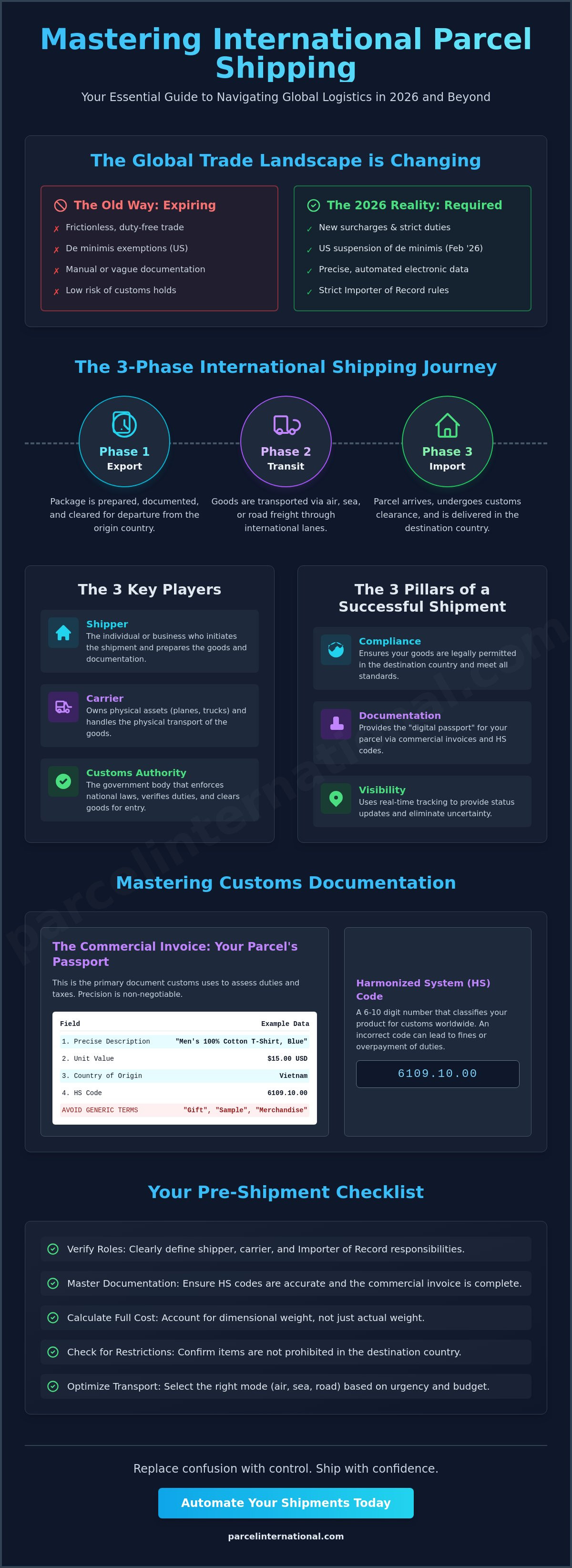
Sending a package across borders isn't a single event. It's a synchronized, three-phase journey involving export from the origin, transit through international lanes, and import into the destination market. While the history of parcel post provides the foundation for these global connections, the 2026 environment is far more complex than its predecessors. Understanding how to send parcel international requires you to manage the interplay between the shipper, who initiates the move; the carrier, who provides the physical transport; and the customs authority, who enforces national laws.
The customs authority acts as the final arbiter of what enters a country. They verify duties, enforce safety standards, and check for restricted items. In 2026, digital precision is the standard requirement. Recent shifts in US and EU regulations mean that manual or vague descriptions are rejected instantly. You must provide verifiable Importer of Record details and precise electronic data for every item. This level of accuracy makes international parcel shipping a vital component of any growth strategy. It allows businesses to reach new markets while avoiding the common traps of seized goods or hidden surcharges.
The Three Pillars of a Successful Shipment
A successful shipment stands on three specific pillars. First, compliance ensures your goods are legally permitted in the destination country. Second, documentation provides the necessary passport for your parcel through commercial invoices and HS codes. Third, visibility uses real-time tracking to eliminate the anxiety of the unknown. These three elements turn a chaotic process into a predictable, orderly system. When you understand how to send parcel international with this foundation in place, you can focus on scaling your operations rather than troubleshooting delays.
Why a Logistics Broker is Different from a Carrier
Don't confuse a carrier with a logistics broker. A carrier owns the physical assets like planes and trucks. They handle the movement. A broker is an optimizer. They aggregate shipping volumes to secure wholesale rates that aren't available to the general public. By using a platform approach instead of a direct-to-carrier model, you get a single interface to manage multiple carriers. This stable intermediary role is essential for navigating the fragmented workflows that often slow down international trade. It removes the barriers of subscription fees or volume requirements, making global shipping accessible for projects of any size.
Navigating Customs Documentation and Compliance
Mastering the paperwork is the most significant hurdle when you're learning how to send parcel international. In 2026, the margin for error has disappeared. Customs authorities now demand digital precision, and vague descriptions that passed in previous years will now trigger immediate holds. Successful shipping requires you to treat your documentation as a digital handshake with foreign governments. By providing clear, automated data, you strip away the procedural friction that often leads to unexpected delays and storage fees.
Every item crossing a border must have a Harmonized System (HS) code. This six-to-ten digit number tells customs exactly what's in the box and determines the tax rate. Don't guess these codes. An incorrect classification can lead to overpayment of duties or, worse, fines for misdeclaration. You also need to select the correct Incoterms, which are standardized rules defining whether the shipper or the recipient is responsible for costs and risks during transit. Most modern shippers now use automated customs filing systems to sync this data directly with customs declaration requirements, significantly reducing the risk of human error.
Mastering the Commercial Invoice
The commercial invoice is the primary document used by customs authorities to assess duties and taxes. To avoid issues, ensure you include a precise description, the unit value, and the country of origin for every item. Avoid generic terms like "gift" or "merchandise." Instead, use specific language like "men's 100% cotton t-shirt." If you feel overwhelmed by these requirements, professional customs support can help you verify your data before the label is even printed.
Understanding Duties and Taxes
The 2026 regulatory landscape has changed fundamentally. As of February 24, 2026, the US suspended the de minimis exemption, meaning all imports are now subject to duties regardless of value. Similarly, the EU removed its €150 customs duty exemption on July 1, 2026. You must decide between Delivered Duty Unpaid (DDU) and Delivered Duty Paid (DDP). DDP is generally preferred for a better customer experience because it ensures the recipient isn't surprised by a bill at their doorstep. Transparency in these costs is no longer optional; it's a requirement for maintaining trust in a global market.
How to Compare International Shipping Rates and Services
Choosing a service level based solely on the lowest sticker price is a common mistake that leads to delays and budget overruns. If you're learning how to send parcel international in 2026, you must look beyond the base rate. Major carriers like FedEx and UPS implemented average General Rate Increases of 5.9% at the start of the year, making it essential to compare the total landed cost rather than just the initial quote. You'll need to balance the urgency of Express Shipping against the cost savings of Air Freight or Sea Freight for larger consignments.
Dimensional weight is the most significant factor in modern pricing. Carriers don't just charge for how much a box weighs; they charge for the space it occupies in the aircraft or container. You calculate this by multiplying the length, width, and height of the package and dividing by a specific dim factor. If your box is large but light, you'll pay for its size. To avoid overpaying, consult an international shipping rates guide to benchmark your costs against current industry standards. Accessing these rates through a logistics platform often provides deep discounts that aren't available to individual shippers.
Evaluating Carrier Networks
Carrier strengths vary significantly by region. DHL remains the dominant force across Europe and Africa, while FedEx and UPS offer the most robust infrastructure within North America. When selecting a partner, consider the quality of the final delivery in the destination country. Even the fastest transit times can be ruined by poor local handling. For businesses looking to scale, the SBA guide to exporting products provides excellent context on how to vet these global networks effectively. Always check if the service includes comprehensive insurance to protect against transit risks.
Hidden Costs to Watch For
The "real" total of a shipping quote often includes surcharges that aren't visible at first glance. In 2026, export fuel surcharges have reached as high as 38.5% at the $4 per gallon jet fuel benchmark. You should also watch for residential delivery fees and remote area surcharges, which apply if the destination is far from a carrier's main hub. To keep costs low, optimize your packaging to reduce dimensional weight. Use the smallest box possible and avoid excess filler. This simple step ensures you don't pay for shipping air across the ocean.
Step-by-Step Guide: Sending Your Parcel Internationally
Before you print a label, you must verify that your items are permitted in the destination country. The 2026 regulatory environment is less forgiving than in previous years. Items that seem harmless, like certain liquids or lithium batteries, are often restricted or require special handling. Check your carrier's current list of prohibited items to avoid a total loss or legal complications. Once you've confirmed the contents are safe to ship, it's time to gather precise data.
Accuracy in weighing and measuring is not optional. Carriers use automated scanners that detect even a half-inch discrepancy in dimensions. If your measurements are off, you'll face a billing adjustment that can significantly increase your costs. Use a digital scale and a measuring tape to record the exact length, width, height, and weight of your package after it's fully packed. This data is essential for mastering how to send parcel international without hidden fees. Use an automated platform to generate your shipping labels and customs documents simultaneously. This ensures that the data on your commercial invoice matches the data on your shipping label. Digital synchronization is the only way to meet the 2026 Importer of Record standards without risking a rejection.
Packaging for the Global Journey
International transit involves multiple touchpoints, humidity changes, and varying climates. You must use sturdy, corrugated cardboard boxes specifically designed for international transit. If you're shipping fragile items, use the "Double-Box" method. Place the item in a smaller box, then place that box inside a larger one with at least two inches of cushioning on all sides. Never reuse old boxes that have existing barcodes or old shipping labels. These can confuse automated sorting systems and send your parcel to the wrong continent.
Labeling and Final Checks
Your shipping label should be placed on the largest flat surface of the box. Don't wrap it around corners or place it over a seam. Secure your customs documents in a clear plastic pouch attached firmly to the outside of the package. You must include the recipient’s phone number and email address; customs authorities in 2026 frequently use these for digital duty collection and identity verification. Finally, perform a one-to-one check to ensure your physical contents match the HTS codes listed on your invoice. Once the package is ready, schedule a pickup or drop it off at a designated point. For urgent deliveries, you can book Express Shipping to guarantee transit speed and reliability.
Avoiding Common Pitfalls and Delays in 2026
Even the most prepared shippers can hit roadblocks if they ignore the finer details of local regulations. When learning how to send parcel international, you must realize that "innocent" items like lithium batteries, perfumes, or even certain types of wood packaging can trigger major delays. Customs officials in 2026 use advanced screening technology to identify restricted contents before the package even leaves the hub. If you fail to declare these items correctly, your parcel won't just be delayed; it might be seized or destroyed. Beyond prohibited items, incorrect address formats remain a leading cause of delivery failure. Every country has its own logic for postal codes and street designations. Use a validation tool to ensure your recipient's details match local standards.
For those managing international shipping for ecommerce, the complexity increases with tax registration requirements. In the European Union, the Import One-Stop Shop (IOSS) is essential for streamlining VAT collection on goods. Without a valid IOSS number or similar registration in other regions, your customers will face unexpected collection fees at the door. This leads to refused packages and high return costs. Manage customer expectations by setting up proactive tracking notifications. This transparency ensures that the recipient knows exactly when duties are due and when to expect the carrier.
The Danger of Under-Declaring Value
Don't fall into the trap of under-declaring the value of your goods to save on duties. Modern customs AI is programmed to flag "gifts" or undervalued items that don't match market rates. If you provide an inaccurate valuation, you risk heavy fines and permanent blacklisting of your Importer of Record status. This is especially critical given the current 10% import surcharge on most articles entering the US. Provide honest, verifiable data on your commercial invoice to maintain a clean shipping history. If you're unsure about VAT or local taxes, professional customs support can provide the necessary guidance to keep your shipments compliant.
Leveraging Technology for Smooth Delivery
The most effective way to avoid these pitfalls is to move away from fragmented, manual workflows. Unlike the inconsistent advice found on public forums, a logistics broker platform acts as a stable intermediary. These platforms offer tools that flag documentation errors before you even pay for a label. By using API integrations, you can sync shipping data directly from your storefront to the carrier's system. This eliminates the manual entry errors that cause a high percentage of international delivery issues. If a parcel does get stuck, having a dedicated partner to navigate the bureaucracy provides the relief and peace of mind needed to keep your business moving.
Streamline Your Global Logistics for 2026
Success in international trade requires moving from fragmented, multi-platform workflows to a singular, unified solution. You've learned that mastering how to send parcel international in 2026 depends on digital precision and proactive compliance. By prioritizing accurate HS codes and optimizing your packaging to manage dimensional weight, you strip away the typical anxieties associated with cross-border logistics. Automated documentation is no longer a luxury; it is the standard for avoiding costly customs holds and surcharges.
Don't let regulatory complexity slow your growth. You can start shipping to over 220 countries with Parcel International today. Our platform lets you compare rates from DHL, FedEx, and UPS in one click. Automated customs documentation is included with every shipment, and there are no subscription fees or volume minimums. Take control of your supply chain and enjoy the relief of a predictable, orderly process. Global markets are waiting, and you're now equipped to reach them with confidence.
Frequently Asked Questions
What is the cheapest way to send a parcel international?
Sea freight or road freight typically offer the lowest rates for high-volume or heavy shipments. If you're learning how to send parcel international on a budget for smaller packages, economy air services provide a balance between cost and speed. You can access significantly lower rates by using a logistics broker platform that aggregates shipping volumes to secure wholesale pricing from major carriers without requiring any subscription fees.
How do I find the correct HTS code for my product?
You can find the correct Harmonized Tariff Schedule (HTS) code by using official government search tools or the classification tools provided within a shipping platform. These codes are standardized globally for the first six digits. Precision is vital because an incorrect code will lead to duty overpayments or customs penalties. If your product is complex, seeking professional customs support ensures you remain compliant with the latest 2026 regulations.
Can I send a parcel internationally without a commercial invoice?
No, you cannot send commercial goods across international borders without a commercial invoice. This document acts as the official declaration for customs authorities to assess duties and taxes. Even for non-commercial items, a detailed packing list or declaration is required. In 2026, authorities demand digital versions of these documents to be submitted electronically before the parcel arrives to speed up the clearance process and reduce manual errors.
What happens if my parcel is held by customs?
Customs holds usually occur due to missing documentation, incorrect HTS codes, or unpaid duties and taxes. If your parcel is held, the carrier will typically contact the recipient or the shipper to request the missing information. This process can be stressful, but having a stable intermediary to handle the communication provides much-needed relief. Most holds are resolved once the required digital data or payment is provided to the local authorities.
How long does international express shipping usually take?
Express shipping generally takes between one and five business days depending on the destination zone. Major global hubs often see next-day delivery, while remote areas may take longer. This service level is the most reliable option for urgent consignments because it prioritizes your parcel in the carrier's network. While it is more expensive than economy options, the speed and detailed tracking offer peace of mind for high-stakes shipments.
Are there items I am strictly prohibited from shipping internationally?
Yes, most countries strictly prohibit dangerous goods like lithium batteries, flammable liquids, and explosives. Perishable items, weapons, and certain chemicals also face heavy restrictions or total bans. In 2026, customs AI has become highly efficient at flagging these items during the digital screening process. Always check the specific prohibited items list for both your carrier and the destination country before you finalize your packaging to avoid seizure.
What is the difference between DDU and DDP shipping?
DDU (Delivered Duty Unpaid) means the recipient is responsible for paying all duties and taxes upon arrival. DDP (Delivered Duty Paid) means the shipper covers these costs upfront. For ecommerce, DDP is the superior choice because it prevents "doorstep shock" where customers are surprised by unexpected bills. Using DDP improves customer satisfaction and reduces the number of refused packages, which is essential for maintaining a successful global storefront.
Do I need special insurance for international parcels?
Special insurance is highly recommended for any high-value international shipment. Standard carrier liability is often limited and may not cover the full value of your goods if they are lost or damaged in transit. Comprehensive shipping insurance provides an extra layer of security, covering the total replacement cost and shipping fees. It's a small investment that ensures you aren't left with a total financial loss if an unforeseen accident occurs during the journey.


Comments