
How to Ship Lithium Batteries Internationally from USA: 2026 Compliance Guide
In 2026, what used to be a safety suggestion for lithium battery transport officially became a mandatory international law. If your business hasn't updated its protocols, you're not just risking a delay; you're risking heavy fines and the permanent seizure of your cargo by customs. It's frustrating to watch your team lose hours to manual paperwork only to realize that IATA and DOT regulations don't always align. You shouldn't have to be a legal expert just to get your products to your global customers.
We understand that the complexity of hazardous materials shipping can feel overwhelming. This guide shows you exactly how to ship lithium batteries internationally from usa with total confidence. You'll master the latest 2026 compliance standards, including the mandatory 30% state of charge (SoC) limit for batteries packed with equipment. We'll provide a clear checklist for packaging, explain how to compare carrier rates for the best value, and show you how to use automation to strip the friction out of your customs documentation. By the end of this article, you'll have a streamlined workflow that turns shipping compliance into a competitive advantage.
Table of Contents
Understanding the 2026 Landscape for International Battery Shipments
Shipping lithium batteries in 2026 requires more than just a sturdy box; it demands a deep understanding of evolving safety protocols. As of January 1, 2026, the International Air Transport Association (IATA) transitioned several previous recommendations into mandatory requirements. This shift reflects a global effort to mitigate the risk of thermal runaway, a phenomenon responsible for over 500 verified incidents of fire or extreme heat in air transport since 2006. For US businesses, learning how to ship lithium batteries internationally from usa starts with Understanding Dangerous Goods Classifications. Batteries are strictly Class 9 Dangerous Goods, and failing to meet these standards can result in massive fines or permanent seizure of your cargo.
The 2026 Regulatory Bodies: IATA, ICAO, and DOT
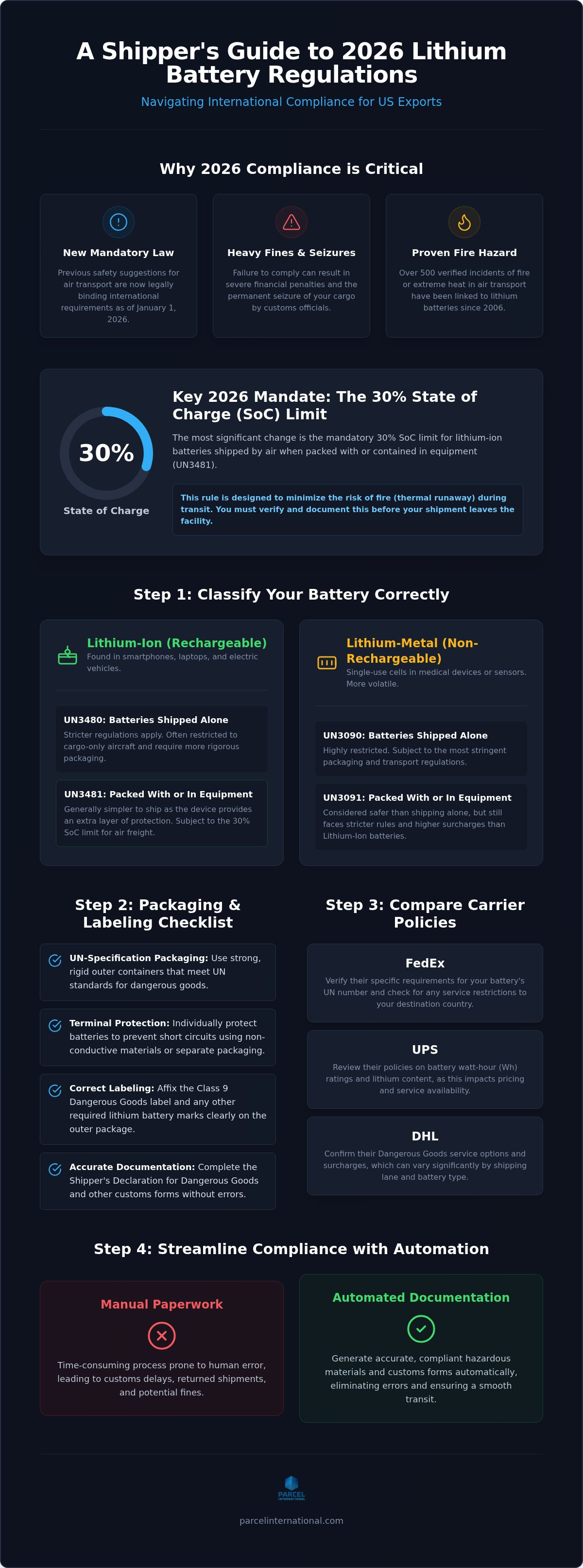
Three main organizations dictate your shipping workflow. The International Civil Aviation Organization (ICAO) provides the technical framework, while IATA adapts these rules for commercial airlines. Within the US, the Department of Transportation (DOT) aligns with these international standards for air exports but maintains distinct rules for sea and road freight. The most significant 2026 update is the mandatory State of Charge (SoC) limit for batteries packed with equipment. The 30% state-of-charge limit serves as a mandatory safety standard designed to minimize the risk of fire during air transit. If you're using air freight, you must ensure your devices or cells don't exceed this threshold before they leave your facility.
Key Changes in Lithium Battery Classifications
The distinction between "Excepted" and "Fully Regulated" shipments has tightened significantly. In 2026, even small-format batteries used in consumer electronics face stricter scrutiny if they aren't contained within the device itself. Knowing how to ship lithium batteries internationally from usa requires checking whether your shipment falls under UN3480 (batteries alone) or UN3481 (with equipment), as the documentation needs differ significantly. You must also account for destination-specific variations; for instance, the EU and certain Asian markets may require additional local certifications beyond standard US export forms. Staying compliant means having a firm grasp on international shipping customs documentation to avoid border delays. Whether you're using express shipping or sea freight, the International Maritime Dangerous Goods (IMDG) Code Amendment 42-24 now enforces stricter rules for battery-powered vehicles, making it vital to verify your battery type before booking.
Identifying Your Battery Type: Lithium-Ion vs. Lithium-Metal
Before you can master how to ship lithium batteries internationally from usa, you must accurately classify the chemistry of your power source. The logistics industry separates these into two distinct categories based on whether they're rechargeable. Lithium-ion batteries are rechargeable and found in everything from smartphones to electric vehicles. Conversely, lithium-metal batteries are non-rechargeable, single-use cells typically used in medical devices or specialized industrial sensors. Because lithium-metal batteries contain metallic lithium, they're considered more volatile. Consequently, they face much stricter export regulations and higher carrier surcharges. For a detailed breakdown of these legal distinctions, consult the US DOT Lithium Battery Shipping Guide.
UN Numbers and Proper Shipping Names
Your shipment's legal identity depends on its UN number. In 2026, air and sea carriers use four primary codes to determine handling requirements. UN3480 identifies lithium-ion batteries shipped alone, while UN3481 applies when they're bundled with a device. UN3481 covers lithium-ion batteries contained in or packed with equipment, such as laptops and mobile devices. For non-rechargeable cells, you'll use UN3090 for loose batteries and UN3091 for those inside equipment. Generally, shipping batteries "contained in equipment" is simpler because the device's housing provides an extra layer of protection against physical damage and short circuits. Loose batteries are often restricted to cargo-only aircraft and require more rigorous packaging standards.
Watt-Hour and Lithium Content Thresholds
The level of regulation your shipment faces depends on its energy density. For lithium-ion batteries, the magic number is 100 Watt-hours (Wh). Any battery exceeding this limit is treated as fully regulated Class 9 Dangerous Goods, requiring specialized labeling and certified packaging. For lithium-metal batteries, the threshold is measured in grams of lithium content, with a 2-gram limit separating "excepted" from "fully regulated" shipments. You can find these specific values on your Product Data Sheet or Material Safety Data Sheet (MSDS). If your battery only lists Amp-hours (Ah) and Voltage (V), simply multiply them to find the Watt-hours. For example, a 14.4V battery with 5Ah has a rating of 72 Wh, placing it below the 100 Wh threshold.
Learning these technical nuances is the most reliable way to understand how to ship lithium batteries internationally from usa without facing customs delays. If you find these calculations or the varying carrier rules confusing, you can simplify your workflow by using automated customs support to verify your battery's regulatory tier instantly.
Packaging and Labeling Standards for US Exports
Once you've classified your battery chemistry, the focus shifts to the physical preparation of the shipment. Physical compliance is where many US exporters face the highest risk of carrier rejection. In 2026, simply placing a product in its original retail box is no longer sufficient for global transit. International handling involves significant vibration and pressure changes that standard consumer packaging isn't designed to withstand. To successfully master how to ship lithium batteries internationally from usa, you must follow a rigid, five-step physical preparation process.
Step 1: Select a UN-specification outer container that matches the weight and volume of your shipment.
Step 2: Prevent short circuits by covering terminals with non-conductive tape or placing each battery in a separate, sealed plastic bag.
Step 3: Apply the updated 2026 Lithium Battery Mark and, if the shipment is fully regulated, the Class 9 Hazard Label.
Step 4: Attach "Cargo Aircraft Only" (CAO) stickers if you're shipping loose batteries (UN3480 or UN3090) that are prohibited on passenger planes.
Step 5: Seal the box using the H-taping method and verify the total weight against your documentation to avoid customs discrepancies.
Internal vs. External Packaging Requirements
Internal protection is your first line of defense against thermal runaway. You must isolate individual batteries using non-conductive materials to ensure they don't touch each other or any metal objects within the box. The 2026 standards mandate "strong rigid outer packaging" capable of passing a 1.2-meter drop test without damage to the contents. Adhering to IATA Lithium Battery Regulations ensures your packaging meets these high-stakes safety benchmarks. If your device can be accidentally activated, you must also provide a secondary means of protection for the power switch.
Labeling and Marking Best Practices
Accuracy in labeling is non-negotiable. The 2026 Lithium Battery Mark requires specific dimensions, typically 100mm by 100mm, and must feature a red bordered hatch pattern. You're required to include a valid emergency contact phone number directly on the label. This number must be monitored by someone who can provide technical information about the shipment at all times. Common mistakes, such as using undersized labels or placing them over box seams, are the leading causes of US customs rejections. Proper placement ensures that handlers and inspectors can identify the risks immediately. Knowing how to ship lithium batteries internationally from usa means treating the outside of the box with as much care as the technology inside.
Carrier Comparison: FedEx vs. UPS vs. DHL Battery Policies
Choosing a carrier involves more than just checking delivery speeds. Each major player has specific carrier variations that can stop your shipment at the gate. If you're figuring out how to ship lithium batteries internationally from usa, you'll quickly find that FedEx, UPS, and DHL don't always agree on the fine print. While they all follow the core IATA framework, their internal safety thresholds for 2026 differ based on the destination and the specific battery classification.
FedEx International Connect Plus offers a balance of cost and speed for e-commerce, but they generally don't permit loose batteries for household or casual shippers. UPS is often the go-to for US-to-Europe lanes, yet they enforce a strict policy where all lithium-ion cells (UN 3480) must be shipped as fully regulated dangerous goods. This means you can't use the simplified Section II provisions that some other carriers might allow. DHL Express is frequently the preferred choice for Asian battery shipments due to their robust infrastructure in the region. As of June 9, 2026, DHL requires many batteries packed with equipment to strictly follow the 30% state-of-charge rule, making prep work vital for shipments to hubs like Singapore or Hong Kong.
Service Availability and Surcharges
Shipping batteries isn't cheap. You need to compare international shipping rates carefully because "Dangerous Goods" surcharges vary wildly between providers. These fees aren't just about the weight; they cover the specialized handling and segregated storage required during transit. Some carriers refuse to fly lithium batteries to specific remote regions or countries with limited hazardous material processing capabilities. For bulk shipments that exceed standard parcel limits, using an international freight forwarder can help you navigate these regional restrictions and secure better pricing through consolidated cargo lanes.
Contract Requirements for HazMat Shipping
You can't simply walk into a retail shipping store with a box of lithium batteries. Most carriers require a pre-approved Dangerous Goods Agreement on file before you can print a label. Carriers also distinguish between Known Consignors who have undergone security screening and casual shippers who haven't. If you're in the latter group, your options for how to ship lithium batteries internationally from usa are extremely limited. DHL and FedEx often require a formal account and a signed hazardous materials contract before they'll accept a single cell. Parcel International simplifies this by acting as your stable intermediary, letting you skip the months of administrative setup. Access pre-vetted carrier networks and get your batteries moving now.
Automating Compliance with Parcel International
The manual burden of hazardous materials logistics is the primary reason shipments fail at the border. When you're managing how to ship lithium batteries internationally from usa, a single typo on a Shipper’s Declaration can lead to weeks of delays and mounting storage fees. Parcel International replaces this fragmented, high-risk process with a singular, unified platform. By automating the most technical aspects of compliance, we transform a chaotic regulatory hurdle into a predictable, orderly workflow. Our system doesn't just provide a label; it ensures that every piece of documentation is pre-validated against current 2026 international standards before your package ever reaches the carrier.
The Power of Automated Customs Documentation
Precision is the only way to avoid a customs hold. Our platform generates automated Commercial Invoices and Shipper’s Declarations that are specifically tailored for Class 9 Dangerous Goods. You don't have to worry about manually cross-referencing UN numbers or energy density limits. Instead, you can integrate your Material Safety Data Sheets (MSDS) directly into the digital workflow. This ensures that your international parcel shipping meets the exact requirements of the destination country. Centralized tracking provides real-time visibility for all your battery exports, giving you the peace of mind that your cargo is moving through the global supply chain without friction.
Transparent Pricing for Complex Logistics
Hidden fees are a common pain point in hazardous materials shipping. Many platforms hide "Dangerous Goods" surcharges until the final billing cycle, making it impossible to calculate your true margins. We believe in radical transparency. When you use our platform, you see every surcharge upfront. This includes specialized handling fees and regional delivery adjustments. We offer the following benefits to simplify your logistics:
Real-time rate comparison between DHL, FedEx, and UPS to find the most cost-effective HazMat-friendly route.
Access to wholesale rates for express shipping that already account for the complexities of battery handling.
Pre-validated paperwork that significantly reduces the risk of your shipment being flagged for inspection.
A modern, flexible interface that works for both small-scale projects and large-scale commercial exports.
You don't need a massive logistics department to master how to ship lithium batteries internationally from usa safely and legally. By leveraging our automated tools, you remove the procedural friction that slows down your business. We act as your stable intermediary, bridging the gap between complex international law and your daily operations. Simplify your battery shipping with Parcel International today.
Streamline Your Global Battery Logistics
Compliance is your competitive advantage in the 2026 global market. By identifying your battery chemistry and adhering to the mandatory 30% state-of-charge limits for air freight, you protect your cargo and your reputation. Mastering how to ship lithium batteries internationally from usa doesn't have to be a source of operational anxiety. Proper packaging and accurate labeling are the final physical hurdles before your products reach their destination. When you align with international safety standards, you eliminate the friction that causes customs delays.
You don't have to navigate these high-stakes regulations alone. Parcel International provides the relief you need from fragmented workflows through automated 2026 customs compliance and expert support for dangerous goods. You can secure discounted wholesale carrier rates and find the most efficient route for your specific battery type in seconds. Compare 2026 Battery Shipping Rates and Book Now. Take the guesswork out of your logistics and move your products with total confidence. Your global expansion is just a few clicks away.
Frequently Asked Questions
Can I use national postal services to ship lithium batteries in 2026?
Most national postal services strictly prohibit the export of loose lithium batteries due to safety risks. While some allow batteries contained in equipment, international regulations are inconsistent and often lead to packages being returned or destroyed at the border. To ensure your shipment reaches its destination safely, you should utilize commercial express shipping providers that are specifically equipped to handle Class 9 Dangerous Goods and offer full tracking transparency.
What is the maximum Watt-hour limit for shipping lithium-ion batteries by air?
The standard limit for lithium-ion batteries is 100 Watt-hours (Wh) per battery. If your battery exceeds this threshold, it is classified as fully regulated Class 9 Dangerous Goods. This classification requires specialized UN-specification packaging, specific hazard labeling, and a certified dangerous goods declaration. You can calculate this value by multiplying the battery's Voltage by its Amp-hour rating to ensure you stay within the legal limits for air transport.
Does every battery shipment require a Material Safety Data Sheet (MSDS)?
Yes, a current Material Safety Data Sheet (MSDS) is mandatory for almost every international battery shipment. This document provides critical information about the battery's chemistry and safety protocols. Carriers use the MSDS to verify the UN number and energy density before they accept the package. You should also provide a UN38.3 Test Report to prove the battery has passed global safety testing standards for international transit.
How do I label a package containing a laptop with a built-in battery?
You must apply the 2026 Lithium Battery Mark featuring the UN3481 designation for laptops with built-in batteries. Ensure the mark includes a valid emergency contact phone number and meets the standard 100mm by 100mm size requirements. Since the battery is contained in equipment, you generally don't need a Class 9 Hazard Label unless the battery exceeds 100 Wh. Place the label on a side of the box that won't be obscured by tape.
Are there extra fees for shipping lithium batteries internationally from the USA?
Yes, carriers apply specific Dangerous Goods surcharges when you learn how to ship lithium batteries internationally from usa. These fees cover the specialized handling, segregated storage, and safety inspections required for hazardous materials. Costs vary significantly between carriers like UPS and DHL. Using a logistics broker helps you compare these fees upfront, ensuring you aren't surprised by hidden administrative costs or regional delivery surcharges after your shipment has already departed.
What happens if I ship lithium batteries without the proper labels?
Shipping batteries without proper labels can lead to severe legal consequences, including heavy civil fines and the permanent seizure of your goods. Customs authorities and carrier safety inspectors scan for undeclared hazardous materials to prevent aircraft fires. If your package is flagged for non-compliance, your business may be blacklisted from future shipments. In the worst-case scenario, you could be held liable for any damages or safety incidents that occur during transit.
Can I ship damaged or recalled lithium batteries internationally?
You cannot ship damaged, defective, or recalled lithium batteries through standard international parcel services. These items are strictly prohibited by IATA and DOT regulations because they pose a critical fire risk. Such batteries must be handled through specialized hazardous waste disposal channels or dedicated recycling services. Attempting to ship a swollen or leaking battery internationally is illegal and carries extreme safety risks for the aircraft and ground personnel handling your package.
How does Parcel International help with customs clearance for batteries?
Parcel International simplifies the process by providing automated tools that generate accurate customs documentation for battery shipments. Our platform validates your paperwork against 2026 standards to minimize the risk of a customs hold. You can compare real-time rates from major carriers to find the best value for your specific battery type. We act as a stable intermediary, offering expert support to ensure your how to ship lithium batteries internationally from usa remains fully compliant and cost-effective.


