
International Freight Cost Calculator: Your 2026 Guide to Transparent Shipping Estimates
- Alex
- Jul 17
- 11 min read
Updated: Jul 19
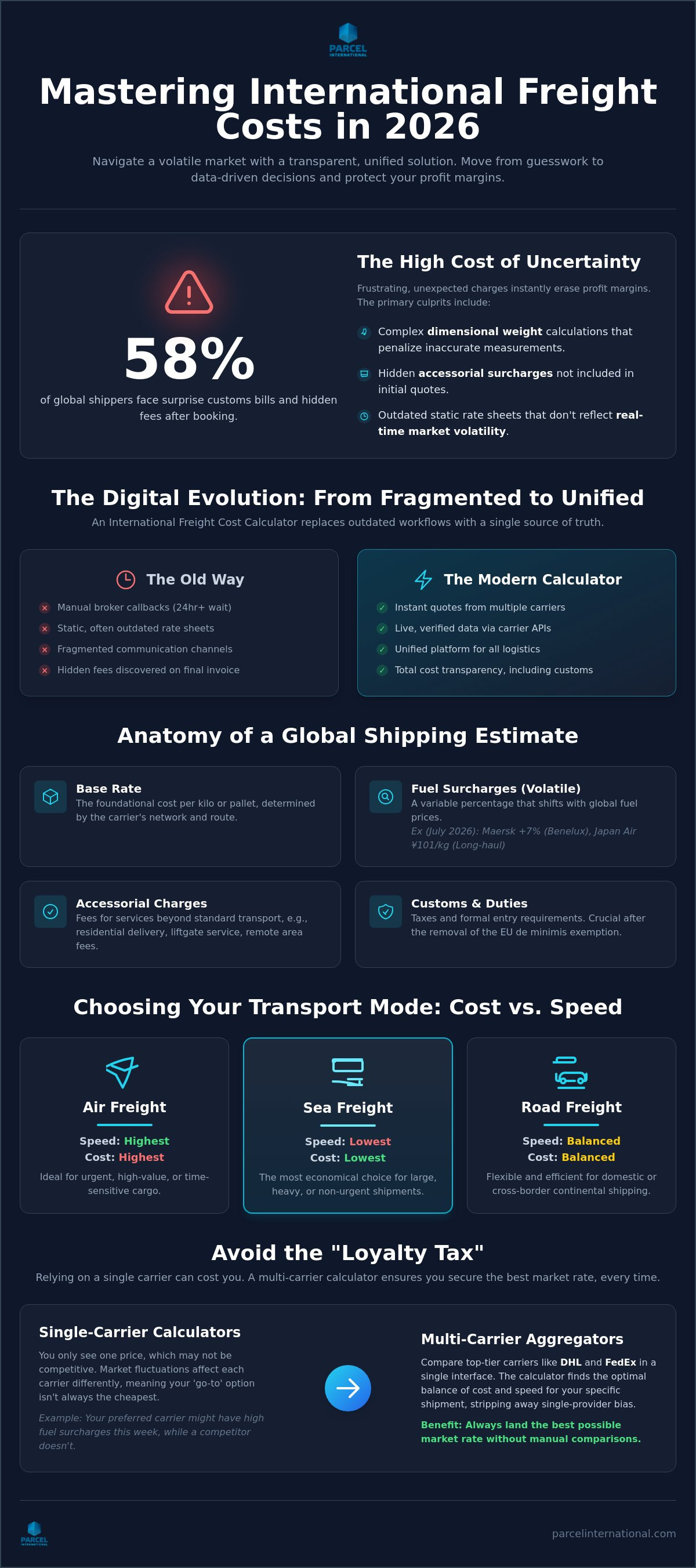
Did you know that 58% of global shippers are hit with surprise customs bills after they've already booked their cargo? It's a frustrating reality where hidden surcharges and complex dimensional weight calculations can instantly erase your profit margins. You deserve a logistics partner that values transparency over corporate jargon. By using a modern international freight cost calculator, you can strip away the typical anxieties of global trade and move from fragmented workflows to a single, unified solution.
We understand the pressure of securing competitive rates in a volatile 2026 market. This guide promises to help you master the complexities of logistics costs, from the removal of EU de minimis exemptions to fluctuating fuel surcharges. You'll learn how to generate reliable estimates that include customs and fuel, giving you the confidence to book immediately. We will explore how to compare air and sea freight instantly, ensuring your business always lands the best possible market rate without the 24 hour wait for a broker callback.
Table of Contents
Understanding the Role of an International Freight Cost Calculator in 2026
Breaking Down the Core Components of Global Shipping Estimates
Optimizing Your Quote: A Guide to Using Freight Calculation Tools
Comparing Transportation Modes: Air, Sea, and Road Cost Dynamics
Leveraging Parcel International for Transparent, Multi-Carrier Freight Quotes
Understanding the Role of an International Freight Cost Calculator in 2026
An international freight cost calculator is no longer just a convenience; it's a critical piece of business infrastructure. In 2026, this digital tool functions as a high-speed aggregator that syncs carrier data, real-time fuel indices, and complex zone mapping to deliver instant pricing. The days of waiting for a broker to manually calculate a rate sheet are over. Automated platforms have replaced fragmented, manual workflows with a singular, unified solution. This shift allows you to move with the speed of the market, which is vital given the volatility of modern global trade.
Calculators act as a bridge, giving small and medium enterprises access to wholesale carrier rates that were once reserved for high-volume shippers. By integrating various modes of transportation into one interface, these tools provide the transparency needed to make informed decisions. You gain the power to see exactly where your money is going, from the base transport cost to the administrative logistics involved in cross-border trade. This level of clarity strips away the typical anxieties associated with hidden fees and procedural friction.
The Difference Between Quotes and Final Invoices
Accuracy in the calculation phase is the only way to avoid the sticker shock of a final invoice. Many shippers see variations because of discrepancies between declared data and actual cargo measurements. If your dimensions are off by even a few centimeters, the dimensional weight calculation can spike your costs significantly. Parcel International addresses this friction through direct API integration with major carriers. This ensures that the quote you see is based on live, verified data rather than outdated estimates. To get the best result, always use precise, rounded-up measurements and weights when inputting your cargo details into the international freight cost calculator.
Why Single-Carrier Calculators May Cost You More
Relying on a single carrier's calculator often leads to what industry experts call a loyalty tax. While a specific carrier might be your go-to for express shipping, they may not be the most cost-effective option for a heavy sea freight shipment this week. Market fluctuations affect different carriers at different rates. For example, in July 2026, Maersk implemented specific intermodal fuel surcharges across Europe, such as a 4% charge for truck and barge transport in the DACH region. During the same period, Japan Airlines set air cargo surcharges at ¥101/kg for long-haul routes. Using an aggregator allows you to see the full market spectrum in one place. It strips away the bias of a single provider and ensures you aren't overpaying simply because you didn't check the alternatives.
Breaking Down the Core Components of Global Shipping Estimates
An international freight cost calculator doesn't just provide a total; it dissects the core components of global shipping estimates to show exactly where your budget goes. The base rate serves as your foundation, representing the cost per kilo or pallet determined by the carrier's network. However, fuel surcharges are the volatile variable that can shift your daily quote. In July 2026, for example, Maersk intermodal fuel surcharges reached 7% for truck and barge transport in the Benelux region. During that same window, Japan Airlines set air cargo fuel surcharges at ¥101/kg for long-haul routes. Using a multi-carrier international freight cost calculator ensures you catch these shifts before they impact your profit margins.
Accessorial charges often hide in the fine print of traditional quotes. These are specific fees for services beyond standard dock-to-dock transport, such as:
Residential delivery surcharges for non-commercial zones
Liftgate requirements for locations without a loading dock
Remote area or 'out-of-area' delivery fees
Redelivery charges if the first attempt fails
You also have to account for the 'unseen' cost of international shipping customs documentation. With the removal of the EU de minimis exemption on July 1, 2026, even low-value shipments now face duties and formal entry requirements. You can view all-in estimates that include these details to avoid post-booking surprises and keep your supply chain moving without friction.
The Volumetric Weight Formula Explained
Carriers charge you based on the space your cargo occupies or its actual weight, whichever is greater. The math is straightforward: (Length x Width x Height) / Divisor. In 2026, the standard industry divisor for air freight is 5000, while road and sea freight typically use a divisor of 1000 per cubic meter. Paying to ship empty space in an oversized box is a costly mistake that can double your freight bill overnight.
Seasonal and Peak Surcharges
Shipping volumes aren't static. Events like 'Golden Week' or the Q4 holiday rush create equipment shortages and drive up prices. In July 2026, many shippers are aggressively front-loading cargo to avoid new tariff deadlines, leading to severe shortages of 40-foot containers across Asia. Strategic shippers use calculation tools to find 'shoulder season' savings by moving inventory just before or after these peaks. Local factors matter too; congestion at our Rotterdam headquarters hub can ripple through regional road freight networks. Staying ahead of these trends keeps your logistics orderly and predictable.
Optimizing Your Quote: A Guide to Using Freight Calculation Tools
To secure the most competitive market rate, you must provide an international freight cost calculator with precise, high-quality data. It isn't just about the total weight of your shipment. You need to specify dimensions and, critically, the stackability of your cargo. Non-stackable pallets effectively double the footprint in a container or truck because nothing can be placed on top of them. This simple oversight can lead to a significant price hike that wasn't reflected in your initial estimate. By being thorough during the input phase, you ensure the quote you receive is a reliable commitment rather than a rough guess.
Choosing the correct Incoterms is another vital step in defining cost responsibility. Whether you select EXW (Ex Works), FOB (Free on Board), or DAP (Delivered at Place), these terms dictate who pays for which leg of the journey. When you compare international shipping rates, always verify that your chosen Incoterm matches your supplier agreement. A DAP quote will naturally appear higher than an EXW quote because it includes more service legs. Finalize your calculation by adding insurance and customs support to protect your capital against the unpredictability of global transit.
Data Input Best Practices
Accuracy begins with the units of measurement you use. Stick to metric units to avoid the common conversion errors between pounds and kilos that often lead to invoice discrepancies. You should also have your Harmonized System (HS) code ready. This code is the DNA of your shipment; it tells customs exactly what you're moving and determines the applicable duty rates. Don't be vague with your "Description of Goods" either. Instead of writing "electronics," use "lithium-ion batteries for consumer laptops." This level of detail prevents customs from defaulting to a higher tariff class and ensures your final bill stays predictable.
Evaluating Service Speed vs. Cost
Finding the right balance between speed and cost depends on your inventory turnover and product value. For high-value electronics or perishables, the ROI of Express shipping often outweighs the savings of a slower economy mode. You reduce the time your capital is tied up in transit and minimize the risk of damage. Considering current maritime freight trends, where port congestion can add unpredictable delays, paying a premium for speed can sometimes be the more economical choice for your supply chain. Parcel International’s tool displays transit times side-by-side with pricing, giving you the clarity to make these trade-offs instantly.
Comparing Transportation Modes: Air, Sea, and Road Cost Dynamics
You can use a calculation tool to find the 'break-even' point where one mode becomes more viable than another. This isn't just about the weight of the box. It involves calculating the total landed cost, which includes port fees, trucking to the final destination, and insurance. To see how these variables interact for your specific cargo, you can get a real-time comparison quote today. This transparency helps you move away from guesswork and toward a data-driven logistics strategy.
LCL vs. FCL: Ocean Freight Savings
Ocean shipping is split into two primary categories: Less than Container Load (LCL) and Full Container Load (FCL). LCL is ideal for smaller volumes where you only pay for the space your pallets occupy within a shared container. However, once your shipment reaches approximately 15 to 20 cubic meters, switching to FCL often becomes cheaper. With FCL, you pay a flat rate for the entire container, which also reduces the risk of damage since your goods aren't handled alongside other shippers' cargo. If your goods are moving within the continent, check the international road freight rates Europe guide to see if land transport offers a more flexible alternative to the sea.
The 2026 Air Freight Premium
Air freight capacity in 2026 remains volatile due to fluctuating passenger flight schedules and high demand for e-commerce exports. While traditional air freight is the standard for large, heavy shipments that need to move fast, an international freight cost calculator can sometimes reveal that 'Express' parcel rates are actually more competitive for smaller loads. This is because express carriers like DHL or FedEx utilize their own dedicated aircraft networks. The 'pivot point' occurs when your cargo reaches approximately 150 kilograms, at which stage the cost-per-kilo for ocean transport typically drops below the premium rates of air carriage. Use the tool to spot these weight-based mode changes instantly.
Leveraging Parcel International for Transparent, Multi-Carrier Freight Quotes
The core of an efficient supply chain is the power of choice. While single-carrier platforms lock you into one ecosystem, our international freight cost calculator provides a market-wide view in a single interface. You can compare rates from DHL, FedEx, and UPS side-by-side without opening multiple tabs or chasing manual quotes. This transparency strips away the bias of individual providers and puts the control back in your hands. We're committed to showing the total landed cost upfront, meaning you don't have to worry about hidden surcharges appearing after you've already booked your shipment.
Global logistics in 2026 requires more than just a price; it needs procedural speed. Our platform includes automated customs documentation to handle the increased scrutiny from global agencies. Whether you're dealing with the new US tariff structures or the removal of EU duty exemptions, our system generates the necessary paperwork to prevent costly border delays. If you hit a complex snag, our Rotterdam-based logistics experts are available to provide personalized support. We act as a stable intermediary, bridging the gap between your business and the world's largest carriers.
Wholesale Rates for Every Business
We leverage our massive shipping volume to secure "big business" rates and pass those savings directly to you. You don't need to meet high volume minimums or pay monthly subscription fees to access these prices. This egalitarian approach makes our freight forwarder platform the preferred choice for Rotterdam exporters and global businesses alike. We've removed the traditional barriers to entry, allowing small and medium enterprises to compete on a global scale without the overhead of a dedicated logistics department.
Seamless Booking and Tracking
Efficiency is our priority. You can move from using the international freight cost calculator to printing your shipping label in under 60 seconds. Our streamlined workflow eliminates the friction of fragmented systems, letting you manage everything from a single dashboard. Once your cargo is in transit, you can track every carrier in one centralized view, ensuring you always know the status of your inventory. Ready to save? Calculate your international freight cost now and experience the relief of a unified logistics solution.
Take Command of Your Global Logistics
Navigating the volatile 2026 shipping market doesn't have to be a source of anxiety. You've now seen how mastering the core components of a quote, from volumetric weight to fluctuating fuel surcharges, protects your profit margins. By moving away from fragmented workflows and manual brokerage, you gain the agility to respond to market shifts in real-time. Using a reliable international freight cost calculator ensures you never pay a loyalty tax to a single carrier again.
Our platform provides you with the radical transparency your business deserves. You can access real-time rates from industry leaders like DHL, FedEx, and UPS in one centralized dashboard. There are no subscription requirements or volume minimums to worry about. We've eliminated hidden fees and included expert customs support to keep your shipments moving smoothly across any border. Ready to optimize your supply chain? Compare live freight rates and book your shipment today. Your journey toward a more orderly and predictable logistics strategy starts here.
Frequently Asked Questions
How do I calculate international freight costs accurately?
You must provide precise cargo data, including rounded-up dimensions, actual weight, and the correct Harmonized System (HS) code. Ensure you select the appropriate Incoterm to define whether you or your supplier is responsible for specific transport legs. Using an international freight cost calculator with these details prevents the common "actual vs. declared" discrepancies that lead to invoice adjustments.
What is dimensional weight, and how does it affect my freight quote?
Dimensional weight is a pricing technique that considers the volume of a package instead of just its physical weight. Carriers calculate this by multiplying length, width, and height, then dividing by a set industry factor. If your box is large but light, you'll be billed for the space it occupies in the aircraft or container rather than its mass on a scale.
Are customs duties and taxes included in the calculator estimate?
Standard estimates often cover only the transport, but our tool provides a total landed cost view. Since the EU removed its de minimis exemption on July 1, 2026, all shipments regardless of value now face formal customs entry. Our system integrates these regulatory costs to ensure you see a transparent final price before you book.
Why do freight rates change so frequently in 2026?
Rates are currently driven by volatile fuel surcharges and severe equipment shortages across Asia. Ongoing vessel diversions around the Cape of Good Hope have absorbed global capacity, leading to weekly adjustments in carrier pricing. Using a real-time calculator helps you spot these market shifts as they happen so you don't rely on outdated, static rate sheets.
What is the difference between LCL and FCL in a sea freight calculator?
LCL stands for Less than Container Load, where you pay only for the pallet space you use within a shared container. FCL, or Full Container Load, gives you exclusive use of a 20ft or 40ft unit. While LCL is great for small volumes, FCL often becomes more economical and reduces handling risks once your shipment exceeds 15 cubic meters.
Can I get a discount on international shipping for my small business?
Small businesses can access wholesale rates by using a broker that aggregates shipping volumes from thousands of users. We provide these "big business" rates from partners like DHL and FedEx without requiring any monthly subscription fees. This model allows you to secure competitive pricing even if you only ship a few times a year.
How does the origin and destination zone system work?
Carriers divide the world into geographical zones based on their hub locations and the difficulty of the delivery route. A shipment from our Rotterdam hub to a neighboring country falls into a lower, cheaper zone than a delivery to a remote island. Your base rate is determined by which zone your origin and destination addresses fall into within the carrier's network.
What documents do I need after using the freight cost calculator?
You'll need a commercial invoice, a detailed packing list, and a transport document like a Bill of Lading. Our international freight cost calculator platform automates the creation of these documents to match current 2026 compliance standards. This automation reduces the risk of your cargo being held at the border due to paperwork errors or missing data.


Comments