
International Freight Forwarding in Rotterdam: Leveraging Digital Tools for 2026 Logistics
Updated: May 28
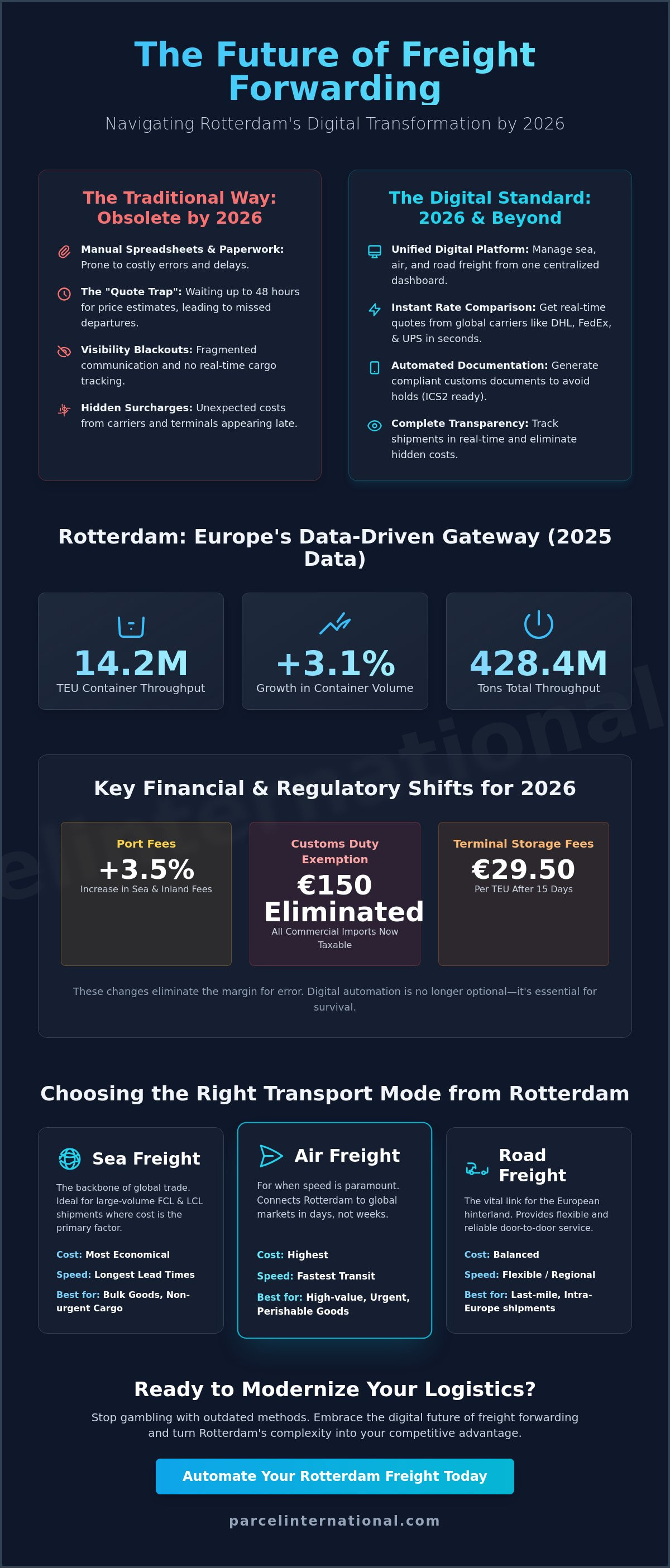
By July 2026, the traditional way of managing international freight forwarding Rotterdam will be obsolete for anyone still relying on manual spreadsheets or physical proximity to the docks. With the Port of Rotterdam increasing sea and inland fees by 3.5% this year, and the elimination of the €150 customs duty exemption on July 1, the margin for error has disappeared. You've likely felt the sting of hidden surcharges and the stress of manual paperwork errors that lead to costly delays at the terminal. It's a high-stakes environment where traditional methods can't keep up with new EU handling fees or the complexities of the Carbon Border Adjustment Mechanism (CBAM).
We know it's frustrating to manage complex logistics when the rules keep changing. This article promises to show you how to streamline your global supply chain from Europe’s largest port using advanced freight tools and automated forwarding platforms. You'll learn how to replace fragmented workflows with a unified solution that provides real-time visibility across all carriers. We'll preview the digital strategies that turn "value over volume" from a slogan into a competitive advantage for your sea, air, and road freight operations.
Key Takeaways
Learn how to use automated freight tools to compare real-time rates from global carriers like DHL, FedEx, and UPS in one centralized interface.
Master the strategic advantages of international freight forwarding Rotterdam by shifting from manual processes to a unified digital ecosystem designed for 2026 standards.
Identify the most cost-effective transport mode for your cargo by comparing sea, air, and road freight options based on lead times and budget requirements.
Navigate the complex 2026 EU customs landscape and avoid common documentation pitfalls that cause expensive delays at the port.
Discover how a singular platform eliminates hidden surcharges and simplifies how you manage FCL and LCL ocean transport.
Table of Contents
Navigating the Rotterdam Gateway: The Evolution of Freight Forwarding
The Modern Freight Tool: Automating Your Rotterdam Logistics
Comparing Multi-modal Solutions: Sea, Air, and Road from Rotterdam
Streamlining Global Trade: Customs Compliance and Documentation
Choosing Parcel International as Your Rotterdam Forwarding Partner
Navigating the Rotterdam Gateway: The Evolution of Freight Forwarding
Rotterdam isn't just a physical location; it's a massive data hub. In 2025, the port handled 14.2 million TEU, showing a 3.1% growth in container throughput despite global economic shifts. This sheer volume makes international freight forwarding Rotterdam a complex puzzle that traditional methods can't solve anymore. The 2026 standard for a modern freight forwarder isn't measured by how many trucks they own, but by how effectively their software integrates with the port's digital infrastructure. We've moved from asset-heavy logistics to a smarter, asset-light model where technology-driven brokerage dictates the speed of your supply chain. Efficiency now depends on digital aggregation rather than just having an office near the docks.
Why Rotterdam Still Dominates Global Logistics
Rotterdam remains the essential bridge between the Americas, Asia, and the European hinterland. The Maasvlakte 2 expansion continues to provide the deep-water capacity needed for the world's largest container vessels, allowing for seamless handling even as trade patterns evolve. While total throughput reached 428.4 million tons in 2025, the real story lies in the container sector's resilience. Fourth-quarter data from 2025 showed a 3.5% year-on-year increase in container volumes, with the port handling roughly 3.8 million TEUs in that period alone. This dominance is supported by a multi-modal network that links sea freight directly to rail and road networks. It's this connectivity that allows Rotterdam to serve as a high-velocity gateway for goods entering the Eurozone.
The Problem with Traditional Forwarding Workflows
Traditional workflows are buckling under Rotterdam's high-volume complexity. Many exporters are still caught in the 'Quote Trap,' where waiting 48 hours for a price estimate leads to missed vessel departures and increased storage fees at terminals like ECT Delta or Euromax. When communication is buried in endless email chains and manual spreadsheets, errors in customs documentation become inevitable. These delays aren't just inconvenient; they're expensive, especially with terminal storage rates reaching €29.50 per TEU after 15 days in 2026. Managing international freight forwarding Rotterdam through these fragmented systems often leads to visibility blackouts. The logistics visibility gap is the systemic failure to provide real-time, cross-carrier data, leaving shippers blind to their cargo's status the moment it leaves the terminal gate.
The Modern Freight Tool: Automating Your Rotterdam Logistics
The logistics industry used to prioritize who owned the most trucks. In 2026, the priority has shifted to who owns the best data. A top-tier freight tool company provides a digital layer that sits above the physical chaos of the Port of Rotterdam. It replaces manual phone calls with instant rate comparisons. By connecting to carriers like DHL, FedEx, and UPS in a single interface, you gain immediate transparency. You don't have to wonder if you're getting the best deal. You can see it. This level of clarity is the new benchmark for international freight forwarding Rotterdam.
Automating your documentation is equally critical. With the EU eliminating the €150 customs duty exemption on July 1, 2026, every commercial shipment requires precise data. Manual errors on commercial invoices lead to customs holds and unexpected handling fees. Digital platforms generate these documents automatically, ensuring compliance with the latest Import Control System 2 (ICS2) requirements. This transition from manual entry to automated generation is the most effective way to manage international freight forwarding Rotterdam without the risk of human error. It provides the relief of knowing your high-value cargo won't be sidelined by a missing signature or a tariff code mistake.
Key Features of a Digital Forwarding Platform
A modern platform acts as a stable intermediary. It aggregates shipping volumes to secure wholesale rates that individual shippers can't access on their own. This "Single Pane of Glass" philosophy allows you to manage air, sea, and road freight from one dashboard. You no longer need to jump between carrier websites to track high-value cargo. Instead, use a centralized freight tool to handle everything from automated document generation to real-time exception management. This approach strips away the procedural friction that often slows down global trade.
The Impact of Automation on SMB Growth
Small and medium businesses (SMBs) often struggle with the overhead of in-house logistics departments. Digital tools level the playing field. They give smaller exporters access to the same global carrier networks used by conglomerates. You can scale your operations from a single express parcel to full container loads (FCL) without switching platforms or hiring more staff. This flexibility is vital in a year where Rotterdam's port fees are increasing by 3.5%. By removing traditional barriers like volume minimums or complex subscriptions, these tools allow you to focus on your product rather than the friction of moving it. Reliability and punctuality become accessible benchmarks for every business, regardless of size.
Comparing Multi-modal Solutions: Sea, Air, and Road from Rotterdam
Choosing the right transport mode is the most critical decision in international freight forwarding Rotterdam. It isn't just about moving goods from point A to point B; it's about navigating the EU Customs Union while balancing lead times against a tightening budget. For large-scale shipments, Sea Freight remains the backbone of global trade. You can choose between Full Container Load (FCL) for maximum security or Less than Container Load (LCL) to keep inventory moving without waiting for a full box. In 2026, managing these costs requires precision. Terminal handling charges for dry containers now sit around €260, and overall port fees have increased by 3.5%. You need a strategy that accounts for these shifts before your cargo even hits the water.
Road Freight provides the final link, utilizing the A15 and A16 motorways for rapid hinterland access. When speed is the only priority, Air Freight justifies its premium price. While Schiphol is the major hub, Rotterdam The Hague Airport (RTM) offers specialized alternatives for specific cargo types that require faster processing than ocean transport allows. Efficiency in road transport often comes down to 'Cross-Docking,' where goods move directly from an inbound vessel to an outbound truck with minimal dwell time. This approach reduces the risk of hitting expensive storage brackets at the terminal.
Ocean Freight Excellence at the Port of Rotterdam
Understanding the 2026 fee structure is vital for maintaining your margins. At terminals like ECT Delta and Euromax, container storage is only free for the first two days. By day three, you'll face charges of €8.50 per TEU per day, which escalate sharply if your cargo sits for more than two weeks. For growing e-commerce brands, LCL is a powerful tool to avoid these bottlenecks. It allows you to ship smaller volumes frequently, maintaining a steady flow of goods without the high capital tie-up of a full container. To better understand how these costs integrate with your wider distribution network, you can consult our guide on International Road Freight Rates Europe for comprehensive trans-European context.
Air and Road: The Speed and Reach Components
The reach of international freight forwarding Rotterdam extends far beyond the docks. Road transport remains the most flexible option for reaching the European interior, though you must account for new 2026 surcharges. For instance, truck visits to Hutchison terminals now carry a €20 distribution surcharge during peak weekday hours. Shifting your schedule to off-peak times can actually earn you a €5 premium discount, showing how digital scheduling tools directly impact your bottom line. In 2026, shippers must balance the immediate demands of delivery speed against the accumulating emissions costs dictated by full CBAM implementation. This trade-off is why a multi-modal approach is no longer optional; it's a survival requirement for modern logistics.
Streamlining Global Trade: Customs Compliance and Documentation
The regulatory environment in 2026 has fundamentally changed the stakes for European trade. As of July 1, 2026, the EU has eliminated the €150 customs duty exemption for all low-value imports. Every commercial item crossing the border now incurs a cost, including a flat customs duty of €3 per item for specific e-commerce classifications. If your approach to international freight forwarding Rotterdam still relies on manual data entry, you're inviting delays. Digital platforms now use AI to pre-validate HS codes and commercial invoices, ensuring that every shipment complies with the fully operational Import Control System 2 (ICS2). This isn't just a convenience; it's a necessity for avoiding the bottleneck of manual customs inspections.
Accuracy reduces the 'Port Dwell Time' that eats into your profit margins. When your customs entries are pre-lodged and validated, your cargo spends less time sitting in the terminal and more time in transit. This shift from reactive to proactive compliance is what separates modern logistics leaders from those struggling with traditional, fragmented workflows. You don't have to worry about whether your paperwork is correct when the system checks it against global databases in real time.
Automated Compliance: Your Shield Against Delays
Managing EORI numbers and VAT requirements for non-EU destinations requires a system that understands global diversity. Automated tools ensure your commercial invoices are accurate the first time. They handle the heavy lifting of tariff classification, which is particularly vital for goods covered by the Carbon Border Adjustment Mechanism (CBAM). By pre-validating data, you eliminate the anxieties of procedural friction. Your focus stays on growth while the technology manages the administrative burden and the new Netherlands national handling fee of approximately €2 per product type.
Transparent Pricing: Avoiding Hidden Surcharges
Hidden fees are the enemy of trust. Many traditional forwarders obscure costs like documentation fees, which can reach €75 for manual submissions, or peak season premiums that appear only after you've committed. We believe in 'All-In' rates as the gold standard for international freight forwarding Rotterdam. This means you see the full cost, including fuel surcharges and port fees, at the point of booking. Our platform ensures price certainty from Rotterdam to over 220 countries, removing the fear of unexpected invoices after your cargo has already shipped. Reliability is built on this foundation of radical transparency.
This commitment to transparency and due diligence is a value shared by other local experts; for instance, when investing in Rotterdam real estate, a bouwkundige keuring huis kopen is an essential part of the process to ensure structural integrity and peace of mind.
Ready to simplify your export process? Explore our customs support services to ensure your documentation is 2026-compliant and your shipments stay on schedule.
Choosing Parcel International as Your Rotterdam Forwarding Partner
Choosing a partner for international freight forwarding Rotterdam shouldn't feel like a gamble. In a market where the Port of Rotterdam is increasing fees and the EU is tightening customs rules, you need a stable intermediary that prioritizes your peace of mind. Our platform acts as that bridge. We strip away the procedural friction by providing an interface where you can compare real-time rates from the world’s leading carriers in seconds. You don't have to wait for a callback or navigate through hidden surcharges. Everything is direct and transparent, allowing you to move from inquiry to action with total confidence.
Whether you're a startup sending your first pallet or an enterprise managing a complex flow of Sea Freight and Air Freight, our solutions are built to be inclusive. We don't believe in restrictive volume minimums or mandatory subscriptions. This egalitarian approach means you get the same high-tier carrier access and automated customs support regardless of your shipment size. You get 24/7 digital visibility through our dashboard, but you're never left alone with a screen. Our human expertise is always available to guide you through the high-stakes decisions of global logistics, ensuring your punctuality remains a competitive advantage.
The Parcel International Advantage in Rotterdam
Located at Goudsesingel 102, 3011 KD Rotterdam, we have a deep understanding of the local market dynamics. Since 2007, we've spent 19 years simplifying how businesses interact with the port and global carrier networks. Our heritage is rooted in reliability and the belief that logistics should be orderly, not chaotic. While we handle large-scale international freight forwarding Rotterdam, we also provide specialized tools for smaller needs. You can explore our guide on International Parcel Shipping to see how we manage global delivery for individual packages with the same level of digital precision.
How to Get Started with Your First Shipment
Starting your first shipment is a logical, three-step process designed for speed. First, use our shipping calculator to enter your cargo details, weight, and destination. Second, compare the instant results from our carrier partners to find the best balance of delivery speed and cost. Third, book your shipment and let our automated system generate your 2026-compliant customs documents. It's an efficient workflow that removes the typical anxieties of global trade. Compare Rotterdam freight rates and book your shipment today to experience the relief of a truly unified logistics solution.
Mastering the 2026 Logistics Landscape
The evolution of international freight forwarding Rotterdam requires a shift from manual chaos to digital precision. Success in the coming years depends on your ability to navigate rising port fees and complex EU customs regulations without slowing down your operations. By integrating automated tools and multi-modal strategies, you replace procedural friction with a streamlined, reliable workflow. Reliability isn't just a goal; it's the foundation of every shipment we handle.
Parcel International has been a stable intermediary in this high-stakes market since 2007. We provide the transparency you need to manage global trade effectively. You can access instant rates from leading carriers like DHL, FedEx, and UPS while ensuring your documentation is 2026-compliant for shipments to over 220 countries. Our platform is designed to give you the relief of a unified solution that values your peace of mind over corporate jargon. Take the first step toward a more efficient supply chain today.
Start comparing international freight rates from Rotterdam now and secure your place in the future of European logistics.
Frequently Asked Questions
What is the role of an international freight forwarder in Rotterdam?
An international freight forwarder acts as a stable intermediary that coordinates the movement of goods through Europe’s largest port. They manage the complex relationship between shippers and carriers while ensuring compliance with local regulations. By handling the logistical heavy lifting, they allow you to focus on your core business. Their expertise in international freight forwarding Rotterdam ensures that your cargo moves efficiently across sea, air, and road networks without procedural friction.
How do I choose between air freight and sea freight for Rotterdam exports?
Your choice depends on your specific lead times and budget requirements. Air freight is the superior option for urgent or high-value cargo that needs to reach global markets in days. Sea freight is more cost-effective for large volumes where speed is less critical. In 2026, you must also consider the emissions costs associated with each mode, as full CBAM implementation now adds a layer of environmental accountability to every shipment choice.
What documents are required for shipping goods internationally from the Netherlands?
Standard international shipments require a commercial invoice, a packing list, and a Bill of Lading or Air Waybill. Since the EU eliminated the €150 duty-free threshold on July 1, 2026, you also need precise HS codes for every item. Automated tools now ensure these documents are accurate before they reach the terminal. This precision is vital for navigating the EU Customs Union and avoiding the new national handling fees introduced this year.
How can a freight tool company help lower my shipping costs?
A digital freight tool lowers costs by aggregating shipping volumes to secure wholesale rates that individual businesses can't access alone. These platforms provide instant price comparisons across multiple carriers like DHL, FedEx, and UPS. This transparency prevents you from overpaying for standard routes. By replacing manual quoting with a unified digital interface, you also reduce the administrative overhead of maintaining an in-house logistics department.
Are there hidden fees when using a digital freight forwarding platform?
A transparent platform eliminates the anxieties of hidden costs by providing "All-In" rates at the point of booking. You shouldn't have to deal with unexpected fuel surcharges or peak season premiums after your cargo has shipped. Radical transparency is a central pillar of modern international freight forwarding Rotterdam. Look for partners who explicitly state their fee structures and include port fees and documentation charges in their initial estimates to ensure price certainty.
Can I track my Rotterdam freight shipment in real-time?
Yes, modern digital platforms provide 24/7 visibility through a "Single Pane of Glass" dashboard. You can monitor your shipment’s progress across different carriers and transport modes without jumping between multiple websites. This real-time data allows for proactive exception management if a disruption occurs. Having this level of insight is essential for maintaining punctuality and providing your own customers with reliable delivery updates in a high-stakes market.
What is the difference between FCL and LCL shipping in Rotterdam?
FCL (Full Container Load) means your goods occupy an entire shipping container, providing maximum security and faster transit. LCL (Less than Container Load) allows you to share container space with other shippers, which is a cost-effective solution for smaller volumes. For many growing e-commerce brands in 2026, LCL is the preferred method to maintain a steady flow of inventory without the high capital investment required for a full container.
How does automated customs documentation prevent delivery delays?
Automated documentation uses AI to pre-validate your data against global standards like Import Control System 2 (ICS2). This ensures that commercial invoices and tariff classifications are correct before the cargo reaches the Port of Rotterdam. By reducing human error, you significantly lower the risk of customs holds and expensive port dwell time. This proactive approach is the most effective shield against the logistical bottlenecks that often affect manual forwarding workflows.


