
International Parcel Tracking for Business: The 2026 Strategy Guide
- Alex
- Jul 19
- 12 min read
Updated: Jul 22
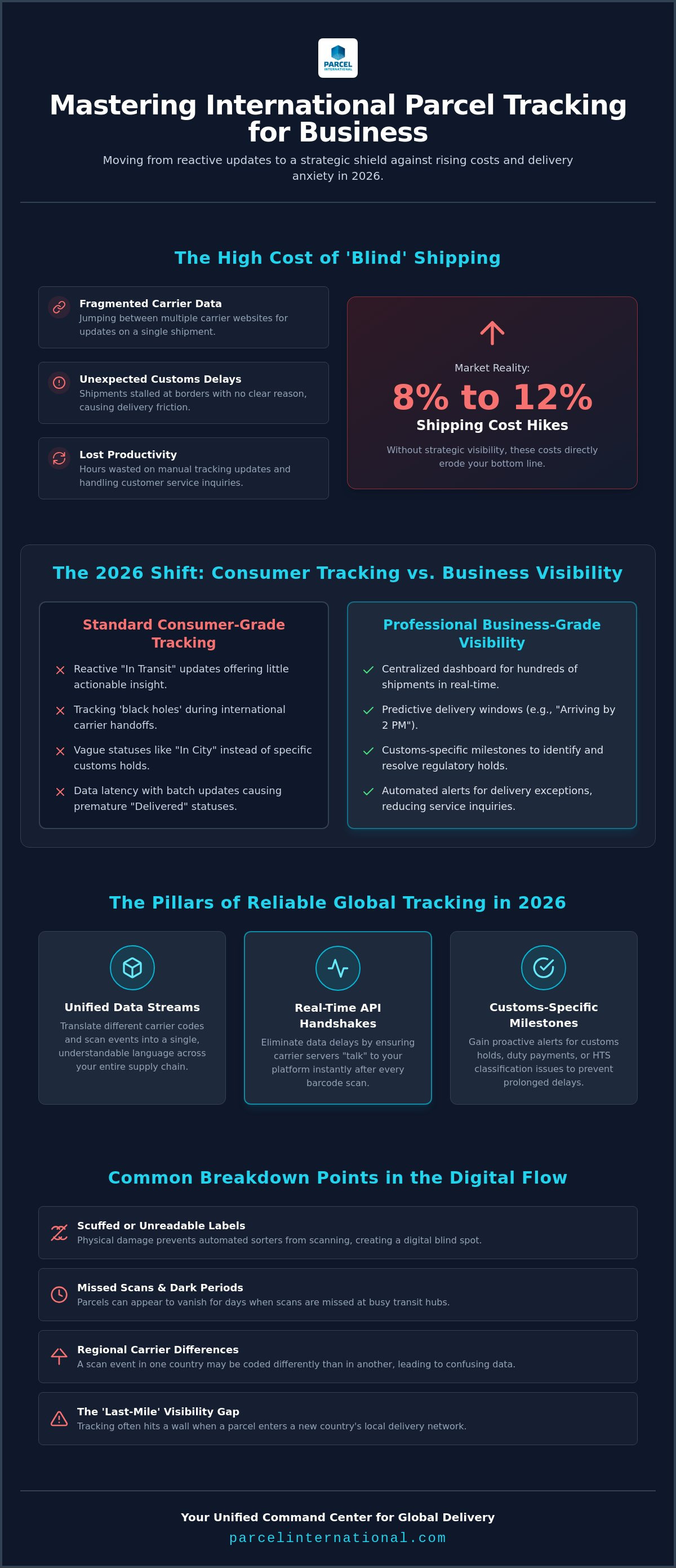
What if your international parcel tracking for business wasn't just a reactive list of "In Transit" updates, but a strategic shield against the 8% to 12% shipping cost hikes hitting the market this year? You're likely tired of jumping between fragmented carrier websites only to find a shipment stalled at a customs border you didn't see coming. It's frustrating when manual updates take up hours of your day, yet customer complaints about "missing" packages continue to pile up.
We understand that the 2026 logistics environment is more complex than ever, especially with the recent suspension of the US $800 de minimis exemption and the removal of the EU's duty-free threshold. This guide promises to help you master global shipment visibility and eliminate delivery anxieties with professional-grade strategies designed for business growth. You'll learn how to create a single source of truth for all shipments, leverage real-time alerts for delivery exceptions, and achieve seamless customs visibility that keeps your operations moving forward without hidden friction.
Table of Contents
What is Business-Grade International Parcel Tracking in 2026?
How Multi-Carrier Tracking Systems Work (and Where They Break)
Comparing Tracking Solutions: Universal Tools vs. Logistics Broker Platforms
Strategic Implementation: Optimizing Your Business Tracking Workflow
Parcel International: Your Unified Command Center for Global Delivery
What is Business-Grade International Parcel Tracking in 2026?
In 2026, professional international parcel tracking for business is no longer a luxury; it's a core operational requirement. It's a centralized visibility system that aggregates data from multiple carriers into a single, real-time dashboard. Unlike consumer tools that just tell you where a box is, business-grade systems allow you to manage the status of hundreds of shipments simultaneously. The industry has shifted toward hyper-transparent supply chains where every stakeholder expects granular data. Understanding how package tracking works at a foundational level is helpful, but businesses today need to move beyond simple location pings to predictive delivery windows.
Your reputation depends on moving from "your package is on the way" to "it will arrive by 2 PM." This transition requires professional logistics aggregator platforms rather than basic courier websites. These platforms act as a reliable bridge, filtering out the noise of complex global logistics and providing the relief of a singular, unified solution. Implementing a robust system for international parcel tracking for business allows you to reclaim hours of lost productivity and project an image of total reliability to your global client base.
The Cost of 'Blind' Shipping for SMBs
Small and medium businesses often fall into the trap of "blind shipping," which refers to the lack of visibility once a parcel leaves the warehouse. This leads to hidden expenses that drain your bottom line. Every minute an employee spends manually refreshing individual carrier sites is a minute of lost productivity. Worse, when you can't answer a customer's question about their "missing" package, trust erodes instantly. Increased customer service churn is the direct result of this visibility gap. Blind shipping is the primary obstacle to e-commerce scaling.
Why Standard Tracking Fails the Global Business
Standard tracking often breaks during international carrier handoffs. When a parcel moves from a domestic carrier to an overseas partner, it often falls into a "black hole" where updates stop for days. Data latency is another major failure point. You've likely seen tracking that says "Delivered" while the customer is still staring at an empty porch because the system updated prematurely. Finally, professional tracking must account for customs. If a package is stalled, your tracking should explicitly state it's held for duty payment or HTS classification, not just that it's in a specific city. Reliable tracking in 2026 demands:
Real-time API handshakes that eliminate data delays.
Customs-specific milestones to identify regulatory holds immediately.
Unified data streams that translate different carrier codes into a single, understandable language.
How Multi-Carrier Tracking Systems Work (and Where They Break)
Modern systems for international parcel tracking for business rely on a technical process known as the API handshake. This is where the carrier’s server "talks" to an aggregator’s platform, transferring data packets every time a barcode is scanned. To successfully manage international shipping and logistics, businesses must look beyond the surface level of a simple tracking ID. You need a system that translates these data packets into meaningful milestones: sorting at the origin hub, export clearance, customs arrival, and final mile dispatch. Without this technical bridge, you're left with a series of disconnected status updates that offer no real insight into your supply chain.
Physical reality often interferes with this digital flow. Tracking breaks when labels are scuffed in transit, making them unreadable by automated sorters. Missed scans at busy transit hubs create "dark periods" where a parcel seems to vanish for days. Regional carrier differences also play a role; a scan event in Germany might be coded differently than one in Japan. Speed of data is the final hurdle. While some systems use batch updates that only refresh every few hours, high-priority express shipping requires real-time data to manage expectations. Choosing a partner that prioritizes high-frequency data ensures your international parcel tracking for business remains accurate and actionable.
The 'Last-Mile' Visibility Gap
Tracking often hits a wall when a parcel enters a new country’s local network. This "last-mile" gap occurs because the global carrier may hand off the package to a local courier who uses a different reporting system. Logistics brokers solve this by integrating these local data streams into a single dashboard. This end-to-end milestone reporting is vital for business accountability. It ensures you know exactly who is responsible for the package at every moment, from the air cargo hold to the customer's doorstep.
Carrier Handoffs and Data Latency
Data latency is most common when a parcel moves from air freight to road transport. These handoffs involve different logistics layers, often causing a delay between the physical movement and the digital update. A unified platform reconciles these different formats, translating them into a standardized timeline. It also manages time-zone discrepancies, so a "delivered" status at 5 PM in Singapore doesn't appear as a future event on your London-based dashboard. Managing these complexities is simpler when you use a platform designed to bridge these gaps, such as the tools available at Parcel International.
Comparing Tracking Solutions: Universal Tools vs. Logistics Broker Platforms
Choosing the right tool for international parcel tracking for business depends on your shipment volume and the level of data depth your operations require. Universal tracking websites are often the first stop for many small businesses. These tools are excellent for one-off consumer purchases because they aggregate data based on standards set by the Universal Postal Union. However, they lack the analytical depth needed for commercial scaling. They don't provide customs status alerts, bulk shipment management, or historical performance data. If you're managing more than a handful of packages a week, relying on these consumer-level tools creates a fragmented workflow that eventually leads to navigational chaos.
Professional SaaS tracking software offers a more robust alternative with features like branded tracking pages and AI-driven delivery estimates. The catch is the cost. Most SaaS providers require high monthly subscription fees that eat into your margins. For businesses looking to optimize their budget, logistics broker platforms provide a more efficient path. These platforms combine real-time tracking with wholesale shipping rates and automated customs tools. You don't just see where your package is; you manage the entire lifecycle of the shipment from a single interface. Move away from manual tracking once your volume makes individual carrier site-hopping a drain on your productivity.
SaaS Software vs. The Broker Model
Analyze the total cost of ownership when choosing between these models. SaaS subscriptions are a recurring overhead that stays the same regardless of your shipping volume. In contrast, the broker model offers a "no-fee" entry point. At Parcel International, we include professional tracking as part of our core service, ensuring you don't face hidden restrictions or subscription barriers. This approach provides the relief of a high-end tool without the high-end price tag. It's a strategic way to keep your international shipping rates competitive while maintaining full visibility.
The Advantage of Unified Visibility
Managing DHL, FedEx, and UPS shipments in separate tabs is a recipe for error. Centralized tracking simplifies the international parcel shipping process by pulling every milestone into a single dashboard. This "radical transparency" is the new benchmark for 2026. It allows you to spot a customs delay in Italy while simultaneously confirming a final-mile delivery in Canada. When your data is unified, your customer service team can answer inquiries with confidence and speed, transforming tracking from a technical task into a strategic asset for growth.
Strategic Implementation: Optimizing Your Business Tracking Workflow
Strategic implementation transforms international parcel tracking for business from a simple status check into a high-performance engine for growth. Instead of waiting for a customer to complain about a late package, use automation to stay ahead of the curve. Set up triggers that send notifications when a parcel reaches "In Transit" or "Out for Delivery" milestones. This keeps your customers informed without requiring a single manual update from your team. You should also use tracking data as an auditing tool. By reviewing historical performance, you can identify which carriers consistently experience delays on specific routes and adjust your logistics strategy accordingly.
Exception management is where professional systems prove their value. When a status changes to "Held in Customs" or "Delivery Attempt Failed", your team needs an immediate alert. Addressing these issues before the customer even notices creates a sense of total reliability. Linking your tracking system directly to your international shipping customs documentation ensures that if a border officer needs more information, you can provide it within minutes rather than days. This level of back-office efficiency is what separates scalable e-commerce brands from those struggling with administrative overhead.
Proactive Exception Management
Set up internal alerts for any shipment that hasn't moved in 24 hours. This proactive approach reduces the anxiety often associated with global shipping. If a physical delay occurs, such as a missed flight or a port strike, working with a freight forwarder can help you find alternative routes or resolve the bottleneck. The goal is to move from reactive firefighting to a controlled, predictable workflow that values the customer's peace of mind.
Just as WithCare Support Services prioritizes peace of mind through professional disability support, a robust tracking system ensures your customers feel supported throughout the delivery journey.
Integrating Tracking with Customs Compliance
Automated commercial invoices are essential to prevent tracking stalls at the border. Incomplete data is the most common reason for a "Held" status in 2026. Use the "Rotterdam Advantage" by leveraging local expertise for European entry points, ensuring your shipments clear customs with minimal friction. When duty payments are handled upfront, you remove the final barrier to the delivery milestone. This ensures that the final mile is as smooth as the first. To see how these professional tools can transform your operations, you can start optimizing your shipping workflow today with our unified platform.
Parcel International: Your Unified Command Center for Global Delivery
Since our founding in 2007, we've provided a stable and reliable bridge for businesses navigating the complexities of global trade. Our Rotterdam-based hub serves as a strategic gateway, connecting your operations to over 220 countries and territories. We understand that in 2026, international parcel tracking for business is about more than just data; it's about the security of knowing your shipments are in expert hands. By partnering with industry leaders like DHL, FedEx, and UPS, we combine massive global reach with the personalized, professional support of a dedicated logistics broker.
Our platform is engineered for speed and total compliance. We've built automated documentation tools that stay ahead of the latest regulatory shifts, such as the 2026 removal of duty-free thresholds in the EU and the suspension of de minimis exemptions in the US. These tools ensure that your commercial invoices and HTS classifications are accurate from the moment of booking, preventing the "black hole" delays that plague unoptimized supply chains. We believe that professional logistics should be accessible, which is why we've removed the barriers of subscription fees and volume minimums that often restrict growing businesses.
The "No Hidden Fees" promise is a central pillar of our identity. While many SaaS tracking providers charge monthly premiums for visibility, we include professional-grade international parcel tracking for business as a standard part of our service. You pay for your shipping, and the visibility comes included. This transparent model allows you to maintain healthy margins while enjoying the same level of shipment control as a multinational corporation. We act as your stable intermediary, ensuring that your data is always accurate, your costs are clear, and your deliveries are punctual.
Why Transparency is Our Signature
We've focused on stripping away procedural friction by creating a user-friendly interface that prioritizes action over jargon. You gain immediate access to wholesale rates from major global carriers, allowing you to compete on a level playing field regardless of your monthly volume. Moving from fragmented, multi-platform workflows to our singular, unified solution provides the immediate relief of an orderly, predictable logistics process. By making the absence of hidden requirements a core feature, we project an honest, straightforward persona that values your peace of mind above all else.
Getting Started with Professional Tracking
Booking your first shipment is a straightforward process that automatically activates real-time tracking across our entire partner network. Our system guides you through the necessary customs data requirements, ensuring your parcels are ready for the rigorous formal entry processes now required in major global markets. You don't have to deal with the stress of held shipments or unexpected surcharges when you have our automated customs support behind every label. Register today for a free account and start tracking like a pro.
Secure Your Supply Chain for 2026 and Beyond
The logistics landscape has shifted toward a model of hyper-transparency. Success in this environment requires more than just a basic tracking number; it demands a proactive strategy that integrates customs visibility with real-time data flow. By moving away from fragmented carrier sites and high-fee SaaS subscriptions, you reclaim both your operational time and your profit margins. Implementing professional international parcel tracking for business ensures that delivery exceptions are identified and resolved before they ever reach the customer's inbox.
Parcel International provides the stable bridge you need to reach over 220 countries and territories from our Rotterdam hub. As an independent partner of DHL, FedEx, and UPS, we offer direct access to wholesale rates and professional visibility with no subscription required. It's time to replace the anxiety of fragmented workflows with the relief of a singular, orderly command center. Compare rates and track your business parcels globally with Parcel International and experience the efficiency of a truly unified logistics partner. Your global growth starts with total visibility.
Frequently Asked Questions
How do I track an international parcel from multiple carriers in one place?
You can track shipments across different carriers by using a logistics aggregator or a multi-carrier dashboard. These platforms use API integrations to pull real-time data from partners like DHL, FedEx, and UPS into a single interface. This creates a unified source of truth for your operations. It eliminates the need to manually check separate carrier websites for every individual shipment.
Why is my international business shipment stuck in customs?
Customs delays typically happen because of missing documentation, incorrect HTS codes, or unpaid duties and taxes. In 2026, the suspension of the US $800 de minimis exemption and the removal of the EU duty-free threshold mean more shipments require formal entry. Check your tracking for status codes like "Held for Duty" to see if a payment or a specific document is required to clear the border.
To manage the secure digital exchange of sensitive customs or legal paperwork, check out byNow - Bezpieczna platforma wymiany dokumentów i wysyłki dokumentów, which serves as a reliable alternative to traditional registered mail.
What is the best international parcel tracking for small businesses?
The best international parcel tracking for business combines professional visibility with cost-effective shipping rates. Logistics brokers are often the superior choice for SMBs because they provide high-end features like customs alerts without the expensive monthly subscription fees of SaaS software. This model allows you to manage global delivery with the same precision as a large corporation while keeping your overhead low.
Can I track air, sea, and road freight on the same platform?
Yes, professional logistics platforms allow you to monitor express shipping, air freight, sea freight, and road freight within one dashboard. This unified visibility is vital for managing complex global supply chains. It ensures you can oversee a container on the ocean and an express parcel on a plane without switching tools. This centralized approach provides the relief of an orderly, predictable workflow.
How often is international tracking data updated?
Tracking data usually refreshes in real-time or every few hours depending on the carrier's scanning frequency at transit hubs. Express air cargo updates more frequently than sea freight because it passes through more milestones in a shorter period. For high-priority shipments, use a platform that utilizes direct API handshakes. This minimizes data latency and ensures you see the most current status available.
What should I do if my tracking number isn't showing any updates?
First, confirm that the parcel was physically picked up by the carrier and not just that a label was created. If updates stop for more than 48 hours, contact your logistics provider to investigate potential label damage or "dark periods" in the carrier network. Proactive monitoring helps you catch these stalls early. This allows you to resolve issues before they result in customer complaints.
Does Parcel International charge a subscription fee for tracking?
No, we do not charge any subscription fees or monthly costs for our tracking tools. Professional international parcel tracking for business is included as a standard feature of our platform. You only pay for the shipping services you use. This transparent model provides you with high-stakes visibility and automated customs tools without the burden of recurring software expenses or hidden requirements.
How can I share tracking updates automatically with my customers?
You can set up automated email or SMS triggers within your logistics dashboard. These notifications alert your customers when a package reaches milestones like "In Transit" or "Out for Delivery." This proactive communication reduces delivery anxiety and builds trust. It also significantly lowers the number of customer service inquiries your team has to handle manually every day.


This guide clearly explains why unified visibility and customs alerts are essential for international business shipping.
Companies can check cargo tracking on Qatar Airways for air shipments and HMM tracking container updates for sea freight.
Thanks for sharing this practical 2026 tracking strategy!