
International Shipping Rates 2026: The Comprehensive Buying Guide
Updated: Jun 3
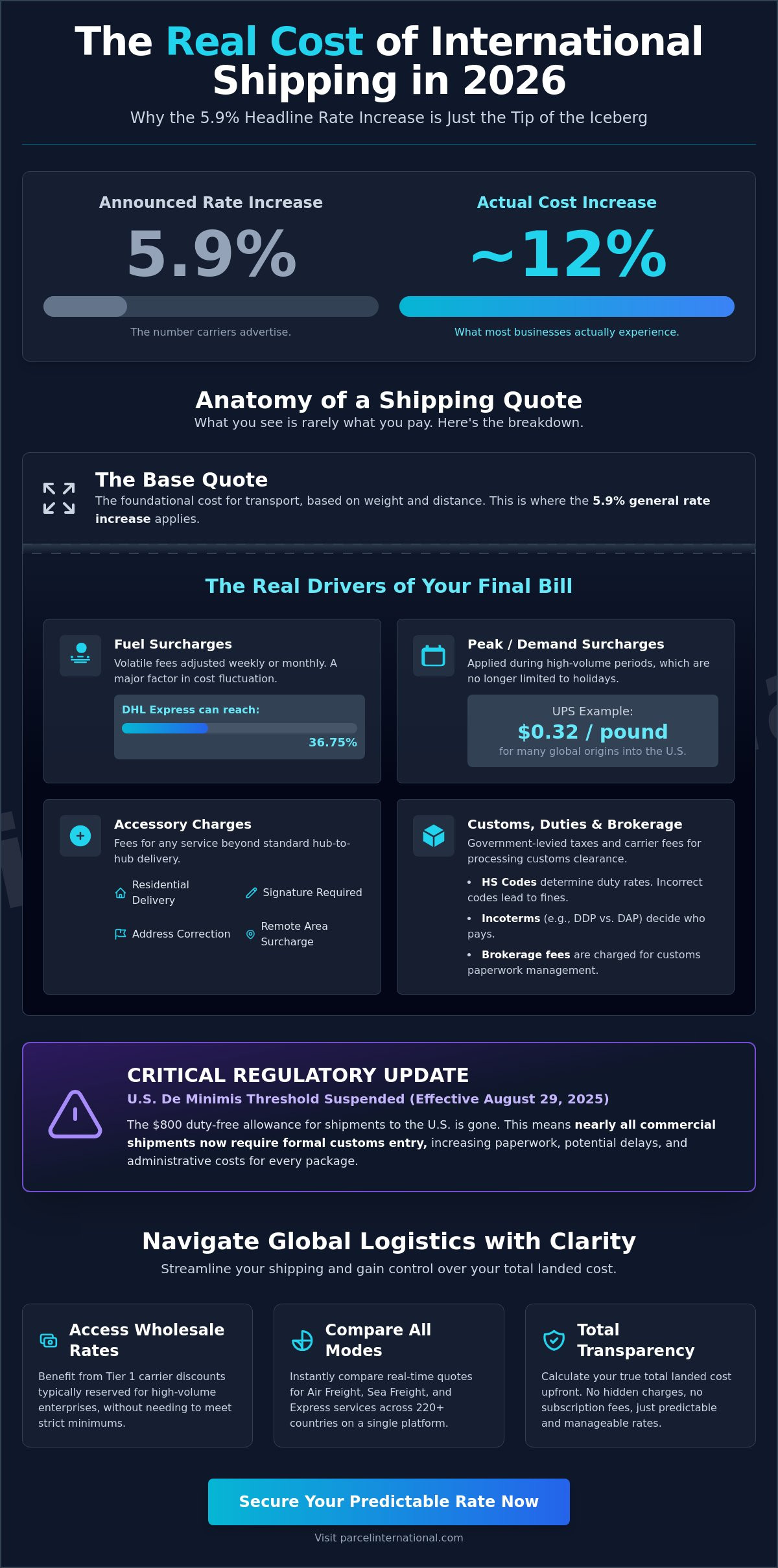
While FedEx, UPS, and DHL announced a headline rate increase of 5.9% for 2026, the actual cost of international shipping rates for most businesses is climbing by as much as 12%. You probably feel that the base quote is rarely what you end up paying at the end of the month. Between the May 2026 fuel surcharge adjustments and the administrative weight of the U.S. de minimis suspension that took effect in August 2025, global logistics can feel like a moving target. It’s frustrating to manage inconsistent delivery times while trying to protect your profit margins from hidden fees.
Sea Freight is the most cost-effective method for high-volume, heavy shipments that are not time-sensitive. For smaller parcels, standard national postal networks often provide the lowest entry price, though they typically offer slower transit times and less robust tracking than express carriers. If you need a balance between speed and budget, LCL (Less than Container Load) shipping allows you to share container space, significantly lowering your per-unit freight cost compared to individual air parcels. For even larger shipments, FCL (Full Container Load) Shipping through specialists like Blue Shipping offers a dedicated solution that further optimizes costs for global trade.
Sea Freight is the most cost-effective method for high-volume, heavy shipments that are not time-sensitive. To optimize your global supply chain, you can find out more about International Sea Freight through experienced providers like Freight and More Pty Ltd. For smaller parcels, standard national postal networks often provide the lowest entry price, though they typically offer slower transit times and less robust tracking than express carriers. If you need a balance between speed and budget, LCL (Less than Container Load) shipping allows you to share container space, significantly lowering your per-unit freight cost compared to individual air parcels.
You deserve a transparent view of your total landed costs. This guide will help you master these complexities so you can secure the most competitive rates and move from fragmented workflows to a unified shipping strategy. We will break down the specific carrier increases for 2026, explain how to handle formal customs entries for all shipments, and show you how to compare Air Freight, Sea Freight, and Express Shipping options to ensure your budget remains predictable while reducing the time spent on manual quotes.
Key Takeaways
Distinguish between base quotes and fluctuating surcharges to build a logistics budget that actually holds up at the end of the month.
Calculate your total landed cost using precise HS Codes to secure predictable international shipping rates and avoid unexpected customs friction.
Identify when to utilize national postal services for non-urgent parcels versus the speed of express carriers for high-priority shipments.
Apply dimensional weight optimization to your packaging to eliminate the cost of shipping air and protect your profit margins.
Streamline your global logistics by comparing multiple freight modes across 220 countries on a single platform with no subscription fees.
Table of Contents
Understanding the Architecture of International Shipping Rates
Your journey to predictable logistics begins with understanding that a quote is a multi-layered calculation. The foundation is the Base Rate. This figure represents the cost of moving your shipment from point A to point B based on weight and distance. However, the base rate is rarely the final price you pay. In 2026, major carriers like FedEx and UPS implemented a 5.9% general rate increase, but this headline number doesn't tell the whole story of international shipping rates.
Variable costs, specifically fuel surcharges, drive the most volatility. These fees aren't fixed; carriers adjust them frequently to align with energy markets. For instance, in May 2026, both UPS and FedEx updated their international fuel surcharge tables. DHL Express updates its surcharges weekly, with export surcharges recently reaching 36.75%. You must also account for Peak Season Surcharges (PSS) or demand fees. These are no longer just for the holidays. As of May 2026, UPS maintains demand surcharges of 32 cents per pound for shipments into the U.S. from most global origins.
While standard parcel rates apply to small packages, larger shipments require the expertise of the global maritime transport industry or specialized Air Freight. Freight forwarding costs involve different math, focusing on pallet positions or container space rather than individual package weight. Understanding these distinctions helps you choose the right transport mode for your specific volume.
Base Rates vs. Accessory Charges
Standard delivery services cover transport between commercial hubs. If your shipment requires a value-added service, carriers apply accessory charges. Common examples include residential delivery fees, signature requirements, and remote area surcharges for hard-to-reach locations. These are the "hidden" fees that often surprise businesses. Always audit your quote for these line items before you book. If a carrier quote seems unusually low, check if they've omitted these essential administrative costs.
The Role of Logistics Brokers and Aggregators
Logistics platforms like Parcel International serve as a bridge between your business and major carriers. Brokers access "Tier 1" wholesale rates that are typically reserved for high-volume enterprises. When you use an aggregator, you benefit from these negotiated discounts without needing to meet strict volume minimums yourself. This business model removes the barriers of retail pricing. You get the same Express Shipping or Sea Freight services but at a lower cost-per-package. Most importantly, transparent platforms don't charge subscription fees, which simplifies your overhead and makes your international shipping rates more manageable.
Calculating Total Landed Cost: Beyond the Base Quote
Profitability in global trade doesn't depend on your initial quote. It depends on your total landed cost. Many businesses make the mistake of focusing only on international shipping rates, ignoring the secondary fees that appear on the final invoice. Total landed cost includes the base freight, fuel surcharges, customs duties, taxes, and brokerage fees. If you don't account for these variables, a shipment that looks profitable on paper can quickly become a financial loss. You need a transparent view of every cost component to maintain healthy margins.
Customs brokerage fees are a standard part of this equation. Carriers charge these fees to act as your intermediary with government agencies. While some lightweight shipping options might seem simpler, commercial shipments usually require formal entry. These administrative costs are separate from the duties themselves, but they're essential for ensuring your goods actually reach their destination without getting stuck in a bonded warehouse. Without professional oversight, these fees can vary wildly between different providers.
Demystifying Duties and Taxes
Your choice of Incoterms determines who pays the government. Under Delivered Duty Paid (DDP), you take responsibility for all costs, providing a seamless experience for your customer. Delivered at Place (DAP) requires the recipient to pay duties before delivery, which often leads to refused packages and customer friction. HS Codes serve as the universal language for classifying and taxing goods across international borders. Using the wrong code can result in overpayment or heavy fines from customs authorities.
The global regulatory environment is shifting toward stricter enforcement. A major change occurred on August 29, 2025, when the U.S. suspended the $800 de minimis threshold. This means that nearly all commercial shipments entering the U.S. are now subject to formal customs entry and duty payments, regardless of their value. You can no longer rely on low-value exemptions to keep your international shipping rates down. You must factor in these mandatory costs for every unit you ship.
Customs Documentation and Compliance
Missing or inaccurate paperwork is the primary cause of delivery delays and unexpected storage fees. When a commercial invoice lacks a clear description or the correct HS Code, customs officials will hold the shipment. These delays aren't just frustrating; they're expensive. Automated commercial invoices help eliminate manual errors and ensure that your data matches carrier requirements. For a deeper look at the specific forms you need, read our guide on Navigating International Customs and Documentation. If you want to simplify this process, our team provides integrated customs support to help you clear shipments without the administrative headache.
Comparing Major Carriers: UPS, FedEx, DHL, and Postal Services
Selecting the right carrier requires a strategy that looks beyond the lowest headline price. Each major provider has specific regional strongholds that influence your international shipping rates. DHL remains the dominant force in Europe and Africa, offering dense delivery networks that often result in faster clearance. FedEx and UPS provide unparalleled infrastructure within North America and have expanded their footprint across the Asia-Pacific region. If you rely on a single carrier for every global destination, you're likely paying a premium for their weaker lanes. A carrier-agnostic approach allows you to leverage the specific strengths of each provider based on the destination zip code.
National postal services offer a different trade-off. Effective January 2026, many government postal rates increased by an average of 4-8%. While these services are generally the most cost-effective option for non-urgent, lightweight parcels, they lack the integrated customs support found with private express carriers. Since the regulatory shift toward stricter enforcement for low-value goods, even small postal shipments face higher scrutiny. Before choosing this route, consult official resources for Understanding Import Tariffs and Fees to ensure you've calculated the full cost of entry. Postal tracking is also less granular, which can be a risk for high-value commercial goods.
Express Carriers: When Speed is Non-Negotiable
Express services are built for reliability and speed. You can typically choose between "Priority" overnight services and "Economy" options that take 3-5 business days. While general rate increases apply to both, economy services offer a significant discount if your timeline allows for a few extra days in transit. These carriers provide the best end-to-end visibility and insurance options. As package weight increases, express rates scale sharply. For shipments over 150 lbs, you should evaluate if the speed of Express Shipping still justifies the cost compared to consolidated freight options.
Freight Forwarding for Bulk Shipments
When your volume grows, transitioning from parcel shipping to Air Freight or Sea Freight becomes essential for protecting your margins. Less than Container Load (LCL) shipping allows you to share container space with other businesses, significantly reducing your cost per unit. This is the most efficient way to manage bulk inventory without the expense of a full container. For heavy-load logistics specifically within the EU, our guide on International Road Freight Rates Europe provides a detailed breakdown of regional pricing. Moving to freight doesn't mean losing speed; Air Freight offers a middle ground that is faster than sea but more affordable than individual express parcels.
Actionable Strategies to Reduce Your International Shipping Spend
Reducing your overhead in 2026 requires looking beyond the carrier's sticker price. While the major logistics providers announced a 5.9% headline increase, industry data from April 2026 suggests the real cost impact for most shippers is between 8% and 12%. This gap is driven by aggressive surcharge structures and stricter enforcement of dimensional weight rules. To protect your margins, you must move from passive acceptance of carrier quotes to active optimization of every package you send. You don't have to be a high-volume enterprise to secure competitive international shipping rates; you simply need to apply the right efficiency levers.
Optimizing Dimensional Weight
Carriers don't just bill you for how much a package weighs; they bill you for the space it occupies in their planes and trucks. This is known as Dimensional (DIM) Weight. To calculate your DIM weight, use the standard industry formula: (Length x Width x Height) / Divisor. While the divisor can vary by carrier, the result is the "volumetric weight" you'll be billed for if it exceeds the actual scale weight. In 2026, your box dimensions are as critical to your rate as the actual weight of the contents. You can instantly lower your costs by choosing the smallest possible box for every order. Avoid "shipping air" by using custom-fit boxes or adjustable packaging that eliminates wasted volume. If you're shipping multiple items to the same destination, consolidate them into a single larger box. This reduces the number of base fees and surcharges applied to your shipment.
You can also find significant savings by decoupling your insurance from the carrier's declared value fees. Carriers often charge a premium for coverage that third-party insurance providers can offer at a fraction of the cost. By using independent insurance, you lower the total invoice without sacrificing the security of your high-value goods.
Leveraging Volume and Frequency
A single-carrier strategy often leads to higher long-term costs because it limits your ability to pivot when surcharges fluctuate. Relying on one provider makes you vulnerable to their specific regional price hikes or demand fees. Instead, utilize your shipping data to negotiate from a position of strength. Even small businesses can access "Tier 1" volume discounts by using multi-carrier platforms. These platforms aggregate the volume of thousands of shippers, allowing you to benefit from enterprise-level pricing without a subscription or minimum volume requirement. This approach ensures you always have the flexibility to choose between Express Shipping, Air Freight, or Sea Freight based on the current market reality. If you're ready to stop overpaying for logistics, you can compare international shipping rates across 220 countries on our unified platform today.
Why Parcel International is the Smart Choice for Global Rates
Managing global logistics shouldn't feel like a fragmented, multi-platform struggle. While carrier-direct portals often obscure the best deals, our platform serves as a transparent intermediary that prioritizes your peace of mind. We provide a singular, unified solution for comparing international shipping rates across more than 220 countries and territories. This carrier-agnostic approach ensures you aren't locked into one provider's specific price hikes or regional limitations. By stripping away the typical anxieties of hidden costs and procedural friction, we allow you to focus on growing your business rather than auditing invoices.
Transparency is the central pillar of our identity. Unlike many competitors, we do not charge subscription fees or hidden registration costs. You only pay for the services you use, whether you're booking Express Shipping for a time-sensitive parcel or coordinating complex Sea Freight for bulk inventory. Our Rotterdam-based expertise acts as a strategic gateway to European and global markets, linking decades of industry experience directly to the practical benefits you receive today. We act as an optimizer, taking the chaotic process of global trade and making it orderly through a logical, action-oriented workflow.
The Platform Advantage
Efficiency is built into our core technology. Our real-time rate engine compares options from DHL, FedEx, and UPS in seconds, presenting you with the most cost-effective routes without the need for manual research. Once your shipment is in transit, you benefit from centralized tracking for all your international orders on one dashboard. This eliminates the need to jump between different carrier sites to monitor your supply chain. If an issue arises, our dedicated support team provides a protective layer of expertise that far exceeds the capabilities of standard carrier call centers. We don't just provide a quote; we provide comprehensive customs support to ensure your paperwork is compliant and your goods clear borders without administrative delays.
Getting Started: Your First Quote
Onboarding is a simple, straightforward process designed for businesses of all sizes. You don't need to meet high-volume minimums to access the same competitive international shipping rates enjoyed by enterprise-level shippers. We've removed the traditional barriers to entry, making our platform inclusive and adaptable to your specific needs. Use our free calculator to generate an immediate estimate and see the difference that radical transparency makes for your bottom line. Take control of your logistics budget and move toward a more predictable, seamless shipping experience. Compare international shipping rates and save today by joining a community of businesses that value reliability and order in a complex global market.
Secure Predictable Logistics in a Shifting Market
Success in global trade requires more than just accepting carrier quotes. You've seen how the 2026 landscape demands a focus on total landed cost, especially with the suspension of the U.S. de minimis threshold and fluctuating fuel surcharges. By optimizing your dimensional weight and moving away from a single-carrier strategy, you regain control over your margins. Logistics shouldn't be a source of anxiety; it should be an orderly part of your business growth. When you bridge the gap between fragmented workflows and a unified platform, you eliminate the friction that slows down your supply chain.
Secure the most competitive international shipping rates by leveraging our direct access to wholesale pricing from DHL, FedEx, and UPS. You don't have to worry about subscription costs or hidden registration fees. Our platform includes automated customs documentation tools to prevent delays and ensure compliance with the latest global regulations. You can now manage your Air Freight, Sea Freight, and Express Shipping from one reliable hub. Compare and Book Your International Shipment Now. Take the first step toward a more efficient, transparent, and profitable shipping strategy today.
Frequently Asked Questions
How are international shipping rates calculated in 2026?
Calculation involves combining the base freight cost with variable accessory charges and government-mandated fees. In 2026, you must factor in the general rate increases implemented by major carriers alongside frequently updated fuel and demand surcharges. The distance between the origin and destination, the actual or dimensional weight, and the chosen transport mode determine the foundation of your quote. You should also account for regional peak season fees that fluctuate based on global trade volume.
What is the cheapest way to ship a parcel internationally?
Sea Freight is the most cost-effective method for high-volume, heavy shipments that are not time-sensitive. For smaller parcels, standard national postal networks often provide the lowest entry price, though they typically offer slower transit times and less robust tracking than express carriers. If you need a balance between speed and budget, LCL (Less than Container Load) shipping allows you to share container space, significantly lowering your per-unit freight cost compared to individual air parcels.
How do customs duties and taxes affect my total shipping rate?
Duties and taxes are mandatory costs that can significantly increase your total landed cost beyond the carrier's initial freight quote. Since the regulatory shift in August 2025 regarding de minimis thresholds, nearly all commercial goods entering the U.S. require formal customs entry and duty payment. These costs vary based on the destination country's tax laws and the specific classification of your goods. Inaccurate documentation can lead to overpayment or expensive administrative fines.
What is dimensional weight and how does it impact my costs?
Dimensional weight is a pricing model that bills based on package volume rather than its actual scale weight. Carriers apply a specific divisor to your package dimensions to ensure they are compensated for the space an item occupies in their network. If the volumetric weight is higher than the actual weight, you are billed for the larger figure. This is particularly impactful for light but bulky items. Reducing your box size is the most direct way to lower these costs.
Can I get discounted international shipping rates as a small business?
Yes, small businesses can access wholesale international shipping rates by leveraging the combined volume of a logistics aggregator. These platforms negotiate "Tier 1" discounts with major carriers that are usually reserved for high-volume enterprises. By using a platform like Parcel International, you avoid the need for restrictive contracts or monthly subscription fees. This allows even small-scale shippers to maintain healthy profit margins while competing effectively on a global scale.
Why do shipping rates fluctuate so frequently?
Rates change often because carriers update fuel and demand surcharges in response to global energy markets and infrastructure constraints. Fuel surcharges are often adjusted weekly to reflect current market indexes, while demand fees shift based on cargo capacity in specific regional lanes. These adjustments happen quickly to protect carrier margins against volatile operating costs. Utilizing a real-time rate engine is essential for maintaining an accurate and predictable logistics budget throughout the year.
Is it better to use a broker or go directly to a carrier like DHL or FedEx?
Using a broker provides a carrier-agnostic view that allows you to compare multiple rates and transit times on a single platform. While going direct to a carrier limits you to one provider's pricing and regional strengths, a broker aggregates options to find the best fit for each specific shipment. This platform advantage removes the friction of managing multiple accounts and typically provides access to better discounts through collective volume negotiation without requiring your own high-volume contract.
What documents are required to secure an accurate international shipping quote?
To receive a precise estimate, you must provide a commercial invoice, a detailed packing list, and the correct HS codes for your items. Accurate documentation ensures your quote reflects the true cost of duties and prevents expensive storage fees at the border. You must also provide the exact dimensions and weight of your packaged goods. This transparency prevents the carrier from applying unexpected adjustments to your final invoice after the shipment has already entered their global network.


