
International Shipping Software: 2026 Small Business Guide
- Alex
- Aug 13
- 11 min read
Updated: Aug 18
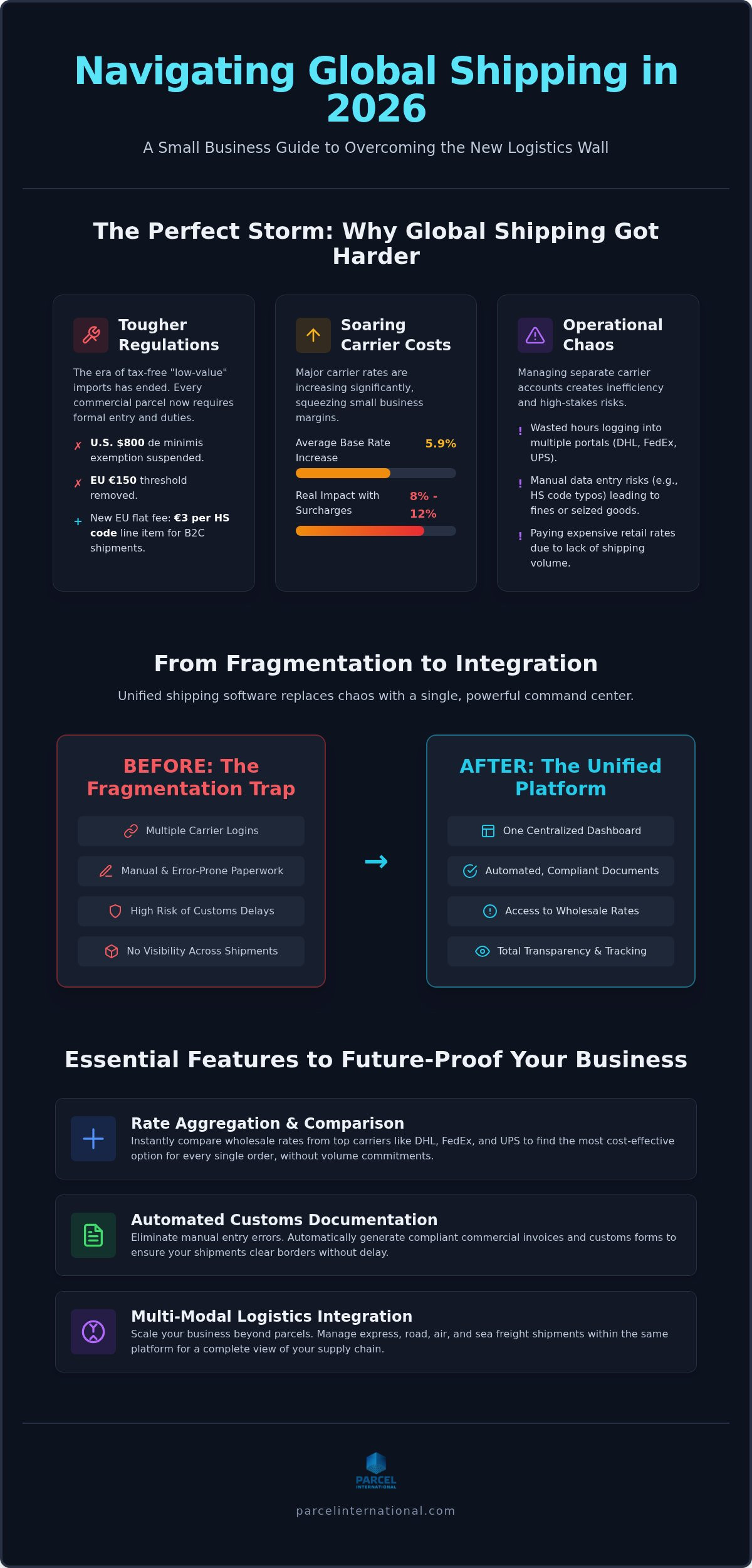
Did you know that as of mid-2026, the era of tax-free "low-value" imports has officially ended in both the U.S. and the EU? With the suspension of the $800 de minimis exemption and the removal of the EU’s €150 threshold, every commercial parcel now requires formal entry and duties. For many, this regulatory shift feels like a wall. If high shipping costs and manual customs paperwork are stalling your global growth, you aren't alone. Finding the right international shipping software for small business is no longer just about printing labels. It's about survival in a landscape where major carrier rates rose by an average of 5.9% this year before surcharges even hit the invoice.
We understand the frustration of logging into multiple carrier portals just to track a single shipment. This guide promises a better way to operate. You'll discover how to eliminate shipping friction, automate your customs compliance, and access wholesale rates without the burden of monthly subscriptions. We are going to preview the transition from fragmented workflows to a unified dashboard that handles everything from express parcels to sea freight. It's time to reclaim your margins and move your products across borders with total transparency and zero hidden fees.
Table of Contents
Why Small Businesses Struggle with Global Logistics in 2026
The logistics landscape in 2026 isn't just complex; it's volatile. Small businesses are currently facing a perfect storm of rising costs and aggressive regulatory shifts. Major carriers like FedEx and UPS implemented average 5.9% rate increases early this year, but the real impact often hits 8% to 12% once you factor in surcharges. When you add the total removal of de minimis exemptions in the U.S. and EU, the administrative burden of cross-border commerce has skyrocketed. Finding effective international shipping software for small business is no longer a luxury. It's a requirement for staying profitable.
The Problem with Fragmented Workflows
Many owners fall into the "fragmentation trap." This happens when you manage separate logins for DHL, FedEx, and various freight forwarders. Logging into five different portals to compare rates or track parcels wastes hours of productive time every week. Manual data entry isn't just slow; it's dangerous. A single typo in a Harmonized System (HS) code can lead to seized shipments or unexpected fines. Without a unified platform acting as a broker, small businesses are often stuck paying retail prices. They lack the leverage to access the wholesale rates typically reserved for high-volume enterprises.
The 2026 Global Shipping Landscape
Modern customers don't differentiate between a local boutique and a global giant. They expect real-time, transparent tracking from your warehouse to their door. Meeting this standard requires a deep understanding of global trade principles and local compliance. As of July 2026, the EU now applies a flat fee of €3 per HS code line item for low-value B2C shipments. If your software doesn't automate these calculations, you'll face "dimensional weight surprises" that eat your margins.
Traditional parcel software often fails because it ignores the bigger picture. When your business grows, you might need more than just express envelopes. You might need sea freight or road transport. Managing these through separate, disconnected systems creates a visibility gap. This leads to delivery delays, which carry a heavy emotional toll. A single lost package or a week-long customs hold doesn't just cost a refund; it destroys customer trust that took years to build. Reliability is the only currency that matters in a global market. You need a solution that replaces chaos with order.
Essential Features of Modern International Shipping Software
Real-Time Rate Comparison and Aggregation
Accessing competitive pricing shouldn't require a massive shipping volume. Modern platforms leverage a broker model to secure wholesale rates from top-tier carriers like DHL, FedEx, and UPS. This allows you to see express and standard shipping options side-by-side; you never have to overpay for speed when a standard service meets the customer's needs. If you're following the SBA export guide to scale your reach, seeing these costs upfront is vital for accurate pricing. Rate aggregation is the process of pulling shipping data from multiple carriers into a single view to identify the most cost-effective route for every order.
Automated Documentation and Compliance
The biggest threat to your delivery timeline is incorrect paperwork. Automated tools help you generate international shipping customs documentation in seconds. By pulling order data directly into commercial invoices and packing lists, you eliminate the risk of "stuck" parcels caused by manual entry errors. This level of automation ensures your shipments comply with the latest 2026 regulations without requiring you to become a customs expert. It provides the relief of knowing your goods will clear borders smoothly and arrive on schedule.
Beyond basic labels, look for a unified tracking dashboard. This single interface should monitor every shipment mode, whether it's a small parcel or road freight. Your software should also integrate seamlessly with your existing ERP or ecommerce platform to sync inventory and order status in real time. Most importantly, choose a model that values your growth. A no-subscription approach means you pay only for what you ship, removing the barrier of fixed monthly costs. You can start comparing live rates today and experience the efficiency of a truly unified logistics solution.
Beyond Parcels: Integrating Air, Sea, and Road Freight
Most small businesses begin their global journey with express envelopes and small boxes. However, as your brand matures, you'll likely outgrow simple parcel-only tools. True international shipping software for small business must offer more than just a connection to DHL or FedEx. It needs to provide a direct path to sea, air, and road freight. This transition is where significant cost savings happen. When you scale, your logistics needs shift from individual units to palletized shipments and bulk inventory.
Choosing the Right Mode for Your Cargo
Selecting the correct transport mode depends on your cargo's value, weight, and urgency. For bulk inventory replenishment, LCL (Less than Container Load) sea freight is often the most economical choice. It allows you to share container space with other shippers, which means you only pay for the volume you use. If you are moving high-value cargo that exceeds parcel weight limits, air freight offers a middle ground between sea speed and express cost. Understanding what is a freight forwarder can help you navigate these complex choices more effectively.
Road freight remains the backbone of regional logistics in North America and Europe. It's often the final link in a multi-modal chain or the primary method for cross-border trade within a continent. By comparing transit times across express, air, and sea modes side-by-side, you can perform a real-time cost-benefit analysis for every bulk order you fulfill.
Unified Freight and Parcel Management
Fragmented data is the enemy of efficiency. When you use one platform for parcels and another for sea freight, you lose sight of your total supply chain. A unified platform eliminates the need for multiple logistics partners by bridging the gap between small parcels and heavy freight in one interface. This visibility advantage allows you to manage a single shipment as it transitions from a container ship to a local delivery van without losing the tracking trail.
You don't have to juggle five different logins or deal with inconsistent tracking formats. Having all your logistics data in one international shipping software for small business ensures your team stays productive and focused on growth. It provides the relief of a singular, reliable overview of your entire operation. You can finally stop reacting to logistics surprises and start optimizing your global strategy with confidence.
Navigating Customs and Documentation Without the Stress
Customs is often the most intimidating part of global trade. The "anxiety of the unknown" stems from a lack of clarity regarding duties, taxes, and potential border holds. However, the primary reason for international delays is actually very simple: incorrect or missing paperwork. Whether it's a vague item description or a missing signature, minor errors cause major logistical bottlenecks. Utilizing international shipping software for small business transforms this chaotic process into a structured, automated workflow. By generating commercial invoices directly from your order data, you ensure that every document is accurate and complete before the parcel even leaves your warehouse.
Understanding Harmonized System (HS) codes is essential for accurate duty estimation. These codes determine the specific tariffs applied to your goods. If you misclassify a product, you risk overpaying or facing penalties for underpayment. Modern software helps you identify the correct codes and provides transparent duty estimates upfront. This transparency protects your margins and prevents the "sticker shock" that occurs when unexpected fees arrive at the destination.
The Role of Technology in Customs Compliance
Technology acts as a filter for common administrative mistakes. Software prevents errors like missing tax IDs or incomplete receiver information by validating data fields in real time. Digital submission of documents also speeds up border processing. Instead of waiting for physical papers to be scanned, customs authorities can review your digital paperwork while the goods are still in transit. If you're scaling an online store, checking an international shipping for ecommerce guide will help you align these tools with your sales strategy.
Managing Import Duties and Taxes
Choosing between Delivered Duty Unpaid (DDU) and Delivered Duty Paid (DDP) significantly impacts the customer experience. Under DDU, the customer pays duties upon delivery, which can lead to refused packages. DDP allows you to collect those fees at checkout, ensuring a seamless "warehouse to door" experience. International shipping software for small business makes managing these options easy. You don't need to be a trade expert to offer professional service. By opting for a platform with service-based fees rather than high monthly costs, you only pay for the automated documentation you actually use. You can automate your customs forms today and stop worrying about border delays.
Parcel International: The Unified Platform for Global Growth
Parcel International provides the relief small business owners need in an increasingly complex trade environment. Unlike many competitors who hide their best rates behind monthly subscription tiers, we offer an egalitarian approach. You don't have to deal with volume minimums or restrictive contracts. As a specialized international shipping software for small business, our platform serves as a stable intermediary between you and the world's largest carriers. We provide a single, professional interface to manage shipments to over 220 countries and territories.
The strength of our model lies in our role as a logistics broker. We leverage our collective shipping volume to secure wholesale rates from partners like DHL, FedEx, and UPS. We then pass these savings directly to you. This ensures that even the smallest startups can compete on a global scale with the same pricing power as established enterprises. Whether you need express shipping for a single parcel or sea freight for a bulk inventory restock, our unified solution handles the complexity so you don't have to.
Why 2026 Businesses Choose Parcel International
Reliability isn't built overnight. Since 2007, we've combined deep industry heritage with modern technology to solve the "fragmentation trap" described earlier in this guide. Based in Rotterdam, one of the world's most vital logistics hubs, our expertise extends across all global markets, including the United States. We maintain a philosophy of radical transparency. This means no hidden fees, no surprise surcharges, and no corporate jargon. You get clear terms and direct access to air, road, and sea freight alongside your parcel deliveries.
Getting Started in Minutes
Moving from fragmented chaos to orderly logistics shouldn't be a months-long project. Our platform uses a simple problem-solution framework designed for speed. You can register, compare live rates, and generate customs-compliant labels in minutes. By consolidating your workflows into one dashboard, you eliminate the need for multiple carrier logins and inconsistent tracking data. It's time to stop fighting with your logistics and start optimizing them for growth. Take the first step toward a more efficient supply chain and compare international shipping rates today to see how much your business can save using a truly unified international shipping software for small business.
Master Your Global Logistics Strategy Today
The 2026 shipping landscape demands more than just a label printer. It requires a unified approach that bridges the gap between small parcels and heavy freight. By consolidating your workflows, you eliminate the fragmentation that eats your time and margins. Automating your customs documentation is no longer optional; it's the only way to ensure punctuality in a stricter regulatory environment. Selecting the right international shipping software for small business turns these complex logistics challenges into a clear competitive advantage.
You don't need to navigate this alone or pay for expensive monthly tiers. Access wholesale rates from industry leaders like DHL, FedEx, and UPS with zero volume minimums and no subscription fees. Whether you are shipping to one of 220+ countries or managing regional road freight, you deserve a partner that values transparency and efficiency. It's time to move past the anxiety of hidden fees and manual paperwork. Start comparing real-time international shipping rates now and experience the relief of an optimized, professional supply chain. Your global growth is within reach.
Frequently Asked Questions
What is the best international shipping software for a small business with low volume?
The best international shipping software for small business is one that doesn't penalize you for low volume. You should look for a platform that offers wholesale rates without charging monthly subscription fees or requiring volume minimums. This egalitarian approach ensures that startups can access the same global reach as large corporations. Parcel International provides this flexibility, allowing you to pay only for the shipments you actually send while maintaining high professional standards.
Do I need a subscription to use international shipping software?
You don't need a subscription to access high-quality logistics tools. While some competitors hide their best features behind monthly paywalls, other platforms operate on a transparent, pay-as-you-go model. This removes the burden of fixed costs from your balance sheet. You gain access to real-time rate comparisons and automated customs documentation without any long-term commitment. It's a modern, flexible way to manage your global trade needs without facing any unnecessary financial barriers.
How does shipping software help with international customs documentation?
Software helps by automating the creation of commercial invoices and packing lists directly from your order data. This significantly reduces the risk of manual entry errors that lead to border delays. Modern tools also assist in identifying the correct Harmonized System (HS) codes for your products. By providing transparent duty estimates and ensuring all required fields are filled, the software acts as a compliance filter that simplifies the entire customs process for your team.
Can I ship large freight and small parcels through the same platform?
You can manage everything from express envelopes to full sea freight containers through a single interface. A unified platform eliminates the need to switch between different carrier portals or separate logistics partners. This consolidation provides a clear overview of your entire supply chain. Whether you're sending a small sample via air or replenishing inventory through road freight, having all your data in one place ensures your operations remain orderly and optimized for growth.
What is the difference between a shipping aggregator and a carrier?
A carrier like DHL, FedEx, or UPS owns the physical planes, trucks, and ships that move your cargo. A shipping aggregator, or broker, provides the technology to compare these carriers and secure better rates. Aggregators pool the volume of thousands of small businesses to negotiate wholesale pricing that you couldn't get on your own. They act as a stable intermediary, providing the software and support needed to navigate the global market efficiently.
How can I get discounted international shipping rates as a small business?
You get discounted rates by using a logistics broker that has established partnerships with major global carriers. These brokers access wholesale pricing based on massive collective volumes. By using an international shipping software for small business, you tap into these pre-negotiated discounts immediately. You don't have to spend years building your own volume or negotiating complex contracts. This allows you to protect your margins and offer more competitive shipping prices to your customers.
Is it possible to track sea freight and express parcels in one place?
It's entirely possible to monitor every mode of transport through a unified tracking dashboard. Modern software consolidates tracking numbers from different carriers and transport methods into a single, real-time view. You can see your sea freight inventory and your express parcel deliveries side-by-side. This visibility advantage allows you to provide accurate updates to your customers and manage your stock levels more effectively. It replaces fragmented chaos with a clear, reliable overview.
What documents are required for international shipping from the US or Europe?
Standard requirements for most international shipments include a commercial invoice and a detailed packing list. Depending on the destination and the type of goods, you might also need a Certificate of Origin or specific export licenses. If you're shipping from the U.S. or Europe, you must also provide the correct tax IDs and Harmonized System codes. Automated software ensures you don't miss these critical details, helping your goods clear customs without any unexpected delays.


Comments