
Parcel Delivery Abroad: The 2026 Guide to Shipping and Commercial Invoices
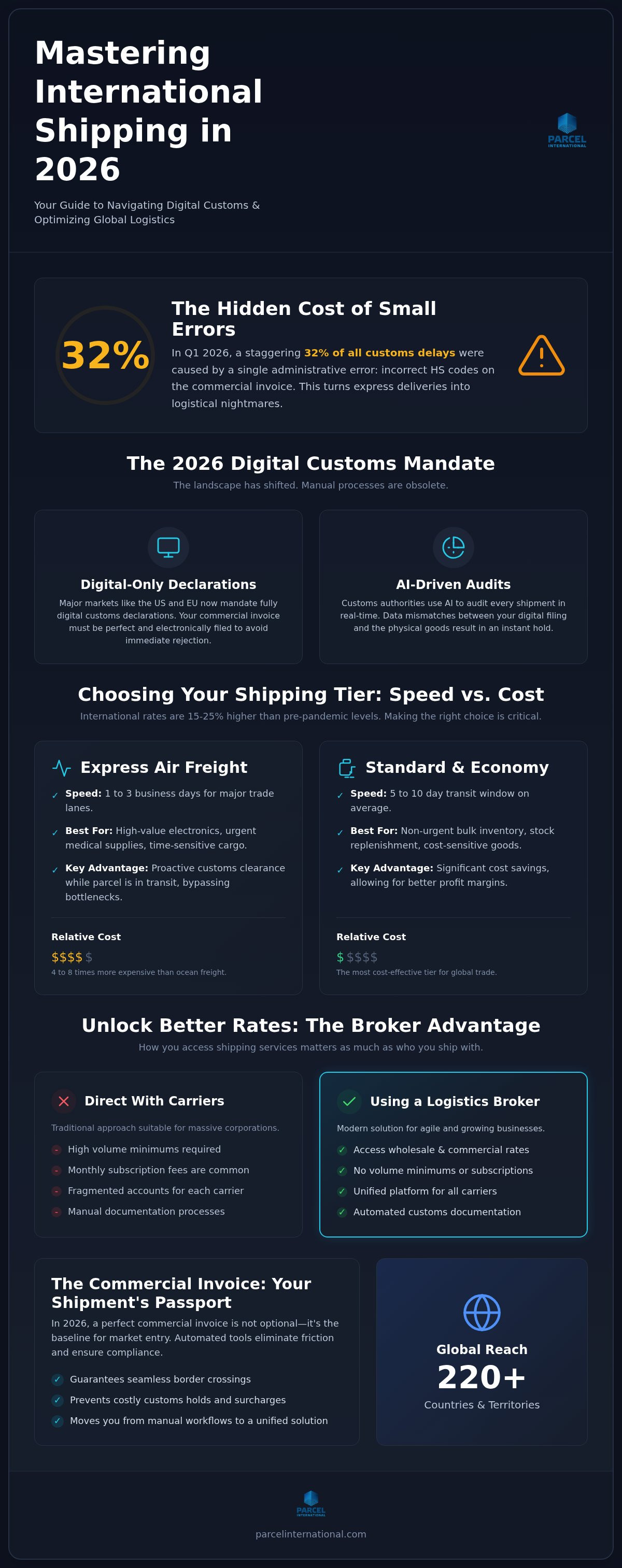
Did you know that 32% of all customs delays in the first quarter of 2026 were caused by a single administrative error: incorrect HS codes? It's a staggering figure that highlights how quickly a simple mistake on a commercial invoice for international shipping can turn an express delivery into a logistical nightmare. You likely feel that sending goods across borders should be straightforward, yet the recent elimination of "de minimis" thresholds in the US and EU has transformed every shipment into a complex compliance exercise. It's exhausting to manage the fear of parcels being held at customs while trying to avoid the hidden surcharges that often plague retail shipping rates.
We're here to strip away that procedural friction and provide total transparency. This guide will help you master the latest regulatory shifts so your goods reach 220+ countries without the typical delays. You'll learn how to move from fragmented, manual workflows to a unified solution that prioritizes security and punctuality. We provide a step-by-step roadmap for choosing the right freight services, accessing wholesale rates, and using automated tools to generate perfect customs documentation every time. By the end of this article, you'll have the tools to ship with the confidence of a global logistics expert.
Table of Contents
Understanding Parcel Delivery Abroad in 2026
The landscape of global trade has reached a critical turning point. By mid-2026, the transition to fully digital customs declarations has become mandatory in major markets like the US and the European Union. This isn't just a change in paperwork; it's a fundamental shift in how data moves across borders. Customs authorities now use AI-driven audits to verify every commercial invoice for international shipping against physical goods in real time. If your data doesn't match the digital filing, your shipment stops. Generating a perfect commercial invoice for international shipping is no longer optional; it's the baseline for entry into the 2026 market.
Businesses across the United States are increasingly scaling via global logistics aggregators to bypass the procedural friction of traditional shipping. By using a broker, these businesses gain access to automated customs tools that handle the heavy lifting of documentation. This setup differs from a simple courier service because it offers a holistic view of road, sea, and air freight options in one place. It's about moving from a chaotic, multi-platform process to an orderly, transparent system that prioritizes your peace of mind.
The Global Shipping Landscape Today
Shipping in 2026 demands more than just speed. There's an increased focus on Green Logistics, where carbon reporting is often as scrutinized as the delivery time itself. Maintaining a 220-country network requires sophisticated real-time tracking to manage customer expectations and ensure security. Success in this environment means international parcel shipping requires a strategic approach. You must balance environmental impact with operational efficiency while ensuring your documentation is robust enough to survive digital screening at every border.
Key Players: Carriers vs. Brokers
Understanding the relationship between global carriers and brokers is the key to unlocking better margins. Major carriers like DHL, FedEx, and UPS provide the massive physical infrastructure, but brokers provide accessibility and flexibility. You don't need to meet high volume minimums or pay monthly subscription fees to access competitive rates. Instead, you utilize the broker's established partnerships to ship like a multinational corporation. Before you book your next shipment, it helps to understand the basics: What is a Commercial Invoice? It's the foundational legal declaration for your goods. Having a single point of contact for multiple carriers removes the need to manage fragmented accounts, allowing you to focus on growth rather than administrative hurdles.
Express vs. Standard: Choosing Your Shipping Tier
Selecting a shipping tier is a strategic calculation of your profit margins. In 2026, international shipping rates have stabilized at levels 15 to 25% higher than pre-pandemic benchmarks, making the choice between speed and cost more consequential. Air freight remains approximately 4 to 8 times more expensive than ocean freight per kilogram. This price gap forces SMBs to be precise. If you're moving high-value electronics or urgent medical supplies, air freight is the logical choice. However, if you're moving bulk inventory, road or sea freight offers the relief of lower overhead. Don't forget that carriers calculate costs based on dimensional weight. If your box is large but light, you'll pay for the space it occupies, not its actual weight.
Express Shipping: When Speed is Non-Negotiable
Time-sensitive cargo requires the infrastructure of express shipping. Typical transit times for major trade lanes, such as Rotterdam to New York or London to Singapore, now average 1 to 3 business days. These services offer door-to-door delivery and white-glove handling, but the real value lies in the administrative fast lane. Express carriers often prioritize official customs documentation, initiating the clearance process while the parcel is still in the air. This proactive approach reduces the risk of your commercial invoice for international shipping being flagged for manual inspection. It's an efficient way to bypass the bottlenecks that often delay standard shipments.
Standard and Economy Options
For businesses managing non-urgent inventory, standard and economy tiers are the workhorses of global trade. These options are ideal when you can afford a 5 to 10-day transit window in exchange for significant cost savings. While these tiers help protect your margins, they sometimes come with limited tracking visibility in specific regions. To mitigate this, ensure your commercial invoice for international shipping is perfectly accurate. Administrative holds are harder to resolve when you don't have real-time premium tracking data. Balancing customer expectations with shipping margins is much easier when you compare multiple carrier tiers on a single, transparent platform.
Geographic nuances also play a role in your decision. In North America, the logistics infrastructure is highly integrated, making standard tiers remarkably predictable. In parts of Asia, however, the rapid growth in parcel volume, which is averaging 8 to 10% annually in 2026, can strain local networks. Choosing a tier with robust regional partnerships ensures your goods don't get stuck in the "last mile." Always account for fuel surcharges, which currently fluctuate between 15% and 28% of the total cost, regardless of the tier you choose.
Generating Commercial Invoices for International Shipping
If your choice of carrier is the engine of your logistics strategy, the commercial invoice for international shipping is the fuel. Without precise documentation, even the fastest express service will stall at the border. This document is the most critical piece of paperwork for parcel delivery abroad because it dictates the duties, taxes, and admissibility of your goods. For shipments leaving the Port of Rotterdam logistics hub, accuracy is paramount. As a primary gateway to global trade, Rotterdam's customs systems are highly automated and leave no room for vague descriptions or clerical errors.
Common mistakes in documentation, such as mismatched weights or generic product descriptions like "electronics" or "gift," lead to immediate border delays or heavy fines. In 2026, customs authorities utilize AI-driven audits to cross-reference your invoice data with real-time trade databases. If a discrepancy is found, your shipment is flagged. Using automated tools is the only way to effectively reduce the risk of these compliance errors and ensure your parcel moves through the network without manual intervention.
Step-by-Step: Creating a Compliant Invoice
To build a bulletproof invoice, you must start with the technical details. Follow these steps to ensure compliance:
Identify HS Codes: Every product needs a Harmonized System (HS) code. Incorrect codes caused 32% of all customs delays in early 2026, so verify yours frequently.
Select Incoterms: Clearly define who pays the duties. DAP (Delivered at Place) means the recipient pays, while DDP (Delivered Duty Paid) means you handle the costs upfront.
Declare Fair Value: Ensure your value declarations match the actual transaction price. Customs authorities monitor for undervaluation to prevent tax evasion.
The Commercial Invoice serves as the primary contract between the shipper and customs authorities.
Automating the Process
Manual data entry is a liability your business don't need. The Parcel International platform generates all necessary paperwork automatically during the booking process, pulling data directly from your order details. This eliminates the friction of fragmented workflows and ensures that every commercial invoice for international shipping meets the specific requirements of the destination country. You can also store product data for recurring shipments, which saves hours of administrative time and prevents "copy-paste" errors.
There is a direct, undeniable link between international shipping customs documentation and delivery speed. When your paperwork is digitally pre-cleared, your parcels often bypass physical inspections entirely. This momentum is what allows SMBs to compete with larger enterprises on a global scale. By moving from manual forms to an integrated digital solution, you protect your margins and your reputation for reliability.
How to Compare and Secure the Best International Rates
Forecasting costs accurately for 220+ countries is the first step toward maintaining healthy margins. In 2026, shipping rates aren't just about the base price; they're heavily influenced by dynamic surcharges. Fuel surcharges currently account for 15% to 28% of the total cost. You also need to account for remote area fees and residential delivery surcharges, which can inflate a quote by 20% or more. Using an integrated calculator allows you to see these variables upfront. This transparency ensures that the value stated on your commercial invoice for international shipping aligns with the final landed cost your customer sees.
Accessing wholesale rates used to be a privilege reserved for high-volume enterprises. We've removed that barrier. By choosing a broker model, you gain the "No Subscription" advantage. This means you get the same rates as a multinational corporation without committing to volume minimums or monthly fees. It's an egalitarian approach to logistics that empowers small businesses to compete globally. Consolidating smaller parcels into a single international freight shipment can further lower your per-parcel cost, especially when moving goods through high-traffic corridors.
Reading Between the Lines of a Quote
Retail carrier pricing often hides complexity in the fine print. When you compare air vs. sea freight, the price difference is stark; air freight is 4 to 8 times more expensive per kilogram. However, for smaller parcel volumes, air freight often provides better total value when you factor in inventory holding costs and customer satisfaction. To make an informed choice, use a shipping calculator to compare multiple carriers at once. This tool strips away the corporate jargon and presents a side-by-side view of transit times and total costs, including all necessary surcharges.
Strategic Shipping for Small Businesses
Small businesses often struggle with fragmented workflows that lead to administrative bloat. By leveraging broker margins, you can significantly reduce your overhead. Rotterdam-based businesses, in particular, benefit from local logistics expertise combined with a global reach. We act as a stable intermediary, bridging the gap between your warehouse and the world's leading carriers. Transparent pricing is the cornerstone of successful e-commerce. When you know exactly what you'll pay, you can set your retail prices with confidence. Accuracy on your commercial invoice for international shipping prevents unexpected duties from eroding these margins later.
Stop overpaying for retail shipping rates. Get a transparent shipping quote today and see how much you can save with our wholesale carrier partnerships.
Simplifying Global Logistics with Parcel International
Managing global trade shouldn't feel like a fragmented battle across multiple websites. You need a singular, unified solution that strips away the typical anxieties of logistics. We provide a platform where you can book express, air, sea, and road freight from one dashboard. It's an orderly system designed for speed and clarity. Unlike carrier-specific ecosystems that lock you into one network, we give you the flexibility to choose the best partner for every individual parcel based on current rates and transit times.
Our platform handles the seamless integration of customs documentation and carrier booking. As you select your service, the system automatically prepares your commercial invoice for international shipping. This ensures that the data used for the label perfectly matches the digital filing sent to customs authorities. We operate on a no-contract, pay-as-you-go model. You don't have to worry about subscription fees, restrictive terms, or volume minimums. It's a modern, egalitarian approach that values your business's flexibility and peace of mind.
Why 2007-Established Expertise Matters
Experience is a conceptual anchor in a volatile market. Established in 2007, we've spent nearly two decades navigating the evolution of international trade. We've seen regulations shift and technology advance, allowing us to build deep, reliable partnerships with DHL, FedEx, and UPS. Our roots in the Rotterdam logistics hub give us a unique advantage. We understand the specific requirements of European exports and use that knowledge to facilitate global trade for businesses of all sizes. You aren't just using a software tool; you're leveraging a history of expertise as a stable intermediary in the global market.
Getting Started with Your First Shipment
Ready to move from fragmented workflows to a unified solution? You can create a free account and start comparing rates immediately. There are no barriers to entry and no hidden requirements. Our onboarding process is designed to move you from inquiry to action as quickly as possible:
Rate Comparison: Access wholesale rates side-by-side without any volume commitments.
Automated Customs: Test the tool to generate a compliant commercial invoice for international shipping for your next export.
Specialist Support: Contact our team for large-scale freight forwarding projects or complex logistics strategies.
Our specialists go beyond standard call center scripts to provide genuine logistics strategy and support. They act as a dedicated partner to ensure your goods move efficiently across borders. Start shipping with a team that prioritizes transparency and reliability over corporate jargon.
Master Your Global Reach in 2026
Global logistics in 2026 demands a shift from manual guesswork to digital precision. You've seen how a perfectly executed commercial invoice for international shipping acts as the definitive legal bridge between your warehouse and 220+ countries. By moving away from fragmented, multi-platform workflows, you eliminate the friction that often leads to border delays and hidden surcharges. Success now depends on your ability to combine strategic carrier selection with automated documentation that clears the path before your parcel even arrives at the hub.
We provide the relief of a singular, unified solution. You don't have to deal with subscription fees or volume requirements to secure the best margins. Instead, you gain immediate access to wholesale rates from top carriers like DHL, FedEx, and UPS, supported by automated customs tools that ensure every shipment is compliant. Compare international rates and book your shipment today to experience a more transparent, efficient way to manage your exports. Your business is ready for the world; let's make sure your logistics keep up.
Frequently Asked Questions
What documents are required for parcel delivery abroad?
The primary documents include the shipping label, a packing list, and the commercial invoice for international shipping. This invoice is the most critical because it serves as the legal declaration for customs authorities worldwide. Depending on the destination and the nature of your goods, you might also need a Certificate of Origin. In 2026, these documents are primarily digital. Using automated tools ensures every field is populated correctly to meet specific mandates in 220+ countries.
How do I calculate the cost of international shipping?
Use an integrated shipping calculator that factors in the parcel's weight, dimensions, and destination. Your final cost includes the base freight rate plus dynamic surcharges like fuel, which currently ranges from 15% to 28%. You also need to account for potential duties and taxes based on the value declared on your invoice. Comparing multiple carriers on a single platform allows you to see transparent, all-in pricing without hidden fees or retail markups.
What is the difference between DDU and DDP shipping?
DDP (Delivered Duty Paid) means the shipper pays all duties and taxes upfront; DDU (officially DAP, Delivered at Place) means the recipient pays upon arrival. DDP is often the best choice for e-commerce because it prevents customers from facing unexpected fees at their door. Choosing DDP requires precise value declarations on your paperwork. This transparency builds trust and ensures a smoother delivery experience for your international customers while protecting your professional reputation.
How can I avoid customs delays for my international parcels?
Ensure your documentation is 100% accurate and submitted digitally before the parcel arrives at the border. Since incorrect HS codes caused 32% of delays in early 2026, you must verify your product classifications frequently. Provide detailed descriptions instead of generic terms like "samples." Using automated customs support tools helps flag potential errors before the parcel leaves your warehouse. This proactive approach clears the path through AI-driven audits used by modern customs authorities.
Do I need a business account to get discounted shipping rates?
You don't need a traditional high-volume business account or a paid subscription to access wholesale rates. We provide an egalitarian model where even small businesses can ship at discounted prices typically reserved for major corporations. There are no volume minimums or hidden requirements. You can create a free account and start comparing rates from DHL, FedEx, and UPS immediately. This flexibility allows you to scale your global reach without administrative barriers or monthly fees.
How do I track my parcel once it leaves the country?
Use the universal tracking number provided at the time of booking to monitor your parcel across its entire 220-country journey. Our platform consolidates tracking data from multiple carriers into a single, real-time view. This eliminates the need to visit different carrier websites to find updates. You'll receive notifications at every major milestone, from the initial pickup in Rotterdam to the final delivery at your customer's doorstep. It's a transparent way to maintain peace of mind.
What are HS codes and why are they mandatory in 2026?
HS codes are a standardized numerical method of classifying traded products. They are mandatory because they determine the exact duty and tax rates applied to your shipment. In 2026, customs authorities have increased scrutiny on these codes to automate tax collection and security screenings. Failing to provide the correct code on your commercial invoice for international shipping often leads to immediate seizures. Accurate classification is the foundation of modern compliance and global trade efficiency.
Why should I use a logistics broker instead of booking directly with a carrier?
A logistics broker acts as a stable intermediary, providing access to wholesale rates and multiple carriers on one platform. Booking directly often locks you into one network and higher retail pricing. We offer the flexibility to switch between express, air, and sea freight based on your specific needs. You also benefit from integrated customs support and expert strategy that standard carrier call centers don't provide. It's about simplifying a chaotic process into an orderly workflow.


