
Post Office USA Shipping: The Complete 2026 Guide to USPS and Express Alternatives
- Alex
- 10 hours ago
- 12 min read
Standing in a long line for post office usa shipping might feel like the most cost-effective way to send a package, but in 2026, it is often a costly mistake. With the July 2026 price increases and the new dimensional weight divisor of 139 for packages over one cubic foot, retail postal rates are no longer the bargain they used to be. You likely want the reliability of a global carrier without the retail markup or the stress of manual customs forms. It is exhausting to manage unpredictable delivery times while shipping costs continue to eat into your budget.
This guide will help you master the complexities of modern US postal services and show you how to access wholesale express rates for faster, more reliable global delivery. You don't have to settle for fragmented workflows or hidden fees. We will preview the latest USPS service changes, explain how to automate your customs paperwork, and compare express alternatives that provide professional tracking for total peace of mind. By the end of this article, you will have a clear path to finding the cheapest, most efficient shipping method for your specific needs.
Table of Contents
Navigating the Post Office USA Shipping Landscape in 2026
The United States Postal Service remains the backbone of American logistics, even as the industry evolves. When you are Navigating the Post Office USA Shipping Landscape, you are dealing with a government-managed entity that reaches every mailbox in the country. For many, post office usa shipping is the default choice because of its accessibility. However, 2026 has brought significant changes to how these networks operate. Postal services are no longer isolated systems. They are increasingly integrated with private logistics partners to handle the surge in e-commerce volume and manage the rising costs of fuel and labor.
USPS Domestic vs. International Services
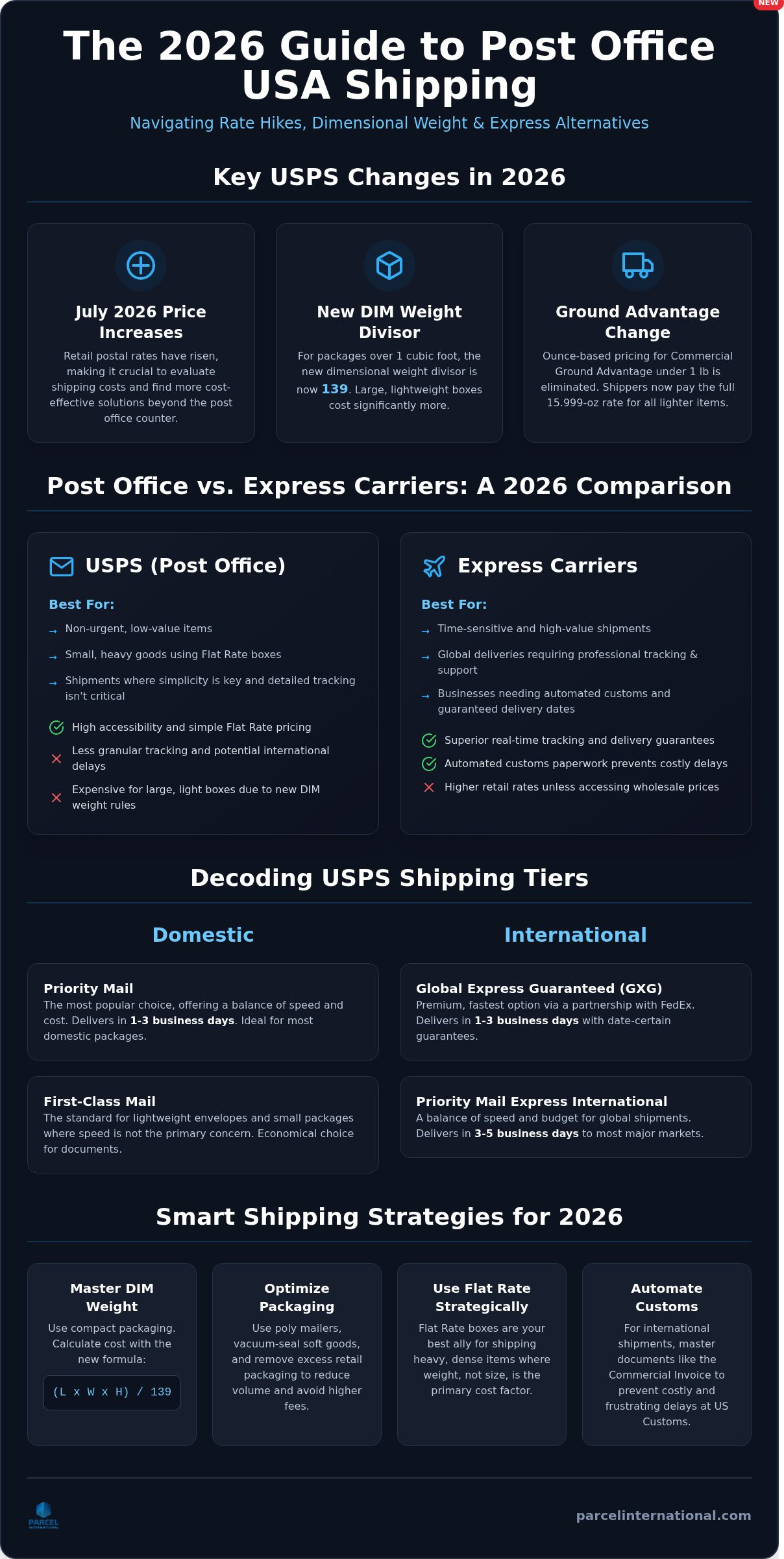
Domestic shipping typically splits between First-Class and Priority Mail. First-Class remains the standard for lightweight envelopes, while Priority Mail offers faster transit times, usually between one to three days. For international needs, Priority Mail International and First-Class Package International Service provide global reach. It's vital to understand that the USPS often handles the initial stages of an international journey, but local post offices in the destination country typically manage the final-mile delivery. This hand-off can sometimes lead to tracking gaps that businesses find frustrating. As of July 12, 2026, USPS has also eliminated ounce-based pricing for Commercial Ground Advantage under 1 lb, meaning small shippers must now pay the full 15.999-oz rate for lighter items.
When to Choose the Post Office Over Express
The post office is your best ally for low-value items where speed isn't the primary concern. If you're sending a non-urgent gift or a small parcel that fits into a Flat Rate box, the USPS offers a simplicity that express carriers often can't match. With Flat Rate options, weight doesn't affect the price as long as the item is under the maximum weight limit. This is a massive advantage for heavy, compact goods.
However, be aware of the limitations. Postal tracking is historically less granular than express carrier standards. If your shipment is high-value or time-sensitive, the lack of real-time updates can be stressful. In 2026, we see more shippers using the post office for budget tiers while reserving express carriers for shipments that require guaranteed delivery dates and detailed documentation support. The new dimensional weight divisor of 139 for packages over one cubic foot means larger boxes now cost significantly more. This change is forcing a shift toward smarter packaging or express alternatives that offer better volume-based rates.
Understanding USPS Shipping Services: Speeds, Costs, and Boxes
Mastering the various service tiers is the only way to keep your post office usa shipping costs under control. In 2026, the USPS has simplified some categories but increased the price of others. Priority Mail remains the most popular choice for domestic packages. It offers a balance of speed and cost, but you must choose your packaging carefully to avoid unnecessary fees.
Priority Mail and Flat Rate Options
Flat Rate boxes are the most predictable choice for shipping heavy, small items across long distances. Because the price is fixed regardless of the destination zone, you don't have to worry about fluctuating costs. For many entrepreneurs, using the usps small flat rate box is a primary strategy for maintaining healthy margins. However, if you use your own packaging, the 2026 pricing logic shifts to a zone-based model. This means the distance your package travels and its dimensions dictate the final fee. With the new dimensional weight divisor of 139 for boxes over one cubic foot, even a light package can become expensive if the box is too large.
To maximize your budget, consider these space-saving strategies:
Use thin protective materials like poly mailers instead of bulky cardboard when possible.
Vacuum-seal apparel and soft goods to fit into smaller Flat Rate tiers.
Remove unnecessary retail packaging to reduce the overall volume of the shipment.
International Postal Tiers Explained
When your business expands globally, you need to understand the hierarchy of international post. Global Express Guaranteed (GXG) is the premium tier. It is a partnership with FedEx, providing delivery in one to three business days with date-certain guarantees. This is the only postal service that rivals the speed of dedicated express carriers. For a balance of speed and budget, Priority Mail Express International typically delivers in three to five business days. If you are shipping lightweight items valued under $400, First-Class Package International Service is the most economical route, though it lacks the speed of GXG.
Reliability in 2026 for post office usa shipping depends heavily on the destination country's local infrastructure. While US-based tracking is reliable, the hand-off to foreign postal services remains a variable. Keep in mind that these services require meticulous attention to Essential Customs and Documentation. Missing information on a commercial invoice can lead to your package being held indefinitely. If the complexity of these tiers feels overwhelming, you can compare real-time rates and transit times on a single platform to ensure you're always choosing the most efficient path.
Post Office vs. Express Carriers: A 2026 Comparison
Choosing between post office usa shipping and private express carriers is no longer a simple matter of price. In 2026, the logistics environment has shifted. While the USPS offers unmatched reach to every domestic mailbox, carriers like DHL, FedEx, and UPS provide a level of speed and precision that postal networks struggle to replicate. You must evaluate the "True Cost" of your shipment. This includes the base rate, but also the cost of potential losses, customs friction, and insurance premiums. Relying solely on the lowest sticker price often leads to hidden expenses when packages are delayed or lost in fragmented postal hand-offs.
Tracking and Visibility Capabilities
Postal networks often rely on milestone tracking. This means you only see an update when a package arrives at a sorting facility or clears a major hub. For modern e-commerce, this is rarely enough. Express carriers utilize real-time GPS tracking, allowing you to see exactly where your goods are at any moment. High visibility is a customer service requirement. It directly reduces "Where Is My Order" (WISMO) inquiries, which can drain your support team's time. If a customer sees their package is stuck in a specific city, they feel informed. If they see no update for three days on a postal route, they feel anxious. Reliability is built on this transparency.
Cost Analysis for Small Businesses
The retail prices you see at the post office counter or on carrier websites are often the highest in the market. Scaling Beyond the Post Office requires understanding the gap between retail and wholesale rates. Most small businesses don't have the volume to negotiate directly with global carriers. This is where logistics aggregators change the equation. By pooling volume, these platforms provide express speed at prices that often rival standard postal services. This levels the playing field for smaller players who need professional reliability without the corporate price tag.
Consider a case study of sending a 2kg parcel from Europe to the USA in 2026. Using a standard postal service might seem cheaper upfront. However, you must factor in the 2026 rate increases. FedEx and UPS announced a 5.9% average rate increase, but the actual impact for many shippers is between 8% and 12% due to surcharges. Meanwhile, the USPS eliminated ounce-based pricing for Commercial Ground Advantage under 1 lb in July 2026, pushing costs higher for lightweight items. When you add the cost of insurance and the value of your time spent managing customs, express options often provide better ROI. To make the right choice, you must compare international shipping rates across all providers simultaneously. This approach ensures you don't overpay for slow service when a faster, more secure alternative is available for a similar price.
Essential Customs and Documentation for USA Shipments
US Customs and Border Protection (CBP) has tightened regulations significantly in 2026. If you rely on post office usa shipping for international orders, you must understand that postal workers are not customs brokers. They accept your package at the counter, but they don't guarantee it will clear the border. A single mistake on your commercial invoice can lead to a "Held in Customs" status. This often results in weeks of silence and eventual return-to-sender fees. For a deeper dive into compliance, consult our international shipping customs documentation guide.
The commercial invoice is the most critical document in your shipping workflow. It tells customs officials what is inside the box, its value, and its country of origin. Many shippers make the mistake of using vague descriptions like "gift" or "merchandise." In 2026, CBP requires specific, line-item detail. Manual paperwork is the primary cause of clearance delays. It's prone to human error and often lacks the digital data that modern customs systems require for rapid processing.
Automating HS Codes and Descriptions
HS codes are a global standard for product identification. These six to ten digit numbers determine the duty and tax rates applied to your goods. The USA requires high accuracy to prevent misclassification and revenue loss. Using digital tools to find the correct classification for your goods is no longer optional for serious businesses. It removes the guesswork and ensures you aren't overpaying or risking non-compliance penalties. Automation software can match your product descriptions to the correct codes instantly, creating a seamless bridge between your warehouse and the destination mailbox.
Avoiding Common US Customs Delays
The "De Minimis" threshold, often referred to under Section 321, remains a vital tool for 2026 shipments. This allows goods valued at $800 or less to enter the USA duty-free. However, CBP has increased scrutiny on "split shipments" intended to bypass these limits. If you're sending multiple packages to the same recipient, ensure they are documented correctly to avoid seizure. Prohibited and restricted items are another common pitfall. The post office won't always warn you about specific foreign restrictions on electronics, textiles, or food items.
Express carriers provide a distinct advantage here. They act as your customs broker, pre-clearing shipments while they are still in the air. This proactive approach is why express packages often clear customs in hours, while postal shipments can sit in a government facility for days. To simplify this entire process, you can access our automated customs support and ensure your documentation is perfect before the package even leaves your hands.
Scaling Beyond the Post Office with Parcel International
Transitioning your strategy away from traditional post office usa shipping requires a digital-first approach. While the USPS remains a staple for domestic mail, growing businesses need the speed and reliability of global express carriers to compete. Parcel International simplifies the international parcel shipping process by acting as a stable intermediary between you and the world's largest logistics providers. You don't have to manage multiple accounts or navigate fragmented workflows. Instead, you gain an orderly, unified solution that removes the typical anxieties of global trade.
Wholesale Rates for Every Business
Our aggregator model allows us to pool the shipping volume of thousands of users to secure deep discounts. We pass these wholesale rates directly to you, regardless of your company size. You don't need to sign restrictive volume contracts or pay monthly subscription fees to access the same pricing usually reserved for major corporations. This egalitarian approach is why businesses in Rotterdam and other global hubs use our platform to manage their USA exports. You see the true cost upfront, with no hidden fees or procedural friction. It's a transparent system designed to protect your margins and simplify your decision-making process.
Unified Logistics Management
Efficiency is the core of our platform. Our "One-Stop" dashboard lets you compare real-time rates from DHL, FedEx, and UPS on a single screen. This is a significant improvement over the standard postal tools, which restrict you to a single carrier's options. You can manage Express Shipping, Air Freight, and Sea Freight from one location, creating a rhythmic, instructional flow for your daily operations. You no longer need to jump between platforms to find the best deal or track a shipment.
Documentation is often the biggest barrier to speed. Our system generates automated customs paperwork as part of the booking process, ensuring your commercial invoices meet the strict 2026 CBP standards discussed in the previous section. If a shipment encounters a delay, you have access to professional support that goes beyond standard industry benchmarks. You aren't just sending a package; you're building a professional logistics strategy that values punctuality and security. Stop standing in line at the counter and start optimizing your global reach today. Transitioning to a professional carrier mindset gives you the peace of mind that your post office usa shipping alternatives are working as hard as you are.
Optimize Your Global Logistics Strategy
Success in 2026 requires more than just finding the nearest retail counter. Relying solely on post office usa shipping in this competitive environment often means sacrificing both speed and profit margins. You've learned that recent 2026 rate increases and stricter customs requirements make professional documentation and real-time tracking essential. By moving beyond a retail mindset, you can protect your business from hidden surcharges and unpredictable delivery times. Orderly logistics start with transparency and the right tools to compare every available option.
Take control of your workflow by using a platform that simplifies complex global trade. You can get instant access to DHL, FedEx, and UPS rates with automated customs paperwork included. We've been trusted by global exporters since 2007 to provide secure, punctual solutions without subscription fees or volume minimums. Compare real-time USA shipping rates and save today with Parcel International. Your packages deserve a reliable bridge to the American market, and your business deserves the relief of a unified shipping solution. Start scaling your reach with confidence today.
Frequently Asked Questions
Is the post office or UPS cheaper for shipping to the USA?
The post office is typically cheaper for small, lightweight items under 2kg, while UPS offers better value for heavier shipments and bulkier boxes. The 2026 rate increases mean the gap between postal and express pricing has narrowed. You should always compare both options based on the specific weight and dimensions of your parcel to find the most cost-effective route.
How long does post office shipping take from Europe to the USA in 2026?
Standard international postal shipping usually takes between 7 to 14 business days. Transit times can vary based on airport congestion and the efficiency of the local sorting facility handling the final delivery. If you require a guaranteed delivery date, premium tiers like Global Express Guaranteed (GXG) are available but come at a significantly higher cost than standard post.
Do I need a customs form for a post office USA shipment?
Yes, you must attach a customs declaration to every post office usa shipping parcel sent internationally. This form, typically a CN22 or CN23, requires you to list the contents, value, and country of origin for each item. Failure to provide accurate information can result in your package being seized or returned to you at your own expense.
What is the cheapest way to send a small parcel to America?
First-Class Package International Service remains the most budget-friendly postal option for items weighing up to 4 lbs. However, this service lacks the speed and granular tracking of express alternatives. For many businesses, the most efficient strategy is to use a logistics broker to access wholesale express rates that rival postal prices while offering much faster delivery.
Can I track a USPS international package once it leaves the US?
Tracking visibility depends on whether the destination country's postal service provides reciprocal tracking data. While many major trading partners offer end-to-end updates, some regions only provide milestone tracking that stops once the package clears the US border. For total peace of mind and real-time GPS updates, express carriers are the more reliable choice.
What items are prohibited when shipping to the USA via the post office?
Prohibited items include hazardous materials, aerosols, perfumes, alcohol, and certain perishables. In 2026, the USPS also introduced strict HazMat handling fees for air-eligible shipments. Always check the current CBP restricted list to ensure your goods don't violate safety regulations or trade embargoes, as mislabeled hazardous shipments can result in a $50 noncompliance penalty.
How do I calculate the shipping cost for a USA parcel?
Calculate your cost by combining the actual weight with the box dimensions to determine the billable weight. For post office usa shipping in 2026, you must use the dimensional weight divisor of 139 for any package over one cubic foot. This calculation ensures you aren't surprised by unexpected surcharges once your parcel reaches the sorting facility.
Why is my post office shipment stuck in US customs?
Most customs delays are caused by missing HS codes, vague product descriptions, or values that exceed the $800 De Minimis threshold. If your paperwork is incomplete or inaccurate, CBP will hold the package for a manual inspection. Automating your commercial invoice generation is the most effective way to prevent these bottlenecks and ensure a smooth clearance process.