
PostNL International Shipping 2026: The Complete FAQ and Guide
Sending a package shouldn't feel like a high-stakes gamble against shifting customs laws. If you've noticed that your postnl international shipments are facing more delays or unexpected fees lately, you're not alone. Between the new €5 per-item handling fee in the Netherlands and the removal of the $800 duty exemption in the United States, the logistics landscape has become a minefield of administrative hurdles. It's frustrating to watch your margins shrink while your parcels disappear into a tracking black hole once they cross the border.
We understand that you need reliability and transparency to keep your business moving. This guide simplifies the complexities of global logistics in 2026, offering a clear roadmap to successful delivery without customs holds. You'll learn how to navigate the latest PostNL rate increases, understand the shift from 'RI' to 'RF' barcodes, and find the most cost-effective alternatives for your specific volume. We'll preview the essential steps to gain total visibility on your parcel location while securing the lowest possible shipping rates for your cross-border operations.
Key Takeaways
Identify the best service tier for your needs, from Standard to EMS, to ensure your postnl international parcels arrive on time and within budget.
Secure full visibility on your shipments by mastering the use of 3S and 2S barcodes across official and third-party tracking platforms.
Prevent customs holds by accurately applying HS Codes and selecting the correct CN22 or CN23 documentation for every cross-border delivery.
Compare cost-efficiency between postal and express carriers to determine the most reliable route for high-value or heavy goods.
Streamline your entire logistics operation by accessing wholesale rates and unified workflows through a carrier-agnostic shipping platform.
Table of Contents
What is PostNL International and How Does it Work in 2026?
As the primary postal service provider for the Netherlands, PostNL operates a vast logistics network that extends far beyond Dutch borders. The postnl international arm functions as a gateway to the global postal system, governed by the Universal Postal Union (UPU). This structure allows them to accept parcels in the Netherlands and hand them over to national postal services in other countries, such as USPS in the United States or Royal Mail in the UK, for final delivery. It's a reliable, cost-effective model for businesses that don't require the specialized, end-to-end infrastructure of private express carriers.
In 2026, the landscape of global trade has shifted significantly. PostNL has adapted to these changes by focusing on digital transparency and regulatory compliance. New regulations have removed the VAT de minimis threshold for EU imports, and the United States has eliminated the $800 duty exemption. These shifts mean that every commercial parcel now faces increased scrutiny. PostNL manages this by prepaying import duties for many destinations and invoicing the sender later, which helps prevent parcels from being held at the border. Efficiency is the priority, but the sheer volume of customs documentation required in 2026 means that standard postal timelines are more dependent on administrative accuracy than ever before.
PostNL International Service Levels
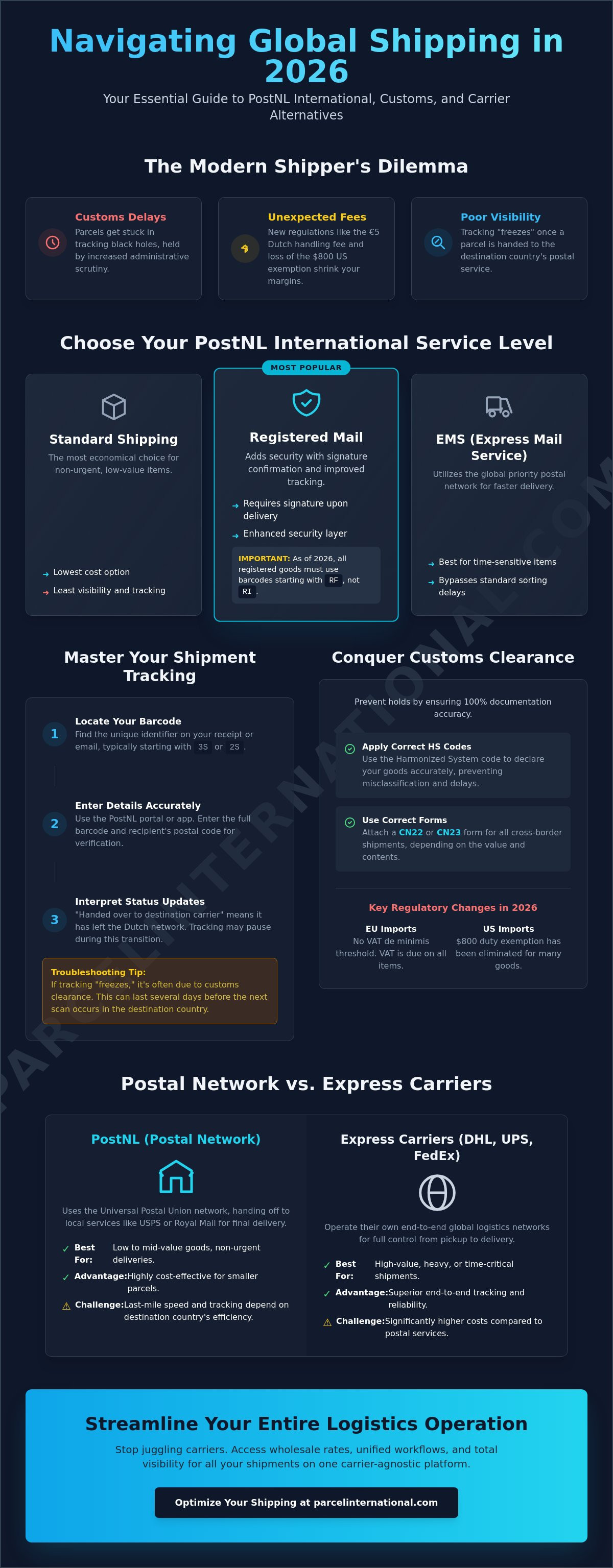
Choose your service tier based on the value and urgency of your goods. Standard Shipping remains the most economical choice for non-urgent items, though it offers the least visibility. Registered Mail adds a critical layer of security by requiring a signature upon delivery. Notably, as of 2026, all registered packets containing goods to destinations outside the Netherlands must use barcodes starting with 'RF' instead of the older 'RI' format. For time-sensitive documents or high-priority parcels, EMS (Express Mail Service) utilizes the global priority postal network to bypass standard sorting delays.
Geographic Zones and Delivery Timelines
PostNL categorizes destinations into specific zones to determine rates and expected transit times. Zone 1 covers most of Europe, where transit is typically fast due to integrated road and air networks. Shipping to World Zones, including the US, Asia, and Australia, involves more variables. While PostNL handles the initial transport, the 'last-mile' speed is entirely dependent on the efficiency of the destination country's local postal service. In 2026, expect longer processing times in countries with high customs backlogs or those implementing new per-item import fees, such as the €5 fee currently active in the Netherlands for non-EU arrivals.
Tracking Your PostNL International Parcel Step-by-Step
Start by locating your unique identifier. Every postnl international shipment is assigned a barcode, typically starting with "3S" or "2S". You'll find this alphanumeric string on your physical shipping receipt or in your digital confirmation email. Don't lose it. Without this code, visibility on your parcel's journey becomes impossible once it leaves the sorting center. While the official PostNL portal is the primary source of truth, international aggregator tools can sometimes provide more granular data from the destination country's perspective.
How to Use the PostNL Barcode System
Accuracy matters when entering your data. Type the barcode into the tracking field without any spaces or extra characters. In many cases, you'll also need to provide the recipient's postal code to verify the shipment. This security measure ensures that sensitive delivery details remain private. If you're managing high-volume shipments, download the PostNL app. It allows you to set up push notifications so you don't have to manually refresh the page every hour. Real-time updates provide the peace of mind you need when handling valuable cargo.
Understanding the shift between different international postal models is key to interpreting your status updates. When your parcel moves from "Sorting" to "Handed over to destination carrier", it has officially left the Dutch network. At this point, the destination country's national post office takes over. Different countries have varying scanning frequencies, which can lead to gaps in the tracking timeline.
Troubleshooting International Tracking Issues
It's common for tracking to "freeze" for several days. This usually happens during customs clearance, where the parcel is physically present but hasn't been scanned into the new country's system yet. If your 3S code stops updating, try entering it into the local tracking site of the destination carrier, such as USPS or Royal Mail. They often assign a secondary local reference number to the package. If you find the fragmented nature of postal tracking too time-consuming, you can simplify your logistics workflow by using a unified platform that aggregates data from all major carriers in one place.
Don't panic if a parcel appears stuck at a transit hub. Most delays are administrative rather than physical. Only contact customer support if the status hasn't changed for more than ten business days. Before doing so, verify that no customs duties are pending. In 2026, many "stuck" parcels are simply waiting for the recipient to pay the new import and handling fees. Direct action and patience are your best tools for managing global transit.
Customs, Duties, and International Documentation
Customs clearance is often the stage where postnl international shipments face the most friction. In 2026, global trade regulations have tightened, making precise documentation a requirement rather than a suggestion. The Universal Postal Union (UPU) sets the framework for these exchanges, but the responsibility for accurate data lies with the sender. If you misclassify a product or omit a digital declaration, your parcel will likely be returned or destroyed at the border. The postnl international network relies on the digital data you provide to move goods through these checkpoints without manual intervention. Avoid poor outcomes by prioritizing data integrity from the start.
The distinction between CN22 and CN23 forms is critical. Use the CN22 for smaller, lower-value items, typically those under the €150 customs duty threshold in the EU. For larger shipments or those exceeding this value, the more detailed CN23 form is mandatory. Beyond the form type, you must include a 6 to 10 digit HS Code (Harmonized System). These codes tell customs officials exactly what is inside your package, which determines the specific import duties and taxes applied. In 2026, vague descriptions like "clothing" or "electronics" are no longer sufficient. You need to specify "men's cotton t-shirts" or "lithium-ion laptop batteries" to pass inspection.
Essential Paperwork for PostNL Shipments
Choosing the right invoice type is your next step. Use a commercial invoice for any transaction involving a sale. If you're shipping items without a commercial transaction, such as internal stock transfers, a pro forma invoice is appropriate. Never mark commercial goods as "gifts" or "samples" to avoid taxes. Customs authorities now use sophisticated data matching to flag these discrepancies, leading to heavy fines and permanent delays. To ensure you're following every requirement, read our guide on how to master parcel delivery abroad for a complete documentation checklist.
Automating Trade Compliance
Manual data entry is the primary cause of customs rejections. A single transposed digit in an HS code can result in a parcel being held for weeks. Transitioning to international trade compliance software removes this risk by validating addresses and tax IDs automatically. This is especially vital for EU-bound shipments where the Import One-Stop Shop (IOSS) system requires digital transmission of VAT data. By automating these processes, you ensure that your business remains compliant with the latest 2026 regulations without adding hours of administrative work to your team's schedule. It's about creating a frictionless path from your warehouse to the customer's door.
Customs officials in 2026 are stricter than ever. Common reasons for rejection include:
Incomplete HS Codes: Providing only four digits when six or eight are required for specific tax calculation.
Undervaluation: Declaring a price significantly lower than the actual market value to reduce duty costs.
Missing IOSS Number: Failing to provide a valid VAT identification for commercial imports into the EU.
Prohibited Items: Shipping restricted goods, such as certain liquids or batteries, without the necessary permits.
Comparing PostNL with Express Carriers: DHL, UPS, and FedEx
PostNL is a reliable baseline for many Dutch shippers, but it isn't always the fastest or most secure option. When you choose postnl international, you're utilizing a global network of national postal services. This is fundamentally different from the "integrator" model used by DHL, UPS, and FedEx. Express carriers own the entire journey, from the initial pickup to the final doorstep. This ownership eliminates the "postal gap", that period where tracking often pauses as a parcel moves between different national systems. If your business depends on time-definite delivery, understanding these operational differences is vital.
For lightweight parcels under 2kg, PostNL remains highly cost-efficient. However, the financial gap is narrowing. In early 2026, major express carriers implemented a 5.9% general rate increase. When you factor in dimensional weight adjustments and surcharges, the actual cost increase for most shippers sits between 8% and 12%. Despite these hikes, express carriers provide superior value for heavier shipments. They use sophisticated volumetric calculations that often favor dense boxes over the rigid weight tiers of postal services. Relying on a postal service for a 10kg box can often be more expensive and slower than a private courier.
When to Stick with PostNL
Use PostNL for small e-commerce items and low-value goods where speed isn't the primary concern. It's an excellent choice for residential deliveries in remote global areas because national postal services already have established daily routes. You don't have to worry about "out-of-area" surcharges that private carriers often apply. Additionally, the density of the Dutch postal network makes drop-offs convenient for small-scale operations that don't want to wait for a scheduled courier pickup.
When to Upgrade to Express Shipping
Upgrade when you're shipping high-value items that require comprehensive insurance. While PostNL offers insurance up to €5,500 for specific tiers, express carriers provide more flexible coverage for luxury goods or sensitive equipment. B2B shipments also demand the time-definite windows that only private carriers can guarantee. For a deeper look at your options, consult our international parcel shipping guide to see how different networks perform across various global regions.
To find the perfect balance between speed and your budget, compare live shipping rates across multiple carriers to see which one offers the best terms for your specific parcel today.
Optimizing Your Shipping Strategy with Parcel International
Managing multiple carrier accounts is a recipe for administrative chaos. While you might use postnl international for your lighter parcels and an express carrier for B2B orders, jumping between different portals wastes valuable time and increases the risk of manual error. A logistics broker acts as a single, transparent bridge, consolidating your entire workflow into one platform. By leveraging the collective volume of thousands of shippers, we provide you with wholesale rates that are typically reserved for large enterprises. This means you get the reliability of major networks without the high-stakes negotiations or restrictive volume minimums that have become common in 2026.
Scaling a business globally shouldn't require a dedicated logistics department. Our platform simplifies the process by automating the most complex parts of cross-border delivery. From calculating the latest 2026 customs fees to ensuring your digital data matches the requirements of the destination carrier, the goal is to create a frictionless experience. You can move from fragmented, multi-platform workflows to a singular, unified solution that values your peace of mind over corporate jargon. This approach allows you to focus on growth while we handle the procedural friction of global transport.
The Broker Advantage for Small Businesses
Small businesses often struggle to secure competitive pricing because they lack the leverage of a massive corporation. Working with a broker levels the playing field. You can compare live quotes from PostNL and its competitors on a single screen, ensuring you always select the most cost-effective route for every specific destination. This transparency eliminates the anxiety of hidden costs and allows for real-time decision-making. To see how these tools fit into your broader growth plan, read the ultimate guide to small business shipping solutions in 2026.
Getting Started with Smarter Shipping
Efficiency depends on seamless integration. Modern shipping platforms connect directly to your e-commerce store, pulling order data automatically to generate accurate shipping labels and customs forms. This removes the danger of human error during the documentation process. By automating your postnl international labels, you significantly reduce administrative overhead. You no longer have to worry about the specificities of 'RF' barcodes or HS code validation because the system handles it for you. Ready to simplify your logistics? Compare international shipping rates today with Parcel International and experience the relief of orderly, efficient global shipping.
Master Your Global Logistics Today
The logistics world in 2026 demands more than just a stamps and labels approach. You've learned that successful postnl international shipping relies on precise digital data, from the correct HS codes to the new 'RF' barcode standards. Whether you're sending lightweight e-commerce parcels or time-sensitive B2B cargo, the key is choosing the right carrier for the right job. By moving away from fragmented, manual workflows, you eliminate the risk of customs holds and unexpected handling fees.
Orderly shipping isn't a luxury; it's a competitive necessity. You don't have to navigate these complexities alone or settle for high-volume contracts you don't need. Access a unified platform that provides real-time rate comparisons from top global carriers and automated customs documentation for over 220 countries. Start comparing international rates with Parcel International to secure the lowest possible prices and total visibility for every shipment. Take control of your global reach and watch your business thrive in the international market.
Frequently Asked Questions
How long does PostNL international shipping typically take in 2026?
Transit times depend on the destination zone, with European deliveries usually arriving within 3 to 7 business days. For global destinations like the United States or Australia, expect a window of 10 to 20 business days. These timelines reflect the 2026 shift in Dutch domestic standards and increased customs scrutiny at international borders, which can add several days to the total journey.
Why is my PostNL international tracking number not updating?
Tracking updates often pause when a parcel is in the "postal gap" between the Netherlands and the destination country. This typically happens during customs clearance or when the package is being handed over to a local carrier. If your postnl international barcode hasn't updated for several days, try entering it into the tracking portal of the destination country's national postal service for more localized data.
What are the customs clearance costs for PostNL shipments?
In 2026, customs costs are more frequent due to the elimination of VAT and duty exemptions in the EU and the United States. For imports into the Netherlands, a €5 per-item fee now applies, consisting of a €3 EU import fee and a €2 handling fee. PostNL typically prepays these duties to speed up delivery and then adds these costs, along with an administration fee, to your shipping invoice.
Can I send liquids or batteries internationally with PostNL?
Shipping liquids and lithium batteries is strictly regulated and often prohibited for standard international mail. Most lithium batteries must be contained within the device they power and require specific safety labeling to meet aviation standards. Always check the current prohibited items list for your specific destination country to avoid your parcel being seized or returned by customs officials.
What is the difference between PostNL Standard and EMS?
PostNL Standard is a cost-effective choice for non-urgent goods, utilizing the global network of national postal services. EMS, or Express Mail Service, is a priority tier that offers faster transit times and more consistent tracking. EMS shipments are treated as priority cargo in the parcel network, making them the better option for time-sensitive documents or commercial goods that need to bypass standard postal sorting delays.
How do I claim insurance for a lost PostNL international parcel?
You must file an official claim through the PostNL website if your insured parcel is confirmed lost or arrives damaged. For postnl international insured tiers, coverage can reach up to €5,500 depending on the service selected. Ensure you have your shipping receipt, the original invoice for the goods, and photos of the damage if applicable, as these are required to process the reimbursement.
Which customs form (CN22 or CN23) do I need for my shipment?
Use the CN22 form for small packages valued under €150 and weighing less than 2kg. For any shipment valued over €150 or weighing more than 2kg, the more detailed CN23 form is mandatory. Both forms must include accurate HS codes and a detailed description of the contents to comply with 2026 digital-first customs regulations and avoid immediate rejection at the border.
Is there a weight limit for PostNL international parcels?
The maximum weight for a standard international parcel is generally 20kg, although some destinations allow up to 31.5kg. Smaller "tracked packets" are limited to a maximum of 2kg. If your shipment exceeds these limits, you'll need to utilize heavy-goods services or consider sea and air freight options to ensure your cargo is handled safely and remains compliant with international weight restrictions.


