
Shipping Fragile Items Overseas: 2026 Logistics Guide
Updated: Aug 16
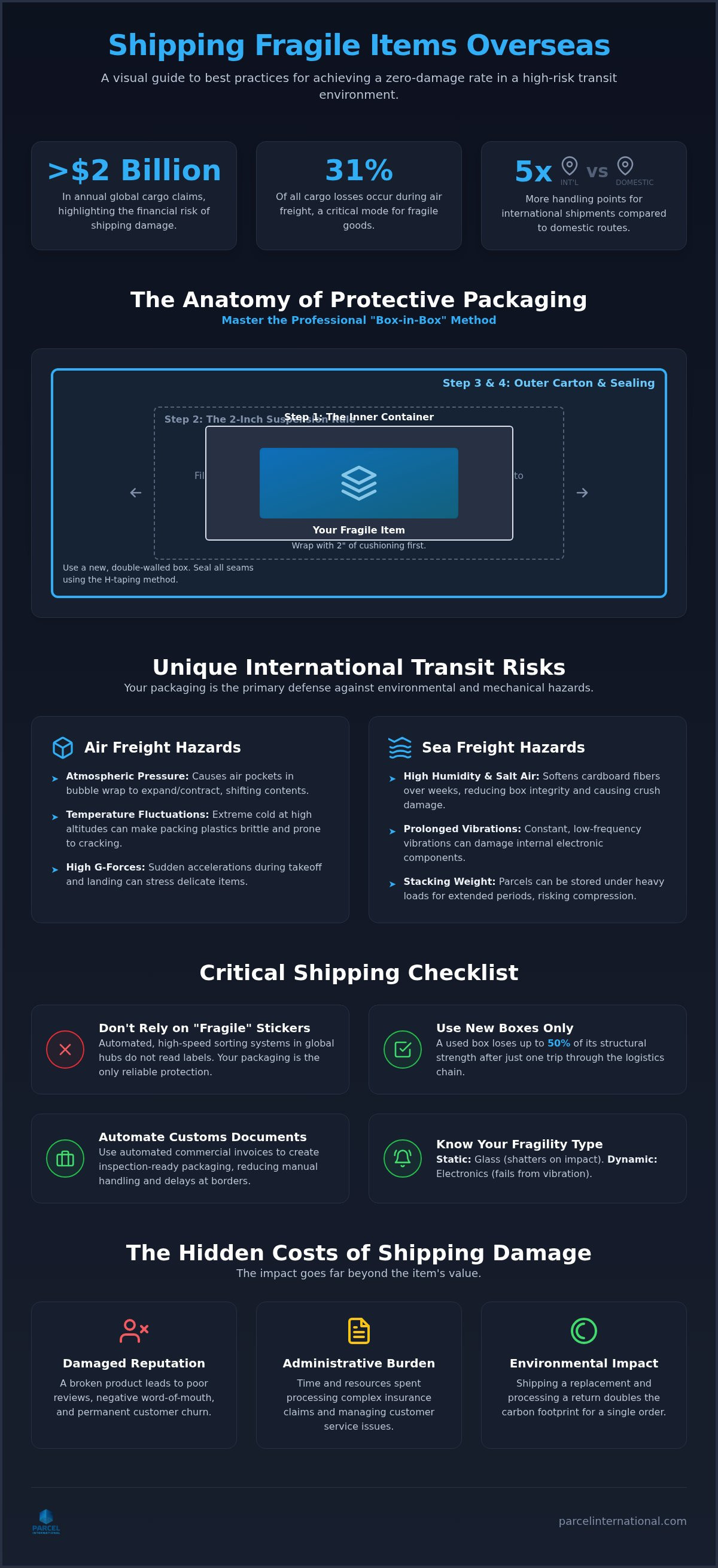
Global cargo claims exceed $2 billion annually, and air freight accounts for 31% of those losses. If you're nervous about sending delicate goods across borders, you aren't alone. Most shippers fear the moment a customer opens a box to find shattered glass or broken electronics; it's a valid concern when high insurance premiums and complex customs forms add to the stress. We believe your reputation shouldn't be at the mercy of a bumpy transit.
This guide explores the best practices for shipping fragile items overseas to help you achieve a zero damage rate. We'll break down professional "Box-in-Box" packing techniques, carrier selection strategies, and the latest 2026 regulatory shifts like the EU's removed duty exemptions. You'll also discover how automated customs documentation can minimize handling risks, making your international shipping process transparent and predictable.
Table of Contents
Understanding the Risks of International Transit for Fragile Goods
The Anatomy of Protective Packaging: Master the Box-in-Box Method
Choosing the Right Carrier and Service Level for Delicate Cargo
Navigating Customs Inspections and Documentation for Fragile Items
Securing Your Shipment: Risk Management with Parcel International
Understanding the Risks of International Transit for Fragile Goods
International shipping isn't just a longer version of domestic delivery. It's a high-stakes environment where a parcel encounters five times more handling points than a standard cross-town trip. From local collection to export hubs, customs warehouses, and final delivery depots, every touchpoint represents a potential failure. Implementing best practices for shipping fragile items overseas starts with acknowledging that your package will be dropped, stacked, and tilted multiple times before it reaches its destination.
Air freight and sea freight present unique environmental challenges that many shippers overlook. In an aircraft hold, atmospheric pressure changes can cause air pockets in bubble wrap to expand or contract, potentially shifting your cargo inside the box. Temperature fluctuations also play a role, as extreme cold at high altitudes can make certain packing plastics brittle and prone to cracking. Conversely, sea freight exposes your goods to high humidity and salt air for weeks. This moisture often softens cardboard fibers, reducing the structural integrity of your boxes and leading to crush damage under the weight of other containers.
Don't rely on "Fragile" stickers to protect your goods from mechanical sorting systems. High-speed conveyors in global hubs process thousands of units per hour. These systems use sensors and diverters that don't read labels. If a parcel is too light, it might be diverted with significant force; if it's too heavy, its own inertia makes it vulnerable during sudden stops or turns on the belt. Your packaging must be the primary defense against these mechanical realities.
Identifying Fragile Cargo Categories
Not all fragility is the same. Static fragility applies to items like glassware or ceramics that shatter upon impact. Dynamic fragility refers to electronics or precision instruments where the exterior remains intact, but internal components fail due to vibration. Heavy delicate items, such as medical equipment, are the most difficult to protect because their weight-to-fragility ratio requires specialized suspension. Without it, the item's own mass can crush its internal supports during a rough landing or sudden braking.
The Hidden Cost of Shipping Damage
Damage costs go far beyond the invoice value of the item. When a customer receives a broken product, brand reputation takes an immediate hit, often leading to permanent customer churn. You're also facing the administrative burden of insurance claims. With cargo claims exceeding $2 billion annually, carriers strictly scrutinize packaging under current 2026 handling standards before approving a payout. Finally, the environmental cost of shipping a replacement and processing a return doubles your carbon footprint, which is a metric increasingly monitored in modern global logistics.
The Anatomy of Protective Packaging: Master the Box-in-Box Method
Follow these four steps to build a professional-grade shipping container:
Step 1: The Inner Container. Select a sturdy box only slightly larger than the item itself. Wrap your item in at least 2 inches of cushioning before placing it inside, ensuring it fits snugly without pressing against the walls.
Step 2: The 2-Inch Rule. Choose an outer carton that allows for a 2-inch (5-8 cm) gap on all six sides of the inner box. Fill this void with dense cushioning material to ensure the inner box remains suspended in the center.
Step 3: Outer Carton Selection. Use only new, double-walled corrugated fiberboard. Reusing old boxes is a significant risk, as cardboard loses up to 50% of its structural strength after a single trip through the logistics chain.
Step 4: Sealing for Security. Use the "H-taping" method. Apply pressure-sensitive tape across all seams and flaps on both the top and bottom of the box to create a tamper-evident, reinforced seal.
Once your packaging is engineered for safety, you can compare global shipping rates to find carriers that specialize in handling high-value, delicate freight.
Professional Cushioning Materials for 2026
The choice of filler depends on your item's weight and fragility. While biodegradable plastics are popular for sustainability, engineered foam inserts remain the best choice for vibration-sensitive electronics. Custom molded pulp offers a middle ground for glassware. Never use packing peanuts for heavy items; they settle during transit and leave your product unprotected at the bottom of the carton. For 2026 standards, dense air pillows or crumpled kraft paper provide more reliable immobilization for most commercial goods.
Securing the Load: Internal Immobilization
Before you apply the final tape, perform the "Shake Test." If you hear any movement or feel the inner box shifting, your suspension layer is insufficient and needs more filler. Use plastic or cardboard edge protectors inside the outer carton to prevent the corners from buckling when other freight is stacked on top. Bursting strength represents the force in pounds per square inch required to rupture the surface of corrugated fiberboard, serving as a key indicator of a box's ability to survive rough handling.
Choosing the Right Carrier and Service Level for Delicate Cargo
Selecting a carrier is just as critical as the engineering of the box itself. While it's tempting to choose the lowest price, economy services often involve more sorting hubs and manual transfers. Every time a parcel changes hands or moves between vehicles, the risk of damage increases. One of the best practices for shipping fragile items overseas is to prioritize speed. Express shipping isn't just about urgency; it's about reducing the number of touchpoints. Fewer stops mean your package spends less time on high-speed conveyors and more time in a secured, static position.
The choice between air and sea freight involves a trade-off between different types of physical stress. Air freight subjects your cargo to high G-forces during takeoff and landing, which can shift items that aren't perfectly immobilized. Sea freight, conversely, exposes goods to weeks of constant, low-frequency vibration. This prolonged shaking can loosen internal components or cause delicate surfaces to rub together. Understanding these forces helps you decide which mode of transport matches your item's specific vulnerability. You can use international parcel shipping platforms to compare how different carriers handle these modes of transport.
Don't ignore the "Last Mile" reality. The final leg of the journey in the destination country is often handled by local courier networks rather than the primary carrier. These networks may have different handling standards or vehicle types. Choosing a premium service level usually ensures that the primary carrier maintains control of the parcel for a larger portion of the journey, offering more consistent protection for your delicate goods.
Evaluating Carrier Specializations
Major global carriers like DHL, FedEx, and UPS have established track records for handling delicate freight, but their strengths vary by region. Hub-and-spoke networks are efficient for speed but increase the "Touchpoint Factor" mentioned earlier. Point-to-point networks, though sometimes slower, can be safer for extremely fragile items as they bypass major sorting hubs. Use a shipping calculator to find a balance between cost and a service level that minimizes transfers.
Service Level Agreements (SLAs) and Fragile Guarantees
Understand the difference between carrier liability and cargo insurance. Under the Montreal Convention, air freight liability is generally limited to approximately $20 per kilogram. For sea freight, the limit is often just $500 per package under COGSA. These limits rarely cover the full value of fragile goods. Always check the carrier's specific packing requirements. If you don't follow their exact best practices for shipping fragile items overseas, such as using new double-walled boxes, they may deny your damage claim regardless of your insurance level.
Navigating Customs Inspections and Documentation for Fragile Items
One of the most overlooked best practices for shipping fragile items overseas is preparing for the customs officer. While you can't control how an official handles your goods, you can influence the outcome. If a box is difficult to open or contains a chaotic mess of loose filler, an inspector is less likely to repack it with the same care you used. Design your packaging to be "inspection-friendly." Use clear internal containers and avoid excessive tape on inner layers so components can be viewed without destructive force. If an officer can't easily see what's inside, they'll likely pull everything out, increasing the risk of breakage during a hurried repacking process.
Friction at the border also increases "dwell time." This is the period your parcel sits in a high-traffic warehouse, exposed to temperature swings and accidental bumps from heavy machinery. Using a precise commercial invoice ensures that your goods move through clearance quickly. Automated documentation reduces the risk of manual data entry errors that lead to "red flag" inspections. When your paperwork is flawless, your parcel stays in motion, and motion is generally safer than sitting in a crowded customs depot.
Minimizing Physical Inspections
Correct Harmonized Tariff Schedule (HTS) codes are your first line of defense. Misclassification often triggers a manual inspection to verify the contents. Provide a detailed packing list that describes each item's material and purpose. This clarity often satisfies X-ray queries without requiring the officer to break your seal. If you aren't sure about current 2026 classification rules, access our customs support tools to ensure your shipment meets every regulatory requirement without unnecessary delays.
Labeling for the Global Journey
Words like "Fragile" lose their meaning across language barriers. Use ISO 780 standard symbols, such as the broken wine glass and upward-pointing arrows, which are recognized globally. Place these labels on at least two adjacent sides for maximum visibility. Never place a shipping label over a seam or a corner where it might be torn or obscured. For high-value items, consider "smart" labeling like impact indicators. These tools change color if the box experiences a significant drop, providing a clear visual record that holds carriers accountable for rough handling throughout the transit chain.
Securing Your Shipment: Risk Management with Parcel International
Engineering a robust "Box-in-Box" system and labeling it correctly are vital steps, but your efforts can be undermined by an inefficient shipping route. Applying the best practices for shipping fragile items overseas is only half the battle; the other half is selecting a logistics partner that prioritizes safety over volume. Parcel International provides a unified platform where you can compare routes based on the number of transfers, allowing you to choose paths that bypass high-risk sorting hubs.
Shipping delicate cargo often requires premium express services, which can be expensive for small businesses. We solve this by offering wholesale rates from major global carriers like DHL, FedEx, and UPS. This pricing model ensures that best practices for shipping fragile items overseas, such as opting for air freight to minimize vibration, remain accessible. By using our automated tools, you can ensure that international shipping for ecommerce remains profitable even when accounting for the increased cost of protective materials.
Centralized tracking and dedicated support provide a final layer of security. Instead of managing fragmented workflows across multiple carrier websites, you get a single point of truth. If an exception occurs, our team acts as your advocate, providing the relief of a managed solution rather than the stress of a generic call center.
The Power of Logistics Brokerage
Parcel International operates as a stable intermediary in a complex global market. We strip away the typical anxieties of international logistics by offering radical transparency. You won't deal with hidden fees or restrictive subscription requirements. Whether you're sending a single delicate antique or managing large-scale commercial freight, our platform scales to your needs. We take a chaotic process and make it orderly, ensuring your cargo moves through a transparent, efficient pipeline.
Getting Started with Your Fragile Shipment
Speed is essential in 2026 logistics. Our platform allows you to generate customs-compliant paperwork in seconds, reducing the "dwell time" in warehouses where damage often occurs. You can compare real-time rates and transit times from the world's most reliable carriers at a glance. Don't leave your delicate goods to chance. Book your fragile shipment with confidence at Parcel International and experience the security of a professional logistics partner.
Secure Your Global Reach with Precision Logistics
International shipping doesn't have to be a source of anxiety. By mastering the structural "Box-in-Box" method and choosing carriers that prioritize minimal touchpoints, you eliminate the primary causes of breakage. Implementing these best practices for shipping fragile items overseas ensures your delicate cargo survives the high-stakes journey across borders, protecting your brand reputation and your bottom line.
Parcel International simplifies this complex process by acting as your stable intermediary. We provide the tools you need to move from fragmented workflows to a single, efficient solution. You get access to wholesale rates from industry leaders like DHL, FedEx, and UPS, along with automated customs documentation that reduces transit friction. We serve over 220 countries, ensuring your goods reach their destination punctually and safely.
Don't leave your high-value items to chance. Compare international shipping rates and book your fragile shipment today. You've done the hard work of packing with precision; now let us handle the logistics with the reliability you deserve. Your global success starts with a shipment that arrives in one piece.
Frequently Asked Questions
Is bubble wrap enough for shipping fragile items overseas?
Bubble wrap alone is insufficient for international transit because it doesn't provide structural rigidity. While it protects against surface scratches, it cannot prevent crushing from other heavy cargo in a shipping container. You must use it as part of a multi-layered system, including a new double-walled box and edge protectors. This approach follows the best practices for shipping fragile items overseas by ensuring the item remains suspended and immobilized.
What is the 'Box-in-Box' method for international shipping?
The "Box-in-Box" method is a professional packing technique where you place a smaller box inside a larger outer carton. You must maintain a 2-inch (5-8 cm) gap on all six sides, filled with dense cushioning like foam or paper. This design creates a suspension system that absorbs external shocks and vibrations before they reach the delicate inner contents, significantly reducing the risk of breakage during long-haul transit.
Does shipping insurance cover fragile items if I pack them myself?
Insurance coverage depends entirely on whether your packaging meets the carrier's specific structural standards. If a claim is filed, carriers will inspect the box for double-walled construction and adequate cushioning. If they deem your packing insufficient, they'll deny the claim regardless of your coverage level. Always document your packing process with photos to prove you followed best practices for shipping fragile items overseas before sealing the parcel.
Which international carrier is best for fragile items?
No single carrier is universally "best," but those offering premium express services like DHL, FedEx, or UPS are generally safer for delicate goods. These carriers utilize sophisticated networks that minimize manual handling compared to standard postal services. Using a brokerage platform allows you to compare these carriers in real-time, helping you select routes with the fewest transfers and the fastest transit times to reduce exposure to potential damage.
How do I label a fragile parcel for international customs?
Use universally recognized ISO 780 icons, such as the broken wine glass and upward arrows, rather than relying on text. Language barriers often make written warnings ineffective in global sorting hubs. Place these labels on at least two adjacent sides of the carton, avoiding seams and corners. Ensure your shipping label is printed clearly and placed on top, as this helps customs officers identify the parcel without excessive flipping or handling.
What happens if customs breaks my fragile item during inspection?
Filing a claim against a government customs agency is notoriously difficult and rarely successful. Most carriers and insurers exclude damage caused by official inspections from their standard policies. To mitigate this risk, design your packaging to be "inspection-ready." Use clear internal wrapping and precise HTS codes on your commercial invoice. This transparency reduces the likelihood of an officer needing to physically unpack and potentially mishandle your delicate items.
Are there items that are 'too fragile' to ship internationally?
Most items can be shipped if you use appropriate materials, but extremely delicate objects like large mirrors or thin-walled ceramics may require professional wooden crating instead of cardboard. High-value items with dynamic fragility, such as calibrated medical sensors, often need specialized services that bypass standard mechanical sorting systems. If an item cannot survive a 3-foot (1-meter) drop test in its current packaging, it is not ready for the international logistics chain.


