
Shipping from USA to UK Customs Fees: The 2026 Comprehensive Guide
Updated: Jul 2
Imagine your $200 package from New York finally reaches London, only for a courier to demand an extra £60 before they'll hand it over. Understanding shipping from usa to uk customs fees shouldn't feel like a guessing game, yet thousands of shippers face unexpected handling fees and weeks of delays because of simple paperwork errors. It's frustrating when a purchase turns into a logistical headache because you aren't sure how much you actually owe or why your parcel is stuck in a warehouse.
You deserve a predictable total cost for your goods without the anxiety of customs hold-ups. This guide provides the clarity you need to master UK import taxes and ensure your shipments from the United States arrive without surprise costs. We'll break down the 20% standard VAT rate, explain exactly how the £135 threshold affects your bottom line, and show you how to navigate courier fees with confidence. By the end of this article, you'll have a clear roadmap for smooth customs clearance and a transparent view of every penny required to get your goods to their destination.
Table of Contents
Understanding the Three Pillars of UK Import Costs
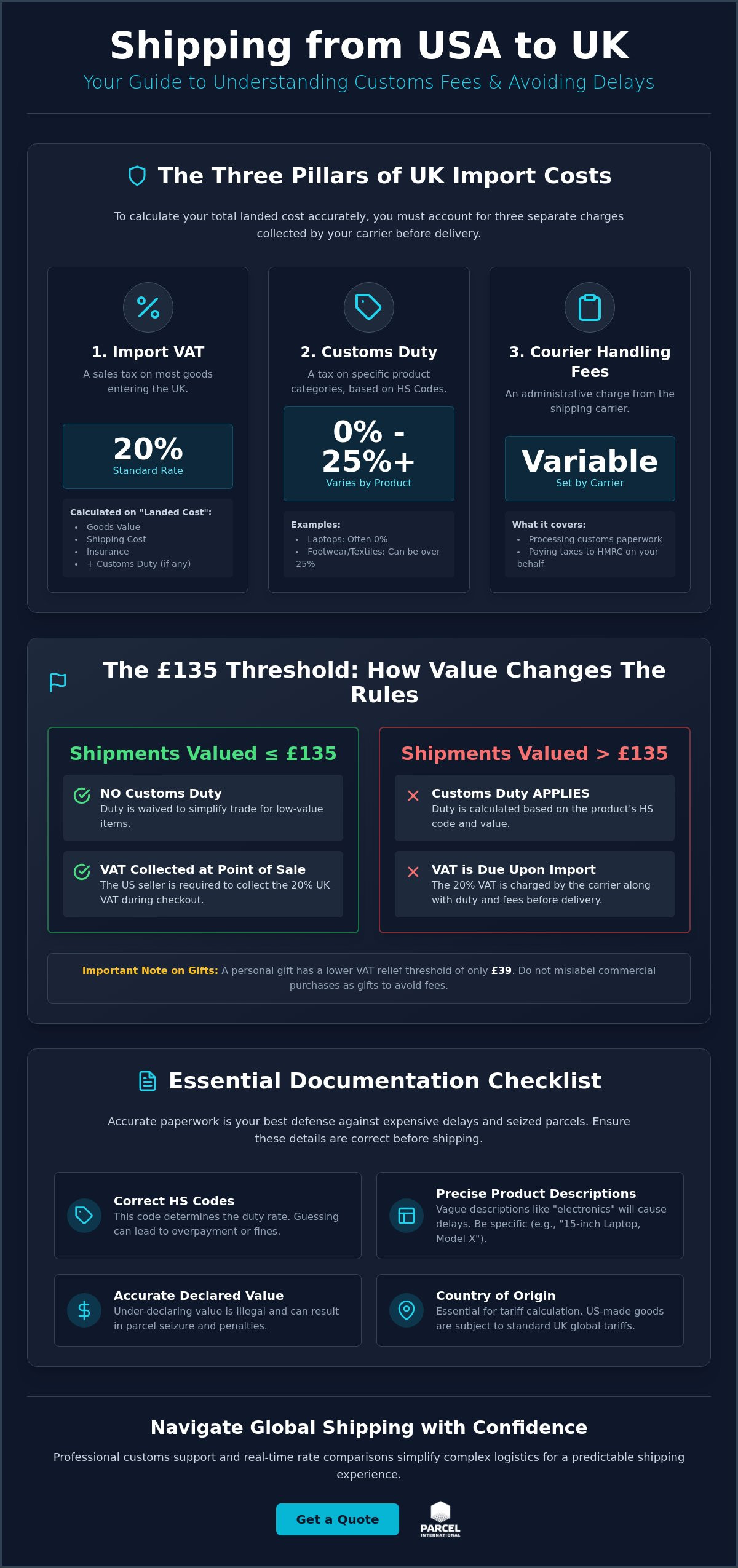
Calculating shipping from usa to uk customs fees accurately requires a clear understanding of three distinct pillars. You aren't paying a single flat tax; you're navigating a combination of government levies and service charges. These costs are usually collected by your carrier before the final delivery is made to your UK address. If you don't account for them upfront, your package may sit in a warehouse for weeks while you scramble to pay the bill.
The three costs you must account for are:
Import VAT: A sales tax applied to most goods.
Customs Duty: A tax on specific categories of imported items.
Courier Handling Fees: Administrative charges from the shipping company for processing the entry.
Import VAT: The Most Common Charge
Most goods entering the UK are subject to the UK's Value Added Tax (VAT) system. This isn't just a tax on the item's purchase price. Instead, it's calculated on the "landed cost." This total includes the price of the goods, the shipping costs, and any insurance you paid for the journey, plus any customs duty owed. Because VAT is calculated last, it often feels higher than expected.
The standard rate is 20%. While some specific items like children's car seats might qualify for a reduced rate of 5%, or books might be zero-rated, most commercial goods hit that 20% mark. If you're a VAT-registered business, you can often reclaim this amount as input tax, which significantly changes your cash flow compared to a private individual. Always verify your registration status before shipping to ensure you're utilizing the correct accounting method.
Customs Duty: Why Product Category Matters
Unlike VAT, which is relatively uniform, Customs Duty depends entirely on what's inside the box. Authorities use HS Codes, or Harmonized System codes, to categorize every possible product. These codes tell the customs officer exactly which tariff applies. Duty rates vary wildly; you might pay 0% on a laptop but over 25% on certain textiles or footwear. This variability makes accurate classification essential for a predictable budget.
The country of origin is another critical factor. Because there's no comprehensive free trade agreement between the US and the UK, American-made goods are subject to standard UK global tariffs. Don't assume that a low purchase price exempts you from duty. Always check your HS codes before you ship; guessing is an expensive strategy that often leads to overpayment or seized goods. Accurate documentation is your best defense against unexpected costs.
Finally, understand that the carrier acts as a stable intermediary. They pay the UK government on your behalf to speed up the process and move your goods through the border quickly. This efficiency isn't free. They'll charge a handling or brokerage fee, which is entirely separate from the taxes themselves. Knowing these pillars helps you avoid the shock of a "held" parcel and ensures your shipping from usa to uk customs fees are fully budgeted before you hit the buy button.
The £135 Threshold: How Value Impacts Your Customs Bill
The £135 threshold is the most critical number for anyone managing shipping from usa to uk customs fees. It acts as the "de minimis" limit, which is the value below which certain taxes are waived to simplify border trade. If your shipment's value stays at or below £135, you won't pay any Customs Duty. However, it's a common mistake to assume this means the shipment is entirely tax-free. VAT remains a factor for almost every commercial import, regardless of how small the box is.
The intent of your shipment also changes the rules. A "Gift" sent from one individual to another has a lower VAT relief threshold of just £39, though the £135 duty threshold still applies. If you're buying goods from a US business, it's classified as a "Sale of Goods," and the standard thresholds apply. You should never attempt to mislabel a commercial purchase as a gift or a sample to avoid fees. Customs officers use sophisticated screening to spot these discrepancies. For a full breakdown of these definitions, you can refer to the Official UK government guidance on imported goods.
Shipping Goods Worth Under £135
For shipments valued at £135 or less, the UK government requires the seller to collect VAT at the point of sale. This means you'll usually pay the 20% tax during the checkout process on the US website. Because the value is low, Customs Duty is waived entirely, which speeds up the journey through the border. Note that excise goods, such as alcohol or tobacco, are the exception. These items are subject to excise duty and VAT from the very first penny, no matter the total value.
Shipping Goods Worth Over £135
Once your shipment exceeds the £135 mark, the logistical responsibility shifts. The seller no longer collects VAT at checkout. Instead, the recipient is responsible for paying both VAT and Customs Duty once the package reaches the UK. Your carrier will typically hold the parcel and issue an invoice that must be settled before final delivery. High-value items often face longer clearance times because they require manual assessment and verification of HS codes by customs officials.
Accuracy is your best defense against border friction. Intentionally undervaluing an item to stay under the £135 limit is a high-risk strategy that leads to seized goods and heavy penalties. If you want to ensure your paperwork is flawless, utilizing professional Customs Support can help you stay compliant and avoid the anxiety of unexpected "held" notifications.
Courier Handling Fees: The "Hidden" Cost of Delivery
Many shippers calculate their taxes perfectly only to be blindsided by a separate invoice from the courier. These are known as handling or brokerage fees. While VAT and duty are government levies, handling fees are paid directly to the carrier. They represent the price of convenience for having a private company manage the border crossing on your behalf. When you are budgeting for shipping from usa to uk customs fees, these administrative costs are just as important as the taxes themselves.
Major carriers like DHL, FedEx, and UPS maintain their own specific fee structures. These often manifest as a flat fee, usually ranging from £8 to £15, or a percentage of the total tax advanced, whichever is greater. They charge this because they effectively act as your temporary bank. They pay the UK government immediately so your package moves through the border without waiting for you to manually settle the bill. This speed is what you pay for when you choose express services over standard postal routes.
Why Do Couriers Charge Handling Fees?
The administrative work required to file a customs entry is surprisingly complex. Carriers employ dedicated staff to check HS codes, verify documentation, and ensure every item in your shipment complies with UK regulations. This "Express Clearance" is a premium service that keeps global trade moving at high speeds. By advancing the tax payments on your behalf, the courier ensures the delivery flow remains uninterrupted. While the UK government's official guidance on tax and duty explains what you owe the state, it does not regulate what private companies charge for their logistics expertise. Paying the courier is almost always faster than attempting to deal with HMRC directly as an individual.
How to Anticipate and Manage These Fees
Transparency is your best tool for avoiding frustration. You can usually find these fee schedules buried in the "Terms and Conditions" or "Additional Surcharges" sections of carrier websites. If you manage larger commercial shipments, these costs can escalate quickly and become a significant portion of your overhead. In these scenarios, partnering with a freight forwarder provides a more unified and predictable cost structure. They can consolidate fees and provide a single invoice that covers both the transport and the administrative legwork.
If you sell products to UK customers, communicate these costs clearly at the point of purchase. Do not let a small handling fee ruin a customer's experience or lead to a refused delivery. Explain that these charges are independent of your shipping rates and represent the carrier's fee for customs brokerage. This proactive approach builds trust and ensures your shipping from usa to uk customs fees are handled professionally by both the sender and the recipient.
Documentation Checklist: Avoiding Customs Delays
Paperwork is the bridge between your US warehouse and a UK doorstep. If that bridge is weak, your shipment stalls. Even if you've budgeted perfectly for shipping from usa to uk customs fees, a single missing digit on a form can lead to weeks of delays or expensive storage charges. Most border friction isn't caused by the taxes themselves but by the lack of clear information provided to customs officers.
Follow this five-step checklist to ensure your documentation is border-ready:
Step 1: Accurate Product Description. Avoid vague terms like "Gift," "Samples," or "Electronics." Instead, be specific: "Men’s 100% Cotton Knitted T-shirt."
Step 2: Correct HS Codes. Every item needs its specific commodity code to determine the correct duty rate.
Step 3: Clear Valuation. State the value of the goods clearly and specify the currency used, such as USD or GBP.
Step 4: Full Contact Details. Include the name, address, and phone number for both the sender and the recipient. UK businesses must also provide their EORI number.
Step 5: Defined Incoterms. Clearly state if the shipment is DAP (Delivered at Place), where the buyer pays fees, or DDP (Delivered Duty Paid), where the sender covers everything.
The Commercial Invoice: Your Most Important Document
The commercial invoice is the primary document customs officials use to assess your shipment. It must contain every detail mentioned in the checklist above to pass through the border without manual intervention. A common reason for parcels being returned to the US is a missing recipient phone number; if the courier can't contact the buyer to collect taxes, they won't deliver the box. For a deeper look at the specific fields required, consult our customs documentation guide to ensure your paperwork is flawless.
HS Codes and Why They Are Non-Negotiable
An HS code acts as a universal language that tells customs officials exactly what is in the box regardless of language barriers. These 6-to-10 digit codes are non-negotiable for international trade. You can find the correct code using online tariff look-up tools provided by the UK government. Using an incorrect code is a costly mistake. It can lead to overpayment of shipping from usa to uk customs fees, or worse, result in heavy fines and the permanent seizure of your goods by authorities.
Don't leave your international growth to chance. If you're ready to streamline your border process and eliminate paperwork errors, you can get professional customs support to help you navigate every requirement with confidence.
Simplifying US-UK Logistics with Parcel International
Managing global trade shouldn't require a degree in tax law. While individual carriers provide transport, a logistics broker acts as your strategic partner to handle the friction between carrier requirements and customs regulations. By centralizing your workflow, you move away from fragmented spreadsheets and toward a unified solution. This approach is essential when calculating shipping from usa to uk customs fees, as it allows you to see the full picture of your landed costs before your goods even leave the warehouse.
The core of a successful global e-commerce strategy is transparent pricing. Customers don't want surprises; they want certainty. By using a platform to compare international shipping rates in real-time, you can select the most efficient route that balances speed with cost. This transparency builds trust and ensures your UK customers aren't left with an unexpected bill at their doorstep, which is the most common reason for refused deliveries.
Automated Customs Support
Manual paperwork is the leading cause of border delays. Our automated tools eliminate this risk by generating accurate commercial invoices based on your specific shipment data. These systems ensure full compliance with 2026 UK import regulations automatically, so you don't have to manually check for policy updates every week. By integrating directly with major global carriers, the platform transfers data seamlessly. This reduces the chance of transcription errors that lead to seized parcels and ensures your shipping from usa to uk customs fees are processed based on clean, verified data.
Getting Started with Your Next Shipment
Ready to move your goods? Use our international parcel shipping tool to find the most reliable route for your specific items. You'll access wholesale rates that are typically reserved for high-volume shippers, along with the administrative support needed to handle the border process without the headache. Stop guessing about taxes and start shipping with confidence. Compare rates and simplify your US to UK shipping today.
Master Your International Logistics Today
Mastering shipping from usa to uk customs fees is about moving from uncertainty to total control. You now understand that VAT, customs duty, and courier handling fees aren't random obstacles but predictable variables. By respecting the £135 threshold and ensuring your commercial invoices are flawless, you eliminate the risk of expensive delays or seized goods. Accurate documentation and correct HS codes are your best defense against border friction.
Reliable global trade requires more than just transport; it requires a stable partner that handles the administrative legwork for you. We provide automated customs documentation and real-time rate comparisons across 220+ countries to ensure your strategy is both efficient and compliant. Our expert support is designed specifically for SMB logistics, helping you scale without the traditional barriers of complex paperwork. Get a transparent international shipping quote now and start moving your goods with absolute confidence. Your next successful delivery is just a few clicks away.
Frequently Asked Questions
Do I have to pay customs fees on a gift sent from the USA to the UK?
You won't pay VAT on gifts valued at £39 or less, provided they are sent from one private individual to another. If the gift's value is between £135 and £630, a flat customs duty rate of 2.5% usually applies. Items exceeding these values or containing excise goods like alcohol will incur full taxes regardless of their status as a gift.
How much is the UK customs handling fee for 2026?
Handling fees vary by carrier and are not set by the government. Most major couriers like DHL, UPS, or FedEx charge between £8 and £15 to process your shipment. This administrative fee covers the cost of the courier acting as a broker and advancing the tax payments to HMRC so your parcel can clear the border faster.
What happens if I refuse to pay the customs charges on my parcel?
If you refuse to pay the shipping from usa to uk customs fees, the courier will hold your parcel for a limited time, typically 21 days. After this period, the package is either returned to the sender in the US or destroyed. You may still be responsible for return shipping costs and original delivery fees depending on the seller's refund policy.
Can I pay the customs fees before the parcel arrives in the UK?
You can pay these fees in advance if you choose a Delivered Duty Paid (DDP) shipping service. Many US retailers now offer this at checkout, collecting all VAT and duties upfront. This prevents the parcel from being held at the border and ensures the recipient doesn't receive an unexpected invoice before delivery can be completed.
How long does customs clearance usually take for US parcels?
Most shipments clear customs within 24 to 48 hours if the digital paperwork is complete and accurate. However, manual inspections or missing documentation can extend this wait to two weeks or more. High-value items over the £135 threshold often face more scrutiny, which can add a few days to the total transit time.
Why is my parcel being held by UK customs if I paid for express shipping?
Express shipping only guarantees the speed of physical transport, not the speed of government processing. Customs is an independent legal procedure that couriers cannot bypass. If your parcel is held, it's usually because of a random inspection, an incorrect HS code, or an outstanding tax balance that needs to be settled by the recipient.
What is an EORI number and do I need one for US to UK shipping?
An EORI number is a unique identification code used by customs to track commercial shipments. You only need an EORI number if you are a business importing goods for commercial purposes. Private individuals receiving personal purchases or gifts from the USA generally don't need to register for one, as the carrier handles the entry under a different protocol.
How do I calculate the exact VAT and Duty for my specific item?
Start by identifying your item's 10-digit HS code to find the specific duty rate, which can range from 0% to over 25%. You then apply the 20% VAT to the "landed cost." This total includes the product price, the shipping cost, and any insurance paid. Adding these figures to the courier's handling fee gives you the total cost of your import.


