
Shopify International Shipping Strategy 2026: The Global Growth Blueprint
Updated: Jul 16
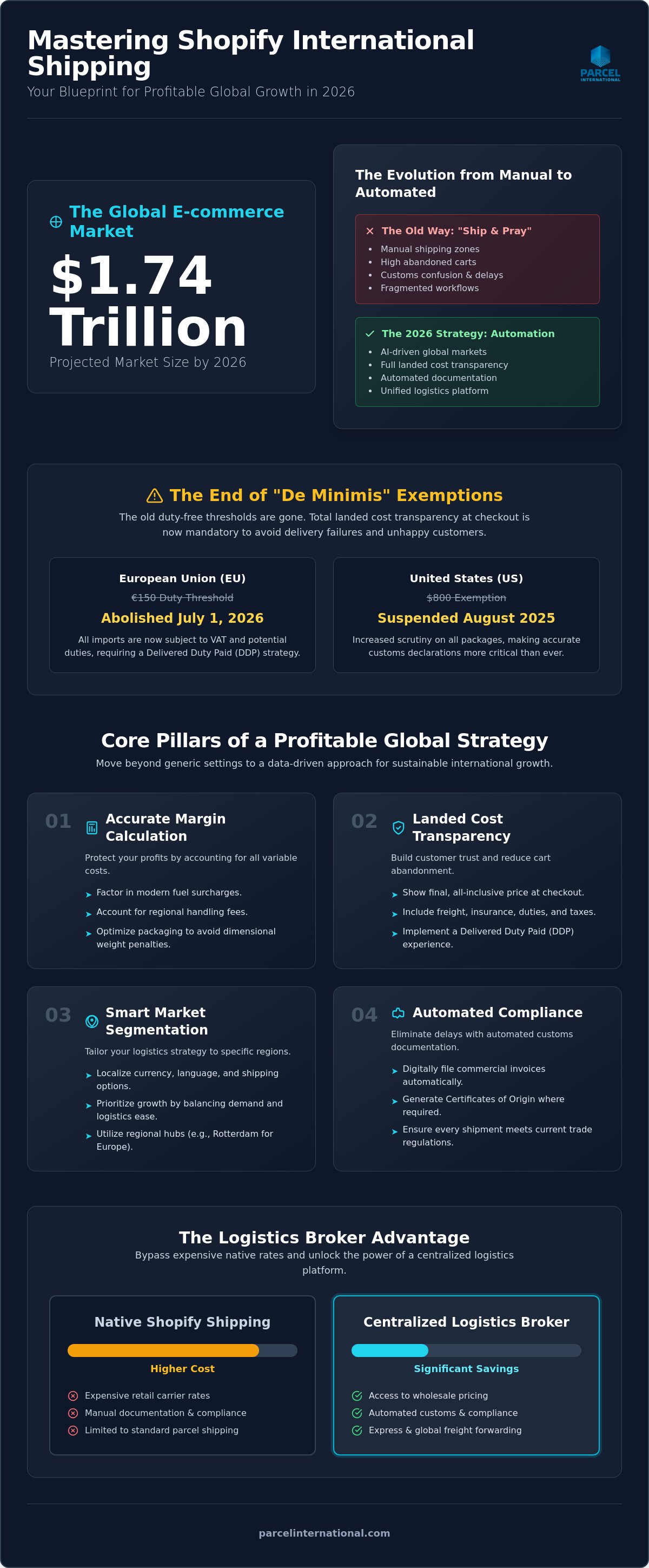
Did you know that the global cross-border e-commerce market is projected to reach $1.74 trillion in 2026? Despite this massive opportunity, many merchants are still losing a significant portion of their international sales to abandoned carts and customs confusion. With the EU recently abolishing the €150 duty threshold and the US suspending its de minimis exemption, the old "ship and pray" method is officially over. Building a profitable shopify international shipping strategy 2026 requires moving beyond basic native tools toward a system that prioritizes automation and cost control.
You've likely felt the sting of high shipping costs and the anxiety of packages stuck in customs for days. It's frustrating to watch your profit margins disappear into carrier fees and fragmented workflows. We promise to help you reclaim those margins by mastering the complexities of global logistics. In this guide, we'll show you how to access wholesale rates, automate your customs documentation, and manage every delivery from a single, unified platform. Here is your blueprint for turning global shipping into a predictable, automated growth engine.
Table of Contents
The Evolution of Shopify International Shipping in 2026
The global cross-border e-commerce market is no longer a niche segment; it's a $1.74 trillion powerhouse. For brands using Shopify, staying domestic is a recipe for stagnation. By 2026, the barrier between local and global sales has effectively dissolved. Merchants are moving away from the tedious setup of manual shipping zones and embracing AI-driven global markets that handle localization automatically. This shift allows businesses to tap into over 220 countries and territories where demand for unique products continues to climb. Success in this environment requires a sophisticated shopify international shipping strategy 2026 that treats every border as an opportunity rather than a hurdle. Engaging in international trade used to be reserved for enterprise giants, but modern logistics platforms have leveled the playing field for every Shopify store.
Consumer expectations have undergone a massive transformation. Shoppers now demand the same speed and clarity from an international order as they do from a local one. If your store doesn't provide a seamless transition between currencies and shipping methods, you'll lose those customers to competitors who do. The transition to AI-driven logistics means your store can now predict transit times with pinpoint accuracy, providing a level of reliability that was impossible just a few years ago.
The Shift to Landed Cost Transparency
Transparency is the currency of trust in 2026. Customers won't tolerate "surprise" fees at their doorstep. High abandoned cart rates are often the direct result of hidden shipping costs and unknown duties. Showing the total landed cost at checkout is now mandatory to maintain competitive conversion rates. Landed cost is the final, all-inclusive price of a product once it reaches the buyer, encompassing the item price, freight, insurance, and all applicable customs duties or taxes. With the EU abolishing the €150 de minimis threshold on July 1, 2026, and the US having suspended its $800 exemption in August 2025, every package is now a subject of scrutiny. You must provide a clear, Delivered Duty Paid experience to keep your customers coming back.
Global Market Segmentation
A winning shopify international shipping strategy 2026 relies on smart segmentation. Shopify Markets allows you to localize currency, language, and shipping options for different regions, but you can't treat every country the same way. Prioritize your growth by balancing market demand against logistics ease. For instance, Europe remains a top priority, but the regulatory environment is complex. Smart merchants utilize regional hubs like Rotterdam to streamline European distribution. This allows for faster road freight across the continent once goods clear customs at the initial point of entry. By categorizing your potential markets into tiers, you can allocate your shipping budget more effectively and ensure your most profitable regions receive the fastest express shipping options.
Core Pillars of a Profitable Shopify Global Strategy
Profitability doesn't happen by accident. In 2026, a successful shopify international shipping strategy 2026 relies on four foundational pillars. You must move away from generic shipping zones and start defining them based on real-world transit times and carrier reliability. If a carrier consistently fails to deliver on time in a specific region, remove them from that zone immediately. This level of granular control ensures you're only paying for performance, not empty promises. It's about building a network that actually works for your specific product type and customer base.
Calculating your margins is more complex than it was just a year ago. You have to account for 2026 fuel surcharges and increased handling fees that vary significantly by region. A flat-rate model might look attractive to customers, but it can quickly erode your profits if it's not backed by wholesale data. Many successful merchants find that carrier-calculated rates provide the most transparency. However, offering free shipping with a minimum order value remains the strongest driver for increasing your average order value. The key is to find the "sweet spot" where your shipping costs don't swallow your profit on every international sale.
Rate Calculation and Dimensional Weight
Carriers in 2026 are increasingly aggressive with dimensional weight pricing. If your packaging is too large for the item inside, you're essentially paying to ship air. Optimizing your box sizes can lead to immediate cost reductions. For a deeper dive into how these rates are structured, check out our guide on international shipping for ecommerce. Real-time rate comparisons across multiple carriers are your best defense against overpaying. Don't settle for the first rate you see; instead, use a platform that compares options in seconds.
Delivery Speed vs. Cost Efficiency
Balancing speed and cost requires a tiered approach. Use Express Shipping for high-value orders where speed is the primary concern for the buyer. For bulk replenishment or heavier items, Sea Freight remains the most economical choice, provided you manage your inventory lead times effectively. Staying compliant with CBP E-Commerce Regulations is essential for avoiding costly delays at the border. By offering tiered options at checkout, you empower the customer to choose between cost and speed. This flexibility significantly improves checkout conversion and reduces cart abandonment. If you're looking to streamline this process, you can find a unified logistics solution that manages all these tiers in one place.
The Logistics Broker Advantage: Beyond Native Shopify Settings
Native shipping tools on Shopify are excellent for businesses just starting their journey, but they often reach a ceiling as you scale. Most SMBs find themselves paying retail or slightly discounted rates because they lack the massive shipping volume required to negotiate directly with global carriers. This is a common pitfall in a shopify international shipping strategy 2026 where every cent of margin counts. By relying solely on default settings, you're essentially leaving money on the table that could be reinvested into your marketing through Enginemailer or product development. A logistics broker changes this dynamic by acting as a stable intermediary between your store and the world's largest transport networks.
The primary advantage of a broker lies in volume aggregation. By combining the shipping power of thousands of independent merchants, brokers secure enterprise-level discounts that would otherwise be inaccessible to a single store. This means you get the same priority service as a Fortune 500 company without needing to meet any minimum volume requirements. You gain the flexibility to ship one parcel or a full container while still benefiting from wholesale pricing. This model removes the traditional barriers to entry, making global growth an egalitarian pursuit for any ambitious Shopify merchant.
Accessing Wholesale Carrier Rates
Securing deep discounts with carriers like DHL, FedEx, and UPS usually requires a long history of high-volume shipping. However, a logistics broker provides immediate access to these rates from day one. This is particularly valuable in 2026, as shipping costs continue to fluctuate based on global demand. Many modern brokers operate on a "no subscription fee" model, ensuring that you only pay for the services you actually use. To understand how these costs impact your bottom line, you can find more details in our international shipping rates 2026 guide. This transparency allows you to price your products competitively in any market.
Unified Logistics Management
Managing international deliveries shouldn't require twenty different browser tabs. Moving from fragmented carrier logins to a single, unified dashboard is the ultimate relief for a busy merchant. You can compare Express Shipping, Air Freight, and Road Freight in a single click, allowing you to make the most efficient choice for every order. Centralizing your booking process doesn't just save time; it ensures you're always following the latest international shipping requirements and regulations. This streamlined approach significantly reduces administrative friction, allowing you to focus on the creative aspects of your business while the logistics platform handles the procedural heavy lifting.
Automating Customs and 2026 Trade Compliance
Customs clearance is often the most stressful part of global e-commerce. In 2026, manual data entry isn't just slow; it's a liability. Global customs authorities have moved toward mandatory digital filing, requiring precise data before a package even leaves your warehouse. If your shopify international shipping strategy 2026 relies on hand-written forms or legacy processes, you're risking "customs purgatory," where shipments sit in warehouses for weeks due to minor clerical errors. Pre-validated data is the solution. By ensuring every piece of information is accurate at the point of label generation, you move your goods through borders with the speed of domestic mail.
The Harmonized System (HS) code is the DNA of your shipment. It tells customs exactly what's inside and determines the duty rate. In the current regulatory environment, guessing an HS code can result in heavy fines or shipment seizures. Automated systems now map your Shopify product categories to the correct HS codes instantly. This precision ensures you pay exactly what's owed, protecting your margins and your reputation with international authorities. Reliability in this area is what separates scalable brands from those that struggle to leave their home market.
Generating Digital Customs Paperwork
Modern logistics tools pull data directly from your Shopify orders to generate commercial invoices, packing lists, and certificates of origin. This process eliminates the risk of a mismatch between what the customer ordered and what's declared to customs. Electronic data transmission sends these documents to carriers and customs officials in real time. This digital handshake significantly reduces the likelihood of physical inspections and delays. For a detailed breakdown of the requirements, see our international shipping customs documentation guide.
Navigating Import Duties and Taxes
Choosing between Delivered Duty Paid (DDP) and Delivered Duty Unpaid (DDU) is a critical decision for your customer experience. In 2026, DDP has become the gold standard. When you ship DDP, you collect duties and regional taxes like VAT or GST at checkout. This transparency ensures the customer isn't met with an unexpected bill upon delivery. Automating these calculations at checkout removes the friction of international buying and drastically lowers your cart abandonment rates. Providing this level of clarity is the best way to build long-term trust with a global audience. If you're ready to simplify your border crossings, you can get expert customs support to automate your entire compliance workflow.
Scaling Your Shopify Store with Parcel International
Integrating high-level logistics into your existing Shopify workflow shouldn't feel like a separate, daunting project. It's about making your shopify international shipping strategy 2026 a natural extension of your daily operations. You don't need to learn a new technical language or spend hours navigating complex carrier portals. Instead, you connect your store to a system that handles the heavy lifting, allowing you to scale without adding significant administrative overhead. This seamless integration ensures that as your order volume grows, your workload stays manageable and your focus remains on your brand.
Utilizing Rotterdam as your strategic gateway is a game-changer for European and global distribution. Its position as a premier global hub means your goods arrive faster and move through Road Freight networks with minimal friction. It's the ideal entry point for brands looking to establish a reliable, long-term presence in the EU market. By clearing customs at a major hub, you avoid the bottlenecks often found at smaller, less efficient ports. This speed and reliability are essential for maintaining the high standards that 2026 consumers expect.
From Parcels to Bulk Freight
Transitioning from individual parcels to LCL (Less than Container Load) freight is a major milestone for any growing store. It signals that your brand is ready for bulk inventory moves rather than just reactive, order-by-order shipping. You can manage these larger Sea Freight or Air Freight shipments with the same ease as a single parcel delivery through our unified interface. To understand how these services support your long-term growth, read our guide on what is a freight forwarder. This specialized knowledge helps you move from basic shipping to sophisticated logistics management.
Your 2026 International Launch Checklist:
Audit your current carrier rates against wholesale broker benchmarks to find hidden savings.
Enable DDP at checkout to ensure total landed cost transparency for every customer.
Automate HS code mapping for your entire product catalog to prevent customs delays.
Establish a regional hub strategy, like using Rotterdam, for your top-performing global markets.
Consolidate all carrier tracking into a single dashboard to reduce customer support inquiries.
Launch Your Global Strategy Today
A "Broker First" approach is the most efficient way to achieve Shopify success in 2026. It gives you the power of a global logistics department without the associated costs or restrictive volume minimums. We believe in radical transparency, which means no hidden fees and no unnecessary subscription requirements. You get the security of a stable intermediary that values your peace of mind and your bottom line. It's time to move beyond domestic limits and embrace the full potential of the trillion-dollar global market. By refining your shopify international shipping strategy 2026 today, you position your brand for years of sustainable growth.
Optimise your Shopify shipping with Parcel International and start your global expansion today.
Secure Your Global Growth in 2026
The transition from a domestic store to a global brand requires more than just opening new markets. It demands a sophisticated shopify international shipping strategy 2026 that prioritizes automation and cost control. By moving away from fragmented carrier workflows and embracing a centralized broker model, you gain the stability needed to scale. You've seen how automated customs documentation and strategic hub placement can eliminate the typical anxieties of cross-border trade. Now, it's time to put these pillars into practice and reclaim the profit margins you've been losing to hidden fees and manual errors.
Stop overpaying for retail shipping and start accessing wholesale rates from industry leaders like DHL, FedEx, and UPS. We offer a transparent model with no subscription fees and no volume minimums, ensuring that even growing stores can compete on a global stage. Our unified platform includes automated customs documentation to keep your deliveries moving and your customers satisfied. Start comparing wholesale international shipping rates today and experience the relief of a truly streamlined logistics solution. Your expansion into the trillion-dollar global market starts with one smart, efficient decision.
Frequently Asked Questions
Does Shopify ship internationally by default in 2026?
Shopify allows international sales by default, but the extent of your reach depends on your specific plan. As of July 2026, Basic and Grow plans are limited to three custom international markets. To expand beyond this, you must upgrade to the Advanced plan and pay an additional monthly fee per market. For a truly scalable shopify international shipping strategy 2026, most merchants integrate third-party logistics brokers to bypass these native limitations and access better rates.
How do I calculate international shipping rates for my Shopify store?
Rates are calculated based on a combination of package dimensions, weight, and the destination's specific zone. In 2026, carriers place a heavy emphasis on dimensional weight, so shipping "air" in large boxes will increase your costs. You can use Shopify’s native carrier-calculated rates or a third-party app to compare wholesale prices in real time. Always ensure your calculations account for the latest fuel surcharges and regional handling fees to protect your profit margins.
What is the cheapest way to ship internationally for a small Shopify business?
The most economical method is to use a logistics broker that offers volume-aggregated wholesale rates. This allows small businesses to access the same deep discounts as enterprise shippers without needing to meet high volume minimums. By using a platform that compares Express Shipping, Air Freight, and Road Freight in one place, you can always select the most cost-effective route for each specific parcel. This approach eliminates unnecessary retail markups and high subscription fees.
How can I automate customs forms for my Shopify orders?
You can automate this process by using a logistics integration that pulls order data directly from your Shopify admin. These tools automatically populate commercial invoices, packing lists, and certificates of origin with the correct HS codes and product values. This digital filing is essential for 2026 compliance, as many global customs authorities now require electronic data transmission before a shipment arrives. Automation removes the risk of manual errors and prevents packages from getting stuck in customs.
What are the main differences between DDP and DDU shipping on Shopify?
DDP (Delivered Duty Paid) means you collect all duties and taxes from the customer at checkout, while DDU (Delivered Duty Unpaid) requires the customer to pay those fees upon delivery. In 2026, DDP is the standard for high-growth brands because it provides total price transparency. It eliminates the "hidden fees" that lead to customer frustration and refused deliveries. Using DDP as part of your shopify international shipping strategy 2026 is the most reliable way to build international trust.
Can I use multiple carriers like DHL, FedEx, and UPS on one Shopify store?
Yes, you can and should use multiple carriers to ensure the best service for different global regions. A unified logistics dashboard allows you to manage shipments from DHL, FedEx, and UPS through a single interface. This removes the need to log into multiple carrier portals and allows for instant rate comparisons. You gain the flexibility to choose the fastest express option for one country and the most economical road freight for another, all from one stable platform.
How do I handle international returns on Shopify?
Managing global returns requires a clear policy and a logistics partner that can provide localized return labels. You should use a system that automates the customs re-entry process to avoid paying duties twice on returned goods. Providing a transparent, easy-to-follow return process is just as important for international customers as it is for domestic ones. This reliability encourages repeat purchases and reduces the overall anxiety associated with buying from an overseas brand.
Is a freight forwarder necessary for my Shopify business?
A freight forwarder becomes necessary when you scale from sending individual parcels to moving bulk inventory. If you're replenishing stock in regional hubs or shipping heavy items, Sea Freight or Air Freight through a forwarder is much more cost-effective than parcel post. They act as a stable intermediary, managing the complex documentation and transport logistics required for large-scale global distribution. This transition is a key milestone in moving from a local boutique to a global e-commerce powerhouse.


