
Small Business Freight Forwarder: 2026 Logistics Guide
- Alex
- 7 hours ago
- 12 min read
Stop letting hidden surcharges swallow up to 28% of your shipping budget in 2026. Finding a dedicated freight forwarder for small business shouldn't feel like a choice between paying retail rates or getting lost in the complexity of international customs. You're likely tired of opaque quotes and the lack of personalized support from giant carriers. It's frustrating to feel like your growth is being stalled by logistics hurdles that should have been automated years ago.
This guide provides a clear roadmap to simplify your global shipping and reclaim your profit margins. You'll learn how to access wholesale rates usually reserved for large enterprises and how to use automated documentation to prevent delays at the border. We will show you how to use a single platform to compare air, sea, and road freight, ensuring your logistics strategy is as efficient and transparent as the rest of your business.
Table of Contents
What is a Freight Forwarder for Small Business?
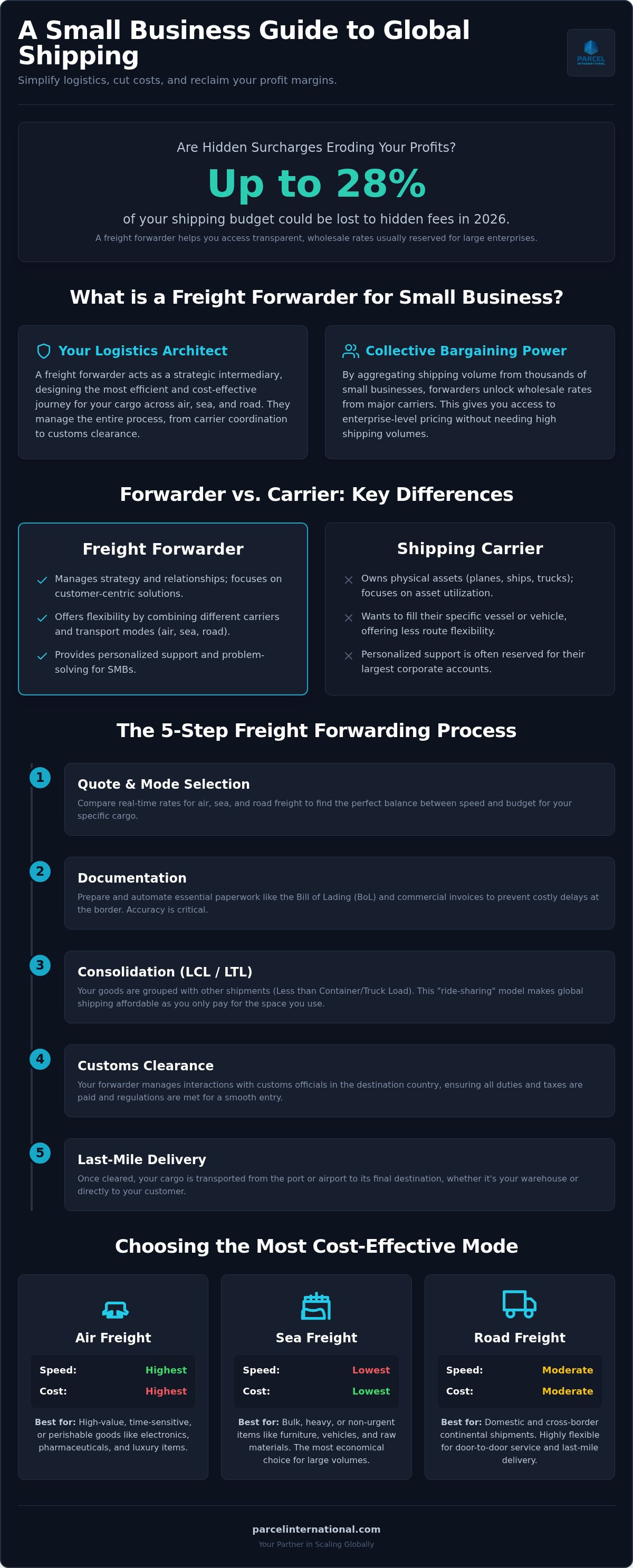
A What is a Freight Forwarder? functions as a logistics architect for SMBs, focusing on cost reduction and regulatory compliance. They act as the bridge between your warehouse and the global marketplace. While you focus on product development and sales, they handle the friction of coordinating carriers, managing schedules, and clearing customs. They don't just move boxes; they design a secure, end-to-end journey for your cargo across air, sea, and road freight.
The primary value for an SMB lies in "rate aggregation." If you ship five pallets a month, a major carrier like DHL or FedEx won't give you their best pricing. A freight forwarder for small business solves this by aggregating the shipping volume of thousands of small clients. This collective bargaining power unlocks wholesale rates that would otherwise be out of reach. It brings a sense of relief to business owners who are tired of being penalized for lower shipping volumes or getting stuck with retail rates.
Freight Forwarder vs. Shipping Carrier: The Key Differences
Carriers own the physical assets, meaning the ships, planes, and trucks. Forwarders own the relationships and the high-level strategy. This distinction is vital for small businesses. A carrier wants to fill their specific vessel. A forwarder wants to find the most efficient path for your cargo, often combining different modes to hit your budget. This flexibility makes a freight forwarder for small business an essential partner for those who need to move goods across borders without a massive internal team.
Carriers: Own the hardware and focus on asset utilization.
Forwarders: Manage the software and focus on customer-centric solutions.
Because forwarders are service-oriented intermediaries, they provide the personalized support and problem-solving that massive carriers often reserve for their largest corporate accounts. They act as an egalitarian ally, ensuring your small shipment gets the same punctuality and security as a massive enterprise load.
Why SMBs Need a Forwarder in 2026
The global trade environment in 2026 is significantly more complex than it was just a few years ago. For instance, the July 1, 2026, abolition of the EU's €150 duty-free threshold means every single B2C shipment now requires formal customs handling. Small teams simply don't have the bandwidth to track these shifting international shipping rates and compliance rules manually. Additionally, the industry has shifted from "just-in-time" to "just-in-case" inventory strategies. This requires a partner who can pivot quickly between air and sea freight when supply chains tighten. A forwarder provides the modern flexibility needed to manage these chaotic processes, making them orderly and predictable.
How the Freight Forwarding Process Works for Your Business
Moving goods globally doesn't have to be a chaotic series of phone calls and spreadsheets. A structured freight forwarding process takes the guesswork out of logistics by following a logical, five-step progression. It begins with Quote and Mode Selection, where you compare air, sea, and road freight based on your specific urgency and budget. Speed is often the priority for high-value electronics, while bulkier items like furniture favor the cost-efficiency of the sea.
Once you've chosen a mode, the focus shifts to Documentation. This involves preparing the Bill of Lading (BoL) and commercial invoices. Accuracy at this stage is non-negotiable; even a minor typo can trigger a two-week delay at the border. Many modern platforms now automate this step to reduce human error. For those new to the process, resources for Navigating Customs and Documentation provide a solid foundation for understanding these legal requirements. After paperwork is cleared, your goods move to Consolidation, followed by Customs Clearance in the destination country, and finally, Last-Mile Delivery to your warehouse or customer.
The Power of Consolidation: LCL and LTL Explained
Small businesses rarely have enough inventory to fill an entire 40-foot shipping container. This is where Less than Container Load (LCL) and Less than Truckload (LTL) become your secret weapons. By using a freight forwarder for small business, you can share container space with other shippers. This "ride-sharing" model for cargo makes global trade affordable for small batches, as you only pay for the volume you actually use. While consolidation might add a few days to the total transit time due to the sorting process, the cost savings are often the difference between a profitable international expansion and a failed one.
Real-Time Tracking and Visibility
In 2026, "set it and forget it" logistics is a dangerous myth. You need to know where your capital is at all times. Digital tracking allows you to manage exceptions, like port congestion or weather delays, before they impact your customer experience. Modern APIs provide SMBs with the same visibility as billion-dollar corporations, pulling live data from carriers directly into a single dashboard. This level of transparency ensures you're never left in the dark. If you're ready to see how this works in practice, you can compare real-time freight quotes and start tracking your first shipment today.
Air, Sea, or Road? Choosing the Most Cost-Effective Mode
Deciding how to move your products is a balance of transit time and bottom-line impact. A freight forwarder for small business helps you navigate this choice by providing real-time data on different modes. You need to understand the math behind dimensional weight versus actual weight. Carriers charge based on whichever is larger: the physical weight of your box or the space it occupies in the cargo hold. If you're shipping lightweight but bulky items like pillows, you'll likely pay for the volume rather than the grams. This makes packing efficiency just as important as the shipping rate itself.
When to Prioritize Speed: The Air Freight Case
Air freight is the fastest option, typically taking 1 to 5 days to reach its destination. It's best for high-value, low-volume, or time-sensitive goods. You must analyze the "cost of delay" for your specific inventory. If an out-of-stock item means losing a loyal customer to a competitor, paying for air freight is often the cheaper long-term choice. Seasonality also plays a massive role. During peak periods like Q4, air capacity tightens and prices spike significantly. For smaller, urgent samples or prototypes, integrating international parcel shipping into your strategy keeps your supply chain moving without the long wait times of traditional freight.
Ocean Freight: FCL vs. LCL for Growing Brands
Sea freight remains the gold standard for bulk goods where cost-per-unit is the priority. Transit times range from 20 to 45 days, so planning is essential. Most SMBs start with Less than Container Load (LCL) to keep costs low. Once you're shipping more than 15 cubic meters, it often makes sense to move to a Full Container Load (FCL). This reduces the risk of damage from multiple handling points and can be faster since there's no consolidation period at the port. Watch out for hidden costs like port handling fees and demurrage charges that can surprise unprepared shippers. If you're entering the European market, Rotterdam serves as a strategic hub, offering some of the most efficient connections to the rest of the continent.
For regional movements, road freight is indispensable. It bridges the gap between major ports and your final destination. Understanding international road freight rates Europe is crucial if you're moving goods cross-border within the EU. A freight forwarder for small business will coordinate these trucking legs as part of a multimodal journey, ensuring your cargo doesn't sit idle at a terminal. This joined-up approach removes the friction of managing multiple carriers and keeps your logistics workflow in a single, manageable platform.
Navigating Customs and Documentation without a Logistics Team
Small businesses often view customs as the most daunting part of global trade. Without an in-house logistics department, the mountain of paperwork can feel like a barrier to entry. However, a freight forwarder for small business provides the tools to turn this complex hurdle into a routine task. The Commercial Invoice is your most critical document. It must detail every item, its value, and its intended use with absolute precision. Even a minor discrepancy here can lead to a two-week delay at a busy port, resulting in storage fees that eat your profit margins.
The Bill of Lading (BoL) serves as your contract of carriage and your legal title to the goods. You'll also need a Packing List to help customs officials verify the contents of your shipment without opening every box. In certain trade agreements, a Certificate of Origin is required to prove where the goods were manufactured, which can significantly reduce the duties you owe. Modern logistics platforms replace the need for an expensive in-house customs broker by offering automated tools that check your data against current global regulations in real-time. This ensures your documentation is audit-ready before your cargo even leaves the warehouse.
Common Customs Pitfalls for Small Businesses
One of the most expensive mistakes you can make is using incorrect Harmonized System (HS) codes. These codes determine your specific duty rates. Selecting the wrong one could result in overpaying or, worse, facing heavy fines for misclassification. Missing documentation or a single forgotten signature can stall a shipment indefinitely. To avoid these traps, consult a detailed breakdown of international shipping customs documentation to ensure your paperwork is flawless. Accuracy is the only way to avoid the procedural friction that typically slows down international growth.
The Role of Incoterms in Your Shipping Strategy
Incoterms define who is responsible for costs and at what point the risk transfers from the seller to the buyer. For international imports, SMBs should generally avoid "Ex Works" (EXW). Under EXW, you're responsible for everything from the moment the goods leave the factory floor. This leaves you vulnerable to hidden local fees and logistics challenges in foreign countries where you have no presence. Instead, consider Free on Board (FOB) or Cost, Insurance, and Freight (CIF). These terms provide much more control over your shipping costs and ensure the seller handles the initial export logistics. Choosing the right Incoterms is a simple way to project an honest, straightforward business persona to your partners while protecting your bottom line.
Simplify your next international shipment and avoid costly paperwork errors by using our automated customs support tools today.
Scaling Your SMB Globally with Parcel International
Scaling a business across borders often feels like managing a series of disconnected crises. You have to juggle carrier quotes, chase tracking numbers, and sweat over customs compliance. Parcel International acts as a dedicated freight forwarder for small business, replacing this fragmented workflow with a single, unified platform. From this one dashboard, you can compare, book, and track shipments to over 220 countries and territories. It's the relief of moving from chaos to order through a system designed for speed and clarity.
The most significant barrier for many is the "volume penalty" often imposed by major carriers. We've removed that restriction entirely. As a freight forwarder for small business, we leverage our collective shipping volume to secure wholesale rates for every client. You don't need a massive warehouse or a 500-container annual quota to access these prices. Whether you're shipping a single pallet or ten full containers, you get the same transparent pricing with no hidden fees or complex subscription requirements. You pay only for what you ship, which keeps your capital where it belongs: in your growth.
A Technology-First Approach to Logistics
Our platform bridges the gap between your growing business and the complex networks of global carriers like DHL, FedEx, and UPS. We've built an optimizer that handles the heavy lifting of rate comparison and documentation. Instead of manually filling out repetitive forms, you can generate all necessary customs paperwork directly within our interface. This reduces administrative friction and frees you up to focus on product development and sales. For those still exploring the fundamentals, you can learn more about what is a freight forwarder in our comprehensive business guide.
Expert Support for Every Shipment
Modern logistics requires more than just software; it needs human expertise. By partnering with us, you gain access to professional advice without the overhead of an internal logistics department. Our Rotterdam-based team acts as your protective ally, handling the nuances of cross-border trade so you don't have to. We ensure your shipments are punctual and secure, providing a level of support that exceeds standard industry benchmarks. If you're ready to stop overpaying for logistics and start growing your global footprint, compare rates on Parcel International today and see how simple international shipping can be.
Take Control of Your International Growth
Managing global trade in 2026 requires more than just a shipping label; it demands a strategic logistics partner. You've seen how selecting the right transport mode and automating your documentation can strip away the anxieties of international expansion. By moving away from fragmented workflows, you reclaim the time needed to focus on your core business goals. A dedicated freight forwarder for small business turns complex global routes into simple, manageable steps.
It's time to stop overpaying for retail rates and start utilizing the same tools as major corporations. You don't need high shipping volumes to access professional logistics solutions. With our platform, you get real-time quotes from major carriers like DHL, FedEx, and UPS with no volume minimums required. We provide the automated customs paperwork generation you need to avoid costly border delays. Start comparing real-time freight rates for your small business today and experience the relief of a truly streamlined supply chain. Your global market is waiting.
Frequently Asked Questions
Do I need a freight forwarder if I only ship small volumes?
Yes, you absolutely need a freight forwarder for small business even with low volumes. These intermediaries aggregate smaller shipments from multiple clients into a single container. This process, known as consolidation, allows you to access wholesale rates that carriers usually reserve for large corporations. It's an egalitarian solution that ensures your small shipment isn't penalized by retail pricing or left behind due to a lack of scale.
What is the cheapest way for a small business to ship internationally?
Sea freight via Less than Container Load (LCL) is typically the cheapest way to move bulk goods internationally. You only pay for the space your cargo occupies in a shared container, making it ideal for budget-conscious SMBs. For regional shipments within Europe, road freight often provides a more affordable alternative to air transport. Always compare real-time rates across different modes to find the best balance between cost and speed.
How much does a freight forwarder cost for a small business?
Costs are determined by the weight, volume, and transport mode of your shipment, along with any required customs support. Forwarders act as brokers, meaning they pass on the carrier's rate plus a service fee for managing the logistics journey. Unlike traditional models, modern platforms often eliminate subscription fees and volume minimums. This transparent approach ensures you only pay for the specific logistics services you use without being trapped by hidden requirements.
Can a freight forwarder help with customs clearance?
Yes, a forwarder manages the legal entry of your goods into foreign countries. They handle the complex coordination between carriers and customs authorities to ensure your shipment stays compliant. Modern platforms utilize automated documentation tools to verify your paperwork against current global regulations. This reduces the risk of expensive delays or fines caused by incorrect HS codes or missing signatures, providing a layer of security for your supply chain.
What is the difference between a freight forwarder and a 3PL?
A freight forwarder for small business focuses specifically on the transportation and documentation of goods between two points. A Third-Party Logistics (3PL) provider offers a broader range of services, including physical warehousing and inventory management. If you only need to move cargo across borders efficiently, a forwarder is the more direct and cost-effective choice. They act as an optimizer for your transport workflow without the overhead of full supply chain management.
How do I choose the right freight forwarder for my SMB?
Select a partner that offers radical transparency regarding their terms and fees. You should look for a platform that provides real-time tracking and a single interface to compare air, sea, and road freight. A reliable ally will also provide automated customs support and have no restrictive volume minimums. This flexibility allows your logistics strategy to adapt as your business grows, moving from small pallets to full containers seamlessly.
What documents do I need for international freight?
The core documents include the Commercial Invoice, Bill of Lading (BoL), and a Packing List. The invoice must detail the value and description of every item to satisfy customs officials. The BoL serves as your contract of carriage and legal title to the goods. Depending on the destination and specific trade agreements, you might also need a Certificate of Origin to qualify for reduced duty rates or prove compliance.
How long does international freight forwarding usually take?
Transit times depend heavily on the mode of transport you choose. Air freight is the fastest option, usually taking between 1 and 5 days for global delivery. Sea freight is the slowest, typically ranging from 20 to 45 days depending on the port of origin and destination. Road freight within regional markets like Europe varies based on distance but generally offers a reliable middle ground for cross-border shipments.


Comments