
Small Business Guide: International Shipping Rates 2026
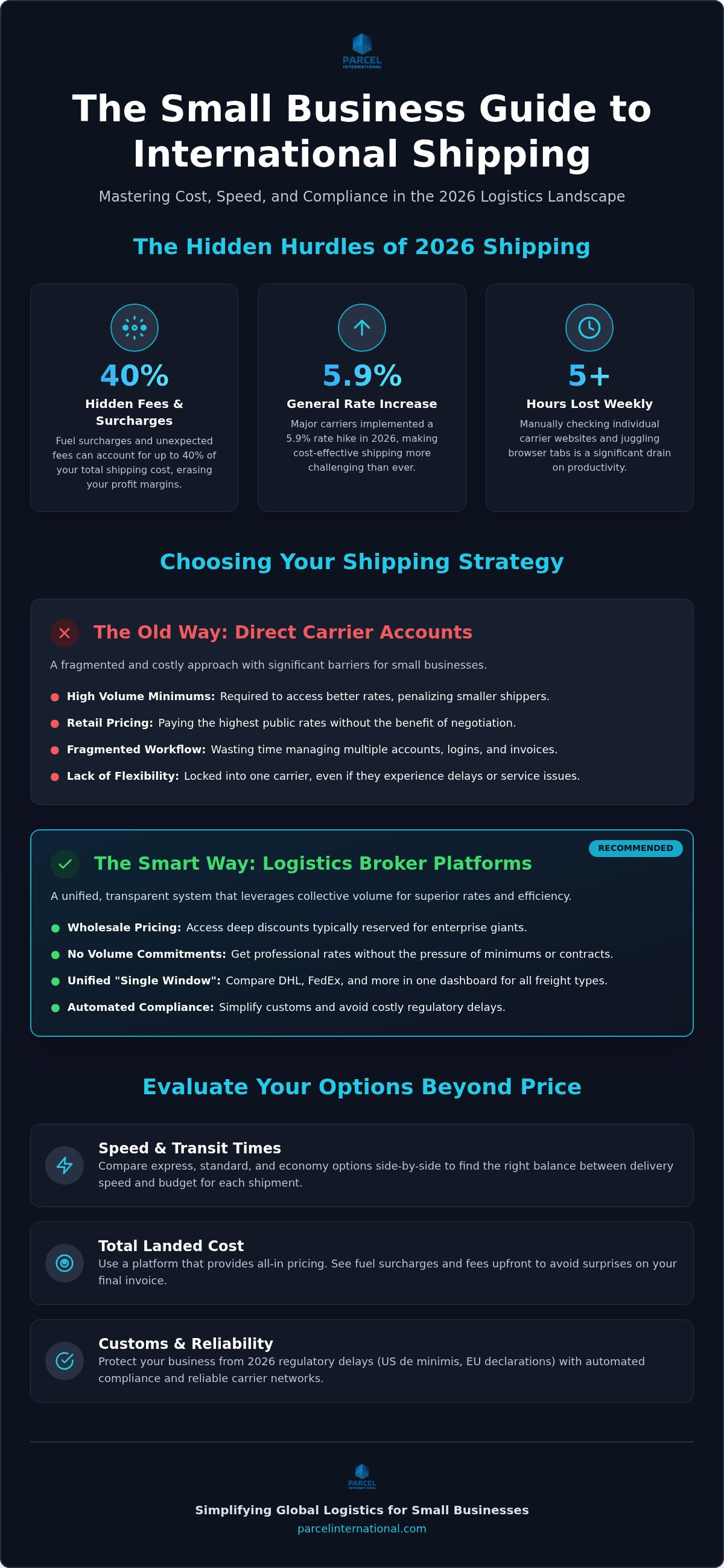
Did you know that hidden fees and fuel surcharges can now account for up to 40% of your total landed shipping cost? In 2026, major carriers have implemented general rate increases of 5.9%, making it harder than ever to protect your profit margins. When you try to compare international shipping rates for small business, the base price you see on a carrier's website is often a trap that ignores the complex reality of modern logistics.
You're likely tired of the manual grind. It's frustrating to juggle multiple browser tabs, calculate volumetric weights by hand, and worry about shipments getting stalled by the latest US de minimis changes or EU declaration rules. You want to grow your global reach, not spend your day acting as a part-time logistics clerk. This guide promises to help you master the art of comparing global courier rates to find the perfect balance of speed, cost, and customs reliability. We'll show you how to transition from fragmented workflows to a single platform that provides transparent, real-time pricing and automated customs compliance. By the end of this article, you'll have a clear roadmap to navigate the complexities of 2026 global trade with total confidence.
Table of Contents
Why Small Businesses Struggle to Compare International Shipping Rates
Many entrepreneurs fall into the "Carrier Hopping" trap. They spend over five hours every week manually checking individual carrier websites, trying to piece together a shipping strategy from a dozen different browser tabs. This fragmented approach hides the true cost of doing business. When you try to compare international shipping rates for small business across multiple platforms, you lose the ability to see the bigger picture. You aren't just losing time; you're losing the leverage that comes with consolidated data.
In 2026, the complexity has scaled significantly. Major carriers implemented a 5.9% general rate increase early this year, and fuel surcharges now fluctuate wildly, sometimes reaching 28% of the total bill. These aren't just minor adjustments; they're substantial costs that can erase your profit margins. Without a way to view these surcharges side-by-side, your "cheap" quote often disappears by the time you reach the final booking screen. Managing parcels and freight separately only adds to this administrative friction, creating a workflow that feels more like a burden than a business process.
The Hidden Costs of Direct Carrier Accounts
Small shippers often face a steep volume barrier. Direct accounts with major carriers typically require strict contractual minimums. If you don't ship enough parcels or pallets, you're often penalized with higher base rates or sudden rate hikes. This creates a rigid environment where you lack flexibility. If one carrier experiences a regional delay, you're stuck because your volume and pricing are tied to that specific contract. Negotiating wholesale rates as an SMB is nearly impossible when you're acting as a lone entity without the backing of a larger logistics network.
The 2026 Logistics Landscape for SMBs
Global trade shifts in 2026 make real-time comparison a necessity rather than a luxury. Transparency is now your most valuable currency in a market where hidden fees are the norm. You need to understand how different modes of freight transport, such as express parcels, sea freight, and air freight, impact your bottom line in real-time.
The solution lies in the logistics broker model. By pooling the volume of thousands of small businesses, a broker provides access to wholesale pricing that was previously reserved for enterprise giants. You get the relief of a unified platform where you can compare international shipping rates for small business without the burden of subscriptions or volume commitments. This shift moves your business from a chaotic, multi-platform workflow to a single, orderly interface that prioritizes your peace of mind.
The Mechanics of Shipping Rate Aggregators vs. Direct Carriers
A logistics broker, or aggregator, functions as a stable intermediary between your business and global shipping giants. Instead of managing individual accounts, you tap into a system that pools the volume of thousands of small businesses. This collective power allows the broker to secure wholesale pricing that's normally restricted to high-volume enterprise clients. By using real-time API connections, these platforms pull live data directly from partners like DHL, FedEx, and UPS. This technical integration ensures that when you compare international shipping rates for small business, you see the most current market data available without visiting a dozen different sites.
The "Single Window" advantage is the primary driver of efficiency here. Rather than logging into multiple portals to check international shipping options, you view everything in one dashboard. This includes everything from small express parcels to bulk sea freight. Because brokers operate on a volume-aggregation model, they can offer "no-minimum" access to top-tier services. You don't need to commit to hundreds of shipments a month to get a professional rate. It's an egalitarian approach that lets you compare international shipping rates for small business on the same terms as much larger competitors.
Wholesale vs. Retail Shipping Rates
Brokers bridge the gap between retail prices found on public carrier sites and the deep discounts given to massive corporations. The pricing model is transparent; the broker earns a small margin on each shipment while still providing you a rate far below what you'd find alone. This partnership also offers a dedicated support layer. If a parcel is delayed, you don't have to deal with a carrier's automated phone tree. A broker's support team acts as your advocate, providing a human touch that global giants often lack.
Multi-Modal Flexibility
Scalability is essential for growth. Your business might start with express parcels but eventually require sea freight or air freight as orders increase. A multi-modal platform handles every parcel and every pallet with the same level of precision. This is particularly vital for omnichannel sellers who need to maintain consistency across different markets. If you want to dive deeper into specific strategies for your online store, check out our guide on international shipping for ecommerce. Moving to a unified system provides the relief of knowing your logistics can grow alongside your sales. You can get a real-time quote today to see how this flexibility works in practice.
Key Evaluation Metrics: Beyond the Cheapest Shipping Price
Price is a primary concern, but focusing solely on the bottom line is a common mistake. When you compare international shipping rates for small business, you must evaluate the total landed cost and the reliability of the service provided. A low base rate often hides the high cost of a lost customer or a shipment that sits in a warehouse for weeks. You need to find the "sweet spot" where transit speed meets budget constraints without sacrificing the customer experience. Reliability creates trust; a cheap rate creates anxiety if tracking updates are non-existent.
Dimensional weight (DIM) is another factor that can silently inflate your costs. In 2026, most carriers use the standard formula of (Length x Width x Height in cm) / 5000 to determine billable weight. If you ship large, lightweight items, you'll be penalized for the space your box occupies rather than its actual weight. Efficient packaging is no longer optional. It's a financial necessity. Ensure your chosen platform calculates these values automatically so you aren't surprised by a bill that's double your initial quote.
The Role of Automated Customs Support
In 2026, manual paperwork is a liability. With the June 2026 suspension of the U.S. de minimis exemption and new EU requirements for precise declarations on packages under €150, automated commercial invoices are essential. These trade compliance tools reduce the risk of delivery delays and ensure your business stays on the right side of shifting regulations. For a deeper look at how to manage these requirements, read our guide on international shipping customs documentation. Automation provides the relief of knowing your compliance is handled accurately every time.
Carrier Specializations by Region
No single carrier is the best choice for every destination. Some providers dominate the US-EU lanes with unmatched speed, while others have built superior infrastructure across the Asia-Pacific region. Having the flexibility to compare international shipping rates for small business across different carriers allows you to pick the best performer for each specific market. You should also evaluate the "last-mile" reputation in your target country. A carrier might get the parcel across the ocean quickly, but if their local delivery partner is unreliable, your customer is the one who suffers. Choose a platform that gives you access to regional specialists alongside global giants like DHL, FedEx, and UPS.
5 Steps to Compare and Select Your Global Shipping Partner
Selecting a logistics partner is a pivotal decision for your growth. You can't optimize what you don't measure. To effectively compare international shipping rates for small business, start with an audit of your current shipping profile. Document your average package weight, physical dimensions, and your top five international destinations. This data acts as your baseline, allowing you to look for specific carrier strengths in your most frequent lanes rather than relying on generic estimates.
Test a shipping calculator: Input your audited data into a real-time tool to verify if the "estimated" rates actually match the final "booked" costs.
Evaluate integration capabilities: Check if the platform syncs directly with your existing ERP or online shop to eliminate manual data entry.
Check for hidden requirements: Avoid platforms that demand monthly subscriptions or impose volume traps. You should only pay for the shipments you actually make.
Run a test shipment: Monitor the ease of customs generation and the accuracy of the tracking updates to ensure the service meets your standards.
Verify carrier variety: Ensure the platform provides access to a mix of global leaders like DHL, FedEx, and UPS to maintain flexibility.
Following these steps moves your business from a chaotic, multi-platform workflow to a single, orderly interface. When you compare international shipping rates for small business using this structured approach, you strip away the typical anxieties associated with hidden costs. You gain the relief of knowing your logistics are handled by a transparent system that values your peace of mind.
Using a Shipping Cost Calculator Effectively
Accuracy is paramount when using a calculator. If you input incorrect dimensions, you'll face back-billing later due to dimensional weight adjustments. Look for international shipping rates that include all surcharges, such as fuel and peak season fees, upfront. This radical transparency ensures your profit margins remain intact and prevents unpleasant surprises on your monthly statement.
Assessing Support and Reliability
Logistics is a high-stakes industry where timing is everything. You need a partner with an established history, like Parcel International, which has been a stable intermediary since 2007. Test the responsiveness of the broker's support team before you commit. You want a dedicated advocate who can navigate complex customs issues or carrier delays on your behalf. A reliable platform doesn't just give you a price; it provides a secure bridge to over 220 countries and territories.
Ready to simplify your global logistics? Compare our live rates across 220 countries today and find the perfect balance of speed and cost for your business.
Simplify Your Logistics with Parcel International’s Transparent Platform
Moving from fragmented, multi-platform workflows to a singular, unified solution provides an immediate sense of relief. You shouldn't have to manage a dozen carrier accounts just to reach your global customers. Parcel International offers a streamlined way to compare international shipping rates for small business across 220 countries and territories. There are no subscription fees or volume minimums. You access the same professional tools whether you're sending a single express document or multiple sea freight containers.
The platform is built on a philosophy of radical transparency. In an industry often clouded by hidden surcharges, we ensure the price you see is the price you pay. Our automated customs support handles the administrative friction of 2026 trade compliance, generating the necessary documentation to keep your shipments moving. This orderly process replaces the chaos of manual paperwork and provides the security your business deserves. By centralizing your logistics, you eliminate the time wasted checking multiple carrier websites and reduce the risk of procedural errors.
Why Parcel International is the SMB Ally
With nearly 20 years of industry experience since our founding in 2007, we understand the specific needs of small and medium-sized businesses. Being based in Rotterdam, one of the world's most vital logistics hubs, gives us a unique vantage point on global trade. We act as a stable intermediary, connecting you to the power of DHL, FedEx, and UPS through a single, efficient interface. You can learn how to send parcel international in just three clicks. This speed allows you to focus on growing your brand while we handle the logistical heavy lifting. Our commitment to brevity and clarity ensures that you spend less time in the dashboard and more time serving your customers.
Getting Started Today
Efficiency is at the core of our business model. You can create a free account and compare international shipping rates for small business in under 60 seconds. Our system is designed to move you from inquiry to action as quickly as possible. Once you select your rate, the platform guides you through a logical progression to book your first shipment, complete with automated customs support. There are no barriers to entry and no complex contracts to sign. You gain the modern flexibility required to compete on a global scale. Compare live international shipping rates now and experience the relief of a truly transparent logistics partner.
Future-Proof Your Global Shipping Strategy
Navigating the logistics landscape of 2026 doesn't have to be a source of constant friction. You've seen how the right metrics, like transit reliability and automated compliance, outweigh the lure of a deceptively cheap base price. By moving away from "carrier hopping" and adopting a unified platform, you reclaim hours of your week and protect your margins from hidden surcharges. It's time to simplify how you compare international shipping rates for small business and embrace a model that rewards your growth instead of penalizing your volume.
Parcel International provides the stable bridge you need to reach 220+ countries and territories. We partner with industry leaders like DHL, FedEx, and UPS to ensure your parcels and freight move with punctuality and security. With automated customs paperwork and no volume minimums, you gain the flexibility to scale at your own pace. Compare live international shipping rates for your business today and experience the relief of radical transparency. Your global expansion is within reach; let's make it orderly and efficient.
Frequently Asked Questions
How do I find the cheapest international shipping rates for my small business?
You can find the lowest rates by using a logistics broker to access wholesale pricing. These platforms pool the volume of thousands of shippers to secure discounts usually reserved for large corporations. You can easily compare international shipping rates for small business across multiple carriers like DHL and FedEx in one place. Focus on the total landed cost, including fuel surcharges, rather than just the base price to find the true lowest cost.
What is the difference between a shipping aggregator and a direct carrier?
A direct carrier owns the physical transport network, while an aggregator or broker acts as a stable intermediary. Aggregators use real-time API connections to pull data from multiple carriers into a single dashboard. This allows you to choose the best service for each destination without managing multiple accounts. Brokers also provide a dedicated support layer that's often more accessible than a carrier's automated phone system or generic help desk.
Are there hidden fees when using a shipping comparison platform?
Transparent platforms like Parcel International eliminate hidden fees by showing all surcharges upfront. While some competitors might obscure details in fine print, a reliable broker ensures the price you see is the price you pay. This includes fuel surcharges and peak season adjustments. Always verify that the platform doesn't require monthly subscriptions or volume minimums. These can become unexpected costs that drain your profit margins over time.
How does automated customs documentation help prevent shipping delays?
Automation generates precise commercial invoices and declarations based on the latest 2026 trade regulations. This reduces the risk of manual errors that often cause parcels to be held at the border. With recent changes to US de minimis rules and EU declaration requirements, having a system that automatically handles trade compliance is essential. It provides the relief of knowing your shipments meet all legal standards before they depart for their destination.
Can I ship large freight and small parcels through the same platform?
Yes, you can manage both small express parcels and large-scale freight through a single unified interface. The platform supports various modes of transport, including sea freight, air freight, and road freight. This multi-modal flexibility allows your business to scale from sending individual envelopes to moving bulk pallets without switching providers. It simplifies your logistics by housing every parcel and every pallet in one orderly dashboard that tracks everything in real-time.
Do I need a high shipping volume to get discounted international rates?
No, you don't need a high volume to access professional shipping discounts. Logistics brokers pool the collective volume of all their users to negotiate wholesale rates with global carriers. This egalitarian approach removes traditional barriers like volume traps or high-stakes contracts. Small businesses can compare international shipping rates for small business and enjoy the same pricing benefits usually reserved for enterprise-level giants without any long-term commitments.
What is dimensional weight and how does it affect my shipping costs?
Dimensional weight is a pricing technique that considers a package's volume rather than just its actual weight. Carriers use a standard formula of (Length x Width x Height in cm) / 5000 to determine the billable weight. If you ship large, lightweight items, you'll be charged for the space the box occupies in the plane or truck. Using a real-time calculator helps you understand these costs upfront to avoid unexpected back-billing later.
How do I track international parcels across different carriers?
A unified shipping platform provides a single tracking interface for all your shipments, regardless of the carrier used. You don't have to visit separate websites for DHL, FedEx, and UPS to check the status of your parcels. The dashboard aggregates tracking data in real-time, providing transparency and peace of mind for you and your customers. This centralized visibility ensures you can provide accurate updates without managing fragmented workflows or multiple login credentials.


Comments