
The Ultimate Guide to Small Business Shipping Solutions in 2026
Updated: May 25
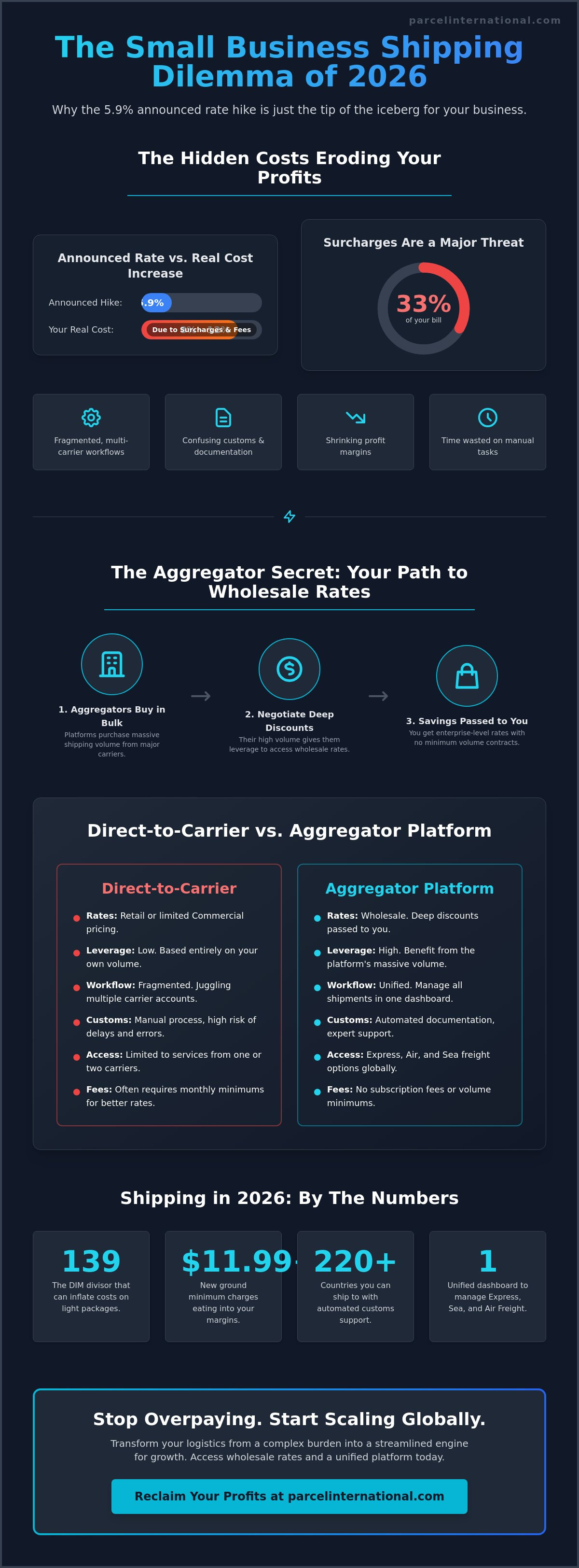
Did you know that while major carriers announced a 5.9% rate hike for 2026, the real cost increase for most shippers is actually between 8% and 12%? Between the new $11.99 ground minimums and ballooning residential surcharges that now account for a third of your total bill, the standard retail model is designed to erode your margins. You need small business shipping solutions that treat you like a high-volume enterprise, even if you aren't one yet.
Logistics platforms simplify your life by providing access to DHL, FedEx, and UPS rates through one single login. You no longer have to manage fragmented accounts or dozens of tracking numbers. Everything is unified. This centralized dashboard allows you to pivot between express shipping and air or road freight seamlessly. For shipments that demand immediate transit, you can discover more about Same Day Courier to ensure your most urgent orders are prioritized and delivered without delay. If a parcel is too large for standard delivery, you can switch to sea freight with a few clicks. This modern flexibility ensures your small business shipping solutions scale with you, regardless of whether you're sending a single envelope or a full container. You gain the efficiency of a streamlined workflow without the burden of subscription fees or restrictive volume minimums.
You likely feel the pressure of these rising costs and the friction of managing fragmented carrier accounts. It's exhausting to handle confusing customs requirements while trying to maintain your bottom line. We understand that transparency and reliability are your top priorities when moving goods across borders. For specialized retailers like The Wrapped Parcel, moving from a chaotic, multi-platform workflow to a unified solution isn't just a convenience; it's a necessity for survival.
This guide teaches you how to reclaim your profits by accessing wholesale rates and automating your entire shipping workflow. We'll explore how to use a single dashboard for your express, sea, and air freight while leveraging professional customs support to prevent international delays. You're about to transform your logistics from a complex burden into a streamlined engine for global growth.
Key Takeaways
Understand why traditional postal models fail scaling brands and how a modern mix of software and carrier partnerships builds a more resilient infrastructure.
Learn the "Aggregator Secret" to bypass high retail margins and access wholesale small business shipping solutions usually reserved for enterprise-level volume.
Compare the direct-to-carrier model against the aggregator approach to find the most cost-effective strategy for your current shipment frequency.
Master international logistics by using automated tools to generate accurate customs documentation, preventing common delays across 220+ countries.
Discover how to access professional express, sea, and air freight services without the burden of subscription fees or monthly volume minimums.
Table of Contents
The Landscape of Small Business Shipping Solutions in 2026
Modern small business shipping solutions represent a sophisticated ecosystem of hardware, cloud-based software, and strategic carrier partnerships. In 2026, the traditional "Post Office model" of standing in line with a stack of boxes is no longer viable for a growing brand. With the cost of a First-Class Mail Forever Stamp reaching 82 cents and effective shipping costs rising by an estimated 8% to 12% this year due to ballooning surcharges, the retail model is designed to erode your profits. Relying on basic domestic services fails to meet the demands of a global e-commerce market where customers expect seamless delivery across borders.
We see a decisive shift toward unified logistics platforms. These systems bridge the gap between small parcels and heavy freight; they allow you to manage express shipping, road freight, and sea freight from a single interface. This transparency removes the friction of hidden costs and procedural delays that once plagued independent exporters. By moving away from fragmented, multi-platform workflows, you gain the peace of mind that comes with a singular, reliable bridge to the global market.
The Evolution of SMB Logistics
Logistics has moved rapidly from manual label printing to automated API integrations. For a business to remain competitive in 2026, it must utilize real-time rate comparisons across 200+ countries. This level of connectivity is essential for international parcel shipping, ensuring you don't overpay for speed or sacrifice reliability. Many entrepreneurs now utilize the drop shipping model to minimize overhead. This strategy places an even greater emphasis on having a digital infrastructure that can coordinate with global suppliers and carriers instantly.
Key Challenges for Modern Shippers
Rising fuel surcharges and complex dimensional weight rules are the primary threats to your margins. In 2026, surcharges account for approximately 33% of the average package cost. Carriers have also introduced stricter cubic volume criteria for additional handling fees, making precision more important than ever. You also face the "Amazon Effect," where consumers expect fast, transparent, and real-time tracking for every order. To compete, you need a system that provides professional-grade visibility without the enterprise-level price tag. Efficient small business shipping solutions solve this by aggregating volume; they give you the leverage to demand better performance and lower rates from national and regional carriers alike.
Decoding Shipping Rates: From Retail to Wholesale Pricing
The hierarchy of pricing determines your long-term profitability. Most entrepreneurs begin with retail rates, which represent the highest prices published by carriers. Commercial rates offer a slight improvement for businesses with consistent volume, but the most effective small business shipping solutions rely on wholesale pricing. Understanding how to move between these tiers is essential for scaling without sacrificing your margins.
The "Aggregator Secret" is simple: volume equals leverage. Logistics platforms buy shipping space in massive bulk, negotiating deep discounts that individual small businesses could never reach alone. They then pass these savings directly to you. This model removes traditional barriers like subscription requirements or volume minimums, making enterprise-level infrastructure accessible to everyone. By acting as a stable intermediary, these platforms strip away the anxieties of high-stakes logistics and provide a direct path to lower costs.
You must also account for the math behind your packaging. Carriers use dimensional weight (DIM) to charge for the space a package occupies rather than its actual weight. In 2026, many major carriers utilize a DIM divisor of 139. If your box is large but light, you pay for the volume. This makes precision critical when calculating your international shipping rates. Accurate dimensions prevent the "sticker shock" of unexpected surcharges that often appear on final invoices.
Understanding Carrier Pricing Models
Carrier pricing relies on zones and weight, but surcharges often drive the final cost. Residential delivery fees, fuel adjustments, and peak season penalties can account for over 33% of your total bill in 2026. Wholesale rates are the deep-discount price points usually reserved for enterprise-level volume, but accessible through the right partners. You can view transparent freight options to see how these rates compare across different modes of transport without hidden fees.
Strategies to Lower Your Per-Package Cost
Consolidating smaller parcels into a single freight shipment can significantly reduce individual label fees. Instead of managing dozens of separate tracking numbers, you move goods as a single unit through road or sea freight. Multi-carrier software allows you to compare rates across different providers in seconds. This ensures you always choose the most efficient path for your budget without being locked into a single carrier's restrictive terms. By automating the rate-shopping process, you eliminate the manual labor that often leads to human error and overspending.
Aggregators vs. Individual Carriers: Finding the Best Fit
Choosing the right partner is a strategic decision that impacts your operational speed. You have two primary paths: working directly with a single carrier or using a logistics aggregator. While some believe a direct relationship with a provider like FedEx or DHL is the only way to ensure reliability, this approach often creates rigid dependencies. Small business shipping solutions that rely on a single carrier leave you vulnerable to regional delays or sudden price spikes. In contrast, the aggregator model acts as a stable bridge, allowing you to pivot between providers based on real-time performance and cost.
Don't fall for the myth that brokers offer inferior support. Professional logistics platforms often provide more dedicated, human-centric oversight than the automated phone trees of national carriers. They function as your advocate, resolving issues with carrier partners so you don't have to. This transparency removes the procedural friction that typically slows down growing brands. You gain the relief of knowing an expert is monitoring your shipments, ensuring punctuality without the corporate jargon.
When to Go Direct to a Carrier
Direct accounts usually require high minimum volume commitments and long-term contract terms. If you can't guarantee thousands of shipments per month, you likely won't receive the attention or the rates your business deserves. Single-carrier software also limits your reach; it locks you into one network even when another carrier might offer better transit times for specific destinations. Because parcel delivery abroad often requires specialized knowledge of regional infrastructure, being tied to one provider can be a significant bottleneck for global expansion. Only consider a direct account if your volume is massive and your shipping lanes are extremely predictable.
The Advantages of Logistics Platforms
Logistics platforms simplify your life by providing access to DHL, FedEx, and UPS rates through one single login. You no longer have to manage fragmented accounts or dozens of tracking numbers. Everything is unified. This centralized dashboard allows you to pivot between express shipping and air or road freight seamlessly. If a parcel is too large for standard delivery, you can switch to sea freight with a few clicks. This modern flexibility ensures your small business shipping solutions scale with you, regardless of whether you're sending a single envelope or a full container. You gain the efficiency of a streamlined workflow without the burden of subscription fees or restrictive volume minimums.
Streamlining Global Logistics: Customs and Automation
Customs documentation remains the primary cause of international delivery delays. If your paperwork is incomplete, your shipment stops. For many entrepreneurs, this is the most stressful part of global trade. Modern small business shipping solutions now integrate automated customs support to remove this friction. These systems generate Commercial Invoices and Packing Slips instantly, ensuring every detail aligns with international regulations before the package even leaves your warehouse. This level of automation strips away the anxieties of moving goods across borders.
Precision starts with the Harmonized System (HS) Codes. These codes determine the exact duty and tax rates for your products. Using automated tools to assign these codes prevents costly miscalculations and keeps your cargo moving. If you're handling larger EU-based shipments, you should also monitor the latest international road freight rates Europe. Transitioning from parcel to road freight for bulk deliveries can significantly lower your overhead while maintaining punctuality. You gain the relief of a unified workflow that handles both small boxes and heavy pallets.
Automating the Paperwork Trail
Digital signatures and paperless trade eliminate manual errors. By integrating your e-commerce store directly with your shipping platform, you can pull product data and weights automatically. This creates a seamless flow of information from the checkout page to the customs office. Automated customs support reduces the risk of shipments being held at the border by verifying documentation in real time. It's a professional, efficient way to manage high-stakes logistics without the need for a dedicated administrative team.
Managing Duties and Taxes (DDU vs. DDP)
You must choose between Delivered Duty Unpaid (DDU) and Delivered Duty Paid (DDP). DDU often leads to a poor customer experience; the buyer receives an unexpected bill before they can collect their package. DDP is the superior choice for brand loyalty because it allows you to calculate and collect all landed costs at the time of purchase. This transparency is vital as you navigate the 2026 VAT and import tax changes. You can start automating your customs workflow today to ensure every shipment arrives without surprise fees or procedural friction.
Scaling Globally with Parcel International’s Unified Platform
Parcel International serves as the essential bridge between your warehouse and 220+ countries. While previous sections detailed the rising costs and complex surcharges of 2026, this platform provides the practical tool to bypass those hurdles. It functions as a singular, unified solution that strips away the typical anxieties of global trade. By removing traditional barriers like subscription requirements or volume minimums, the platform remains inclusive for startups while offering the heavy-duty infrastructure required by established exporters. You get the relief of an orderly process in an otherwise chaotic market.
Integrating the capabilities of a freight forwarder directly into a parcel platform creates a unique competitive advantage. You aren't just sending boxes; you're building a scalable supply chain. Whether you need express shipping for a single customer or sea freight for a bulk restock, the interface remains the same. This consistency makes it one of the most effective small business shipping solutions because it eliminates the need to learn multiple systems as your company grows. You maintain full visibility over your logistics without the corporate jargon or hidden procedural friction.
From One Parcel to Full Freight
Your logistics strategy should grow alongside your sales. The platform allows you to start with simple parcel deliveries and transition to air, sea, or road freight as your volume increases. Dedicated support is available for complex projects, ensuring your cargo moves with punctuality and security. Transparent pricing is a central pillar here; you see the total cost upfront without hidden fees or restrictive terms. This honesty builds the trust necessary for long-term global expansion. You no longer have to worry about the fragmented workflows that typically slow down growing brands.
Getting Started: Your First Shipment
The "Compare, Book, Track" workflow is designed for speed and clarity. You start by entering your package dimensions and destination to see real-time rates from the world's leading carriers. After choosing the best fit for your budget, you can generate an automated customs label that complies with the latest 2026 regulations. This logical progression guides you from inquiry to action in minutes. It's time to move away from fragmented workflows and embrace a more efficient model. Optimize your small business shipping today at Parcel International and take your brand to the global stage.
Master Your Global Logistics Today
The shipping landscape of 2026 demands more than just a basic carrier account. You've learned how to bypass high retail margins by accessing wholesale pricing and why automating customs documentation is the only way to prevent border delays. By consolidating your express, sea, and air freight into a single workflow, you eliminate the friction that holds back most growing brands. It's time to replace fragmented systems with a reliable bridge to the global market.
Finding the right small business shipping solutions doesn't have to be a source of anxiety. You can access enterprise-level infrastructure without the burden of monthly subscription fees or volume minimums. Gain instant reach to 220+ countries and see the transparency of real-time comparisons between DHL, FedEx, and UPS. This modern approach ensures your logistics remain as agile as your business model.
Start comparing global shipping rates for your small business and reclaim your margins. You have the tools to scale your operations with confidence and precision. Your global journey begins with a single, streamlined step. We're ready to help you move forward.
Frequently Asked Questions
How can a small business get the best shipping rates?
You get the best rates by using a logistics aggregator that buys shipping volume in bulk. These platforms pass deep wholesale discounts directly to you, bypassing the high margins of retail shipping. It's a more efficient strategy than attempting to negotiate direct contracts, which usually require massive monthly minimums. By leveraging an aggregator's collective volume, you access enterprise-level pricing without the need for large upfront commitments or subscription fees.
What is the cheapest way to ship internationally for a small business?
Sea freight or road freight is typically the most cost-effective method for larger, non-urgent shipments. For smaller parcels, using small business shipping solutions that offer consolidated carrier rates is the cheapest path. With effective shipping costs rising by an estimated 8% to 12% in 2026, comparing multiple carriers in real-time is essential to avoid ballooning surcharges. Choosing a slower transit time often yields significant savings for international deliveries.
Do I need a high volume of packages to get shipping discounts?
You don't need high volume if you use a platform that offers a "no minimum" policy. Modern logistics partners act as a stable intermediary, pooling the volume of thousands of small businesses to secure wholesale rates. This egalitarian model allows startups and small-scale projects to access the same discounts as major corporations. You gain the relief of professional pricing from your very first shipment without the burden of restrictive contracts.
How do automated customs tools work for small businesses?
Automated customs tools pull product data directly from your shipment entry to generate Commercial Invoices and Packing Slips instantly. These systems assign the correct Harmonized System (HS) codes to ensure accurate duty calculations. By digitizing the paperwork trail, you eliminate manual errors and reduce the risk of your goods being held at the border. This automation provides a seamless bridge between your warehouse and international customs offices, ensuring punctuality and security.
Should I use one carrier or a multi-carrier shipping platform?
A multi-carrier platform is superior because it provides the flexibility to pivot between providers based on destination performance and cost. Relying on a single carrier leaves your business vulnerable to regional strikes, delays, or sudden surcharge adjustments. Using a unified dashboard allows you to compare DHL, FedEx, and UPS rates side-by-side. This ensures you always select the most efficient path for every specific package without being locked into one network's restrictive terms.
What are the most common shipping mistakes small businesses make?
The most common mistakes include ignoring dimensional weight (DIM) and relying on manual customs documentation. If you don't calculate the cubic volume of your packages correctly, you'll face unexpected surcharges that erode your profits. Additionally, using retail rates instead of wholesale small business shipping solutions leads to overspending. Failing to provide accurate HS codes is another frequent error that causes avoidable international delivery delays and extra administrative fees.
How do I calculate the total landed cost for international customers?
You calculate total landed cost by summing the product price, shipping rates, insurance, and all applicable duties and taxes. Modern shipping platforms help you estimate these costs before the customer pays, which is essential for a Delivered Duty Paid (DDP) model. Providing this transparency prevents "sticker shock" for your buyers when the package arrives. Accurate calculations ensure your business remains profitable while maintaining a positive and professional customer experience.
Can I ship freight and parcels through the same platform?
Yes, a unified logistics platform allows you to manage express parcels, road freight, air freight, and sea freight from one dashboard. This integration simplifies your accounting and tracking by keeping all shipments in a single location. Whether you're sending a small sample via express or a full container via sea, the workflow remains consistent. This scalability ensures your logistics infrastructure grows with your business without the need for fragmented, multi-platform workflows.


