
Types of International Shipping Services: The 2026 Global Logistics Guide
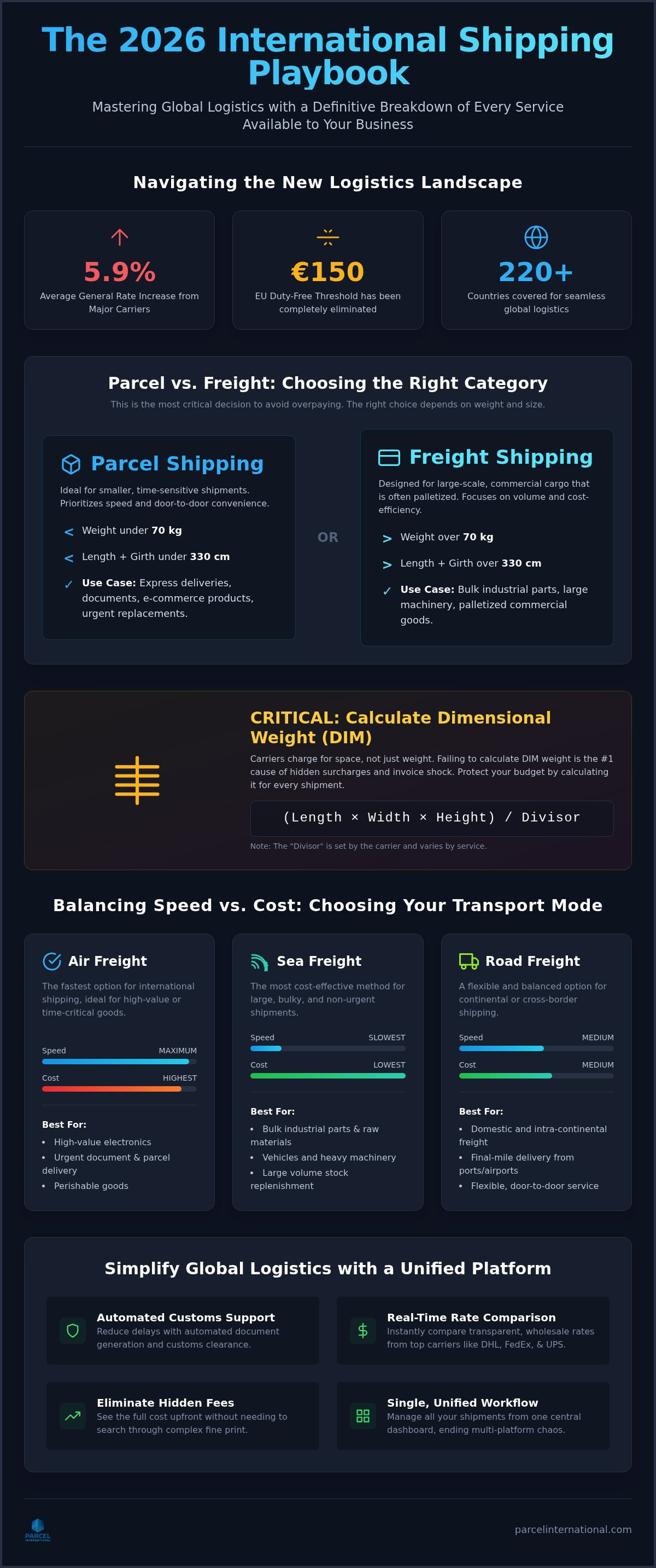
In 2026, the concept of a "standard" shipping rate has officially vanished. Between the 5.9% general rate increases from major carriers and the EU's total elimination of the €150 duty-free threshold, understanding the specific types of international shipping services is no longer optional; it's a requirement for profitability. Your final invoice shouldn't be a surprise, yet many businesses still struggle with costs that double once surcharges and handling fees are applied.
You've likely felt the frustration of hidden fees or the paralysis of trying to compare air and sea freight for a mid-sized shipment. It's exhausting to manage fragmented workflows while worrying if a single missing document will cause a week-long customs delay. We understand that you need reliability and transparency, not more corporate jargon or procedural friction.
This guide is designed to strip away that complexity. You'll master the complex world of global logistics with a definitive breakdown of every service available to your business. Our goal is to move you from logistics anxiety to total confidence in your supply chain.
We'll analyze the different service tiers including express, air, and sea freight. You will learn how to select the right service to reduce costs and handle the latest customs regulations without the typical friction.
Table of Contents
Understanding the Spectrum of International Shipping Services
International shipping services are the coordinated transport of goods across borders via air, sea, or land. In 2026, this isn't just a linear path from A to B; it's a multi-modal ecosystem that integrates parcel, freight, and document services. Choosing between these types of international shipping services requires a sharp focus on three core drivers: speed, weight, and the final destination. Understanding these variables ensures your cargo moves efficiently without draining your budget.
The 2026 landscape has created a sharp divide between courier services and traditional freight forwarding. Courier services prioritize speed and door-to-door convenience for smaller consignments. Conversely, freight forwarding involves complex freight transport modes designed for large-scale, commercial cargo. This distinction is critical for business owners. If you treat a 500kg pallet like a small parcel, you'll face astronomical costs. If you treat an urgent document like bulk freight, you'll miss your deadline.
The Role of the Logistics Broker in 2026
Managing global logistics often feels like solving a puzzle with missing pieces. You're forced to juggle multiple carrier platforms, each with its own confusing pricing structure. A logistics broker acts as an optimizer, taking this chaotic process and making it orderly. By using an independent broker like Parcel International, you gain a stable intermediary that bridges the gap between your business and major carriers like DHL, FedEx, and UPS. A broker helps you compare the various types of international shipping services to find the most efficient route for every specific shipment.
This approach eliminates multi-platform chaos. You get direct access to wholesale rates without the burden of high-volume commitments or monthly subscription fees. Transparency is the core pillar here. Instead of searching through fine print for hidden fees, you see the full cost upfront. This relief allows you to focus on your business while the broker handles the procedural friction of global trade.
Why Service Type Selection Dictates Your Bottom Line
Selecting the wrong service type is a fast track to over-shipping. This happens when you pay for premium express services for goods that could have traveled via sea or road freight. These decisions directly impact your profit margins and insurance premiums. While transporting high-value electronics via air is often necessary for security and speed, bulky industrial parts usually belong on a ship.
Beyond the immediate cost, your service choice impacts customer satisfaction and repeat business. A delayed shipment due to poor planning erodes trust. You must match your transport mode to your budget and urgency to maintain a healthy supply chain. By choosing the right service tier, you ensure punctuality and keep your landed costs predictable.
Parcel vs. Freight: Choosing the Right Logistics Category
The logistics world splits into two primary paths based on volume and weight. Identifying where your shipment falls is the first step in mastering the different types of international shipping services. Generally, the threshold for a parcel is 70kg. If your box weighs more than this, or if its combined length and girth exceed 330cm, you've moved into the category of freight. This distinction is vital because carriers use entirely different sorting systems and pricing models for these two categories. Mistaking one for the other leads to heavy surcharges that can derail your profit margins.
Standard international shipping provides a budget-friendly alternative for non-urgent shipments. It's slower than express options, but it removes the premium cost associated with air priority. For legal and financial needs, document shipping remains a specialized niche. These services prioritize security and chain of custody for sensitive paperwork, often bypassing the more rigorous customs checks applied to physical merchandise. Choosing standard or document services allows you to match your spend to the actual urgency of the shipment.
Express Parcel Delivery: Speed and Door-to-Door Convenience
Express shipping is the gold standard for speed and reliability. In 2026, major global corridors like London to New York or Rotterdam to Singapore often see transit times of just 24 to 48 hours. This service offers end-to-end tracking and guaranteed delivery windows, providing the relief of knowing exactly where your high-priority items are at any second. If you're managing small-scale deliveries or urgent replacements, mastering international parcel shipping ensures your customers receive their orders without the friction of long wait times.
International Freight: When Your Cargo Outgrows the Box
When your cargo outgrows the box, you enter the world of international freight. This category handles palletized shipments and bulk goods that require specialized equipment like forklifts or loading docks. There's a specific transition point where shipping multiple individual parcels becomes significantly more expensive than booking a single freight shipment. This crossover usually happens around the 100kg mark, though dimensional weight often shifts that number earlier. Understanding what is a freight forwarder helps you navigate these larger logistics requirements, especially when dealing with heavy machinery or wholesale inventory.
Choosing the right category shouldn't be a guessing game. You can compare real-time rates for both parcel and freight categories on a single dashboard to see exactly which service fits your current load and budget.
Modes of Transport: Air, Sea, and Road Freight Explained
Selecting the right mode of transport is the most impactful decision you'll make when comparing types of international shipping services. While weight often dictates your category, the "where" and "when" determine whether your cargo travels by sky, sea, or land. Each mode offers a different balance of speed, cost, and reliability. In 2026, the global market demands a multi-modal approach where you aren't tied to a single carrier or method.
Ocean freight is the backbone of global trade, perfect for bulk goods and heavy machinery. It's the most economical choice for long-haul routes, though it requires the most lead time. For businesses moving goods across the continent, road freight remains the essential link for cross-border connectivity. If you're shipping within the EU, keeping a close eye on international road freight rates Europe helps you avoid the volatility of seasonal demand. Rail freight has also solidified its position as a reliable middle-ground for Eurasian routes, offering a faster alternative to ships without the high cost of planes.
Ocean Freight Deep Dive: LCL vs. FCL
You don't always need to fill a 40-foot container to benefit from sea freight. Less than Container Load (LCL) allows you to share container space with other businesses. It's an optimizer's dream, letting you pay only for the volume you use. This removes the barrier for smaller companies to access global markets. Full Container Load (FCL) is the better choice when your volume justifies a dedicated unit. It's faster because your cargo doesn't need to be consolidated at the origin or sorted at the destination. It also offers a higher level of security, as the container is sealed from the moment it leaves your facility until it reaches the buyer.
Air Freight Dynamics in 2026
Air freight is the premium choice for high-value inventory or urgent "just-in-time" supply chains. However, 2026 has brought new complexities to air rates. Major carriers like DHL, FedEx, and UPS each implemented a 5.9% general rate increase in early 2026. Fuel surcharges also continue to fluctuate; for example, the DHL eCommerce international fuel surcharge reached $0.40 per pound in August 2026. You can manage these costs by choosing between Standard and Deferred Air Freight. Standard Air gets your goods on the first available flight, while Deferred Air utilizes lower-priority space to save you money. This choice is vital when navigating the 8% to 12% total cost increases seen by most shippers this year. Using air freight strategically allows you to maintain low inventory levels without risking stockouts.
The Decision Framework: Which Service Fits Your Business?
Choosing between the various types of international shipping services requires a logical, step-by-step approach. You can't rely on guesswork when carrier rates are increasing by an average of 5.9% in 2026. To protect your margins, follow this structured framework to identify the most efficient logistics path for your specific cargo.
Step 1: Calculate Dimensional Weight (DIM). Dimensional weight is a pricing technique that uses an estimated weight calculated from the length, width, and height of a package. Carriers charge based on whichever is greater: the actual scale weight or the DIM weight. Failing to account for this leads to "billable weight" surprises on your final invoice.
Step 2: Balance the Logistics Triangle. Evaluate your priorities between speed, cost, and reliability. If you need a package in New York by tomorrow, express is your only choice. If you can wait 30 days, sea freight offers massive savings.
Step 3: Evaluate Destination Accessibility. Major hubs are cheaper to reach. Remote areas often trigger significant surcharges; for example, in 2026, UPS remote area fees can start at a minimum of $61.00 per shipment.
Step 4: Verify Compliance. Ensure your chosen service matches the regulatory needs of the destination. The 2026 elimination of the EU's €150 duty-free threshold means every shipment now requires precise documentation.
Navigating Customs and Duties by Service Type
The complexity of customs depends heavily on your service tier. Express services often offer "Delivered Duty Paid" (DDP) options, where the carrier handles the payment of taxes upfront to ensure a frictionless delivery. This is a vital relief for B2C businesses. However, international freight requires more robust data, especially with new EU Product Identifiers (PIDs) becoming mandatory in November 2026. Using automated tools for international shipping customs documentation removes the anxiety of potential delays and ensures you meet the latest regulatory standards without manual errors.
Cost Optimization Strategies for 2026
Don't let rising carrier fees dictate your bottom line. One of the most effective strategies is consolidation: combining multiple small parcels into a single palletized freight shipment. This moves you from expensive per-piece pricing to more efficient bulk rates. Additionally, you should exploit carrier capacity fluctuations. Rates change daily based on fuel prices and seasonal demand. By accessing international shipping rates through a unified dashboard, you can compare different service levels in real-time. This transparency allows you to pick the best value for every individual shipment. Compare real-time rates across every service tier at Parcel International to start optimizing your logistics spend today.
Simplifying Global Logistics with Parcel International
Managing various types of international shipping services shouldn't feel like a full-time administrative burden. Parcel International acts as a stable intermediary, providing a unified bridge between your business and the world's leading carriers. Instead of logging into multiple portals and deciphering fragmented workflows, you gain a single, streamlined dashboard. This platform allows you to compare real-time rates for express shipping, air freight, sea freight, and road freight in seconds.
Transparency is our core signature. Many platforms hide their best rates behind monthly subscription fees or volume minimums. We've removed those barriers entirely. You get immediate access to wholesale rates from DHL, FedEx, and UPS without any hidden requirements. Our automated customs support further strips away procedural friction, ensuring that your documentation is accurate and compliant before the package even leaves your dock. It's an egalitarian approach that gives small and mid-sized businesses the same logistics power as global corporations.
From Rotterdam to the World: Our Global Reach
Based in the logistics hub of Rotterdam, we leverage deep expertise to manage European road and sea freight with precision. Our reach extends to over 220 countries and territories, providing specialized export solutions for businesses across the globe. We understand that every territory has its own customs nuances. Our platform handles this complexity for you, acting as a reliable shield against the delays and penalties that often plague international trade. You don't have to be a customs expert to ship like one; our tools automate the heavy lifting.
Getting Started: Your First Shipment in Minutes
Moving from multi-platform chaos to a singular solution is the ultimate relief for a busy shipping manager. You can stop juggling disparate tracking numbers and inconsistent invoices. Simply create one login to access our comprehensive suite of logistics tools. Use the integrated rate calculator to get an instant estimate across all available transport modes. This logical progression moves you from inquiry to action as quickly as possible, ensuring your supply chain remains agile and cost-effective. Compare real-time rates and book your shipment today to experience a more orderly way to move your goods across borders.
Mastering Your 2026 Logistics Strategy
Selecting the right types of international shipping services doesn't have to be a source of business anxiety. By identifying whether your cargo fits the parcel or freight category and selecting the transport mode that balances your budget with urgency, you've already won half the battle. Remember to always account for dimensional weight and the latest 2026 customs regulations to keep your landed costs predictable and your customers satisfied.
Parcel International provides the relief you need from fragmented workflows. As a trusted global partner since 2007, we offer a unified platform with automated customs documentation and direct access to wholesale rates. You won't face any subscription fees or volume minimums here; just radical transparency and reliable support across 220 countries. It's time to move from logistics chaos to an orderly, efficient supply chain that supports your growth.
Start comparing real-time international shipping rates now and take full control of your global deliveries today. You have the tools to ship with confidence.
Frequently Asked Questions
What is the difference between express and standard international shipping?
Express shipping prioritizes speed and reliability, often delivering in 1 to 3 business days via priority air routes. It includes premium features like guaranteed delivery windows and end-to-end tracking. Standard international shipping is the budget-friendly alternative for non-urgent items, usually taking 5 to 10 days. While standard services are slower, they significantly reduce your landed costs when time isn't the primary constraint for your customer.
How do I choose between air freight and sea freight for my business?
Base your decision on the Logistics Triangle of urgency, budget, and cargo value. Air freight is the premium choice for high-value electronics or urgent inventory that needs to arrive within days. Sea freight remains the backbone for bulk goods and heavy machinery where cost-efficiency is more important than speed. If your lead time allows for 30 to 45 days, sea freight offers the most relief for your bottom line.
What are Incoterms and why do they matter for service selection?
Incoterms are standardized international rules that define the responsibilities of buyers and sellers in the shipping process. They determine who pays for freight, insurance, and duties at specific points of the journey. Selecting the right Incoterm, such as DDP (Delivered Duty Paid), simplifies the customer experience by handling all taxes upfront. This choice directly impacts your service selection and the final complexity of your customs documentation.
Can I ship large freight items through a parcel service?
You can't typically ship large freight items through parcel services once they exceed specific weight and size thresholds. Most carriers set a 70kg limit for parcels; anything heavier requires palletization and freight handling. Attempting to send oversized items as parcels often results in massive over-maximum surcharges. Instead, transition to air, sea, or road freight services to ensure your large cargo moves safely and at a more predictable price point.
What is a logistics broker and how do they lower shipping costs?
A logistics broker like Parcel International acts as a stable intermediary between your business and major global carriers. They consolidate the volume of many shippers to secure wholesale rates that are usually inaccessible to individual SMBs. By using a broker, you eliminate multi-platform chaos and compare real-time rates in a single dashboard. This approach removes hidden fees and provides the transparency needed to optimize your total shipping spend.
How does dimensional weight affect the price of different shipping services?
Dimensional weight (DIM) is a pricing technique that calculates the cost of a package based on its volume rather than just its actual weight. Carriers use this across all types of international shipping services to ensure they are compensated for the space a package occupies in a plane or truck. You calculate DIM by multiplying the package dimensions and dividing by a specific factor. Always optimize your packaging to avoid paying for empty space.
What documents are required for most international shipping services?
Most shipments require a commercial invoice, a detailed packing list, and a bill of lading or waybill. In 2026, you must also provide mandatory Product Identifiers (PIDs) for goods entering the EU to comply with updated customs laws. Automated customs support tools can generate this documentation for you, stripping away procedural friction. Ensuring these documents are accurate is the best way to prevent your cargo from being delayed at the border.
Is door-to-door delivery available for sea and air freight?
Door-to-door delivery is definitely available for both sea and air freight. While these modes are often associated with port-to-port transport, many modern logistics providers offer integrated solutions. This includes using road freight to handle the first mile from your warehouse and the final mile to your customer's doorstep. Booking a door-to-door service provides the relief of a singular, unified workflow where the entire journey is managed under one tracking number.


