
UPS International Shipping: A 2026 Comparison Guide for Global Businesses
What if the biggest barrier to your global expansion isn't the distance, but the $40 surcharge you're paying simply for using a paper invoice? As of May 2026, the cost of manual documentation and rising fuel surcharges has made the logistics landscape more expensive than ever. You likely recognize that ups international shipping offers an unmatched global network, yet the fear of customs delays and high retail rates often makes cross-border commerce feel like a high-stakes gamble. It's exhausting to manage complex Incoterms while your margins are squeezed by fees you didn't see coming.
This guide will show you how to master the UPS network and access the wholesale rates typically reserved for the world's largest shippers. You'll learn to navigate the 2026 rate updates and automate your customs paperwork to ensure faster delivery times. We'll compare express, air, sea, and road freight options so you can choose the most cost-effective path for every package, transforming a fragmented workflow into a streamlined, reliable engine for growth.
Key Takeaways
Differentiate between small parcel and freight services to select the most efficient transport mode for your global cargo.
Discover how to bypass high retail costs and access wholesale volume discounts for ups international shipping through logistics brokers.
Master the 2026 customs checklist to avoid costly delays by accurately identifying HS codes and generating precise commercial invoices.
Streamline your operations by using a unified interface to compare real-time rates for express, air, sea, and road freight.
Protect your profit margins by moving from fragmented, high-friction workflows to a transparent and automated shipping process.
Table of Contents
Understanding the UPS International Shipping Network in 2026
UPS manages one of the most sophisticated integrated logistics systems on the planet. For businesses managing ups international shipping, this network provides a predictable foundation for global trade. The system splits into two primary categories: small parcel services and freight services. While small parcel handles individual boxes, UPS freight manages larger moves via air, sea, and road. This distinction is vital. Selecting the wrong service level can lead to unnecessary handling fees or delays that stall your supply chain. 2026 has brought a transition toward more digital, efficient routing. These shifts have stabilized transit times after years of volatility, though they've also introduced stricter documentation requirements. Companies choose United Parcel Service (UPS) because it removes the guesswork. You get end-to-end tracking and access to a robust customs brokerage team that handles the administrative friction of crossing borders.
The Role of UPS in Global E-commerce
Modern e-commerce requires instant connectivity. UPS integrates directly with major platforms to ensure that international order fulfillment happens without manual data entry. When you ship across borders, your brand's reputation depends on the final delivery phase. In diverse international territories, the UPS network utilizes its established local infrastructure to ensure packages reach the doorstep on time. Investing in quality international parcel shipping isn't just a logistics choice; it's a customer retention strategy. If a customer in Paris receives their package as quickly as one in New York, your brand authority grows instantly.
UPS Hubs and Transit Power
The efficiency of the UPS network relies on its massive sorting hubs. Worldport in Louisville, Kentucky, serves as the central nervous system for North American and transpacific cargo. Meanwhile, the European hub in Cologne, Germany, facilitates rapid movement across the continent and into Africa. These hubs determine your shipping speed. Routes to Asia often flow through specific Pacific gateways, while North American exports benefit from the high-frequency departures at Worldport. Your transit time isn't just about distance. It's about how many "sorts" your package undergoes at these massive facilities. In 2026, the UPS global network operates as a synchronized logistics engine that bridges the gap between local production and international demand across 220 countries and territories.
UPS International Service Levels: Express vs. Saver vs. Expedited
Selecting the correct tier for ups international shipping requires a clear understanding of your package's urgency and physical dimensions. UPS categorizes its global services to help businesses prioritize either speed or budget. Choosing the wrong level often leads to overpaying for speed you don't need or missing delivery windows that your customers expect. By analyzing your volume and destination, you can align your logistics strategy with your profit goals.
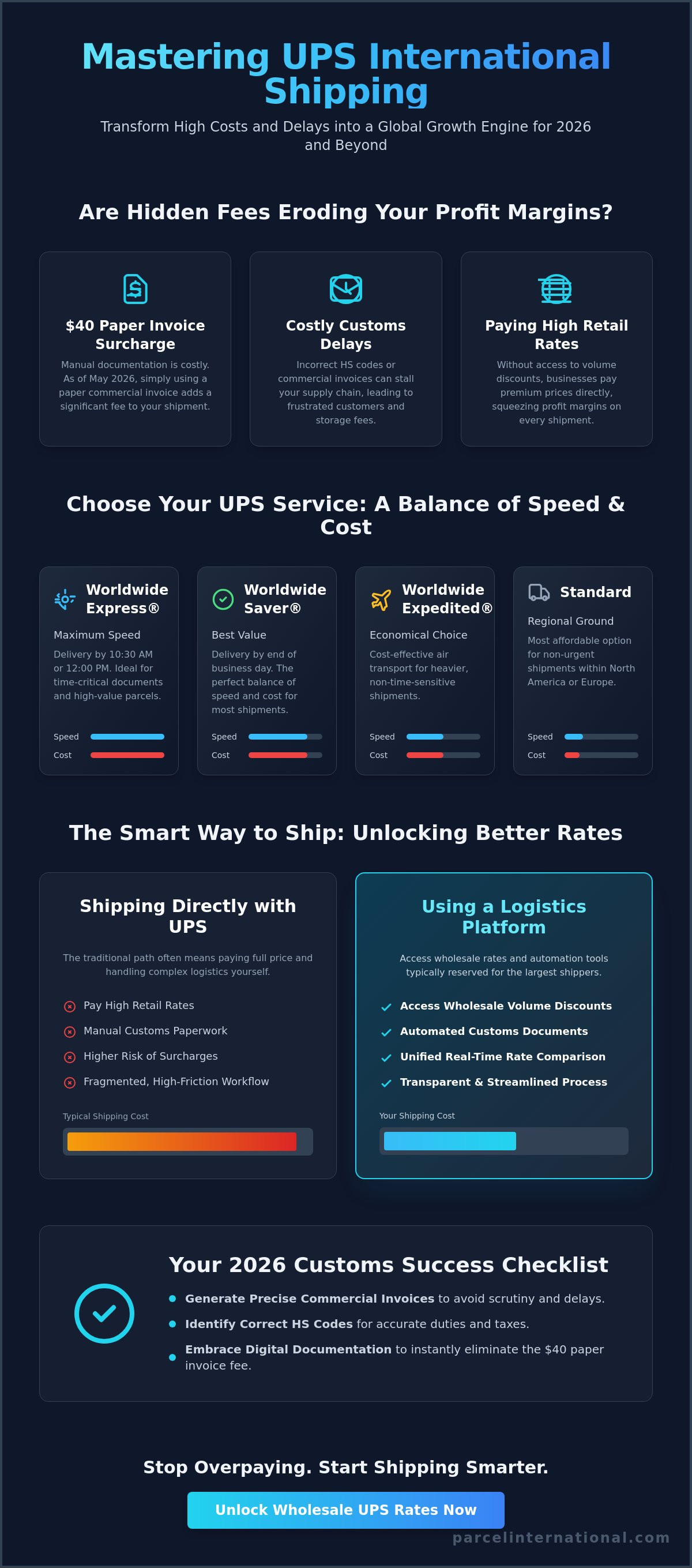
Worldwide Express: This is the premium choice for time-critical documents and high-value parcels. It offers delivery by 10:30 a.m. or 12:00 p.m. to most global destinations.
Worldwide Saver: This service balances speed and cost. It maintains the same delivery days as Express but moves the commitment to the end of the business day.
Worldwide Expedited: This is the most economical choice for heavier shipments that aren't time-sensitive. It relies on air transport but with a slower priority.
Standard: Best for regional ground moves within North America or Europe. It's cost-effective but lacks the speed of air-based tiers.
Speed vs. Cost: Making the Right Trade-off
Customer expectations vary by industry. A retail buyer might expect a three-day turnaround, while a manufacturing plant might need an Express part by tomorrow morning. You must also consider dimensional weight. UPS calculates costs based on the space a package occupies, not just its weight. This means a large, light box might cost as much in the Expedited tier as a small, heavy box in the Express tier. Use an international shipping rates guide to visualize these price gaps before you commit to a label.
Guaranteed Delivery Times and Reliability
UPS offers a money-back guarantee for many ups international shipping express services. This provides a safety net for high-stakes shipments. However, these guarantees aren't absolute. Compliance with U.S. and foreign regulations is mandatory to keep these protections active. If your documentation is incorrect or customs officials hold a package for inspection, the guarantee is usually void. While Worldwide Saver typically arrives within one to three business days, Worldwide Expedited takes two to five business days depending on the specific destination.
If you're unsure which tier fits your current shipment, you can compare real-time UPS rates on the Parcel International platform to see the exact cost difference.
UPS Direct vs. Logistics Brokers: Finding the Best Rates
Many businesses assume that going directly to the carrier is the only way to secure ups international shipping. In reality, retail pricing for small volume shippers is often significantly higher than what a broker can offer. Large carriers prioritize high-volume contracts; if you aren't shipping thousands of packages monthly, you're likely paying a premium. Logistics brokers act as aggregators. They combine the volume of thousands of smaller businesses to negotiate wholesale discounts that would otherwise be out of reach. This makes discounted express shipping for small business a reality rather than a corporate perk. By using a single broker platform, you can compare UPS against other global carriers side-by-side, ensuring you always choose the most cost-effective route for every specific destination.
Accessing Wholesale Rates Without Volume Minimums
Traditional shipping contracts usually require strict volume minimums and long-term commitments. Brokers bypass these barriers entirely. You get access to deep discounts from day one without signing a restrictive contract. Direct accounts often hide costs behind subscription fees or complex surcharge structures. Transparent pricing is a core advantage of the broker model. You see the total cost upfront. This prevents the "sticker shock" of unexpected fuel surcharges or administrative fees that often appear on direct carrier invoices weeks after the package has arrived. It's a cleaner, more predictable way to manage your logistics budget.
Personalized Support vs. Automated Call Centres
Resolving an international shipping dispute with a mega-carrier can be a frustrating process. You're often stuck in automated phone loops or waiting days for a generic email response. When you send parcel international through a broker, you gain a dedicated intermediary. If a package is stuck in customs or a tracking number stops updating, the broker handles the communication with the carrier on your behalf. This speeds up claims and provides a human point of contact who understands your business needs. It's about moving from a faceless transaction to a partnership where your peace of mind is the priority. You don't just get a label; you get a team that ensures that label actually reaches its destination without procedural friction.
The 2026 UPS Customs Checklist: Avoiding Delays
Customs clearance is often the primary reason international shipments stall. While ups international shipping provides a high-speed network, the efficiency of that network depends entirely on the accuracy of your documentation. Most delays aren't the result of transport failures; they're the result of missing data or vague descriptions. To ensure your goods move through borders without friction, you must treat documentation as a core part of your logistics strategy. Use this 2026 checklist to prepare every shipment:
Identify the precise 10-digit Harmonized System (HS) code for every product in your inventory.
Generate a Commercial Invoice that includes specific item descriptions, unit values, and the country of origin.
Determine your Incoterms (DDP vs. DAP) to establish who is responsible for paying duties and taxes.
Verify the destination country's restricted and prohibited items list to avoid immediate seizures.
Utilize automated customs support tools to validate your data against the latest 2026 regulatory updates.
The Importance of Accurate HS Codes
An HS code acts as a universal language for customs officials. If you provide an incorrect code, you risk overpaying duties or having your shipment flagged for misdeclaration. These codes are the direct link between your product and the specific import tax rate applied by the destination country. Finding the correct 2026 updated tariff codes is vital because global trade agreements shift frequently. Don't rely on outdated spreadsheets. A single digit error can lead to a shipment being held for weeks while officials demand clarification.
DDP vs. DAP: Who Pays the Duties?
Choosing the wrong Incoterm is a fast way to damage your brand reputation. If you ship via DAP (Delivered at Place), your customer receives a "surprise" bill for duties and taxes at their door. This often leads to refused deliveries and high return costs. Most successful e-commerce businesses now prefer DDP (Delivered Duty Paid) for ups international shipping. With DDP, you manage all costs upfront. The customer receives their package without any administrative hurdles or unexpected fees. Before you ship, review an international parcel checklist to ensure your paperwork aligns with your customer's expectations.
If you want to remove the complexity of cross-border paperwork, you can access automated customs tools through the Parcel International platform to ensure every shipment is compliant from the start.
Booking Your UPS Shipment with Parcel International
The Parcel International platform removes the friction from ups international shipping by consolidating complex logistics into a single, intuitive interface. Instead of jumping between different carrier sites and managing multiple logins, you handle your entire global output from one secure dashboard. This integration ensures that your shipping data remains consistent and accurate across every label you generate. For businesses operating out of major trade hubs, our express shipping Rotterdam expertise provides localized insights that speed up global delivery. By automating the documentation process, we help you eliminate the manual entry errors that frequently lead to customs seizures or holding fees. It's a professional solution designed for businesses that value speed and transparency over corporate jargon.
Simplified Booking Process
Efficiency is the core priority of our workflow. You enter your package dimensions and weight once, and the system displays all available UPS service levels instantly. This allows you to see the exact price difference between Worldwide Express and Worldwide Saver without the need to refresh multiple pages or re-enter data. Once you select a rate, you can print labels and schedule pickups with just a few clicks. This streamlined approach saves hours of administrative labor every week. Your centralized tracking dashboard then provides real-time updates for all your international shipments, giving you a unified view of your entire global supply chain from origin to final delivery.
Why Thousands of Businesses Trust Our Platform
Businesses choose our platform because we've stripped away the typical barriers and anxieties of global logistics. We don't require subscription fees, volume minimums, or long-term contracts. Our philosophy of radical transparency means you never deal with hidden requirements or surprise surcharges that appear weeks after a delivery is completed. You get the relief of a stable intermediary that handles the high-stakes coordination of ups international shipping on your behalf. Our users frequently report significant cost savings compared to retail pricing, but the real value is the reliability of our support. Whether you're moving a single document or a complex freight shipment, our platform ensures your cargo stays on schedule and within your budget.
Compare UPS international shipping rates and start saving today!
Future-Proof Your Global Logistics Strategy
Success in the 2026 global market requires more than just a delivery network. It demands a strategic approach to ups international shipping that balances speed with administrative precision. We've explored how navigating the latest rate updates and choosing the correct service level can significantly impact your bottom line. By moving from high retail prices to a broker-led model, you eliminate the friction of hidden fees and complex documentation. You gain the relief of a singular, unified solution that prioritizes your profit margins and your customer's peace of mind.
You don't have to manage these complexities alone. Our platform offers wholesale rates from top carriers and automated customs documentation with absolutely no subscription fees or volume minimums. It's time to replace fragmented workflows with a transparent, efficient system that works for your business. Compare UPS International Shipping Rates Now and take the first step toward a more reliable global supply chain. Your international expansion is closer than you think.
Frequently Asked Questions
How much does UPS international shipping cost in 2026?
The total cost of ups international shipping in 2026 depends on your package dimensions, weight, destination, and selected service level. You must also account for specific 2026 surcharges, such as the $40.00 fee for paper commercial invoices and the $17.00 minimum disbursement fee. To secure the most competitive rates, use a comparison platform that provides access to wholesale discounts instead of paying standard retail prices.
What is the difference between UPS Worldwide Express and UPS Worldwide Saver?
The primary difference lies in the delivery time commitment. UPS Worldwide Express guarantees delivery by 10:30 a.m. or 12:00 p.m. to most global locations. UPS Worldwide Saver offers the same transit speed but delivers by the end of the business day. Choosing Saver is an efficient way to maintain speed when a morning delivery isn't critical for your recipient.
How do I avoid customs delays when shipping internationally with UPS?
Avoid delays by switching to electronic documentation and ensuring your HS codes are accurate. As of May 2026, UPS has increased the surcharge for paper invoices to $40.00, so digital submission saves both time and money. Providing a detailed item description on your commercial invoice prevents customs officials from flagging your shipment for manual inspection.
Does UPS provide international tracking for all service levels?
Yes, UPS provides comprehensive end-to-end tracking for all its international service levels. You can monitor your package from the moment it leaves your facility until it reaches the final destination. This visibility is standard across Express, Saver, and Expedited tiers, ensuring you and your customers always know the exact status of the shipment.
Can I get discounted UPS rates for my small business?
Small businesses can access discounted ups international shipping rates by using a logistics broker. These intermediaries aggregate the shipping volume of many small companies to negotiate wholesale pricing that isn't available to individual retail accounts. This model allows you to save on every shipment without meeting high-volume minimums or paying monthly subscription fees.
What documents are required for a UPS international shipment?
Most shipments require a Commercial Invoice and a detailed Packing List. Depending on the destination and the nature of the goods, you may also need a Certificate of Origin or specific export licenses. Always verify the latest 2026 requirements for your specific destination to ensure your paperwork complies with both U.S. and foreign import regulations.
How long does UPS international shipping take from Europe to the USA?
Transit times from Europe to the USA typically range from one to three business days for premium services. UPS Worldwide Express and Saver levels offer the fastest routes, often arriving within 48 hours. If you select Worldwide Expedited, expect a delivery window of three to five business days depending on the specific state and zip code of the recipient.
What are Incoterms and why do they matter for my UPS shipment?
Incoterms are standardized international trade rules that define whether the shipper or the receiver is responsible for costs like duties and taxes. For example, Delivered Duty Paid (DDP) means you cover all fees upfront, which prevents your customer from receiving unexpected bills at the door. Selecting the right Incoterm is essential for protecting your profit margins and ensuring a positive customer experience.


