
UPS vs. DHL International Shipping Costs: 2026 Comparison Guide
Updated: Aug 22
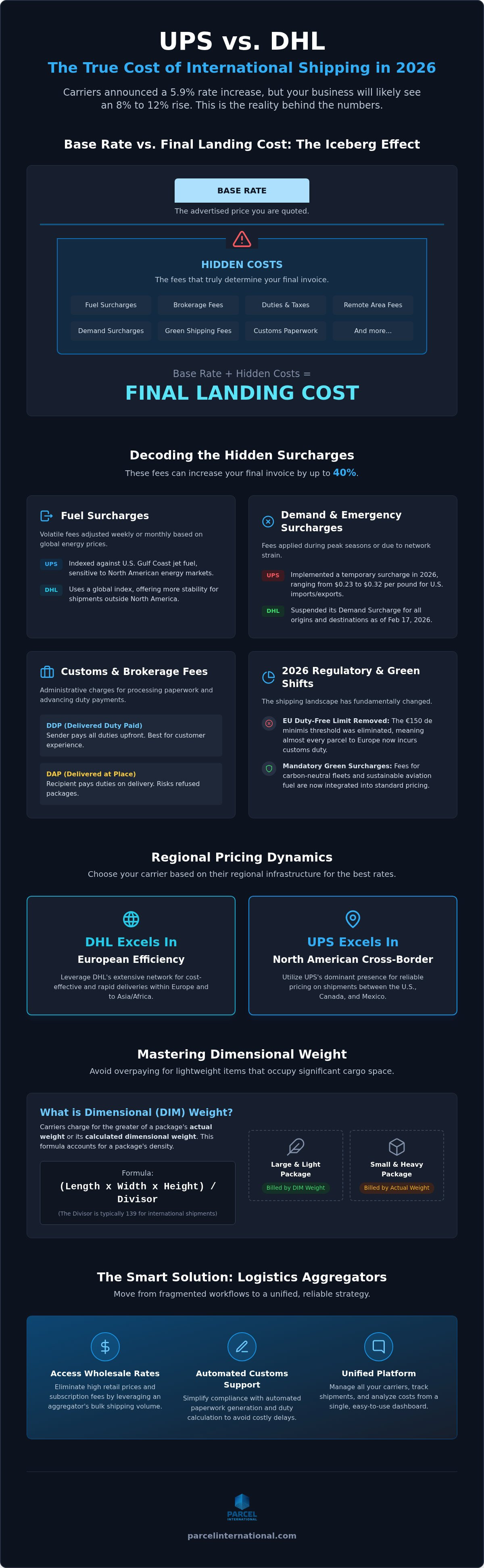
While UPS and DHL both announced a 5.9% rate increase for 2026, the average business will actually see their shipping bills climb by 8% to 12% this year. Understanding the reality of ups vs dhl international shipping costs is frustrating when your budget disappears into a black hole of demand surcharges and complex calculations. You want transparency, not a guessing game every time a parcel leaves your dock.
This guide helps you master the complex world of international rates to find the most cost-effective carrier for your global deliveries. We'll break down the latest surcharge triggers, analyze regional price gaps, and show you how to simplify customs compliance. By the end, you'll know how to achieve predictable shipping budgets and faster delivery times, moving from fragmented workflows to a unified, reliable logistics strategy.
Table of Contents
Understanding the Base Rate vs. Final Landing Cost in 2026
Don't mistake a quote for an invoice. In the world of global logistics, the "Base Rate" is merely the starting line. It represents the raw cost of moving a package from point A to point B, but it excludes the variables that actually determine your profit margins. If you only look at the initial number on a carrier's website, you're only seeing half the story.
The "Final Landing Cost" is the only figure that truly impacts your bottom line. This total includes government duties, local taxes, and specific carrier fees that only trigger once the parcel crosses a border. Because of these variables, the carrier with the lowest base rate often ends up producing the most expensive final invoice. As international parcel shipping has evolved in 2026, the gap between these two numbers has widened, making a detailed audit essential for every shipment.
The Role of Brokerage Fees in International Shipping
Both UPS and DHL act as customs brokers to move your goods through regulatory checkpoints. They don't do this for free. Brokerage fees are administrative charges for processing paperwork and advancing duty payments to local governments. These costs are often hidden in the fine print and vary wildly depending on the destination country's regulations.
DDP (Delivered Duty Paid): You pay all duties and taxes upfront. This creates a transparent, "no-surprise" experience for your customer.
DAP (Delivered at Place): The recipient pays the duties upon delivery. While this lowers your initial cost, it often leads to refused packages and customer friction.
Choosing the wrong billing term can lead to unexpected administrative surcharges that inflate ups vs dhl international shipping costs beyond your original budget.
Why 2026 Rates Differ from Previous Years
The shipping environment in 2026 is defined by two major shifts: regulation and sustainability. A critical change occurred on July 1, 2026, when the EU eliminated the €150 duty-free de minimis threshold. This means almost every parcel entering Europe now incurs a customs duty, adding a mandatory layer to your landing cost that didn't exist in previous years.
Carriers have also introduced "Green Shipping" surcharges to fund their transition to carbon-neutral fleets. These are no longer optional "add-ons" but are increasingly integrated into the standard fee structure. Additionally, shifts in global trade lanes have forced carriers to rebalance their networks, causing price spikes in routes that were previously stable. You can't rely on 2024 or 2025 data to predict your 2026 expenses; the math has fundamentally changed.
The Hidden Surcharge Battle: Fuel, Peak, and Remote Area Fees
Surcharges are the primary reason your shipping invoice rarely matches your initial quote. In 2026, these additional levies often account for 20% to 40% of the total cost. While base rates are easy to compare, the real complexity of ups vs dhl international shipping costs lies in the fine print of fuel, demand, and geographic fees. Understanding these variables is the difference between a profitable shipment and an unexpected loss.
Fuel Surcharge Indexing: UPS vs. DHL
Fuel costs are volatile. Carriers adjust their surcharges weekly or monthly to stay ahead of the market. UPS typically indexes its fuel surcharge against the U.S. Gulf Coast kerosene-type jet fuel price. This makes UPS rates particularly sensitive to North American energy fluctuations. In contrast, DHL utilizes a global indexing system that reflects a broader international average, which can be an advantage for European exporters shipping to Asia or Africa.
For 2026, accuracy in budgeting is critical. In August 2026, the DHL eCommerce international fuel surcharge reached $0.40 per pound, a significant climb from the $0.24 recorded in February 2026. To forecast your shipping budget effectively, monitor these indices monthly rather than relying on annual averages. This allows you to adjust your pricing before fuel spikes eat into your margins.
Emergency and Environmental Surcharges
The "Emergency Situation Surcharge" (ESS) has largely been replaced by more dynamic "Demand Surcharges." However, the application of these fees varies significantly by carrier strategy. DHL suspended its Demand Surcharge for all origins and destinations on February 17, 2026. Conversely, UPS implemented a temporary per-pound surcharge on U.S. imports and exports starting April 19, 2026. This fee ranges from $0.23 per pound for most regions to $0.32 per pound for shipments involving China and Hong Kong.
Environmental levies are also becoming a standard fixture. Both carriers now apply fees related to carbon-offsetting or "green" logistics initiatives. These are often mandatory rather than optional. When reviewing a quote, look for "Clean Fuel" or "Sustainable Aviation" line items. These fees fund the transition to electric fleets and sustainable fuels, but they must be accounted for in your total landed cost.
Geography also plays a massive role in your final bill. As of July 2026, UPS remote area fees can start at a minimum of $61.00 per shipment. If you are shipping to rural destinations, these fees can easily exceed the base rate of the parcel itself. Minor data entry errors are equally expensive; address correction fees are a high-margin penalty for simple typos. To avoid these traps, you can compare all-in rates through a broker that provides transparency before you print the label. This ensures you aren't hit with a $61 surprise for a rural delivery that seemed like a bargain.
Regional Pricing Dynamics: Where Each Carrier Wins
Geography is the most influential variable in the ups vs dhl international shipping costs debate. While both carriers operate globally, their infrastructure was built differently. DHL was born as an international specialist, giving it an undeniable edge across Europe, Africa, and parts of Asia. UPS, however, leveraged its massive North American domestic footprint to create the world's most efficient cross-border network for the US, Canada, and Mexico.
If you're shipping to or from North America, UPS often wins on price by utilizing its extensive ground network. For a 10 lb package to Canada, UPS Standard is significantly cheaper than DHL Express, which can be approximately 71% more expensive. To further optimize these North American routes, businesses often turn to regional experts like Sameday Express Inc. for specialized courier services and reliable local distribution. However, for shipments to the UK or Germany, the roles typically reverse. DHL's dense delivery network in these regions allows them to offer lower rates and faster transit times because they maintain total control over the delivery chain.
When speed is less critical than cost, switching from express services to intermodal solutions can save significant capital. For deliveries within the continent, checking international road freight rates Europe is often more logical than paying for premium air space. This is especially true for heavier B2B shipments where road transport offers the best balance of reliability and price.
Rotterdam serves as a strategic gateway for European exporters. By consolidating shipments in this hub, businesses reduce the first-mile transit costs that often inflate final invoices. When comparing DHL Express and UPS Worldwide Saver for Euro-zone deliveries, DHL usually provides a slight edge in speed due to its regional density. However, European businesses must remain vigilant regarding local VAT implications. In 2026, the absence of the €150 de minimis threshold means every parcel requires precise documentation to avoid expensive holding fees at the border.
The Transatlantic Corridor: US to EU and Back
Efficiency in the transatlantic corridor depends on hub location. UPS funnels its international volume through its Worldport in Louisville, while DHL relies on its massive hub in Leipzig. For high-volume US-UK trade, UPS often offers more competitive rates for heavier shipments due to its established air freight lanes.
Customs clearance speed is the hidden cost of the transatlantic route. Delays at the border translate to storage fees and customer dissatisfaction. DHL's integrated customs tools often provide a faster pre-clearance process for EU-bound goods. Conversely, UPS often excels at clearing goods entering the United States. Choosing the carrier with the strongest hub in your destination region is a simple way to optimize your 2026 shipping strategy.
Calculating Dimensional Weight and Volumetric Costs
Carrier pricing isn't just about what your scale says. It's about how much space your package occupies in an aircraft's cargo hold. This is the "DIM Factor," a calculation that turns volume into billable weight. If you ship lightweight items in oversized boxes, you're paying for air. Understanding how ups vs dhl international shipping costs are influenced by package dimensions is the first step toward reclaiming your logistics budget.
The formula is straightforward but punishing: (Length x Width x Height) / Divisor. For 2026, both UPS and DHL have standardized their imperial divisor at 139 for shipments billed in inches and pounds. For metric shipments, DHL uses a divisor of 5,000. A critical change for 2026 is that all fractional dimensions are now rounded up to the next whole inch before the calculation. This means a box measuring 10.1 inches is treated as 11 inches, which can trigger a significant jump in international shipping rates if you aren't careful.
Packaging Strategies to Lower Volumetric Weight
Eliminate the "air tax" by right-sizing your packaging. Every inch of empty space inside a box is a wasted expense. Switch to poly mailers for non-fragile items like apparel; these don't have a fixed cubic volume and often bypass DIM weight penalties entirely. While corrugated boxes offer superior protection, heavy-duty double-walled options can add enough actual weight or external bulk to push you into a higher pricing tier. Audit your packaging materials to ensure you're using the thinnest possible wall that still guarantees safety.
Case Study: Shipping a 5kg Large Box vs. 10kg Small Box
Visualizing the math helps clarify the stakes. Imagine you're shipping a 5kg box of pillows that measures 50cm x 50cm x 50cm. Using the DHL metric divisor of 5,000, the dimensional weight is 25kg. You will be billed for 25kg, even though the actual weight is only 5kg. Now, consider a 10kg box of metal parts measuring 20cm x 20cm x 20cm. Its dimensional weight is only 1.6kg. In this case, you're billed for the actual 10kg weight.
The larger, lighter box costs significantly more to ship than the heavier, smaller one. Carriers also apply specific "Oversize" surcharges if any single dimension exceeds certain thresholds, typically around 120cm. These fees are additive and can double your costs instantly. Before you seal your next shipment, use a shipping calculator to pre-emptively catch DIM weight spikes. This simple step ensures you aren't surprised by an invoice that treats your 5kg parcel like a 25kg heavy-lift shipment.
How to Access Wholesale Rates Through a Logistics Aggregator
Most small to medium businesses can't negotiate the deep, high-volume discounts that enterprise-level corporations enjoy. This is where the volume aggregation model provides a significant advantage. A logistics broker combines the shipping volume of thousands of different clients to secure wholesale rates that are otherwise inaccessible. This model allows you to optimize ups vs dhl international shipping costs without being tied to restrictive volume minimums or long-term single-carrier contracts.
Parcel International operates on a philosophy of radical transparency, offering a pay-per-shipment model that eliminates the burden of monthly subscription fees. This approach provides immediate relief from the fragmented workflows that usually plague global logistics. By using a centralized platform, you can also automate your international shipping customs documentation. This automation reduces the risk of human error and ensures that your parcels meet the 2026 regulatory standards for every destination country, saving both time and administrative capital.
The Benefit of Being Carrier-Agnostic
Relying on a single-carrier contract is a risk to your supply chain's stability. Regional outages, carrier strikes, or sudden changes in demand surcharges can instantly make one provider much more expensive than another. A multi-carrier platform allows you to be carrier-agnostic, switching between UPS and DHL based on real-time route performance and all-in costs. If one carrier implements a temporary surcharge for a specific trade lane, you can pivot your volume to the other without renegotiating your entire logistics strategy.
This flexibility doesn't just lower costs; it improves reliability. You gain a single point of contact for all tracking and support inquiries, regardless of which carrier is moving the goods. It's an orderly way to manage a chaotic process, ensuring your deliveries remain punctual even when global networks face friction.
Scaling from Parcels to Freight
Your logistics needs will likely evolve as your business grows. While express parcels are ideal for smaller deliveries, larger shipments often require the expertise of a freight forwarder to handle the transition to air or sea freight. A professional broker provides a bridge between these different modes of transport, allowing you to manage everything from a single dashboard.
For large, one-off international shipments, you can access "Spot Rates" through an aggregator. These rates reflect current market capacity rather than fixed list prices, which is particularly useful for managing 2026's volatile fuel and demand levies. Whether you are moving a 2kg express parcel or a full container, the goal is the same: predictable budgets and simplified compliance without hidden barriers.
Master Your Global Shipping Strategy
Success in 2026 requires looking beyond the base rate to the final landing cost. By understanding how fuel indices, regional infrastructure, and dimensional weight formulas impact your invoice, you can protect your margins from unexpected spikes. Choosing between ups vs dhl international shipping costs is no longer a matter of guesswork but a strategic decision based on real-time data and route performance.
You don't have to manage these complexities alone. Compare UPS and DHL rates instantly with Parcel International to simplify your workflow. You can access wholesale rates from day one with no subscription fees, while our automated customs tools handle the regulatory burden for you. This transparency ensures you never overpay for a delivery again.
Orderly logistics lead to predictable growth. Start optimizing your shipments today and enjoy the peace of mind that comes with a reliable, cost-effective global partner.
Frequently Asked Questions
Is DHL or UPS cheaper for international shipping in 2026?
DHL typically offers lower rates for shipments to Europe, Asia, and Africa because of its dense regional networks. UPS is usually more cost-effective for North American trade lanes, particularly for shipments to Canada and Mexico where they leverage their ground fleet. Choosing between ups vs dhl international shipping costs requires checking the specific destination, as a 10 lb package to Canada is often 71% more expensive with DHL than UPS.
Why is my international shipping cost higher than the original quote?
Your final invoice likely includes surcharges that weren't visible in the base quote. While carriers announced a 5.9% rate increase for 2026, the actual cost increase for many shippers is closer to 8-12% once you add variables. Common culprits include fuel surcharges, residential delivery fees, and remote area surcharges. As of July 2026, UPS remote area fees can start at $61.00, which can easily double the cost of a small parcel.
What is the cheapest way to ship a 2kg package internationally?
The most economical way to ship a 2kg package is through a logistics aggregator that provides access to wholesale rates. For European deliveries, road freight is often the cheapest option if speed isn't the primary concern. If you need express delivery, compare the all-in landing cost between carriers. Using a broker allows you to bypass retail prices and subscription fees, ensuring you only pay for the specific transport you use.
Do I need a high volume of shipments to get discounted rates?
You don't need high individual volume to access deep discounts. Logistics brokers aggregate the shipping volume of thousands of customers to negotiate Tier-1 rates from major carriers. This model allows small businesses to benefit from the same pricing as large corporations from day one. It's an egalitarian approach that removes traditional barriers like monthly subscription requirements or minimum shipment quotas, providing immediate relief for your shipping budget.
How do fuel surcharges affect my final shipping invoice?
Fuel surcharges are dynamic levies that carriers adjust weekly or monthly based on global energy indices. In August 2026, the DHL eCommerce international fuel surcharge reached $0.40 per pound, up from $0.24 in February 2026. These fees are applied as a percentage of the base rate and can significantly inflate your final bill. Monitoring these indices monthly helps you predict your 2026 shipping expenses more accurately and adjust your own pricing accordingly.
Does DHL or UPS have better customs clearance speed?
DHL generally maintains a slight edge for customs clearance speed in Europe and Asia due to its extensive local infrastructure and pre-clearance tools. UPS often performs better for goods entering the United States. To ensure the fastest possible clearance, utilize automated customs documentation tools. Choosing a DDP (Delivered Duty Paid) model also prevents delays by ensuring all taxes are handled before the package reaches the destination border.
Can I use my own packaging with UPS and DHL international services?
You can use your own packaging, but carriers will bill you based on the greater of actual weight or dimensional weight. In 2026, both carriers use a divisor of 139 for imperial measurements. To lower your ups vs dhl international shipping costs, use the smallest possible box for your items. All fractional dimensions are now rounded up to the next whole inch, so even a minor over-packaging error can trigger a higher weight bracket.
What are the 2026 peak season dates for international shipping?
Traditional peak seasons like the winter holidays and China's Golden Week remain critical, but carriers are shifting toward real-time demand surcharges. These fees can be adjusted based on network capacity at any time. UPS implemented a per-pound surcharge on U.S. imports and exports in April 2026, while DHL suspended its demand surcharges in February 2026. Always check the current surcharge status before committing to high-volume shipments during busy periods.


