
UPS vs FedEx International Shipping Rates 2026: Which Is Cheaper?
- Alex
- 5 days ago
- 11 min read
While UPS and FedEx both announced a headline rate increase of 5.9% for 2026, many shippers are seeing their actual costs climb by as much as 12% due to new surcharge structures. This surge makes comparing ups vs fedex international shipping rates more critical than ever if you want to protect your margins. Unpredictable fuel surcharges and complex dimensional weight pricing can quickly inflate your budget; these factors create procedural friction that most businesses simply can't afford.
You're likely looking for relief from the anxiety of hidden fees and fragmented logistics. We provide a direct path toward lower international shipping spend by stripping away the complexity of global trade. This article compares the latest 2026 rates and service levels to find the best value for your global shipments. We'll preview regional price advantages, analyze the impact of new trade surcharges, and show you how to move from chaotic workflows to a singular, efficient solution that ensures faster customs clearance.
Table of Contents
UPS vs. FedEx International Shipping Rates in 2026: The Core Differences
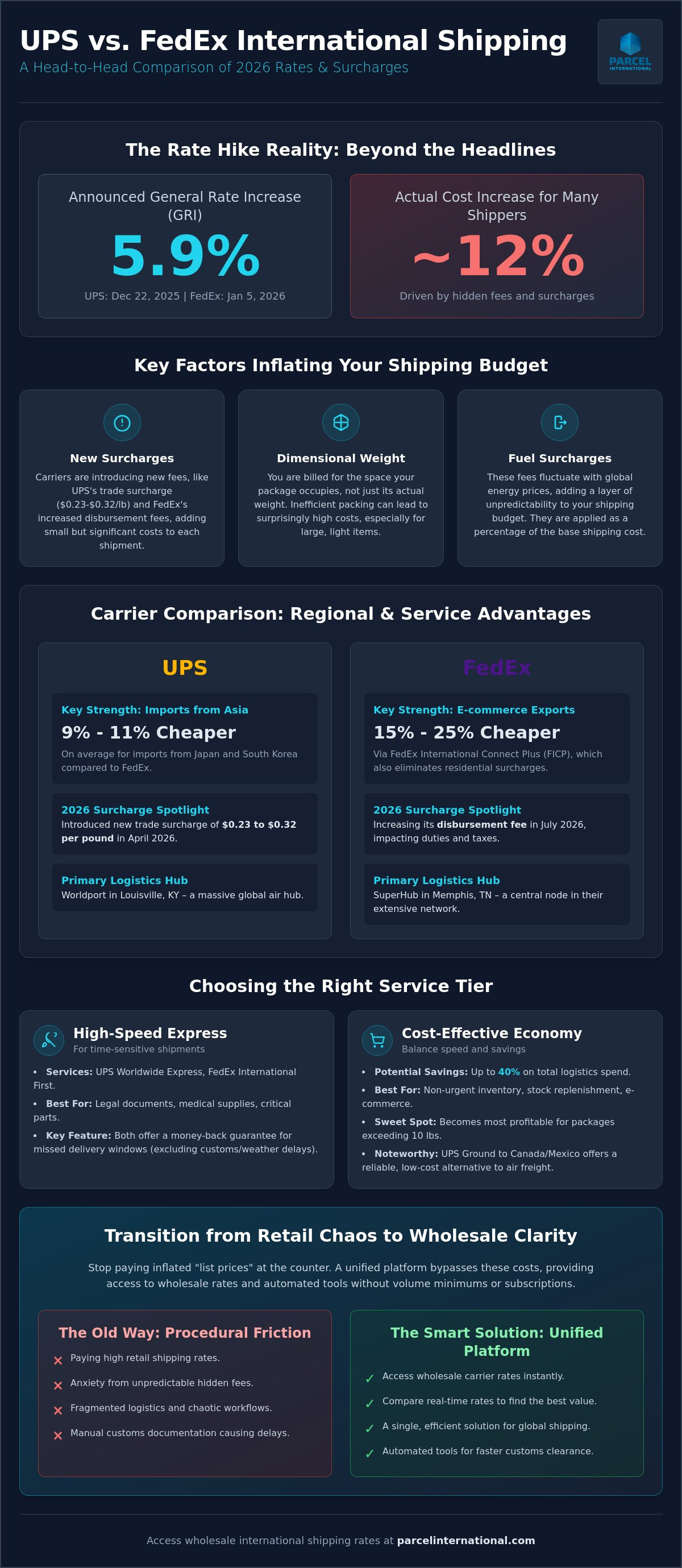
In 2026, the global package delivery industry has shifted toward a high-surcharge model. Both carriers announced a 5.9% General Rate Increase (GRI), but this number is merely a starting point. UPS implemented its changes on December 22, 2025, while FedEx followed on January 5, 2026. When you account for new dimensional weight rules and fluctuating fuel surcharges, your actual costs may rise by 8% to 12%. Understanding ups vs fedex international shipping rates requires looking past these headline figures to the underlying fee structures that quietly inflate your final invoice.
Stop paying retail rates at the counter. These "list prices" are designed for occasional shippers and carry the highest margins. Professional logistics platforms bypass these inflated costs by aggregating volume. This allows small businesses to access wholesale carrier rates that were once reserved for enterprise-level corporations. By utilizing a single platform to compare these giants, you strip away the typical anxieties of hidden costs and procedural friction.
Understanding the Base Rate Structure
Zones are the foundation of your quote. Both carriers categorize destinations into tiers; however, they don't always agree on which country belongs where. A destination might be a "Zone 7" for one and a "Zone 8" for the other, causing a price gap before you even weigh the box. Watch for hidden adjustments in 2026. UPS introduced a trade surcharge of $0.23 to $0.32 per pound in April 2026, while FedEx is increasing its disbursement fee in July 2026. These micro-adjustments mean the cheaper carrier today might be the more expensive one by next quarter.
The Role of Global Networks and Logistics Hubs
Delivery speed and cost are dictated by hub efficiency. UPS funnels international traffic through its Worldport in Louisville, while FedEx relies on its SuperHub in Memphis. These massive facilities determine how quickly a parcel reaches Europe or Asia. Network density often leads to lower rates in specific corridors. For instance, UPS currently holds a price advantage for imports from Japan and South Korea, with rates approximately 9% to 11% lower than FedEx. Conversely, FedEx International Connect Plus often provides a 15% to 25% discount for e-commerce exports, proving that the best value depends entirely on your specific trade lane.
Comparing Express and Economy International Services
Choosing between speed and savings requires a clear understanding of service tiers. If your cargo is time-sensitive, the "Need it Now" category offers peace of mind through guaranteed delivery windows. However, for non-urgent inventory, "Budget Friendly" options can significantly reduce your overhead. When evaluating ups vs fedex international shipping rates, the difference between an express and economy service often determines the profitability of a global sale.
FedEx International Connect Plus (FICP) has emerged as a disruptive force for e-commerce in 2026. This service is typically 15-25% cheaper than FedEx International Economy and eliminates the residential delivery surcharge. It bridges the gap between speed and cost, making it an ideal choice for businesses looking to scale globally without sacrificing margin. To accurately calculate ups vs fedex international shipping rates for your specific lanes, you must also consider the international shipping, packing, labeling, documentation, and insurance requirements that apply to each service level.
High-Speed Options: UPS Worldwide Express vs. FedEx International First
For high-stakes shipments like legal documents or medical supplies, UPS Worldwide Express and FedEx International First are the primary contenders. Both carriers have optimized their networks to maintain high reliability ratings for next-day global delivery in 2026. While their base rates are similar, their specific delivery windows differ by destination. For 2026, both UPS and FedEx offer a money-back guarantee for their premium express services if the delivery window is missed, provided the delay isn't caused by customs or weather.
Cost-Effective Solutions: Economy and Ground Cross-Border Services
If you can wait 4-7 days for delivery, economy services can save you up to 40% on total logistics spend. UPS Ground to Canada and Mexico remains a hidden gem for North American trade, offering reliable transit times that often rival air freight at a fraction of the cost. The threshold where economy becomes more profitable than express usually occurs when the package weight exceeds 10 lbs or when the shipment value doesn't justify a 20% premium for speed.
Managing these various tiers across different carriers can be a logistical headache. You can compare real-time express and economy rates side-by-side to find the most efficient path for every parcel you send.
Hidden Costs: Surcharges, Dimensional Weight, and Customs
Your initial quote is rarely your final invoice. Analyzing ups vs fedex international shipping rates requires a deep dive into the fine print where surcharges live. These additional fees aren't just minor adjustments; they're substantial costs that can double your expected spend if you aren't careful. For 2026, fuel surcharges remain a volatile variable, fluctuating weekly based on global energy indices. While the base rate stays static, the fuel percentage is applied to the total, meaning every other surcharge also becomes more expensive as oil prices rise.
The "final mile" in global logistics is another area where costs quietly accumulate. Delivering to a home in rural France costs significantly more than a commercial hub in Paris. Carriers apply residential delivery surcharges and remote area fees to offset the inefficiency of these routes. To understand the broader context of these pricing shifts, look at this comprehensive 2025 UPS vs. FedEx analysis, which highlights how these fees have evolved into the current 2026 landscape. By identifying these zones before you ship, you can adjust your pricing or choose a carrier with a stronger local partner network.
Calculating Dimensional Weight (DIM) in 2026
Carriers charge based on the space your package occupies, not just what it weighs. If you ship a large, lightweight box, you'll be billed for its "volume weight" rather than its actual mass. While retail rates often use a 139 divisor to inflate billable weight, some commercial contracts still allow for a 166 divisor to keep costs manageable. Poor packaging choices are the leading cause of accidental rate doubling. Use the smallest box possible and avoid over-padding to stay under the next weight bracket.
Customs, Duties, and Trade Compliance
Customs delays are profit killers. Beyond the taxes themselves, both carriers charge brokerage fees for clearing your goods through the border. FedEx is set to increase its Disbursement Fee on July 20, 2026, to the greater of $17.50 or 2.5% of duty and tax charges. You can mitigate these costs by using automated customs documentation tools. These digital solutions ensure your paperwork is complete before the parcel reaches the border, helping you avoid the typical $50 fee for missing or incorrect information. Understanding the De Minimis values for your destination country is also vital, as small e-commerce parcels may qualify for tax-free entry if they stay below specific price thresholds.
Regional Performance: Who Wins in Europe, Asia, and the Americas?
Global dominance is a myth in logistics. Carriers specialize in specific lanes, and their "home field" advantage directly impacts your bottom line. When comparing ups vs fedex international shipping rates, you'll find that geographical density translates to lower surcharges and fewer customs delays. One carrier might offer a 10% discount on a specific route simply because they have more planes landing at that destination daily. Don't assume a carrier's domestic strength applies to every global corridor.
Strategic lane selection is the most effective way to lower your spend. For instance, while FedEx is often seen as the leader in air express, UPS currently holds a significant price advantage for imports from Japan and South Korea, with rates approximately 9% to 11.1% lower than its primary competitor. Conversely, FedEx import rates are reported to be 1.4% higher than UPS on average across several major trade routes. Use these regional variances to your advantage by matching your cargo to the carrier's strongest network.
Shipping to the UK and Europe from the US
UPS maintains a massive footprint across the European Union, making it the preferred choice for many businesses shipping to the continent. Post-Brexit complexities have made UK VAT and documentation a significant hurdle, but UPS has integrated these requirements into their digital workflow to minimize friction. Many shippers utilize Rotterdam as a primary gateway for European distribution, leveraging local hubs for onward delivery. To understand the costs of moving goods from these hubs to final destinations, consult our guide on International Road Freight Rates Europe.
Logistics Dominance in the Asia-Pacific Region
FedEx has historically held the edge in Asian markets due to its extensive intra-Asia network and massive hubs in Guangzhou and Singapore. Shipping to China in 2026 requires navigating a strict regulatory environment; FedEx's established presence often results in more predictable transit times for major hubs like Hong Kong and Tokyo. However, UPS has expanded its targeted trade lanes in the region, focusing on tech-heavy corridors. Transit time comparisons show that while FedEx may lead in frequency, UPS is often more cost-effective for heavy imports from South East Asian manufacturing centers.
Stop guessing which carrier wins in a specific region. Compare real-time regional rates to see exactly how these network advantages affect your specific shipment costs today.
Beyond Direct Booking: Securing Wholesale Shipping Rates
Most individual businesses unknowingly pay "retail" rates when they book directly through carrier websites. These prices are designed for low-volume users and include the highest profit margins for the carriers. In contrast, logistics brokers operate on a wholesale model. By aggregating the volume of thousands of small and medium businesses, a platform like Parcel International secures enterprise-level pricing that is typically unavailable to the general public. This shift in strategy allows you to optimize ups vs fedex international shipping rates without needing a massive shipping department or a dedicated account manager.
Subscription-free access is the future of global logistics. You shouldn't have to pay a monthly fee just to see a price. By removing these traditional barriers, we provide a transparent, egalitarian solution for both small-scale projects and large commercial shipments. You gain the flexibility to choose the best carrier for every individual parcel based on real-time data rather than brand loyalty. This approach strips away the typical anxieties associated with hidden costs, giving you the relief of a predictable shipping budget.
The Advantage of Multi-Carrier Aggregator Platforms
A single-carrier strategy is often a recipe for overspending. Daily rate fluctuations and service alerts mean that the "cheapest" option on Monday might be the most expensive by Wednesday. Multi-carrier platforms let you switch between UPS, FedEx, and DHL on a single screen. This consolidated approach also simplifies your back-office work; you receive one bill for all your global shipments regardless of which carrier handled the final mile. This is especially useful for accessing international shipping for ecommerce discounts, ensuring you stay competitive without needing high volume minimums.
Simplifying Customs with Parcel International
Customs documentation is the most common point of failure in global trade. Missing paperwork can lead to "held in customs" nightmares that damage your reputation and increase your costs. We solve this through automated document generation that prepares your forms as you book. For a deep dive into compliance, see our guide on international shipping customs documentation. This system provides total transparency by showing you the total landed cost before you click "ship." You don't have to deal with unexpected tax bills or hidden brokerage fees after the fact. It's about moving from a fragmented, multi-platform workflow to a singular, unified solution that values your peace of mind.
Master Your Global Shipping Strategy for 2026
Navigating the complex landscape of 2026 logistics requires more than just checking a base rate. The 5.9% general rate increase is often eclipsed by regional surcharges and new dimensional weight thresholds. Finding the lowest ups vs fedex international shipping rates requires looking beyond list prices to the specific regional advantages of each network. Whether you're leveraging established European trade lanes or high-frequency trans-Pacific routes, the key to profitability lies in data-driven carrier selection rather than brand habit.
You don't have to manage this complexity alone. Moving to a unified platform eliminates the friction of multi-carrier workflows and provides the relief of transparent, upfront pricing. You can access wholesale rates with no subscription requirements and utilize automated tools for customs paperwork to prevent border delays. Our platform allows you to compare services for over 220 countries in seconds, ensuring you always find the best value for your cargo.
Take control of your logistics spend today. Compare real-time UPS vs FedEx rates and save on your next shipment. Secure your margins and ensure your global packages arrive on time and under budget.
Frequently Asked Questions
Is UPS or FedEx cheaper for international shipping in 2026?
FedEx often holds a price advantage for international exports, while UPS is typically more cost-effective for international imports. For example, UPS import rates from Japan are approximately 11% lower than FedEx. To find the lowest ups vs fedex international shipping rates, you must compare specific trade lanes rather than relying on average list prices.
Which carrier is faster for shipping from the US to Europe?
UPS frequently leads in speed for shipments to the UK and Europe due to its dense continental network and major hub in Rotterdam. While FedEx is highly competitive, UPS's ground and air integration in the EU often results in more predictable transit times. Always verify the specific city-to-city transit time before booking time-sensitive cargo.
What is the difference between UPS Worldwide Express and FedEx International Priority?
Both services provide time-definite delivery, but they differ in their specific arrival windows. UPS Worldwide Express usually guarantees delivery by 10:30 AM or 12:00 PM on the scheduled day. FedEx International Priority typically aims for a mid-day delivery. Both carriers offer money-back guarantees for these premium tiers if the window is missed.
How do I calculate dimensional weight for international parcels?
Multiply the length, width, and height of your box, then divide the total by the carrier's divisor. In 2026, most retail rates use a 139 divisor, while some commercial contracts utilize a 166 divisor. Always use the resulting dimensional weight if it's higher than the actual physical weight of the parcel to avoid unexpected billings.
Are there hidden fees when shipping internationally with UPS or FedEx?
Beyond the base rate, you'll encounter fuel surcharges, residential delivery fees, and remote area surcharges. In 2026, watch for the new UPS trade surcharge and the increased FedEx disbursement fee effective July 20. These additional costs can increase your final invoice by 8% to 12% if they aren't calculated upfront during the quoting process.
Can I get discounted UPS and FedEx rates without a high-volume contract?
You can secure wholesale carrier rates by using a logistics broker instead of booking directly with the carrier. These platforms aggregate volume from thousands of businesses to unlock enterprise-level pricing for everyone. This approach removes the need for high-volume contracts or monthly subscription fees, making it ideal for both small businesses and large projects.
How does Parcel International help with customs documentation?
Our platform generates all necessary customs forms automatically as you complete your booking. This ensures documentation is accurate and compliant before the package reaches the border. By automating this process, you eliminate the procedural friction that often leads to costly delays and missing paperwork fees.
What happens if my international shipment is delayed in 2026?
Check if your specific service level includes a money-back guarantee if a delay occurs. Most express tiers offer refunds for late deliveries, but these don't apply if the delay is caused by customs clearance or extreme weather events. Using automated documentation tools helps reduce the risk of administrative delays at the border, which is the most common cause of friction.