
USPS International Shipping Rates: The 2026 Guide to Global Delivery
Why is your standard postal delivery suddenly costing more and arriving later than it did just six months ago? If you feel like navigating usps international shipping rates has become a moving target, you aren't alone. Shipping across borders shouldn't feel like a gamble with your bottom line. You deserve predictable costs and clear timelines; however, the reality often involves navigating a maze of July 2026 rate hikes and stricter EU customs regulations for packages under €150.
This guide will help you master global delivery in 2026. You'll learn how to secure the most competitive pricing for your shipments while avoiding the hidden fuel adjustments that eat into your margins. We've stripped away the jargon to provide a transparent look at the current market, from the $1.75 Global Forever stamp to the complexities of Priority Mail Express. We'll break down the latest service tiers, explain how to automate your customs paperwork, and show you exactly how to optimize your workflow for faster, more reliable international delivery. By the end of this article, you'll have a clear roadmap to move from fragmented shipping processes to a singular, efficient global strategy.
Table of Contents
Understanding USPS International Shipping Tiers and Speeds in 2026
Calculating USPS International Shipping Rates: Weight, Zones, and Fees
USPS vs. Private Carriers: When to Choose Postal over Express
How to Reduce Your International Shipping Costs Beyond Standard Rates
Simplifying Global Logistics with Parcel International’s Comparison Platform
Understanding USPS International Shipping Tiers and Speeds in 2026
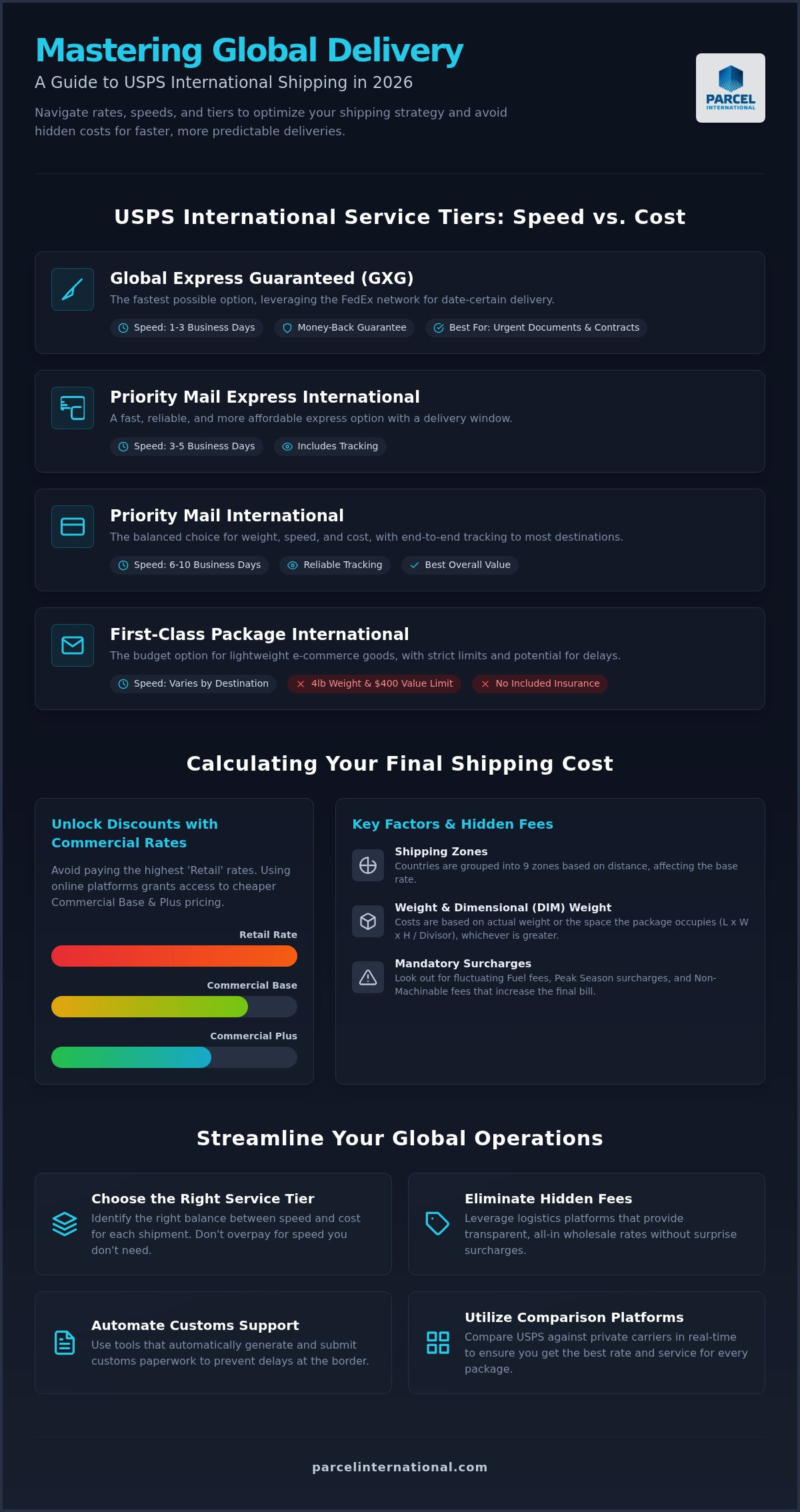
Selecting the right delivery tier requires more than just looking at a price tag. Understanding the structure of usps international shipping rates is the first step toward optimizing your supply chain. The hierarchy begins with Global Express Guaranteed (GXG), followed by Priority Mail Express International, Priority Mail International, and finally, First-Class Package International. Each tier offers a specific trade-off between cost, speed, and visibility. For those requiring maximum speed, USPS international express mail services provide the most robust guarantees for urgent delivery.
Reliability isn't uniform across the globe. Shipments to major European hubs benefit from robust infrastructure and frequent flights, often arriving ahead of schedule. Conversely, deliveries to Southeast Asia often face variable "last-mile" performance once the parcel transitions to local postal authorities. Priority Mail International serves as the balanced choice for weight and speed in 2026. This tier includes end-to-end tracking to most major destinations, providing the transparency that modern customers expect without the premium cost of express tiers.
Global Express Guaranteed (GXG) vs. Priority Express
GXG stands as the fastest option available, leveraging FedEx’s extensive international network to deliver within one to three business days. While Priority Mail Express offers a three to five day window, GXG provides a more rigid date-certain delivery guarantee. Both services include money-back guarantees, but the GXG infrastructure is significantly more resilient during peak seasons. You should justify the higher cost of GXG when sending high-stakes business contracts or time-sensitive documents that cannot afford a single day of delay.
First-Class Package International: The Budget Option
For e-commerce businesses shipping lightweight goods, First-Class is often the default choice due to its low entry price. However, it comes with a strict 4lb weight limit and a maximum package value of $400. While usps international shipping rates for First-Class are attractive for small items, the trade-off is a lack of built-in insurance. This tier is also the most susceptible to customs delays. Because it lacks the priority processing of higher tiers, your package may sit in a customs queue for days or weeks during high-volume periods. Use this service only for non-urgent, low-value items where the customer is comfortable with a longer wait time.
Calculating USPS International Shipping Rates: Weight, Zones, and Fees
Determining usps international shipping rates starts with understanding the nine-zone system. USPS classifies every country into a specific zone based on its distance from the United States and the complexity of the trade lane. Canada and Mexico typically sit in the lower zones; however, shipping to remote islands or specific African nations pushes you into Zone 9. Beyond location, your price depends heavily on the type of label you purchase. Retail rates are the highest, while Commercial Base and Commercial Plus offer significant discounts for businesses that generate labels through online platforms. If you don't use these commercial tiers, you're essentially leaving money on the table with every parcel.
The 2026 pricing landscape for usps international shipping rates includes several mandatory surcharges that can inflate your final bill. Fuel surcharges fluctuate monthly based on global energy markets. Peak season surcharges apply during high-volume months like November and December. Additionally, if your package is odd-shaped or requires manual handling, expect non-machinable fees to appear on your invoice. These costs are often transparently listed, but they can still surprise shippers who only look at the base weight-based rate.
The Impact of Dimensional Weight on International Costs
Shipping costs aren't just about what your package weighs on a scale. USPS uses dimensional (DIM) weight to account for the space a parcel occupies in a cargo hold. The formula is straightforward: multiply the length, width, and height of your box, then divide that total by the current industry divisor. In 2026, USPS has aligned more closely with private carriers, using more aggressive calculations that penalize large, lightweight boxes. You can bypass these complex calculations by choosing a usps small flat rate box when possible. This allows you to ship based on volume rather than weight or DIM calculations, providing much-needed predictability for your budget.
Understanding Destination-Specific Surcharges
Your costs also reflect the complexity of international shipping logistics in the destination country. Shipping to remote areas often incurs an "Extended Area" surcharge because local infrastructure is limited. Delivery confirmation isn't available for every country; some nations don't provide the digital handshakes required for end-to-end tracking. Because international shipping rates fluctuate based on global trade lanes, prices can shift based on port congestion or regional instability. To ensure you aren't overpaying for these variables, you should compare real-time quotes before you print your next label to see if a private carrier offers a better deal for your specific destination.
USPS vs. Private Carriers: When to Choose Postal over Express
Many small businesses assume that usps international shipping rates represent the only viable option for their budget. While USPS is an industry staple, it's essential to recognize when the postal system reaches its operational limits. Private carriers like DHL, FedEx, and UPS operate on a different business model that prioritizes speed and visibility over universal access. Choosing between them isn't just about the lowest price; it's about the value of the goods and the expectations of your customer.
USPS finds its "sweet spot" in residential delivery and lightweight parcels, particularly those under five pounds. Because the postal service hands off packages to the destination country's local postal authority, they have unparalleled access to residential mailboxes that private couriers might find difficult or expensive to reach. However, this hand-off is also the primary source of delivery friction for many global shipments.
The Customs Advantage: Private Express vs. USPS
Private carriers act as their own customs brokers, often clearing shipments while they're still in the air. This "Commercial Clearing" model drastically reduces the time a package spends in a bonded warehouse. Contrast this with the "Postal Clearing" method used by USPS, where packages are handed over to local authorities and may sit in a queue behind thousands of other items. For a deeper understanding of these requirements, review our guide on international shipping customs documentation. This difference in processing is often the gap between a three-day delivery and a three-week delay.
Reliability and Tracking Granularity
Tracking quality varies significantly between these providers. DHL Express, for example, offers milestone updates at every touchpoint, whereas USPS tracking can sometimes enter a "black hole" during the transition between international postal systems. If you're shipping high-value goods, the granular visibility of a private carrier provides necessary peace of mind. Consider switching from USPS to a private carrier if any of the following apply:
The value of the goods exceeds $400.
Delivery is required in under seven business days.
The destination country has a history of postal theft or inefficiency.
The package exceeds the 4lb limit for First-Class service.
Don't assume private carriers are always too expensive for small volumes. When you account for the cost of lost packages, customer support time, and the higher insurance rates required for postal shipments, the price gap often narrows. Leveraging a logistics broker can bridge this gap, providing access to commercial rates that rival standard usps international shipping rates while offering the security of a private express network.
How to Reduce Your International Shipping Costs Beyond Standard Rates
Relying solely on retail usps international shipping rates is a common mistake that caps your growth. To truly optimize your margins, you must look toward rate aggregation. This model allows small and medium-sized businesses (SMBs) to access Tier 1 carrier rates that are typically reserved for high-volume enterprise corporations. By pooling the volume of thousands of shippers, a central platform creates the leverage needed to negotiate significant discounts. This shift from fragmented, individual shipping to a unified logistics strategy is the most effective way to protect your bottom line in 2026.
Leveraging Logistics Brokers for Better Margins
A logistics broker like Parcel International acts as a stable intermediary between your business and major global carriers. Brokers secure wholesale rates by managing massive shipping volumes, passing those savings directly to you. Unlike many software-as-a-service (SaaS) platforms, professional brokers often operate without restrictive subscription fees or monthly volume minimums. This egalitarian approach ensures that even a startup sending five packages a month can enjoy the same cost per parcel as a seasoned industry manager. Brokers bridge the gap between small shippers and global giants, providing the professional support needed to resolve customs friction without the overhead of an internal logistics department.
Consolidation and Multi-Carrier Strategies
Sticking with a single carrier for every destination is rarely the most cost-effective path. While one provider might offer the best rates for North American trade lanes, another may dominate the European or Asian markets. You should use a shipping calculator to compare live rates across multiple carriers for every unique route. Real-time comparison prevents you from overpaying for regional surcharges or inefficient routing. This "single-window" approach to logistics removes the procedural friction of managing multiple accounts while ensuring you always select the most efficient carrier for the job.
Effective packaging is your second line of defense against rising costs. Avoid DIM weight penalties by right-sizing your boxes to eliminate empty space. For soft goods like apparel, switch to poly mailers or bubble envelopes; these do not trigger the same volumetric calculations as rigid cardboard boxes. If you must use a box, trim the corners to the height of the product to ensure you aren't paying to ship air. Every inch saved directly lowers your usps international shipping rates and private carrier fees alike. To see how much you could save by switching to a professional brokerage model, compare our latest wholesale rates now.
Simplifying Global Logistics with Parcel International’s Comparison Platform
Manual rate checking is an inefficient use of your time. If you're still hopping between carrier websites to find the best usps international shipping rates, you're likely missing out on superior alternatives. Parcel International provides a unified platform that strips away the procedural friction of global logistics. By aggregating data from major carriers, we allow you to compare, book, and track shipments in a single, streamlined workflow. This is the professional upgrade for businesses that have outgrown the limitations of standard retail postal services.
Access to over 220 countries and territories ensures your reach is truly global. Whether you require express shipping for urgent documents or air freight for larger inventory restocks, our platform adapts to your specific needs. There are no subscription requirements and no volume minimums. We believe in radical transparency; you see the final price upfront without hidden surcharges or restrictive terms. This egalitarian approach allows you to focus on your customers instead of your logistics paperwork.
Automated Customs: Ending the Paperwork Headache
Customs documentation is often the biggest barrier to successful international trade. Our platform addresses this directly by automating the generation of commercial invoices and compliance documents. This reduces the risk of human error and ensures your shipments meet current 2026 regulations, such as the latest EU import requirements. For SMBs moving bulk goods, this feature is a critical differentiator. It provides the peace of mind that your cargo will move through ports without unnecessary delays or administrative penalties. Our customs support ensures you remain compliant without needing to become an expert in international law.
Scalable Solutions: From Small Parcels to Sea Freight
As your business expands, your logistics needs will naturally evolve. You may start with small packages but eventually require the capacity of sea freight or road freight for regional distribution. Parcel International is designed to scale alongside you. We provide a stable bridge between your current operations and the complex world of global freight. You don't need to find new partners every time your volume increases; you simply choose a different service tier within our platform. This flexibility is essential for maintaining momentum in a competitive global market.
Take control of your global delivery strategy today. Move away from fragmented workflows and embrace a solution that prioritizes your peace of mind. Our commitment to brevity and efficiency means you spend less time on logistics and more time on growth. Compare 2026 international shipping rates on Parcel International to secure the most competitive pricing for your next global shipment.
Optimize Your Global Delivery Strategy for 2026
Mastering the complexities of usps international shipping rates in 2026 requires a shift from reactive shipping to proactive logistics management. You've seen how service tiers and dimensional weight calculations impact your bottom line. You also understand that while the postal system offers reliability for lightweight parcels, private carriers provide the customs brokerage speed necessary for high-stakes global trade. The key to long-term success is no longer just finding the cheapest label; it's about building a scalable, transparent workflow that eliminates procedural friction.
Stop managing fragmented accounts and hidden surcharges. You can access wholesale rates from DHL, FedEx, and UPS while benefiting from automated customs documentation for every shipment. There are no monthly subscriptions or hidden fees to worry about. By moving to a unified comparison platform, you gain the order and predictability your business deserves. Start comparing real-time international shipping rates today and transform your global delivery from a chaotic chore into a competitive advantage. You have the tools to ship smarter; it's time to put them to work.
Frequently Asked Questions
How much does it cost to ship a 5lb package internationally with USPS in 2026?
For a 5lb package, you must move beyond First-Class or small Flat Rate boxes, which are limited to 4 lbs. Priority Mail International by weight starts at $43.55 in 2026, but the final price depends on the destination zone. Prices increase significantly when shipping to more distant regions like Southeast Asia. Always check the latest pricing using an online calculator to account for current fuel surcharges and destination specific fees.
Is USPS Priority Mail International tracked all the way to the destination?
Priority Mail International offers tracking to most major destinations; however, it isn't always end-to-end. Some local postal authorities don't provide the digital handshakes necessary for continuous updates once the parcel enters their country. This can lead to gaps where tracking stops until delivery is attempted. If you require granular visibility for high-value goods, private express carriers generally offer more consistent tracking milestones across their global networks.
What is the cheapest way to ship internationally from the USA?
First-Class Package International remains the most economical choice for parcels weighing under 4 lbs, with rates starting at $19.40. This service is best suited for non-urgent e-commerce items with a value under $400. For heavier shipments, the cheapest option is often a consolidated service through a logistics broker. Comparing usps international shipping rates against wholesale private carrier prices ensures you don't overpay for slow delivery times when a faster alternative exists.
Does USPS international shipping include customs duties and taxes?
USPS international services do not include customs duties or taxes. These shipments are sent Delivered Duty Unpaid (DDU), meaning the recipient must pay any local import fees before the package is released. Failure to pay these costs can lead to returned parcels and unhappy customers. You can reduce this friction by using platforms that offer automated customs support to help you prepare the correct documentation for international trade compliance.
How do I calculate dimensional weight for USPS international parcels?
To calculate dimensional (DIM) weight, multiply the length, width, and height of your box and divide the total by the industry divisor. If the DIM weight exceeds the actual scale weight, you are billed for the space the package occupies. This 2026 calculation is particularly aggressive for large, lightweight boxes. Switching to poly mailers or right-sizing your packaging is the most effective way to avoid these volumetric surcharges.
What happens if my USPS international package is delayed in customs?
Customs delays are typically caused by missing documentation or local inspections, such as the stricter 2026 EU rules for merchandise under €150. USPS cannot intervene once a package is held by foreign customs authorities. You can prevent these headaches by providing precise descriptions and accurate values on your commercial invoices. Using a platform with automated customs tools ensures your paperwork meets international standards, significantly reducing the risk of procedural friction.
Can I get discounted USPS international shipping rates as a small business?
Small businesses can access discounted Commercial Base or Commercial Plus pricing by using online shipping platforms instead of paying retail counter rates. These usps international shipping rates offer substantial savings without requiring high volume minimums. Working with a logistics broker is the most efficient way to secure these rates while gaining access to private express carriers. This egalitarian approach helps SMBs compete globally by lowering the entry cost of international delivery.
How does Parcel International compare to using USPS directly?
Parcel International provides a more versatile solution than using USPS directly by providing a single window to compare multiple carriers. While USPS is excellent for lightweight residential parcels, our platform allows you to book express shipping, air freight, and sea freight with automated customs support. There are no monthly subscription fees or hidden requirements. This transparency ensures you always find the most reliable and cost-effective bridge for your shipments across 220 countries and territories.


