
USPS vs UPS International Shipping: The 2026 Comparison Guide for Businesses
Choosing the cheapest carrier used to be a simple math problem, but in 2026, the lowest rate on paper often leads to the highest cost at the border. You've likely noticed that high shipping costs are eating into your margins, especially after the 5.9% UPS general rate increase and the 4% to 8% hike in USPS international prices. When you're weighing usps vs ups international shipping for your global deliveries, the decision now hinges on more than just base postage. It's about who manages the digital customs barrier most effectively to prevent packages from getting stuck in transit.
We understand that inconsistent delivery times and complex paperwork create unnecessary friction for your business growth. This guide provides the clarity you need to achieve predictable delivery windows and lower overall costs. We'll examine the real impact of the new UPS per-pound surcharges, the July 2026 EU de minimis changes, and how new Delivered Duty Paid (DDP) services can finally streamline your operations. By the end of this comparison, you'll know exactly which carrier will protect your bottom line and your customer experience this year.
Key Takeaways
Identify the structural differences between national postal networks and private global logistics to determine which offers better security for your specific route.
Pinpoint the most cost-effective scenarios for USPS, specifically for lightweight items under 4 lbs that do not require urgent delivery.
Evaluate UPS Worldwide Express and Saver options to achieve next-day delivery and superior tracking for high-value or time-sensitive shipments.
Compare usps vs ups international shipping metrics for cost, speed, and customs reliability to navigate the 2026 regulatory changes effectively.
Discover how to consolidate your workflow and secure wholesale rates through a single interface, removing the complexity of manual carrier comparisons.
Table of Contents
USPS vs UPS International Shipping: Key Differences in 2026
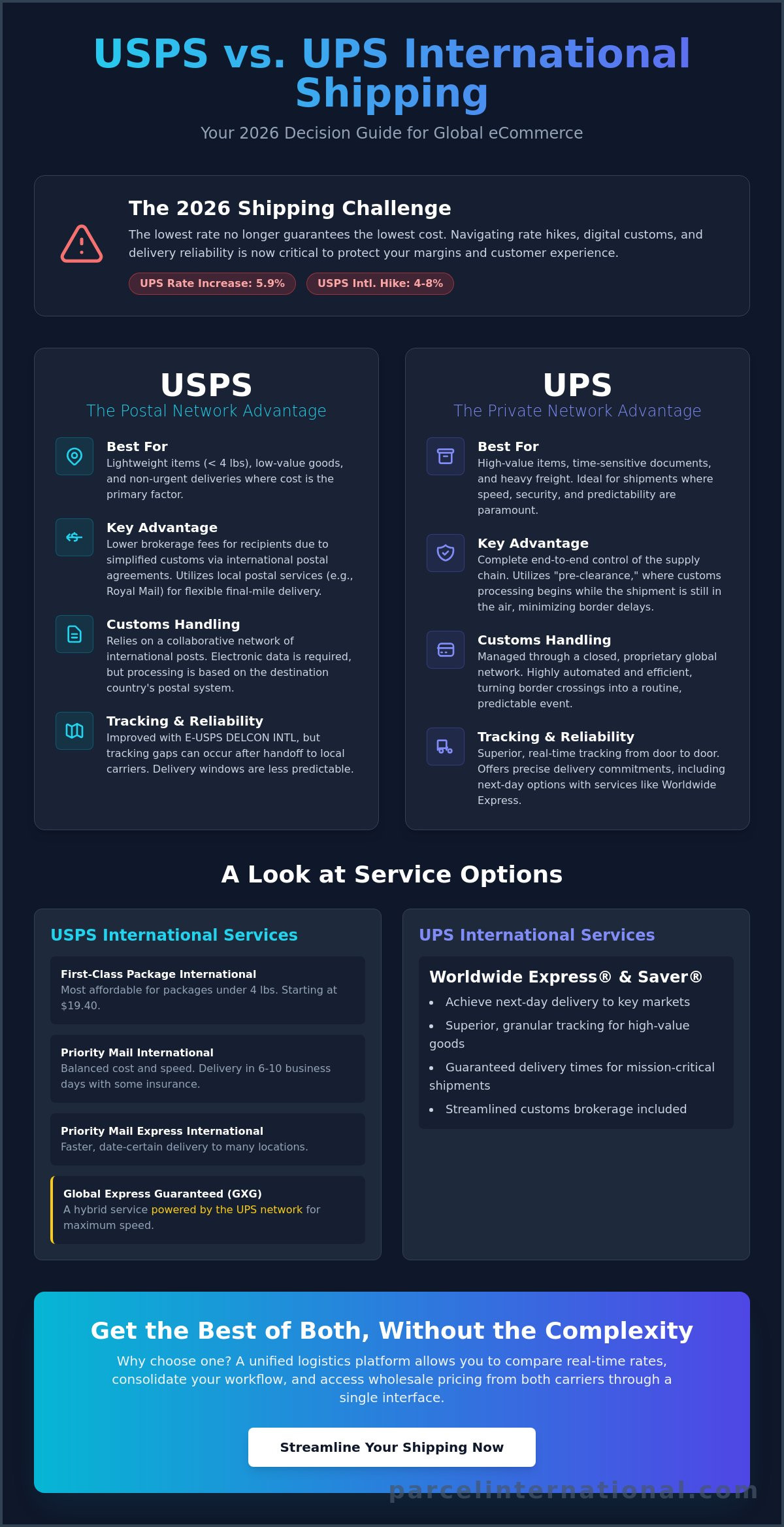
The choice between these two carriers isn't just about picking a logo. It's about selecting a logistical philosophy. The United States Postal Service (USPS) operates as a national postal service. It relies on the "Terminal Dues" system, which is a set of international agreements where the destination country's postal service handles the final delivery. Contrast this with UPS, a private global logistics company that owns its entire supply chain. They don't hand off your package to a third party; they carry it from your door to the destination.
In 2026, this distinction matters more than ever because of the global shift toward mandatory digitized customs data. Every parcel now requires precise electronic documentation before it crosses a border. While both carriers handle this, their methods differ. USPS uses a collaborative network of international posts. UPS uses a closed, proprietary one. This leads to the primary trade-off in usps vs ups international shipping: you choose USPS for economy and local accessibility, or you choose UPS for massive infrastructure and high-speed reliability.
The Postal Advantage: USPS International
When you ship via USPS, you're tapping into a massive partnership with local post offices like Royal Mail in the UK or PostNL in the Netherlands. This "last-mile" collaboration is often more flexible for residential deliveries. One major benefit is that USPS shipments typically incur lower brokerage fees for the recipient. Because postal services often use simplified customs processes for low-value goods, your customer might avoid the steep administrative charges private couriers sometimes apply. It's the ideal choice for lightweight, low-value, or non-urgent parcels. If your package is under 4 lbs and cost is your main driver, the postal network is hard to beat.
The Private Network Advantage: UPS International
UPS offers a level of end-to-end control that a postal service simply cannot match. They manage their own fleet of aircraft and global sorting hubs, meaning your package rarely leaves their sight. Their most powerful tool is "pre-clearance." UPS begins the customs process while the plane is still in the air. They use digital manifests to secure release before landing, which eliminates the "wait and see" period at the border. If you're shipping high-value items, time-sensitive documents, or heavy freight, the UPS private network provides the predictability you need. It turns a chaotic border crossing into a routine, automated event.
USPS International Shipping Options: Services and Reliability
The USPS international menu is built on a hierarchy of speed and cost. At the entry level, First-Class Package International Service (FCPIS) remains the most affordable option for lightweight items under 4 lbs, with 2026 starting rates from $19.40. For businesses sending higher volumes of small parcels, Priority Mail International offers a reliable middle ground. It provides delivery in 6 to 10 business days and includes a degree of insurance that First-Class lacks. If your shipment is time-sensitive, Priority Mail Express International offers date-certain delivery to many locations, though it still relies on the destination country's postal infrastructure for the final handoff.
A unique outlier is Global Express Guaranteed (GXG). While you purchase it at the post office, it's actually powered by the UPS network. This service provides the speed of a private carrier with the accessibility of a local post office. When evaluating usps vs ups international shipping, GXG is often the bridge for businesses that need speed but prefer the USPS interface. However, regardless of the service level, you must ensure your documentation aligns with the latest standards from U.S. Customs and Border Protection to avoid delays.
USPS Tracking and Delivery Windows
Reliability in 2026 is often measured by data transparency. While USPS has improved its E-USPS DELCON INTL tracking, gaps still exist once a package enters certain international territories. You won't find "Delivery by 10 AM" options here. Postal delivery follows the local mail carrier's route, which can be unpredictable. If you're shipping high-value electronics, perishable goods, or items destined for countries with unstable local postal networks, the usps vs ups international shipping debate usually swings toward private carriers. If you need to optimize your outbound logistics, consider using a platform that simplifies Express Shipping across multiple carriers.
2026 USPS Rate Adjustments
On January 18, 2026, USPS implemented international rate hikes between 4% and 8%. These changes didn't just affect base postage. Dimensional weight (DIM) rules are now applied more strictly to Priority Mail International, meaning the size of your box might cost you more than its actual weight. Additionally, the July 12, 2026, adjustment for First-Class Mail International flats and postcards further tightens margins for small-scale exporters. To stay ahead of these shifts, always use a shipping cost calculator to verify your landed costs before printing a label. This transparency prevents the "bill shock" that often occurs when manual calculations miss the latest zone-based surcharges.
UPS International Shipping: Speed, Tracking, and Brokerage
UPS offers a tiered service structure designed for precise commercial needs. UPS Worldwide Express provides next-day delivery to major global markets, while UPS Worldwide Saver offers a cost-optimized alternative that arrives by the end of the business day. For heavier shipments that aren't time-critical, UPS Worldwide Expedited remains a staple for businesses balancing cost and reliability. If you're shipping to Canada or Mexico, UPS Standard provides a reliable ground-based solution that bridges the gap between postal economy and express speed. The real differentiator in the usps vs ups international shipping comparison is the infrastructure behind the label. UPS doesn't just move boxes; they move data.
Why UPS Dominates in Customs Brokerage
UPS acts as its own in-house customs broker. This means they don't wait for a third party to process your paperwork. They handle it internally. This is a massive advantage for 2026 compliance, especially with the UPS Paperless Invoice feature. This tool transmits commercial invoice data directly to customs offices, reducing the risk of physical documents being lost or damaged. While USPS has recently introduced limited DDP services, UPS offers comprehensive Duty and Tax Forwarding options across a much wider global footprint. You can choose to pay the duties yourself or have the recipient pay them, giving you full control over the customer experience. If you aren't sure which documents you need, review our guide on international shipping customs documentation to ensure your commercial shipments meet current global standards.
Advanced Tracking for High-Value Goods
The UPS private network provides milestone-based tracking that postal services can't replicate. Every time a package moves through a hub or onto a plane, it's scanned into a proprietary system. This creates a highly accurate audit trail. For your customers, "UPS My Choice" offers an additional layer of control. Recipients can track their own parcels, change delivery dates, or redirect packages to a local UPS Access Point. This transparency reduces "where is my package" inquiries and builds trust. When comparing usps vs ups international shipping, the ability to see exactly where a high-value item sits at 3 AM in a foreign sorting hub is often worth the premium price. It removes the guesswork and provides the security that modern businesses require.
2026 Comparison Matrix: Cost, Speed, and Customs
When you compare a 5lb parcel heading to Europe, the data reveals a stark contrast in performance. A standard postal shipment typically takes an average of 14 days to clear various national networks. UPS Worldwide Saver delivers the same package in a 3-day average. While retail rates for USPS might look lower at first glance, wholesale UPS rates available through logistics platforms often close the gap for business shippers. The tipping point usually occurs at the 10lb mark. Once your package exceeds 10lbs, the UPS infrastructure often becomes more cost-effective than USPS Priority Mail, especially when factoring in the risk of delivery failure.
Reliability isn't just about speed; it's about how often a human has to step in. Research indicates that postal shipments require manual customs intervention more frequently than packages moving through private networks. This friction creates the delays we discussed in earlier sections. In the usps vs ups international shipping debate, the private network's ability to automate clearance significantly reduces the percentage of parcels that get stuck at the border.
Hidden Costs: Surcharges and Brokerage Fees
UPS utilizes a transparent but complex surcharge system. You'll encounter residential surcharges and fuel surcharges that fluctuate with market rates. Conversely, USPS shipments often face a hidden "Customs Clearance Fee" levied by the destination country's local post. This is a fee your customer pays, not you. It's also vital to understand Dimensional Weight. This is a pricing technique where carriers charge based on the package's volume rather than its physical weight, which significantly impacts 2026 costs for bulky items. These layers of costs mean the price on the label is rarely the final cost of the delivery.
Which Carrier Wins for Your Business?
Choosing the right carrier requires a simple value-to-weight analysis. If you're shipping low-value, lightweight goods where the customer isn't in a rush, USPS remains the winner. However, if the item's value is high or the weight is substantial, UPS provides the security you need. Many successful e-commerce businesses now offer both options at checkout to give customers the choice between economy and speed. To optimize your strategy, read our detailed guide on international shipping for ecommerce. If you want to see how these usps vs ups international shipping rates apply to your specific products, compare real-time quotes to secure the best possible margin.
Getting the Best of Both: Using a Logistics Platform
Managing global deliveries doesn't have to be a choice between two fragmented worlds. A logistics platform like Parcel International acts as a stable intermediary, bridging the gap between postal accessibility and private network speed. By aggregating volume from thousands of shippers, we secure wholesale UPS rates that are typically reserved for enterprise-level corporations. This allows you to compare usps vs ups international shipping in a single, unified interface. You gain the power to select the best route for every parcel without the inefficiency of jumping between different carrier websites or managing multiple accounts.
Reliability is the core of our approach. Our universal tracking feature follows your shipment across multiple carriers, providing a single source of truth from pickup to final delivery. Whether the package is currently in a UPS sorting hub or being handled by a local postal carrier, you see the same milestone-based data. This visibility eliminates the anxiety of package handoffs and ensures your customer always has accurate information. You gain the relief of a streamlined workflow while maintaining the flexibility to choose the carrier that fits your specific margin goals for each unique destination.
Wholesale Rates for Small Businesses
Small businesses often struggle with high shipping costs because they lack the volume to negotiate directly with major carriers. We remove this barrier. You gain access to significant "big business" discounts without the burden of high-volume contracts or hidden 2026 surcharges. Our all-in pricing model ensures radical transparency, so the rate you see is the rate you pay. This predictability is vital for protecting your margins against the price hikes discussed in previous sections. For a deeper look at building a resilient outbound strategy, consult our international parcel shipping guide. It provides the framework needed to navigate the complexities of global trade with confidence.
Simplified Customs Compliance
Customs paperwork is often the primary cause of procedural friction and delivery delays. Our platform generates commercial invoices automatically, pulling data directly from your order details to ensure total accuracy. By utilizing automated customs support, you significantly reduce the risk of human error. Missing or incorrect HS codes are a leading cause of parcels being "Returned to Sender," especially with the stricter 2026 digital requirements. Our system validates this data before the label is even printed, acting as a protective barrier for your brand reputation. We handle the technical logistics so you can focus on your business growth. Stop guessing which carrier is better for a specific country and let data drive your decisions. Compare 2026 USPS and UPS rates on Parcel International today.
Master Your Global Logistics in 2026
The landscape of global delivery has shifted toward digital transparency and automated compliance. You now know that the usps vs ups international shipping choice depends on balancing the postal network's economy with the private network's end-to-end control. While USPS handles your lightweight parcels, UPS manages the high-stakes, time-sensitive shipments that require in-house brokerage. Success in 2026 requires moving beyond manual carrier comparisons. Relying on a single platform allows you to strip away the procedural friction of customs documentation while securing the best possible margins.
With over 15 years of global logistics expertise, we've built a system that makes complex shipping orderly. You can compare real-time rates from 500+ services and utilize automated customs documentation to prevent border delays. Access discounted UPS and USPS international rates instantly and take the guesswork out of your global strategy. It's time to simplify your workflow and protect your bottom line. We're ready to help you navigate every border with confidence.
Frequently Asked Questions
Is USPS or UPS cheaper for international shipping in 2026?
USPS is typically the more economical choice for lightweight parcels under 4 lbs. However, for shipments over 10 lbs, UPS often provides better value through wholesale pricing available on logistics platforms. Remember that USPS raised international rates by 4% to 8% in January 2026, while UPS implemented a 5.9% general rate increase. When evaluating usps vs ups international shipping, consider the total landed cost including potential customs fees rather than just the base postage rate.
Which carrier is faster for shipping from the USA to Europe?
UPS is the clear winner for speed between the USA and Europe. UPS Worldwide Express can deliver in as little as 24 to 48 hours. In contrast, USPS Priority Mail International typically averages 6 to 10 business days. Because UPS manages its own aircraft and sorting hubs, it bypasses the slower "Terminal Dues" exchange system used by national postal services. This makes UPS the reliable choice for time-critical commercial deliveries.
Does UPS include customs brokerage in its international rates?
UPS includes routine customs brokerage in the rates for its international air express services. This in-house brokerage service allows for "pre-clearance" while the package is still in transit. USPS does not offer an equivalent in-house service and instead relies on the destination country's local customs authority. For businesses, the UPS model provides more control and transparency over the import process, which helps prevent packages from getting stuck in customs.
Can I track a USPS international package once it leaves the United States?
Tracking for USPS international packages depends entirely on the destination country's postal infrastructure. While the E-USPS DELCON INTL service provides tracking to many major nations, gaps often appear once the package leaves the US network. UPS provides milestone-based tracking across its entire private network. This ensures you see every scan from pickup to final delivery, offering a level of security that postal services simply cannot replicate for global routes.
What is the maximum weight for USPS international shipping?
The maximum weight for USPS Priority Mail International is 70 lbs, though some countries may have lower limits. First-Class Package International Service is strictly capped at 4 lbs. If you're shipping items heavier than 70 lbs or large freight, UPS is the necessary alternative. UPS handles heavy shipments through its Worldwide Expedited service or dedicated air freight options, providing the infrastructure needed for large-scale commercial logistics that the postal service cannot support.
How do 2026 fuel surcharges affect UPS international shipping costs?
UPS fuel surcharges fluctuate weekly and directly impact the final cost of every shipment. Effective June 1, 2026, UPS updated its U.S. International Ground and Air fuel surcharges to reflect current market energy costs. These surcharges are applied as a percentage of the base shipping rate and any relevant transportation charges. You should use a real-time rate calculator to account for these weekly shifts and avoid unexpected expenses on your monthly shipping bill.
Do I need a commercial invoice for both USPS and UPS?
Yes, you must provide a commercial invoice for all commercial shipments regardless of the carrier you choose. This document is vital for 2026 customs compliance and digitized data requirements. UPS offers a Paperless Invoice feature that transmits this data electronically to customs offices, reducing the risk of lost physical paperwork. For usps vs ups international shipping, ensure your HS codes are accurate on every invoice to prevent your parcels from being returned to the sender.
Which carrier is better for shipping fragile items internationally?
UPS is the superior choice for shipping fragile or high-value items internationally. Because UPS maintains end-to-end control of the parcel within its own fleet, there are fewer handoffs and less risk of damage. USPS shipments are handled by multiple postal organizations and third-party contractors, increasing the likelihood of rough handling. If you're sending delicate goods, the specialized sorting and tracking of a private network provide the reassurance your business needs.


