
Best International Parcel Carriers: 2026 Strategy Guide
- Alex
- 9 hours ago
- 11 min read
Did you know that in 2026, hidden surcharges and fuel fees can account for up to 28% of your total shipping invoice? Finding the best carriers for international parcel delivery is no longer a simple matter of comparing base rates. With FedEx and UPS implementing 5.9% general rate increases this year, the real cost of shipping is often hidden in the fine print. You need a strategy that bypasses these hurdles while keeping your parcels moving through increasingly strict customs checkpoints without delay.
It's frustrating to watch your margins shrink because of paperwork errors or a lack of volume to negotiate better deals. You deserve a logistics process that's transparent, predictable, and efficient. This guide will help you navigate the complex landscape of global logistics with a data-driven comparison of top carriers and expert strategies to optimize your 2026 shipping workflow. We'll explore how to access wholesale shipping rates with no minimums and use automated customs documentation to manage DHL, FedEx, and UPS shipments from a single, unified platform.
Table of Contents
Defining International Parcel Delivery Standards in 2026
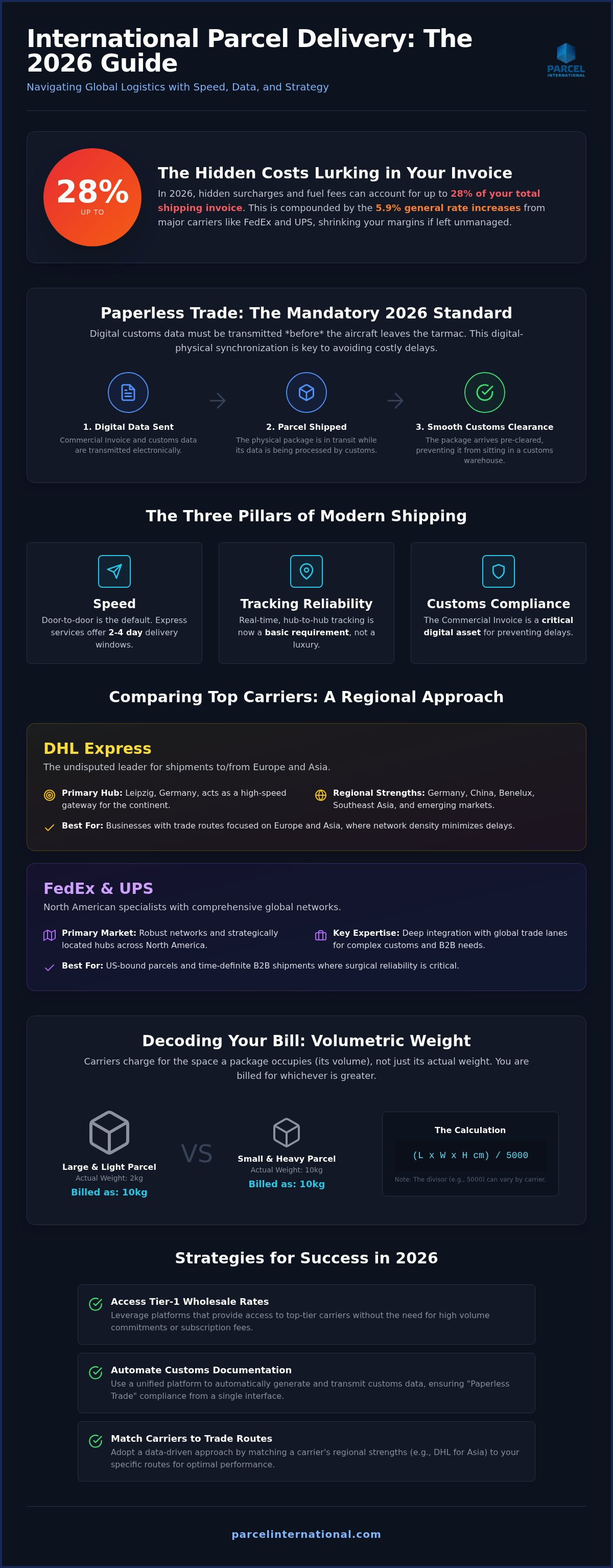
International parcel delivery in 2026 is no longer a simple physical hand-off. It's a multi-stage journey where digital data travels just as fast as the package itself. Finding the best carriers for international parcel delivery requires looking at how they handle this digital-physical synchronization. A package that moves quickly but lacks proper electronic documentation will inevitably sit in a customs warehouse for days. This year, the industry has shifted toward 'Paperless Trade' as the global baseline, meaning that digital customs data is now transmitted before the aircraft even leaves the tarmac.
To succeed in this environment, you must focus on three pillars: speed, tracking reliability, and customs compliance. Professional global shipments are now expected to be door-to-door by default. This standard removes the friction of your customer having to deal with local collection points or unexpected administrative hurdles. While the history of parcel post began with simple governmental mail exchanges, the 2026 standard is a high-tech ecosystem built on radical transparency and predictive logistics.
The Evolution of Global Shipping Expectations
Real-time tracking transparency has moved from a premium luxury to a basic requirement. Customers don't just want to know that their package is "in transit"; they expect to see exactly which hub it's passing through in real-time. At the same time, 2026 sustainability regulations, particularly within the EU, have forced carriers to optimize their routing for carbon efficiency. This shift has led many businesses to move away from rigid, single-carrier contracts. They're turning to flexible aggregators that offer the agility to switch between providers based on current route performance and regulatory compliance.
Key Terminology for Modern Senders
When choosing the best carriers for international parcel delivery, you'll work with three main types of service providers. A Courier is the entity that physically moves the box from A to B. A Broker acts as a stable intermediary, negotiating rates and managing the logistics platform. A Freight Forwarder typically handles larger, bulkier shipments that might require multiple modes of transport. The Last-mile delivery is the final leg of the journey, and it's the stage that most directly impacts your customer satisfaction scores. Finally, Incoterms are the standardized international rules that define whether the sender or the recipient is responsible for shipping costs, insurance, and duties.
Comparing Top Carriers: DHL, FedEx, and UPS for Global Reach
Choosing the best carriers for international parcel delivery requires a strategic look at regional infrastructure. DHL remains the undisputed leader for shipments entering or leaving Europe and Asia. Their primary global hub in Leipzig, Germany, acts as a high-speed gateway that ensures packages move through the continent with minimal friction. If your trade routes involve Germany, China, or the Benelux region, DHL’s density usually translates to fewer delays. They've invested heavily in local ground networks, making them highly reliable for "difficult" postal codes in Southeast Asia and emerging markets.
For comprehensive global coverage, leading carriers also offer robust networks across North America. Many leverage strategically located hubs to facilitate efficient US-bound parcels, providing a significant advantage for businesses focused on this market. These top providers often deliver a range of services, from economy to premium express, which cater to diverse e-commerce needs and offer a favorable balance between speed and cost. Furthermore, for B2B shipments where time-definite delivery is critical, some providers are renowned for their surgical reliability. Their long-standing brokerage expertise and deep integration with global trade lanes often allow them to excel in complex customs environments, ensuring smooth transit for crucial consignments.
Express vs. Economy: Balancing Speed and Budget
Speed costs money. For high-value electronics or urgent legal documents, time-definite express services are essential. These shipments rely almost exclusively on dedicated air transport to hit 2-4 day delivery windows. However, the future of parcel shipping suggests that AI-driven routing is making economy options more viable for non-urgent goods. Reaching remote territories often requires a hybrid approach. You can use international parcel shipping strategies to combine the reach of Tier-1 carriers with local last-mile experts. This ensures that even the most isolated destinations receive the same level of tracking visibility as a major city.
When Your Parcel Becomes Freight
Most carriers trigger a shift to freight once a single package exceeds 70 kilograms or specific dimensional limits. Don't let this transition catch you off guard. For larger business consignments, LCL (Less than Container Load) is often more cost-effective than sending multiple individual parcels. LCL allows you to share container space with other shippers, drastically reducing the cost per kilogram. If you find yourself consistently hitting these weight limits, it's time to learn what is a freight forwarder and how they manage bulk movements. You can compare these different modes and carriers effortlessly through a unified logistics platform to ensure you're always using the most efficient method for your current volume.
The Data-First Approach to Customs and Compliance
Customs is often the "black box" of logistics. You send a parcel and hope it reaches its destination without a hitch. But hope isn't a strategy for business growth. In 2026, the primary reason for parcels being delayed or returned isn't a physical transport failure; it's a data mismatch. Even the best carriers for international parcel delivery can't bypass a customs hold if the digital paperwork is incomplete. Your Commercial Invoice is the essential identity document for every international parcel. If the description, value, or origin is vague, authorities will flag it for manual inspection, adding days or weeks to your transit time.
Harmonized System (HS) codes have become the mandatory backbone of 2026 trade compliance. These six-to-ten-digit numbers tell customs exactly what is in the box without the risk of translation errors. Using the best carriers for international parcel delivery won't save your shipment from a penalty if your HS codes are outdated or missing. Accuracy is your primary shield against border friction.
You must also decide on the delivery terms that define your customer experience. DDU (Delivery Duty Unpaid) often leads to frustration, as the recipient receives an unexpected bill at the door before they can claim their package. DDP (Delivery Duty Paid) allows you to handle these costs upfront. This creates a smooth, predictable delivery experience that builds long-term trust and eliminates "package ransom" scenarios.
Automating Your Customs Documentation
Manual entry is a relic of the past that invites human error. Platform-generated paperwork ensures that all required fields are populated correctly every time. In major trade hubs like Rotterdam, the transition to digital-only customs declarations is already the standard. This means your data must be ready and transmitted before the shipment even arrives at the border. For a full compliance checklist, refer to our guide on international shipping customs documentation.
Understanding 2026 Import Duties and Taxes
The regulatory landscape has shifted significantly this year. Starting July 1, 2026, the European Union removed the duty-free status for most shipments valued under €150. In the US, the suspension of the $800 de minimis exemption for many imports means most low-value items now require formal customs entry. New VAT regulations on e-commerce mean you must provide transparent landing costs at the point of sale. If your customers don't know the final price including duties, they're less likely to complete the purchase. Providing this transparency is no longer optional; it's a competitive necessity.
Deciphering International Shipping Rates and Volumetric Weight
Your shipping invoice is rarely determined by the scale alone. Carriers use a logic called 'Dimensional Weight' or Volumetric Weight to price their services. This system accounts for the space a package occupies in a cargo hold, not just its mass. If you're shipping a large box of lightweight items, you'll pay for the volume it takes up rather than its physical weight. Carriers always charge based on whichever value is greater: the actual weight or the package volume. In 2026, the standard dimensional divisor for international shipments with DHL, FedEx, and UPS is 5,000 when measuring in centimeters. This means a 10kg box with large dimensions could easily be billed as a 25kg shipment.
Accessing the best carriers for international parcel delivery often feels impossible for small and medium businesses due to high volume requirements. This is where a brokerage platform changes the game. By aggregating the shipping volume of thousands of SMBs, a broker secures wholesale rates that are usually reserved for enterprise-level shippers. Unlike direct carrier contracts that often hide fees in complex tiers, a transparent aggregator shows you the final price upfront. You must also account for common surcharges like fluctuating fuel fees, remote area delivery, and residential address fees. In 2026, these surcharges can account for 15% to 28% of your total shipping cost. To see how these factors impact your specific routes, compare real-time rates on our platform.
Using a Shipping Cost Calculator Effectively
To get an accurate 2026 shipping estimate, you need precise data points. Enter the exact dimensions, weight, destination postal code, and the declared value for insurance. Comparing multiple carrier quotes side-by-side is the only way to find the optimal route for your specific timeline. For a deeper look at how peak seasons and global events influence these numbers, check out our international shipping rates 2026 guide. This tool allows you to spot the best carriers for international parcel delivery based on current market volatility rather than outdated price lists.
Practical Tips for Reducing Your Shipping Spend
Optimization starts with your packaging. Minimize 'shipped air' by using boxes that fit your products snugly to lower your volumetric costs. For businesses with fluctuating volumes, a 'no subscription' model is a massive advantage. You only pay for what you ship, without being locked into monthly fees or minimum volume commitments. Consider consolidation strategies as well. If you have multiple parcels heading to the same region, combining them into a single larger shipment can drastically reduce the per-unit cost. These small adjustments move your logistics from a cost center to a competitive advantage.
Scaling Globally with Parcel International
The journey through complex customs regulations and volumetric calculations leads to a single question: how do you manage it all without a dedicated logistics department? Parcel International acts as your unified gateway for express shipping, sea freight, air freight, and road freight. Instead of logging into four different carrier portals and juggling multiple accounts, you use one interface to access the best carriers for international parcel delivery. Our Rotterdam-based team understands the nuances of European exports and global trade routes, providing the expert support you need to navigate procedural friction at the border.
The 'Compare, Book, Track' workflow is designed for speed and clarity. You don't have to guess which carrier is performing best on a specific route this week. The platform provides real-time data so you can make informed decisions in seconds. This system allows your business to scale from sending a single document via express to managing full freight projects without changing your internal process. By removing the traditional barriers of volume minimums and complex contracts, we ensure that global expansion is accessible to every ambitious business.
Why a Logistics Broker is Your Competitive Advantage
A logistics broker is your competitive advantage because it levels the playing field for small and medium businesses. You gain access to the global networks of DHL, FedEx, and UPS without the high-volume price tag usually required for wholesale rates. Our automated compliance tools handle the data-heavy lifting of customs documentation, allowing you to enter new international markets faster and with more confidence. We've served as a stable intermediary in the global market since 2007, proving that radical transparency is the best foundation for a reliable shipping strategy. You get the reach of the best carriers for international parcel delivery combined with the personalized support of a dedicated logistics partner.
Next Steps: Starting Your First Shipment
Expansion shouldn't be gated by subscription fees or restrictive terms. You can create a free account today and access real-time rate comparisons immediately. The platform guides you through the process of preparing your first commercial invoice, ensuring every HS code and value is accurate before you ship. This reduces the risk of parcels being stuck in customs due to paperwork errors. Compare international shipping rates and book your first delivery today to experience a logistics workflow that values your time and your peace of mind.
Future-Proof Your Global Shipping Strategy
The logistics landscape of 2026 demands a data-driven approach to every shipment you send. You've seen that identifying the best carriers for international parcel delivery is about more than just comparing base rates; it requires a deep understanding of regional hub strengths and digital customs integration. Success now depends on your ability to automate documentation and optimize packaging to minimize volumetric weight costs. By moving away from fragmented workflows and rigid carrier contracts, you gain the agility needed to navigate shifting import regulations and volatile surcharges.
You don't need high shipping volumes to access elite logistics tools. We provide wholesale rates from DHL, FedEx, and UPS with automated customs documentation included in every booking. There are no subscription fees and no volume minimums, ensuring that your business stays lean and adaptable. It's time to turn your international shipping from a complex hurdle into a streamlined competitive advantage. Compare global shipping rates and book your delivery with Parcel International. Start scaling your global reach today with total transparency and peace of mind.
Frequently Asked Questions
How long does international parcel delivery typically take in 2026?
International delivery times depend primarily on the service level you select and the destination's location. Express services typically arrive within 1 to 4 business days. Economy options generally take between 5 and 10 business days. These timelines vary based on whether your shipment is moving between major global hubs or heading to a remote territory with less developed infrastructure.
What are the most common reasons for customs delays in international shipping?
Inaccurate or incomplete documentation is the most frequent cause of customs holds. Common errors include vague item descriptions, missing commercial invoices, or incorrect Harmonized System (HS) codes. Since many regions now require digital-only declarations, any data mismatch between your electronic filing and the physical parcel will likely trigger a manual inspection and significant delays.
How do I calculate the dimensional weight of my international package?
Calculate dimensional weight by multiplying the package's length, width, and height in centimeters, then dividing the total by 5,000. Carriers compare this result to the actual physical weight and bill you for whichever number is higher. Minimizing package volume is essential for securing the best carriers for international parcel delivery at a competitive price point.
Who is responsible for paying import duties and taxes on international parcels?
Responsibility depends entirely on the Incoterms selected during the booking process. Under Delivered Duty Paid (DDP), the sender covers all duties and taxes upfront. If you choose Delivered at Place (DAP), the recipient is responsible for paying these fees before the local carrier can complete the delivery. Choosing DDP often leads to a better customer experience by removing surprise costs at the door.
Can I track my parcel in real-time across different international carriers?
Yes, modern logistics platforms allow you to track shipments from multiple carriers like DHL, FedEx, and UPS in one place. You receive a single tracking interface regardless of which provider is physically moving the box. This visibility is now a standard requirement for professional global shipments, providing peace of mind for both the sender and the recipient throughout the journey.
What is the cheapest way to send a heavy parcel abroad in 2026?
For heavy consignments that exceed 70kg, sea freight or Less than Container Load (LCL) services are typically the most cost-effective options. If the parcel must travel by air, using a broker to access wholesale rates is the most effective way to lower costs. Brokers aggregate volume from many shippers to offer discounts that individual small businesses cannot negotiate on their own.
Do I need a special business account to access wholesale shipping rates?
You don't need a complex corporate contract or a high-volume subscription to access wholesale rates. Our platform operates on a no-subscription model with no volume minimums. This flexibility allows small businesses to use the best carriers for international parcel delivery without the burden of monthly fees, hidden charges, or restrictive long-term commitments that often hinder growth.
How do I generate a commercial invoice for an international shipment?
You can generate a commercial invoice automatically through our shipping platform during the booking process. The system prompts you for essential data like the item description, value, origin, and HS code. This automation ensures that your paperwork meets 2026 digital standards and reduces the risk of human error that leads to border friction and unexpected returns.