
Certificate of Origin Requirements for USA Exports: The 2026 Compliance Guide
What if the difference between a zero-duty shipment and a 12.5% penalty wasn't the quality of your goods, but the specific data elements on your paperwork? In 2026, failing to meet the updated certificate of origin requirements for usa exports leads to more than just a minor headache. With new Section 301 tariffs affecting dozens of countries and the recent implementation of the EU-US Turnberry Agreement, your documentation is now your most important financial tool.
It's frustrating to manage manual paperwork while worrying if a shipment will be held at customs because of a missing Chamber of Commerce signature. You need a process that's transparent and reliable, not one buried in procedural friction. This guide promises to help you master the essential documentation and filing procedures required to ensure your exports clear customs without unnecessary duties. We'll provide a clear checklist of required data elements, explain the shift toward self-certification under the USMCA, and show you exactly when a formal stamp is mandatory to keep your global logistics moving efficiently.
Table of Contents
What is a Certificate of Origin and Why is it Critical for US Exports?
Understanding What is a Certificate of Origin? is the first step toward a friction-free export strategy. At its core, this document certifies the specific country where your goods were manufactured or produced. It isn't just a formality; it's a legal declaration that customs officials use to determine how your cargo is treated at the border. Without it, your shipment is just a box of unidentified goods subject to the highest possible scrutiny and tax rates.
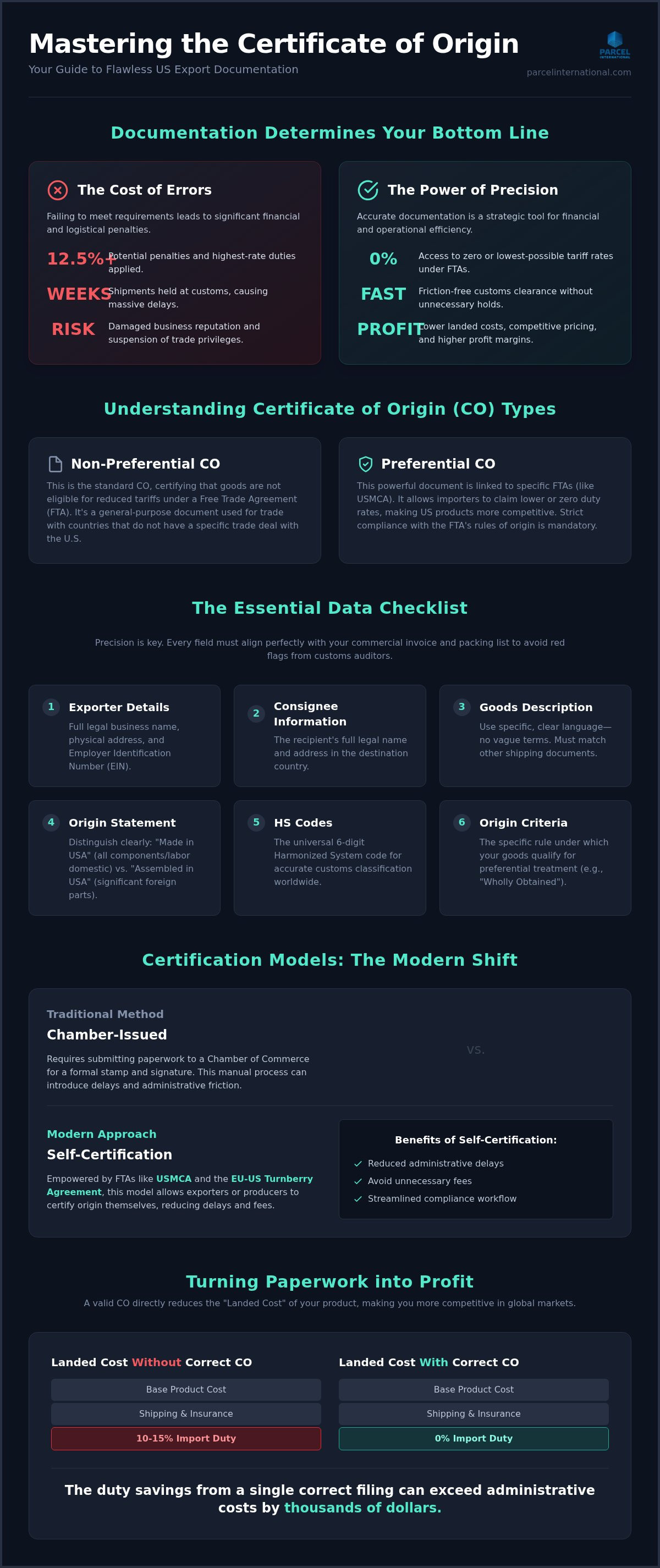
You'll encounter two primary categories when managing your paperwork. Non-Preferential COs are general documents used for countries that don't have a specific trade deal with the U.S. Preferential COs are more powerful. These are linked to Free Trade Agreements (FTAs) like the USMCA. Meeting the certificate of origin requirements for usa exports for these agreements is what allows you to claim lower or zero tariff rates, making your products more attractive to international buyers.
Governments use these documents to prevent "trade re-routing," where goods from a high-tariff country are moved through a third country to skip duties. In 2026, with global trade tension rising and new Section 301 tariffs in place, these documents ensure fair application of trade laws. We're also seeing a massive shift toward electronic Certificates of Origin (eCO). These digital versions allow for same-day processing, moving you away from the slow, manual PDF templates that cause unnecessary shipping delays.
The Role of Customs Authorities in Verifying Origin
U.S. Customs and Border Protection (CBP) relies on these records to compile trade statistics and monitor the flow of goods. However, the destination country's authorities are even more focused on them. They use the CO to enforce anti-dumping duties or specific quotas. If you provide an incorrect origin declaration, you risk more than a fine. You damage your business reputation and could face a suspension of your preferential tariff treatment. Accurate documentation is your best defense against having shipments held at customs for weeks.
Tariff Preferences: Turning Paperwork into Profit
A valid CO is often the only thing standing between you and a 10% to 15% import duty. When you reduce these costs, your "Landed Cost"—the total price of a product once it reaches the buyer's door—drops significantly. This makes your pricing more competitive in foreign markets and increases your profit margins. The total duty savings achieved through a single correct filing can easily exceed the administrative cost of the document by thousands of dollars. By mastering the certificate of origin requirements for usa exports, you transform a simple compliance task into a strategic financial advantage.
Mandatory Data Elements for a Valid US Certificate of Origin
Precision is the only way to avoid customs delays. When you address the certificate of origin requirements for usa exports, every field must align perfectly with your commercial invoice and packing list. Discrepancies are red flags for auditors. Start with the Exporter Details; you must provide your full legal business name, physical address, and Employer Identification Number (EIN). This establishes who is legally responsible for the origin claim.
Next, ensure the Consignee Information is complete. This includes the recipient's full legal name and address in the destination country. When describing your goods, avoid vague terms like "parts" or "samples." Use specific language that mirrors your other shipping documents. You must also clearly distinguish between "Made in USA" and "Assembled in USA." These terms aren't interchangeable. "Made in USA" implies that all or virtually all of the product's components and labor are domestic, while "Assembled in USA" suggests a significant portion of the value comes from foreign parts.
Harmonized System (HS) Codes and Classification
The first six digits of an HS code are universal. This numerical language allows customs authorities worldwide to identify exactly what you're shipping. Misclassifying your goods is a fast track to fines or even shipment seizures. If you're unsure of the correct classification, use the U.S. Census Bureau’s Schedule B search tool or cross-reference with previous successful entries. Getting this right ensures your cargo moves through the port without manual intervention.
Origin Criteria and Preference Indicators
To qualify for duty-free status, you must prove how your goods meet the origin rules. Products are usually classified as "Wholly Obtained," meaning they are entirely produced in a single country, or as having undergone "Substantial Transformation." This means the foreign materials were processed enough to change their HS classification. You'll often need to provide an Exporter's Affidavit to support these claims during an audit.
Understanding these FTA Certificates of Origin guidelines is critical for maximizing your tax benefits. If managing these complex data fields feels overwhelming, you can use automated customs support tools to pull data directly from your shipment bookings. This reduces the risk of manual entry errors and ensures your certificate of origin requirements for usa exports are met every time.
Free Trade Agreements (FTAs) and Preferential Requirements
Global trade agreements are designed to make your products more affordable in foreign markets, but they only work if you follow the specific certificate of origin requirements for usa exports. The U.S. currently maintains 14 comprehensive free trade agreements with 20 different countries. Each agreement, from the long-standing deal with Israel to the 2026 EU-US Turnberry Agreement, has its own set of rules. Understanding these nuances is the difference between a seamless delivery and a shipment stuck in a customs warehouse. Many modern agreements now favor "declarative statements" placed directly on the commercial invoice, which eliminates the need for separate, bulky forms.
By January 2026, USMCA utilization among exporters reached 85%, proving that businesses are increasingly relying on these benefits to stay competitive. However, a June 2026 Executive Order has strengthened customs enforcement, making accuracy more critical than ever. If you're shipping to Korea, Australia, or Singapore, you must ensure your origin claims are backed by verifiable data. This isn't just about avoiding taxes; it's about building a reliable, transparent supply chain that customs authorities trust.
USMCA Compliance: The Most Common US Export Document
The transition from the old NAFTA form to the current USMCA certification format replaced rigid government templates with a flexible nine-point data set. You don't need a formal government form anymore. Instead, the exporter, producer, or even the importer can complete the certification. While this flexibility is a relief, it comes with strict record-keeping requirements. You must keep copies of all origin certifications and supporting documentation for a minimum of five years. This is a mandatory safeguard in case of a post-clearance audit.
Low-Value Shipment Exceptions ($2,500 Threshold)
You don't always need a full Certificate of Origin for smaller orders. For most shipments valued at $2,500 or less, a simple statement on the commercial invoice is often sufficient to claim preferential treatment. This "de minimis" rule is a major time-saver for e-commerce and small-scale commercial exports. However, there are exceptions to this rule. High-risk goods or those subject to specific forced labor investigations may still require a full CO regardless of their value. For a deeper look at how this fits into your broader logistics strategy, see our guide on International Shipping Customs Documentation. Using these exceptions correctly reduces your administrative burden without compromising compliance.
How to Apply for a Certificate: Chamber-Issued vs. Self-Certified
Applying for your documentation doesn't have to be a multi-platform struggle. The process follows a logical sequence that starts with understanding your buyer's specific needs and the laws of the destination country. To stay compliant with the certificate of origin requirements for usa exports, follow these four steps:
Step 1: Determine if the destination country or the buyer's bank requires a formal Chamber of Commerce stamp.
Step 2: Prepare your supporting documents, ensuring your Commercial Invoice and Packing List are accurate and consistent.
Step 3: Choose between a traditional physical stamp or an electronic Certificate of Origin (eCO) for faster processing.
Step 4: Execute the final signature and arrange for notarization if the importing country mandates it.
When a U.S. Chamber of Commerce Signature is Mandatory
You'll find that many Middle Eastern markets still require formal 'legalization' of documents. This often involves a Chamber stamp followed by an embassy or consulate visit. If you're working with a Letter of Credit, the bank will likely demand a Chamber-issued document to release payment. While physical stamps were once the norm, most Chambers now offer digital certificates through platforms like essCert or Swiftdox. These tools provide same-day processing, which is a major relief compared to the days of mailing paper documents back and forth. Fees for these services typically vary based on your membership status and the complexity of the legalization required.
The Risks and Benefits of Self-Certification
Self-certification is the fastest way to meet the certificate of origin requirements for usa exports, especially under modern agreements like the USMCA or the EU-US Turnberry Agreement. It allows you to draft a compliant statement directly on your invoice using the Manufacturer's Certificate of Origin as a baseline. This speed comes with a trade-off. You carry the full burden of proof during a customs audit. If you can't produce the supporting records within the five-year mandatory window, you face retroactive duties and penalties. To mitigate this risk, ensure your internal records clearly document the manufacturing process or the "substantial transformation" of the goods.
If you're tired of fragmented workflows and manual PDF templates, you can automate your customs support today. Our tools unify the documentation process, allowing you to generate compliant certificates directly from your shipment bookings without the typical administrative friction.
Streamlining Export Compliance with Parcel International
Managing the certificate of origin requirements for usa exports manually is a significant drain on your time and resources. When you rely on static PDF templates, you're forced to re-enter data that already exists in your shipping logs. This fragmentation is where costly errors happen. Parcel International eliminates this friction by integrating your documentation directly into the shipment booking process. Our platform pulls data from your commercial invoice to generate a compliant CO automatically. This ensures that your HS codes, consignee details, and origin criteria match across every document in your export set.
Efficiency doesn't stop at paperwork. By unifying your workflow, you also gain access to discounted express rates from major partners like DHL, FedEx, and UPS. You don't have to choose between fast shipping and accurate compliance. The platform performs real-time checks to flag potential mismatches before your cargo even leaves the warehouse. This proactive approach strips away the anxiety of shipments being held at customs due to minor clerical mistakes. You get the relief of moving from fragmented, multi-platform workflows to a singular, unified solution.
Centralizing Your Customs Workflow
Keeping your invoices and Certificates of Origin in a single digital dashboard provides the relief of order in a chaotic market. When your data syncs across all export documents, the risk of human error drops significantly. You no longer need to worry if the address on your CO matches the one on your bill of lading. This level of oversight is a key part of modern logistics. If you're curious about how this fits into the bigger picture of global trade, you can read more about What is a Freight Forwarder? and how they manage these moving parts.
Expert Support for Complex Destinations
Even with automated tools, some destinations present unique challenges. Whether you're navigating the 2026 Section 301 tariff updates or the specific legalization requirements of Middle Eastern markets, our customs support team is available to assist. We act as a stable intermediary, helping you interpret changing regulations with agility. You don't need to be a trade lawyer to export successfully; you just need a partner that values transparency and punctuality. We provide the expertise needed for 220+ countries without the burden of hidden subscription fees or volume minimums. Streamline your US exports with automated customs documentation today and move your business toward a faster, more reliable shipping model.
Future-Proof Your Export Strategy for 2026
Mastering the certificate of origin requirements for usa exports is no longer just a clerical task; it's a strategic competitive advantage. You've learned that precision in data elements and understanding the nuances of Free Trade Agreements are essential for avoiding punitive tariffs. Whether you're self-certifying for speed or obtaining a Chamber stamp for specific international markets, your documentation must be transparent and verifiable. Accuracy ensures your goods move through customs without the friction of manual holds or unnecessary fees.
You don't have to manage these high-stakes logistics alone. Parcel International offers a unified solution to strip away the anxiety of fragmented workflows. You can compare real-time rates from DHL, FedEx, and UPS while accessing expert customs support for over 220 countries. There are no hidden subscription fees or volume minimums. This allows businesses of all sizes to ship with confidence. Start shipping smarter with automated customs tools and turn your compliance paperwork into a seamless part of your global success. Your path to efficient, secure trade starts here.
Frequently Asked Questions
Is a Certificate of Origin mandatory for all US exports?
A Certificate of Origin is not mandatory for every single shipment leaving the United States, but it is often required by the importing country's customs authorities. You'll need it to claim preferential tariff treatment under a Free Trade Agreement or if the destination's domestic laws mandate proof of origin for non-preferential goods. Always check the specific entry requirements of your destination to avoid having your cargo held at the border.
What is the difference between a Commercial Invoice and a Certificate of Origin?
A Commercial Invoice is a bill for the goods sold, detailing the transaction value, quantity, and payment terms. In contrast, a Certificate of Origin specifically certifies where the products were manufactured or produced. While both are essential for meeting certificate of origin requirements for usa exports, they serve different legal purposes. Customs officials use the invoice to determine value-based duties and the CO to apply trade agreement benefits.
Can I sign my own Certificate of Origin for USMCA shipments?
Yes, under USMCA rules, the exporter, producer, or even the importer can sign the certification of origin. You no longer need a formal government form or a Chamber of Commerce stamp for these North American shipments. You can provide the required nine data elements directly on your commercial invoice or as a separate attachment. Just ensure you maintain all supporting records for five years to satisfy potential audit requests from customs authorities.
How much does it cost to get a Chamber-issued Certificate of Origin in 2026?
The cost for a Chamber-issued Certificate of Origin varies depending on your location and membership status. As of 2026, many U.S. Chambers charge between $25 and $35 for members, while non-members can expect to pay between $50 and $65 per document. Online processing through electronic platforms is often the most cost-effective and fastest route. These fees are separate from any courier or embassy legalization costs required for specific Middle Eastern markets.
Do I need a Certificate of Origin for shipments valued under $2,500?
Generally, you don't need a formal Certificate of Origin for shipments valued under the $2,500 threshold for informal entries. For most Free Trade Agreements, a simple statement on the commercial invoice is sufficient to claim duty-free status for low-value goods. However, certain high-risk products or those subject to specific trade enforcement orders may still require full documentation. It's best to verify the current 2026 thresholds for your specific product category before shipping.
What happens if my Certificate of Origin has an error?
Errors on your documentation can lead to significant financial penalties, including retroactive duties and fines. If the origin is misdeclared, customs authorities may seize the shipment or suspend your ability to claim preferential treatment in the future. Inaccurate data also damages your business reputation with international partners. Using automated customs support tools helps eliminate these risks by syncing your certificate of origin requirements for usa exports data directly with your shipping records.
How long must I keep copies of my export Certificates of Origin?
You are legally required to maintain copies of your Certificates of Origin and all supporting documentation for a minimum of five years. This requirement applies to both self-certified documents like the USMCA and formal Chamber-issued certificates. During this window, customs authorities can conduct post-clearance audits to verify your origin claims. Keeping organized digital records within a unified dashboard ensures you can quickly respond to any inquiry and protect your duty-free status.
Can an electronic Certificate of Origin (eCO) be used for all countries?
While electronic Certificates of Origin (eCO) are accepted by a growing number of countries, they are not yet universal. Many modern trade partners, including those in the EU and North America, embrace digital signatures and same-day electronic processing. However, certain regions in the Middle East and South America may still demand physical stamps or embassy legalization. Always verify the specific documentation standards of your destination country to ensure your eCO will be recognized.


Comments