
How to Reduce International Shipping Costs for SMBs: The 2026 Logistics Strategy
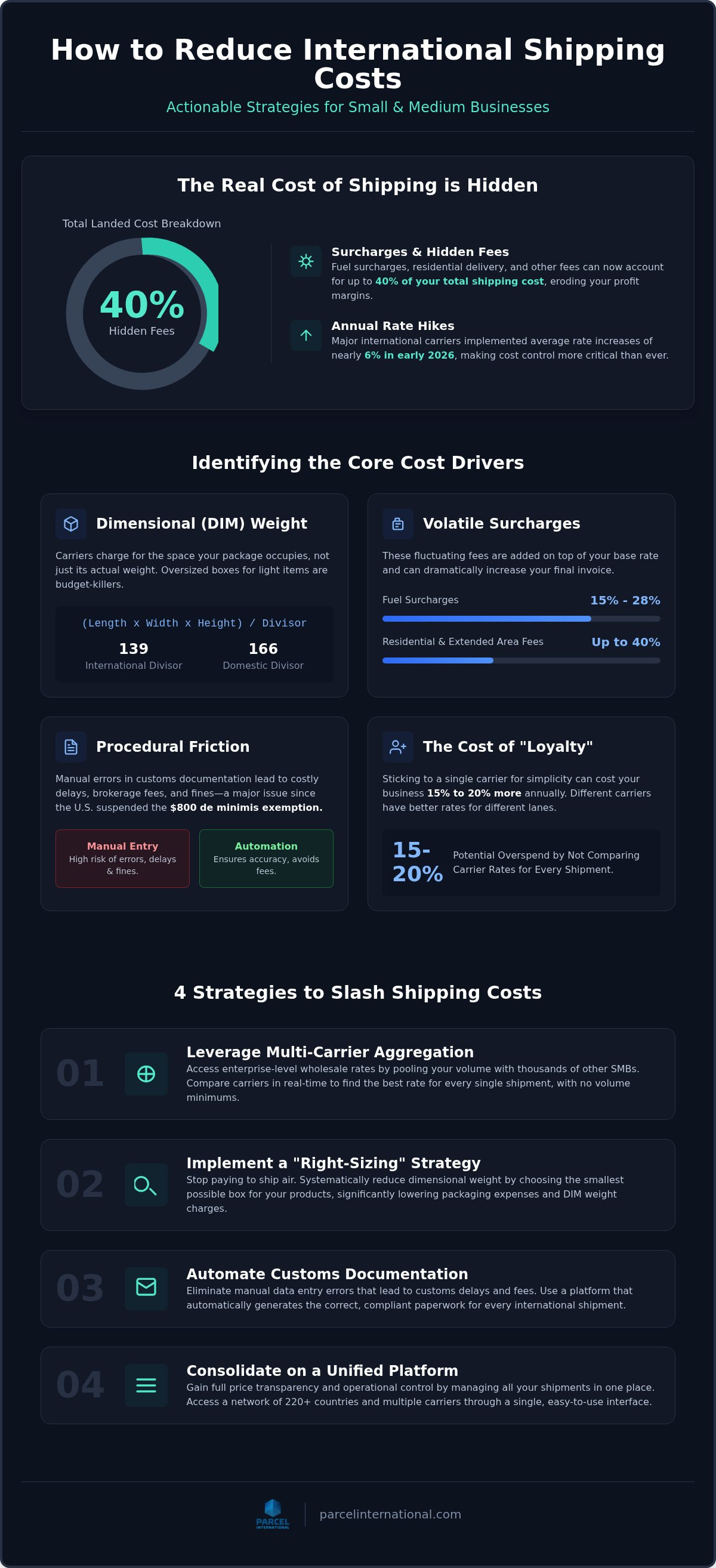
Did you know that fuel surcharges and hidden fees can now account for up to 40% of your total landed cost? With major international carriers implementing average rate hikes of nearly 6% in early 2026, many small businesses feel like they're being priced out of the global market. Learning how to reduce international shipping costs for smb isn't just about finding the cheapest base rate anymore. It's about stripping away the procedural friction and unexpected surcharges that eat your margins.
We understand the frustration of seeing your profits swallowed by unpredictable fees or the sudden suspension of the $800 de minimis exemption in the U.S. You deserve the same predictable, transparent shipping costs that large enterprises enjoy. This guide will show you how to master actionable strategies and automated tools to slash cross-border expenses without sacrificing delivery speed. We'll explore how to leverage carrier-agnostic aggregation and compliance-first automation to turn logistics from a headache into a competitive advantage for your business.
Table of Contents
Identifying the Core Cost Drivers in Global Logistics
To truly master how to reduce international shipping costs for smb, you've got to look past the sticker price. The base carrier rate is a deceptive metric. What matters is the Total Cost of Delivery (TCD), which is the final amount you pay once every surcharge and fee is added. Many businesses find that their final invoice is significantly higher than the initial quote because they didn't account for the administrative and logistical layers involved in cross-border trade. Relying on a base quote without factoring in these variables is a recipe for shrinking margins.
Fuel surcharges are currently one of the most volatile components, often fluctuating between 15% and 28% of the total bill. When combined with the general rate increases that hit the industry in early 2026, these costs can quickly erode your profit. You also have to consider the "last mile" impact. Residential delivery surcharges and extended area fees aren't just minor inconveniences; they can constitute up to 40% of the total landed cost for specific routes. Ignoring these variables makes it impossible to maintain a predictable budget or price your products accurately for international buyers.
The Impact of Volumetric Weight on Your Bottom Line
Carriers don't just charge for how much your box weighs; they charge for the physical space it takes up in their vehicles. This is known as dimensional (DIM) weight. Most international services use a standard divisor of 139 to determine this billable weight, while domestic ground services often use 166. If you ship lightweight items in oversized boxes, you're effectively paying to transport air. For a small business, large but light parcels are the biggest budget killers because they trigger these high-volume penalties without adding value to the shipment.
Surcharges: The Silent Profit Margin Eroders
Beyond fuel and weight, several "silent" costs can derail your strategy. Peak season surcharges are now a year-round reality used to manage capacity across different modes of global freight transport. You also have to account for currency fluctuations, which can change the net cost of a shipment between the time of the quote and the time of delivery. These shifts might seem small, but they add up across hundreds of shipments.
The most damaging cost, however, is procedural friction. This happens when incorrect data leads to customs delays or fines. Since the U.S. suspended the $800 de minimis exemption in June 2026, the administrative burden on small parcels has increased significantly. Implementing automated customs documentation is the most effective way to eliminate these manual errors. It ensures your paperwork is right every time, preventing the brokerage fees and storage costs that arise from simple data entry mistakes.
Leveraging Multi-Carrier Aggregation for Wholesale Rates
Carrier loyalty is a myth that costs small businesses between 15% and 20% every year. While it's tempting to stick with one provider for simplicity, you're likely paying a premium on lanes where another carrier has better capacity or lower overhead. Aggregation solves this by pooling the shipping volume of thousands of small businesses into one stream. This collective power allows logistics brokers to unlock enterprise-level pricing usually reserved for massive corporations.
When you use a unified platform, you gain the ability to perform real-time rate comparisons across multiple carriers. You can weigh the speed of express shipping against the cost-effectiveness of sea freight or road freight for every single order. This transparency is vital for understanding how to reduce international shipping costs for smb without sacrificing the reliability your customers expect. It's about choosing the right tool for the specific job rather than settling for a one-size-fits-all contract.
Accessing Tier-1 Rates Without Volume Commitments
Most major carriers require high monthly volumes before they'll even consider a discount. Parcel International bridges this gap by offering access to partners like DHL, FedEx, and UPS with no volume minimums required. You get the benefit of wholesale logistics without the pressure of meeting a quota or paying a monthly subscription fee. This flexibility is essential for growing businesses with seasonal fluctuations. To see the difference, you can use a shipping cost calculator to audit your current spend against live market rates.
Choosing the Right Mode: Air, Sea, or Road?
Choosing the right transport mode is a balancing act. If your shipment is under 100 kilograms, express parcel services are generally the most efficient. For larger consignments, sea freight or International Road Freight often provides a more economical path. For instance, shipping across Europe via road is frequently cheaper and more sustainable than air transport.
Navigating these choices requires a solid understanding of global regulations and paperwork. The U.S. Small Business Administration provides excellent trade compliance resources to help you manage these complexities. By combining different modes, you can create a hybrid shipping model that optimizes for both cost and urgency. You can compare freight rates instantly to see which mode fits your current project best.
Practical Packaging Strategies to Lower Shipping Expenses
Every centimeter of empty space in a box is a direct tax on your business. Even if you've secured wholesale rates through aggregation, inefficient packaging will still trigger the dimensional weight penalties discussed earlier. Mastering the physical side of logistics is a critical step in learning how to reduce international shipping costs for smb. Start by standardizing your box sizes to fit carrier "Small Box" or "Flat Rate" tiers. If your products don't fit these standard dimensions, nesting multi-item orders within a single, right-sized container prevents the "multiple package" surcharges that often surprise exporters.
Choose your dunnage with weight in mind. Traditional heavy corrugate adds unnecessary grams that accumulate into significant costs over time. Switch to high-strength, low-weight alternatives like air pillows or recycled paper mesh. These materials provide the same level of protection without the weight penalty of heavy foam or cardboard inserts. Reducing your average packaging weight by just 1kg per shipment across a 1,000-order annual volume can save your business thousands in international surcharges.
Dimensional Weight Optimization Steps
Follow this 3-step process to audit and optimize your physical shipping footprint:
Step 1: Measure your top-selling products and compare them against your current box inventory. Identify where "air pockets" are most prevalent.
Step 2: Switch to variable-depth boxes. These allow you to fold the cardboard down to the height of the product, eliminating the need for excess filler and reducing the package's DIM volume.
Step 3: Replace standard double-wall boxes with high-performance, single-wall corrugate for lighter items. This maintains structural integrity while stripping away dead weight.
Consolidation: Shipping More for Less
Batching orders is a powerful way to leverage bulk freight rates. Instead of sending ten individual express parcels to customers in the same region, consolidate them into a single pallet. This allows you to use "zone skipping" strategies. You ship the bulk consignment across the expensive international leg once, then use local carriers for the final delivery. This move significantly reduces the per-item cost and simplifies the customs process.
While consolidating shipments, consult the SBA guide to trade compliance to ensure your bulk consignments meet all regulatory requirements. Proper documentation at the consolidation stage prevents the procedural friction that leads to storage fees or fines. By combining physical optimization with smart batching, you ensure that every gram of weight you pay for is actually product, not just packaging and air.
Streamlining Customs and Documentation for Cost Avoidance
Manual paperwork is a trap. If your documentation contains a single typo or an incorrect HS code, your shipment could sit in a bonded warehouse for days. This leads to storage fees that often exceed the original shipping cost. Mastering how to reduce international shipping costs for smb requires a "compliance-first" mindset. When you rely on carriers to fix your errors, they'll charge high brokerage fees that aren't visible in your initial quote.
HS Code accuracy is your first line of defense. These codes determine the exact duty rate applied to your goods. Misclassifying a product can lead to overpaying import taxes or, worse, heavy fines from customs authorities. By using automated customs documentation, you ensure that every data point is pulled directly from your order system. This strips away the risk of human error and the subsequent brokerage surcharges that eat into your margins.
Reducing Administrative Overhead with Automation
Integrate your e-commerce platform directly with your logistics tool to streamline your workflow. This allows for the instant generation of commercial invoices and packing lists. In major global hubs like Rotterdam, digital documentation allows for "pre-clearance." Your goods can be cleared while they're still in transit, moving them directly from the port to the final destination without delay. This speed prevents the "Return to Sender" trap, which occurs when incomplete data forces a carrier to ship the package back at your expense.
Understanding Import Duties and Tax Liabilities
Choosing the right Incoterms is a strategic decision for any growing business. With DAP (Delivered at Place), your customer pays the duties upon arrival. While this lowers your upfront cost, it often leads to abandoned packages and a poor customer experience. DDP (Delivered Duty Paid) allows you to collect these fees at checkout, providing the transparency customers expect in 2026.
Researching country-specific de minimis values is another way to find savings. Even with the U.S. suspension of the $800 exemption, other regions still have thresholds where small parcels enter tax-free. If you're struggling with these regional trade blocks, partnering with a freight forwarder can provide the expertise needed to navigate complex European or Asian markets. It's a reliable way to learn how to reduce international shipping costs for smb while expanding your reach. You can automate your customs compliance today to stop overpaying on every cross-border shipment.
Scaling Globally with Parcel International’s Unified Platform
Fragmented workflows are the primary enemy of efficient logistics. Juggling a dozen different carrier logins and manual spreadsheets creates the exact procedural friction that leads to errors and delays. By moving to a single interface for 220+ countries and territories, you replace chaos with order. This transition is a fundamental step in how to reduce international shipping costs for smb. You gain a high-level view of your entire supply chain, allowing you to spot inefficiencies before they become expensive problems.
Our commitment to radical transparency means you never have to deal with hidden requirements or surprise surcharges. The "No Hidden Fees" policy ensures that the quote you receive is the final price you pay. This predictability allows you to scale with confidence. Whether you are sending your first package or managing a thousand orders, our international parcel shipping tools provide the framework needed for global delivery. We leverage our Rotterdam-based expertise to help you navigate European distribution hubs with unmatched speed and precision.
Professional Support for Complex Logistics
Growth often requires moving beyond small parcels. As your business expands, you can access Air Freight, Sea Freight, and Road Freight through the same unified platform. In a market defined by volatile freight rates and shifting capacity, having a dedicated logistics partner provides a necessary conceptual anchor. You don't need a massive budget or high-volume commitments to get started. You can create an account in minutes without any subscription fees or restrictive terms. This egalitarian approach ensures that small businesses can access the same wholesale rates as large enterprises.
A Future-Proof Strategy for 2026 and Beyond
The logistics landscape in 2026 is increasingly shaped by new environmental regulations and "Green" shipping surcharges. A future-proof strategy requires staying ahead of these regulatory shifts. Our platform integrates AI-driven predictive rate shopping and route optimization to ensure you always choose the most cost-effective and compliant path. This proactive approach helps you understand how to reduce international shipping costs for smb while adapting to a changing world. Don't let fragmented systems hold your business back. Compare your current rates with Parcel International today and see how a unified solution simplifies your global reach.
Take Control of Your Global Logistics Strategy
Managing a cross-border business in 2026 requires more than just a great product. It demands a logistics strategy that prioritizes transparency and automation over fragmented, manual workflows. By combining physical packaging optimization with multi-carrier aggregation, you can protect your margins from rising fuel surcharges and hidden fees. Understanding how to reduce international shipping costs for smb is no longer just a luxury; it's a critical survival skill for any business aiming to scale beyond its domestic borders.
You don't have to navigate these complexities alone. You can access wholesale rates usually reserved for large enterprises through our partnerships with DHL, FedEx, and UPS. With no subscription fees, no volume minimums, and automated customs documentation included, we strip away the barriers that hold small businesses back. It's time to move from fragmented logistics to a singular, unified solution that values your peace of mind. Start saving on your international shipping today with Parcel International. Your global growth is within reach, and we're here to help you bridge the gap.
Frequently Asked Questions
What is the cheapest way to ship internationally for a small business?
The most cost-effective method is using a logistics broker to access wholesale rates usually reserved for large enterprises. This aggregator model allows you to compare express, air, sea, and road freight in one place. By bypassing direct carrier contracts, you avoid high retail margins. Choosing the right mode for your shipment weight, such as road freight for European destinations, is another key strategy in how to reduce international shipping costs for smb.
How do I calculate dimensional weight for international parcels?
You calculate dimensional weight by multiplying the package length, width, and height, then dividing by a carrier-specific divisor. For international express services, the divisor is typically 139. If you ship via domestic ground, it's often 166. Carriers charge based on the higher value between actual weight and this volumetric calculation. Minimizing empty space in your boxes is the most direct way to lower these costs and improve your overall shipping efficiency.
What are the most common hidden fees in international shipping?
Common hidden costs include fuel surcharges, which can reach 28% of the bill, and residential delivery fees. You might also encounter "out of area" surcharges if the destination is remote. Brokerage fees charged by carriers for handling paperwork are another frequent surprise. Parcel International uses a "No Hidden Fees" policy to ensure transparency. This helps you understand how to reduce international shipping costs for smb by providing a total price before you commit.
Can automated customs documentation really save me money?
Yes, automation significantly reduces expenses by eliminating human error in paperwork. Incorrect documentation often leads to customs delays and expensive bonded warehouse storage fees. Automated tools generate commercial invoices and packing lists directly from your order data, ensuring accuracy. This allows for "pre-clearance" at major hubs like Rotterdam. By avoiding manual brokerage surcharges and the "Return to Sender" trap, you keep your logistics budget predictable and your profit margins protected.
Is it better to use a single carrier or a logistics broker?
A logistics broker is generally superior for small businesses because they consolidate volume to unlock tier-1 rates. Sticking to a single carrier creates a loyalty trap that can cost you 15% to 20% annually. Brokers provide a unified interface to compare partners like DHL, FedEx, and UPS side-by-side. This flexibility allows you to choose the best carrier for specific lanes or urgencies, ensuring you always get the most competitive price without being locked into a rigid contract.
What is the difference between DDP and DAP for international shipping?
DDP (Delivered Duty Paid) means the seller handles all duties and taxes, providing a seamless experience for the customer. DAP (Delivered at Place) requires the recipient to pay these fees before they can receive the package. While DAP might look cheaper for the seller initially, it often leads to abandoned shipments and customer frustration. For a professional international strategy, DDP is usually the better choice to ensure high delivery success rates and long-term customer satisfaction.
How can I avoid customs delays for my international shipments?
Avoiding delays starts with HS code accuracy and complete digital documentation. Every item must be correctly classified to ensure the right duties are applied. Using automated customs support prevents the procedural friction caused by manual typos or missing data. Providing clear descriptions and ensuring all values match your commercial invoice will speed up the clearance process. This proactive approach keeps your shipments moving through global hubs without the need for manual intervention from customs officials.
Do I need a high shipping volume to get discounted rates?
No, you don't need high volume to access discounted rates when using an aggregator. Traditional carriers often require thousands of shipments per month before they offer significant discounts. However, Parcel International offers wholesale pricing with no volume minimums or subscription requirements. This egalitarian model allows even small shops to access the same shipping power as large corporations. You can scale your business from a single parcel to bulk freight while maintaining the same cost-effective pricing structure.


Comments