
What is a Customs Broker? 2026 Global Shipping Guide
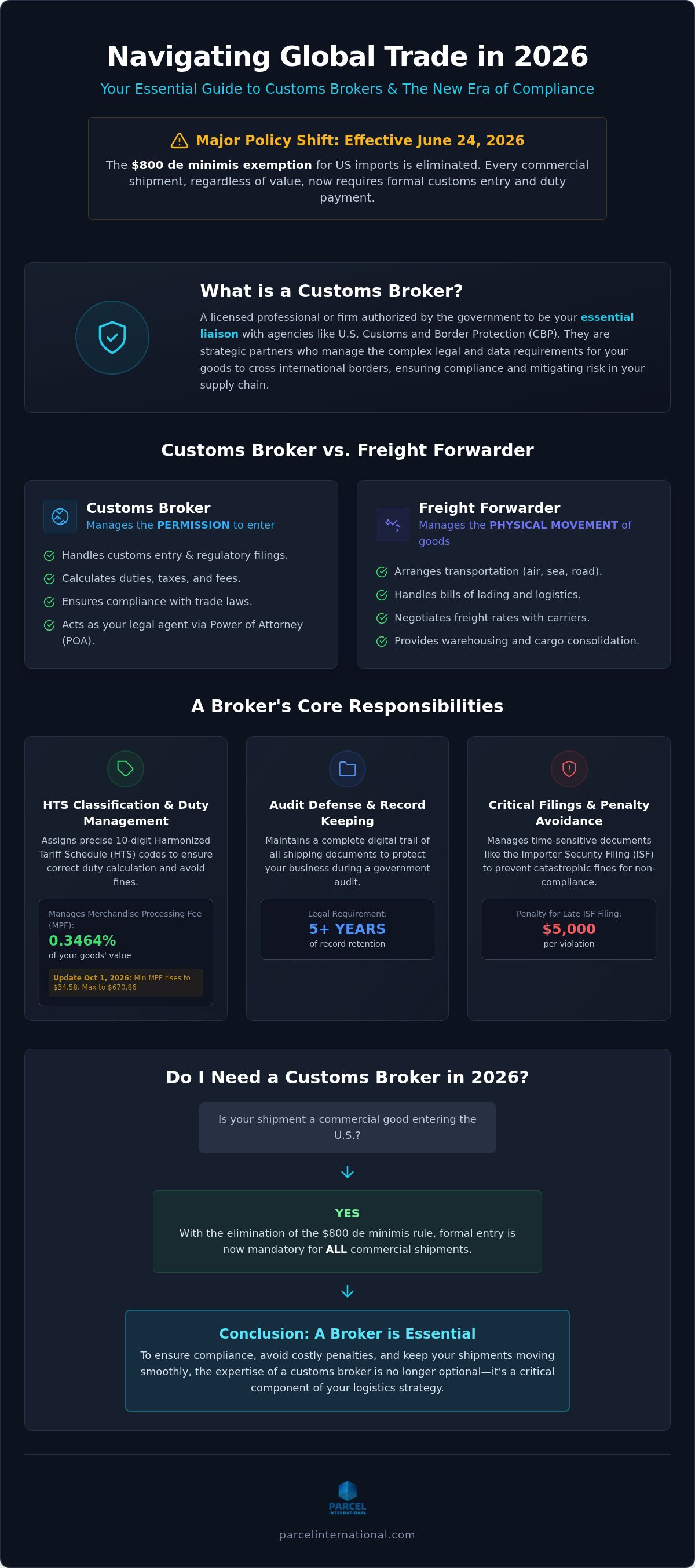
The $800 de minimis exemption is officially a thing of the past. Since June 24, 2026, every commercial shipment entering the US requires a formal entry and duty payment, regardless of its value. This massive policy shift has left many businesses wondering exactly what is a customs broker and do i need one to survive this new era of global trade. If you're feeling overwhelmed by HTS codes or the fear of a $5,000 ISF late filing penalty, you aren't alone. It's frustrating to watch your cargo sit in limbo while paperwork piles up.
You deserve a shipping process that's predictable and transparent. In this 2026 guide, you'll discover exactly what a customs broker does, when their expertise is essential, and how modern automation can simplify your cross-border logistics. We'll provide a clear checklist for hiring a professional and explain the difference between traditional manual brokerage and integrated shipping platforms. By the end, you'll know how to reduce manual paperwork and keep your deliveries moving without the anxiety of unexpected fines or delays.
Table of Contents
What is a Customs Broker? Defining the Role in 2026
A customs broker is a licensed professional or firm authorized by national governments to facilitate the legal entry and exit of goods across international borders. They serve as the primary liaison between your business and agencies like US Customs and Border Protection (CBP) or the European Union’s various national customs administrations. As global trade becomes more data-driven, their role has evolved. Modern brokers have transitioned from traditional paper-pushers into digital compliance consultants who manage complex electronic filings in real time. Fundamentally, a customs broker is a strategic partner in global supply chain risk management.
If you're wondering "what is a customs broker and do i need one," start by looking at your risk tolerance. These experts ensure that your commercial invoices and shipping documents align with strict government standards. They protect you from the financial sting of misclassification and the operational nightmare of seized cargo. When determining what is a customs broker and do i need one, consider that their expertise often pays for itself through duty optimization and the avoidance of costly penalties.
The Licensing and Regulation of Customs Experts
National authorities regulate brokers through rigorous certification processes. In the US, for instance, brokers must pass a comprehensive exam and maintain a valid permit. This permit carries an annual user fee of $185.38 for the 2026 calendar year. This high barrier to entry ensures they understand the nuances of trade law and valuation.
The foundation of your professional relationship is the Power of Attorney (POA). This document grants the broker the legal right to execute customs business on your behalf. Without a valid POA, a broker cannot file entries or represent your interests during a government audit. Their most valuable asset is their command of local trade laws. They interpret complex regulations so your business remains compliant even as geopolitical landscapes shift.
Customs Broker vs. Freight Forwarder: Clearing the Confusion
It's easy to confuse these two roles because they often work side-by-side. A freight forwarder is a logistics architect. They focus on the physical movement of cargo, arranging transportation via air, sea, or road. You can learn more about their specific duties in our guide: What is a Freight Forwarder?.
While the forwarder manages the "travel" of your goods, the customs broker manages the "permission" for those goods to enter a country. The forwarder handles the bill of lading; the broker handles the customs entry. These roles overlap frequently in 2026. Many modern logistics platforms integrate both functions to provide a seamless flow from the warehouse to the final destination, removing the friction of managing multiple intermediaries.
Core Responsibilities: What a Broker Actually Does for You
When you ask what is a customs broker and do i need one, the answer lies in the technical workload they manage. These professionals are licensed, regulated and empowered by U.S. Customs and Border Protection to act as your legal proxy. Their primary mission is to ensure your cargo clears the border without friction. They handle the Entry Summary, calculate complex fees, and act as a shield against regulatory errors. In 2026, this role is more critical than ever; with the $800 de minimis suspension, every shipment now requires a formal entry filing.
HTS Classification and Duty Management
Precision is the only way to avoid delivery delays. Brokers use the Harmonized Tariff Schedule (HTS) to assign a 10-digit code to your goods. One wrong digit triggers a chain reaction of fines and inspections. Beyond classification, they manage the payment of the Merchandise Processing Fee (MPF), which currently sits at 0.3464% of your goods' value.
Be aware of upcoming changes in late 2026. Starting October 1, 2026, the minimum MPF increases to $34.58 and the maximum rises to $670.86. A skilled broker identifies duty drawbacks or tax exemptions that can offset these costs. They also coordinate with Partner Government Agencies like the FDA or USDA if your products require additional health or safety certifications. Using a platform that helps you generate customs documentation automatically can significantly reduce the risk of these manual classification errors.
Audit Defense and Record Keeping
The job doesn't end when the cargo arrives at your door. You are legally required to maintain all shipping records for at least five years. A broker manages this digital trail, ensuring every invoice and entry form is accessible for a post-clearance government audit. If authorities question your valuation or origin claims, your broker provides the audit defense necessary to protect your business reputation.
Digital documentation is now the global standard. Modern compliance involves more than just filing papers; it requires real time data accuracy to avoid the $5,000 ISF late filing penalty. Brokers provide the expertise to manage these high stakes requirements, but for many businesses, the key is finding a balance. Understanding what is a customs broker and do i need one often leads to choosing a hybrid approach: using expert advice for complex goods while leveraging automated tools for standard express shipping.
Do I Need a Customs Broker? A Decision Matrix for 2026
Deciding exactly what is a customs broker and do i need one depends on your specific logistics profile and risk tolerance. In 2026, the baseline for international trade has shifted significantly. Since the indefinite suspension of the $800 de minimis threshold in June 2026, every commercial shipment entering the US now requires a formal entry and duty payment. You can no longer rely on low-value exemptions to bypass complex paperwork. Your decision should be based on shipment value, product complexity, and your chosen mode of transport.
When a Broker is Mandatory or Highly Recommended
If you are moving high-value commercial entries, a broker is essentially mandatory. These shipments require a customs bond to guarantee payment of duties and taxes to the U.S. Customs and Border Protection (CBP). You should also prioritize a professional broker when dealing with regulated goods. Products like medical devices, chemicals, or food items fall under the jurisdiction of Partner Government Agencies (PGAs) and require specialized filings that go beyond standard HTS classification.
The mode of transport also dictates your need. Large-scale logistics, such as sea freight or full container loads (FCL), involve multi-layered documentation like the Importer Security Filing (ISF). Failing to file an ISF correctly can result in a $5,000 penalty per violation. In these high-stakes scenarios, the technical expertise of a licensed broker acts as an insurance policy against delivery delays and legal friction.
When You Can Likely Skip the Manual Broker
You don't always need to hire a standalone brokerage firm for every parcel. For low-value B2C e-commerce shipments sent via express shipping, many global carriers provide "brokerage inclusive" services. Carriers like DHL, FedEx, and UPS often handle the basic customs clearance as part of their express delivery fee. This is ideal for standard retail items that don't fall under complex regulatory categories.
Modern businesses are also moving toward automated customs documentation. If you are shipping high volumes of standard goods, an automated platform can generate the necessary paperwork for over 220 countries without the per-entry fees associated with manual brokers. This hybrid approach allows you to maintain compliance and speed without the overhead of traditional brokerage. For a more efficient workflow, consider using a platform like Parcel International to compare carrier rates and automate your trade compliance tools in one place.
Manual Brokerage vs. Automated Compliance Tools
The choice between manual brokerage and automated tools often comes down to your operational speed and budget. Traditional manual brokerage relies on human experts to review every commercial invoice and shipping label. While this provides a high level of scrutiny for complex goods, it introduces a transactional cost structure that can become a barrier for high-volume shippers. Automated compliance tools represent the modern alternative. They leverage direct data integration to process shipments in seconds rather than hours. When evaluating what is a customs broker and do i need one, look closely at how automation can remove the friction from your daily workflow.
The Rise of Logistics Aggregators in 2026
Logistics aggregators have fundamentally changed the industry by integrating customs data directly into the booking process. Instead of managing separate relationships with a broker and a carrier, you can now compare international shipping rates and generate compliance documents in one unified step. This transition toward unified logistics is replacing the fragmented workflows that once caused frequent delivery delays. AI-driven HTS suggestions now rival human selection for standard retail goods, offering high accuracy without the manual entry wait times. This scalability allows small businesses to grow into global markets without hiring a dedicated compliance team.
Hidden Costs of Traditional Brokerage
Many businesses overlook the administrative overhead associated with traditional brokerage. You aren't just paying for the broker's time; you are often dealing with disbursement fees, individual filing fees, and annual bond premiums. These costs accumulate quickly, especially for businesses sending multiple small parcels. Automated platforms prioritize transparency by bundling these requirements into a singular solution. Platform automation drastically reduces the per-parcel compliance cost for SMBs by removing the need for manual human intervention on every entry. This shift allows you to focus on growth rather than paperwork.
Simplify your cross-border operations today by using automated trade compliance tools to manage your global shipments.
Simplifying Your Global Reach with Parcel International
Parcel International serves as the efficient bridge for businesses asking what is a customs broker and do i need one for their daily operations. We don't just provide shipping; we provide a unified platform that automates the technical friction of cross-border trade. Our system generates customs documentation automatically, ensuring your commercial invoices and packing lists meet the specific requirements of over 220 countries. By using pre-validated shipping data, you significantly reduce the risk of border delays that impact customer trust. This proactive approach ensures your goods move through customs without the typical hang-ups associated with manual data entry.
Accessing a global network of premier carriers like DHL, FedEx, and UPS has never been simpler. Our platform includes built-in compliance support, allowing you to compare real-time rates across different modes of transport, including Express Shipping and Air Freight. This eliminates the need to manage fragmented, multi-platform workflows. You get the reliability of a high-stakes industry authority with the accessibility of a modern partner. We provide the tools to navigate complex global shipping guides without the need for expensive, standalone brokerage fees for every parcel.
Automated Tools for Trade Compliance
Scaling your e-commerce shipping shouldn't require hiring a full-time compliance team. Our automated tools generate the necessary paperwork in seconds, matching your goods to the correct HTS codes and calculating the required duties. This is particularly vital in 2026 as regulatory scrutiny intensifies across all borders. We strip away the typical anxieties of global logistics by ensuring your data is accurate before the cargo ever reaches the port. You save hours on manual paperwork while maintaining total transparency over your supply chain costs and landed totals.
Get Started with Transparent Global Shipping
We believe in an egalitarian approach to global trade. That's why Parcel International offers no subscription fees or volume minimums for small and medium businesses. Whether you're sending a single express parcel or managing complex Sea Freight, you receive the same level of professional support and punctuality. Our philosophy of radical transparency means you won't encounter hidden requirements or procedural friction. We act as your stable intermediary, making a chaotic process orderly and predictable for every shipment you send. You don't have to deal with restrictive terms or volume barriers to access world-class logistics.
Simplify your customs process and compare rates today to experience the relief of a singular, unified logistics solution.
Master Your Global Trade Strategy in 2026
The global trade landscape has fundamentally shifted. Since the suspension of de minimis thresholds, every commercial shipment requires formal entry and precise documentation. Understanding what is a customs broker and do i need one is the first step toward securing your supply chain. While traditional brokers remain vital for complex freight, modern automation offers a faster, more transparent alternative for express parcels and standard goods. You can avoid the anxiety of unexpected fines and delivery delays by choosing a unified solution that handles the paperwork for you.
Parcel International provides the relief of automated customs tools for over 220 countries. You don't have to deal with subscription requirements or hidden fees. We provide real-time rates from DHL, UPS, and FedEx in one singular platform; this makes your logistics process orderly and predictable. Take control of your international operations and move from fragmented workflows to total compliance. Compare International Shipping Rates and Automate Your Customs Today. Your business is ready to reach new markets with confidence and speed.
Frequently Asked Questions
What is the average cost of hiring a customs broker in 2026?
Costs vary based on volume and complexity. Traditional brokers often charge a per-entry fee plus additional charges for bonds or partner agency filings. In 2026, the annual permit fee for brokers is $185.38. When considering what is a customs broker and do i need one, remember that automated platforms often bundle these costs into the shipping transaction. This removes the need for separate manual brokerage fees for standard express parcels.
Can I be my own customs broker for my small business?
Yes, you can technically file your own entries, but it requires significant technical knowledge. You must correctly classify goods using HTS codes and manage payments for fees like the MPF, which is 0.3464% of the shipment value. Most small businesses find this too risky due to the $5,000 ISF late filing penalty. Using an automated platform provides a middle ground by generating documentation for over 220 countries without requiring a professional license.
What happens if my shipment arrives at the border without a broker?
Customs authorities will hold your cargo until a formal entry is filed and duties are paid. Since the $800 de minimis suspension in June 2026, even low-value commercial goods face this requirement. Without a broker or an automated compliance tool, your shipment will sit in a bonded warehouse, racking up storage fees. Eventually, the cargo may be seized or returned to the sender at your expense, impacting your customer trust and bottom line.
Do express carriers like DHL or FedEx act as customs brokers?
Yes, major express carriers like DHL, FedEx, and UPS provide brokerage inclusive services for standard parcel deliveries. They handle the basic entry filing as part of the shipping fee. However, they may still charge additional disbursement fees for paying duties on your behalf. For complex freight or regulated goods, you might still need a dedicated broker or a specialized platform to ensure total compliance and avoid unexpected delivery delays at the border.
What is a customs bond, and do I need one for every shipment?
A customs bond is a contract that guarantees the government will receive all duties and taxes. You generally need one for any formal commercial entry, which now includes almost all business shipments following the 2026 policy changes. You can choose a single entry bond for one-off shipments or a continuous bond for high-volume trade. Automated shipping platforms often manage these requirements as part of the integrated booking process to simplify your logistics.
How do I find a reliable customs broker for specialized freight?
Look for brokers with specific expertise in your product category, such as electronics or food items. Verify their licensing through official government directories. If you use a logistics aggregator like Parcel International, you gain access to a global network of carriers with built-in compliance support. This allows you to leverage expert systems that understand the specific trade laws of the destination country without the need to search for an individual firm.
What is the difference between an import broker and a customs broker?
These terms are often used interchangeably. A customs broker is the official term for a licensed professional who clears goods through government agencies. An import broker is a more general term sometimes used to describe the same role. When asking what is a customs broker and do i need one, remember that their primary function is acting as your legal liaison to ensure your goods meet all national import regulations and duty requirements.
How has the 2026 digital customs initiative changed the filing process?
The 2026 digital initiative has replaced most manual paperwork with real-time electronic data interchange. Governments now require pre-validated shipping data before the cargo even arrives. This shift has made automated trade compliance tools essential for businesses of all sizes. By using a platform that integrates directly with carrier systems, you ensure your digital filings are accurate. This ensures they are submitted within the strict timeframes required to avoid heavy fines or seized cargo.


Comments