
Cheapest International Shipping from USA: 2026 Comparison & Strategy Guide
- Alex
- 11 minutes ago
- 12 min read
The "cheapest" label on a carrier’s website is often the most expensive mistake you'll make this year. While you search for the cheapest international shipping from usa, major carriers have already implemented average 5.9% rate increases for 2026. You're likely struggling with the suspension of the U.S. de minimis exemption and the new customs fees for low-value EU shipments. It's exhausting to watch a low base rate disappear under the weight of disbursement fees and trade surcharges.
We agree that global logistics should be transparent and efficient, not a series of hidden traps. You deserve a clear path to wholesale rates and predictable delivery times without the burden of subscription fees or volume minimums. This guide provides a direct comparison of carrier performance and costs for 2026. You'll learn how to balance postal services with wholesale express rates to strip away retail surcharges. We will show you how to automate your customs paperwork and finally secure a reliable bridge to the global market. Let's move your workflow from fragmented to unified.
Table of Contents
Understanding the Landscape of International Shipping from the USA
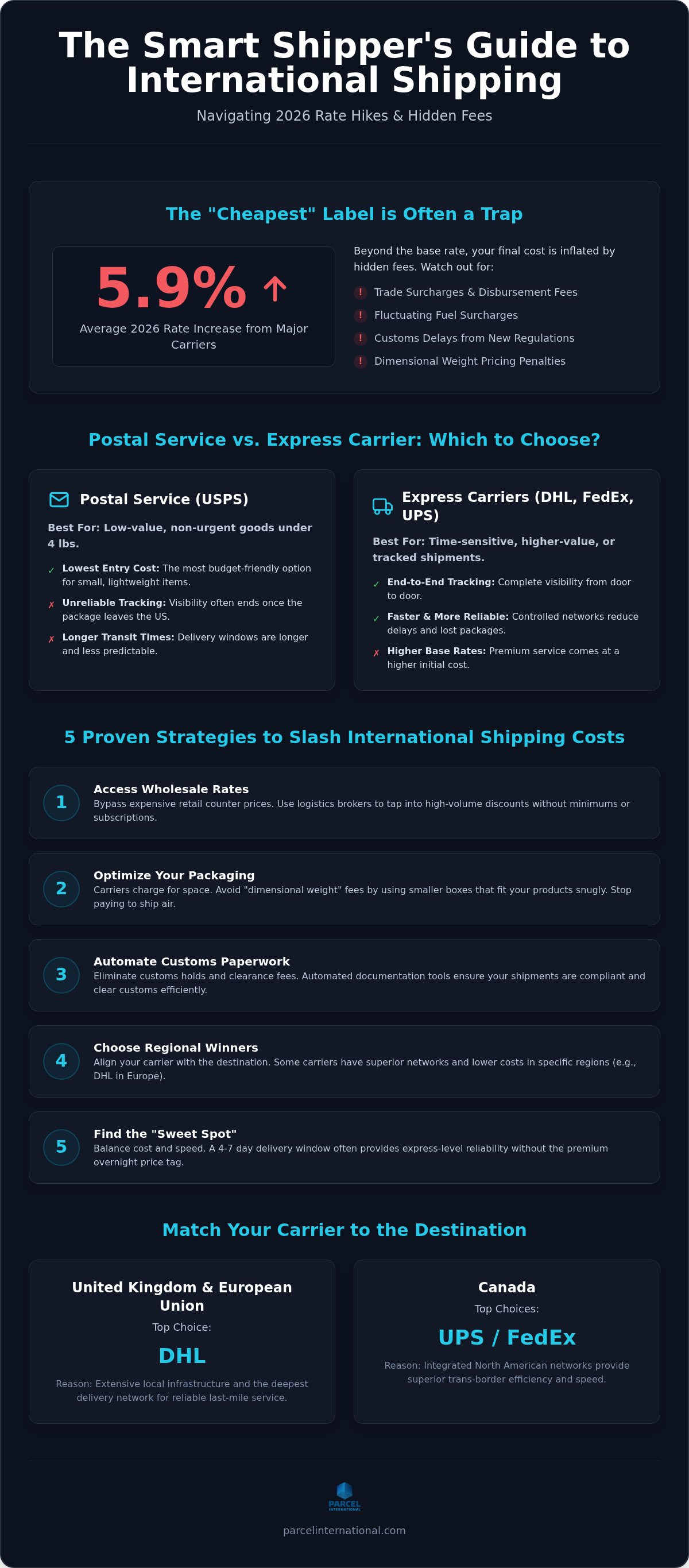
Finding the cheapest international shipping from usa requires looking past the initial quote. In 2026, major carriers like FedEx and UPS have pushed average rate increases of 5.9%, but the real cost often hides in surcharges and customs delays. Truly "cheap" shipping balances the base rate with transit speed and reliability. If a package takes six weeks to arrive or gets stuck in customs because of poor documentation, the low initial price becomes a liability. The modern global freight transport network has evolved, and shippers now rely on hybrid models that combine the reach of national postal services with the precision of private express networks.
Stop paying retail rates at the counter. Walking into a post office or a carrier storefront is the most expensive way to ship internationally. These locations charge premium prices to cover their physical overhead. Professional shippers bypass these surcharges by using logistics brokers who provide access to wholesale rates. This shift is essential in 2026, as fuel surcharges and inbound processing fees continue to fluctuate monthly. You need a strategy that bypasses these retail traps to keep your margins intact.
Postal vs. Commercial Express Carriers
USPS First-Class Package International Service remains a primary choice for lightweight, low-value items under four pounds. It's often the lowest entry point, but it lacks the granular tracking and speed of commercial express services. Private carriers like DHL, FedEx, and UPS excel when you need door-to-door visibility and faster transit. The "last-mile" factor is the critical differentiator; while USPS hands off your parcel to a destination country's local postal service, private carriers typically maintain control through their own networks, reducing the risk of a package disappearing in a foreign sorting facility. Choose the carrier based on the value of the item and the urgency of the delivery.
The Hidden Impact of Dimensional Weight
Weight isn't the only factor that dictates your bill. Carriers prioritize space, meaning a large box filled with feathers can cost more than a small box filled with lead. Dimensional weight is a pricing technique used by carriers to calculate shipping costs based on a package's volume relative to its actual weight, ensuring that bulky items take up their fair share of space in the cargo hold. In 2026, dimensional weight calculations have become even more stringent across the industry. You must optimize your packaging to match the size of your items, or you'll find yourself paying for shipped air. Reducing box dimensions by even an inch can lead to significant savings over time.
Comparing the Top 4 Shipping Options for 2026
Choosing the cheapest international shipping from usa in 2026 requires a tactical shift. Carriers across the board implemented general rate increases of 5.9% this year, but the real cost depends on your destination. For instance, shipping to Canada often favors UPS or FedEx due to their integrated North American networks and recent investments in trans-border efficiency. Conversely, DHL typically dominates the UK and European markets because of their extensive local infrastructure and the depth of their delivery network. You must align your carrier choice with the geography of your customer base to avoid unnecessary transit surcharges.
Finding the "sweet spot" between speed and cost is vital for small business growth. While a 21-day transit time might look cheap on paper, the customer service burden of "where is my package" inquiries can quickly erode those savings. Aim for the four to seven-day window. This range offers the reliability of express networks without the extreme price tag of overnight services. If you need assistance navigating these choices, you can access real-time rate comparisons through a unified dashboard to see which carrier wins for your specific route today.
USPS: The Budget King for Small Parcels
USPS remains a primary choice for lightweight items under four pounds. First-Class Package International is often the lowest price point for non-urgent goods, but it comes with a significant trade-off: tracking often becomes unreliable once the parcel leaves US soil. For higher-value items, Priority Mail International offers better visibility and faster transit, though rates increased by roughly 4-8% in January 2026. Use USPS for low-stakes shipments where cost is the only driver, but be prepared for longer delivery windows and less predictable customs clearance compared to commercial alternatives.
The "Big Three" Express Carriers
DHL, FedEx, and UPS provide the infrastructure for high-stakes global trade. DHL is the undisputed leader for international reach, particularly in Europe and emerging markets. FedEx and UPS offer exceptional reliability for shipments within the Americas. To ensure your documentation meets International Trade Administration guidelines, these carriers provide robust digital tools that help you avoid the delays associated with 2026's stricter customs regulations. In 2026, we've also seen the rise of regional specialty carriers that fill the gaps between the majors, offering niche pricing for specific lanes like US-to-Southeast Asia.
You don't have to pay retail counter prices for this level of service. By using a logistics broker, you gain access to wholesale margins previously reserved for massive corporations. This approach removes the barriers of volume minimums and subscription fees, allowing you to ship with the world's best carriers at a fraction of the standard cost. It's about moving from a fragmented workflow to a single, efficient solution that prioritizes your bottom line.
5 Proven Strategies to Slash Your International Shipping Costs
Securing the cheapest international shipping from usa isn't about luck; it's about using the right levers to bypass retail margins. While carriers focus on their annual rate hikes, you can protect your bottom line by adopting expert shipping strategies that prioritize efficiency over convenience. These five methods move you away from fragmented, high-cost workflows toward a unified, cost-effective shipping model.
Leverage Logistics Brokers: Access wholesale rates from DHL, FedEx, and UPS that are typically reserved for high-volume corporations.
Consolidate Shipments: Group multiple orders into a single larger shipment to reduce the per-unit transportation cost.
Minimize Dimensional Weight: Use the smallest possible packaging to avoid paying for empty space.
Utilize Flat-Rate Options: For dense, compact items, carrier-provided flat-rate boxes can offer significant savings.
Negotiate as You Scale: Don't settle for static rates as your volume grows; use your data to request better margins.
The Power of Wholesale Rate Aggregators
Logistics brokers like Parcel International act as a bridge between small business needs and big-carrier infrastructure. By aggregating the volume of thousands of shippers, these brokers negotiate bulk discounts that individual businesses simply cannot access on their own. You don't need to ship 500 packages a month to get "big business" rates. Unlike direct carrier accounts that often require volume minimums or monthly subscription fees, a wholesale aggregator offers radical transparency. You see the true cost upfront, allowing you to choose the most efficient path for every parcel without being locked into a restrictive contract.
Packaging Optimization for Global Transit
Dead space is your biggest enemy in 2026. If you're shipping a small item in a large box, you're paying for air. Switch to poly mailers for soft goods like apparel to eliminate the weight and volume of rigid cardboard. When boxes are necessary, select a size that leaves no more than two inches of space around the product. This precision helps you avoid the steep dimensional weight surcharges we discussed earlier. For e-commerce owners, mastering this balance is the key to maintaining profitability. You can find more detailed advice in our International Shipping for Ecommerce guide to ensure your packaging strategy matches your budget.
Always consider the density of your products. If you ship heavy items like books or metal components, flat-rate boxes are often the cheapest international shipping from usa. These options ignore weight up to a certain limit, providing a predictable cost structure that simplifies your financial planning. By combining these strategies, you move from a chaotic shipping process to an orderly, optimized operation.
Avoiding the "Cheap" Trap: Customs, Duties, and Hidden Fees
The absolute cheapest international shipping from usa isn't just the price on the shipping label; it's the total cost of getting the package into your customer's hands. In 2026, the landscape has become significantly more complex. With the suspension of the U.S. de minimis exemption and the removal of the EU's €150 duty exemption, every commercial shipment is now under the microscope. If you choose a budget carrier that provides zero customs support, you're likely setting yourself up for a "cheap" trap where packages sit in warehouses for weeks, accruing storage fees and frustrating your recipients.
One of the most critical decisions you'll make is choosing between DDP (Delivered Duty Paid) and DDU (Delivered Duty Unpaid). When you ship DDU, your customer is hit with unexpected bills for taxes and duties before they can receive their package. This often leads to refused deliveries and expensive "return to sender" fees that you, as the shipper, must eventually cover. Shifting to a DDP model allows you to collect these fees at checkout, providing a transparent and professional experience that protects your margins and your reputation.
Calculating the True Total Cost of Delivery
To find a sustainable shipping strategy, you must look beyond the base transportation rate. You need to factor in local VAT, regional import taxes, and the disbursement fees charged by carriers for advancing duty payments. For instance, as of July 2026, some major carriers have increased their disbursement fees to $17.50 or 2.5% of the total duty amount. If you aren't communicating these costs clearly to your international customers, you'll see a spike in abandoned packages. For a deeper look at the paperwork required to navigate these hurdles, consult our guide on International Shipping Customs Documentation.
Automating Compliance to Save Money
Manual paperwork is a relic of an inefficient past that invites human error and customs delays. In 2026, digital compliance tools are the only way to ensure your commercial invoices meet the latest regulatory standards across 220+ countries. These tools generate accurate Harmonized System (HS) codes and ensure your documentation is electronically transmitted to customs authorities before the package even arrives at the border. Automated customs support reduces labor costs for SMBs by eliminating the need for manual data entry and cross-referencing complex tariff codes. This precision reduces the risk of costly "return to sender" fees and ensures your shipments move through the global network without friction.
Don't let hidden fees erode your international profits. You can access our automated customs support tools today to ensure every shipment is compliant, transparent, and cost-effective from the moment it leaves your door.
Why Parcel International is the Smart Choice for US Shippers
Finding the cheapest international shipping from usa shouldn't feel like a full-time job. Most shippers waste hours logging into different carrier portals, only to find that retail rates have climbed again. We act as your stable intermediary, stripping away the friction of fragmented workflows. By consolidating your logistics into a single dashboard, you gain instant access to real-time comparisons across 220+ countries. It's an orderly solution for a chaotic market that prioritizes your peace of mind over corporate jargon.
Wholesale Rates for Every Shipment
Our platform bridges the gap between your specific needs and the massive infrastructure of global carriers. While direct carrier accounts often demand high volume or monthly subscription fees, we believe in an egalitarian approach. You shouldn't have to pay a premium just because you don't ship a thousand packages a day. We pass our wholesale margins directly to you, providing instant quotes that include all surcharges for total transparency. There are no hidden requirements or fine print to obscure your true costs. For a detailed breakdown of how prices have shifted this year, review our guide on International Shipping Rates 2026. This transparency ensures you never face the procedural friction that typically plagues global logistics.
Beyond Parcels: Freight Solutions
As your business scales, your needs will inevitably evolve beyond small parcels. We support this growth by offering a unified solution for express shipping, air freight, and sea freight. Transitioning to freight transport is a logical step when your volume reaches a point where palletized shipping becomes more cost-effective than individual boxes. We provide professional customs support tailored for commercial exporters, ensuring your large-scale shipments meet 2026 compliance standards without delay. This versatility makes us a dedicated partner for both personal projects and commercial operations. You don't need multiple platforms to manage different modes of transport. Everything you need to secure the cheapest international shipping from usa is available in one place. Stop dealing with restrictive terms and start optimizing your global reach. Compare international shipping rates today and see how a professional partner makes the world feel smaller.
Master Your Global Logistics Strategy for 2026
Securing the cheapest international shipping from usa requires more than just picking a name off a list. It demands a strategy that balances base rates with the total landed cost, including 2026's updated customs duties and surcharges. You now understand that while USPS is a budget choice for small parcels, wholesale express rates often provide better value and tracking for commercial shipments. By automating your customs paperwork and avoiding the retail counter, you remove the procedural friction that typically drains your budget. It's time to move from fragmented workflows to a singular, unified solution. You don't have to navigate these complexities alone or pay high subscription fees to get corporate-level service.
Get an instant international shipping quote now to compare rates from DHL, FedEx, and UPS in seconds. Our platform includes automated customs paperwork and ensures there are no hidden fees or subscription requirements. Take control of your global reach today and ship with confidence.
Frequently Asked Questions
What is the absolute cheapest way to ship a small package from the USA?
USPS First-Class Package International Service remains the lowest base price option for lightweight items under four pounds. While it's the most budget-friendly entry point, it lacks the granular tracking and speed of commercial express carriers. For items that aren't urgent, this is often the cheapest international shipping from usa, though you should factor in the 4–8% rate increase implemented in January 2026.
How can I avoid customs delays when shipping internationally?
Utilizing automated customs support tools is the most effective way to prevent packages from being held at the border. These tools generate accurate commercial invoices and Harmonized System (HS) codes, ensuring your documentation meets 2026 regulatory standards. Choosing a Delivered Duty Paid (DDP) shipping model also prevents delays by handling tax and duty payments before the package reaches the recipient.
Is USPS or UPS cheaper for international shipping in 2026?
The answer depends entirely on the weight of your parcel and your access to wholesale rates. USPS is generally cheaper for mail and very light parcels, but UPS often becomes the more cost-effective choice for heavier shipments when you use a logistics broker. Both carriers implemented an average 5.9% rate increase in early 2026, so comparing real-time quotes for your specific route is essential.
What is dimensional weight and how does it affect my shipping cost?
Dimensional weight is a pricing calculation that carriers use to bill you based on the amount of space a package occupies rather than just its actual weight. Carriers multiply the length, width, and height of your box and divide by a specific factor to determine this value. If the dimensional weight is higher than the actual weight, you'll be billed for the larger number, making packaging optimization vital.
Do I need a commercial account to get discounted international rates?
You don't need a direct commercial account or high shipping volumes to access enterprise-level discounts. Logistics brokers allow small businesses and individual shippers to use their negotiated wholesale margins with carriers like DHL and FedEx. This model removes traditional barriers like subscription fees or minimum monthly requirements, giving you immediate access to professional rates.
What is the difference between DDP and DDU shipping?
DDP (Delivered Duty Paid) means the shipper takes responsibility for all import duties and taxes, while DDU (Delivered Duty Unpaid) requires the recipient to pay these fees upon arrival. In 2026, DDP is the preferred method for e-commerce because it eliminates the risk of customers refusing packages due to unexpected costs. It creates a more transparent and reliable delivery experience for the buyer.
How do logistics brokers like Parcel International offer lower rates?
Brokers function as a bridge by aggregating the shipment volume of thousands of small users to secure bulk discounts from major global carriers. These are the same wholesale rates usually reserved for massive corporations with high-volume contracts. By passing these savings directly to you, brokers provide a unified way to access the cheapest international shipping from usa without the need for complex negotiations.
Which carrier is best for shipping from the US to Europe?
DHL is widely regarded as the leader for European destinations because of its deep-rooted local infrastructure and delivery network across the continent. While FedEx and UPS are reliable alternatives, DHL's expertise in handling the new 2026 EU customs regulations makes them particularly efficient. Their ability to manage low-value shipments under the new €3 customs duty rule helps prevent unnecessary friction at the border.


Comments