
How to Reduce International Shipping Costs: 10 Proven Strategies for 2026
- Alex
- 12 hours ago
- 12 min read
Did you know that hidden fees and surcharges now account for up to 40% of the total landed cost for many international shipments? Between the 6% general rate increases from major carriers and the permanent suspension of de minimis exemptions in both the US and EU, the price of global trade has reached a tipping point. It's exhausting to manage fragmented workflows while watching fuel surcharges eat your profits, especially when you're stuck manually comparing dozens of carrier rates just to stay competitive.
You deserve a logistics strategy that provides relief, not more paperwork. This guide reveals how to reduce international shipping costs using actionable, 2026-ready tactics that slash overhead without sacrificing delivery speed. We'll explore ten proven strategies, including how to access wholesale rates, optimize for new dimensional weight rounding rules, and automate customs documentation to eliminate costly delays. By the end of this article, you'll have a clear roadmap to predictable costs and a simplified, unified shipping process.
Table of Contents
Why International Shipping Costs Remain Volatile in 2026
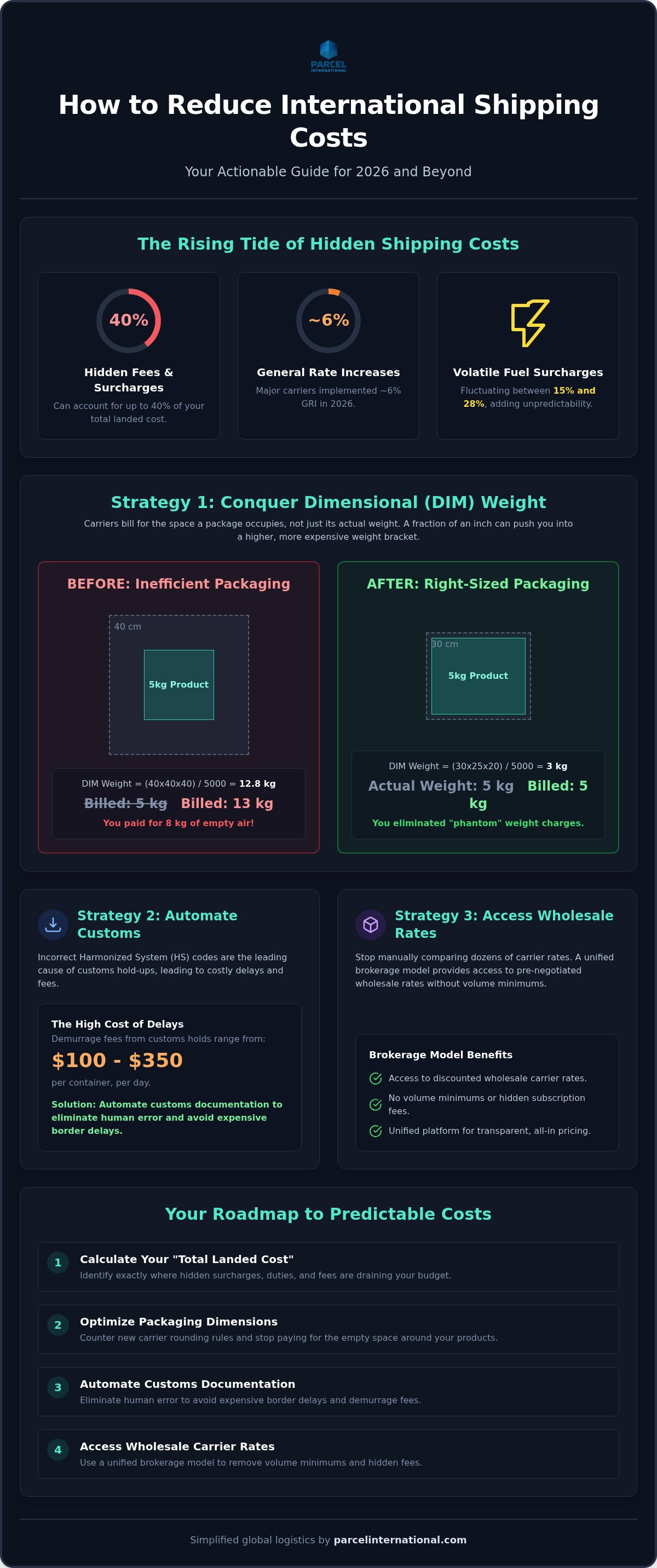
The global logistics market isn't just complex; it's unpredictable. If you're wondering how to reduce international shipping costs, you first need to understand that the price on your initial quote rarely matches the final bill. In January 2026, major carriers like FedEx and UPS implemented General Rate Increases (GRI) of approximately 6.0%. When you add fuel surcharges that currently fluctuate between 15% and 28%, your shipping budget can spiral out of control without warning. Reliance on outdated pricing models is a liability you can't afford.
To master your overhead, you must focus on the "Total Landed Cost." This metric accounts for the freight itself, but also includes the impact of the 2026 regulatory shift. For instance, the suspension of the $800 de minimis exemption in the US and the removal of the €150 threshold in the EU mean that almost every commercial shipment now faces formal entry duties. When you choose between various modes of freight transport, these administrative costs often outweigh the base transport fee. Ignoring these variables leads to "procedural friction," where manual data entry and fragmented workflows create invisible drains on your revenue and your team's time.
The Anatomy of a Global Shipping Invoice
Break down your invoices to see where the money actually goes. Carriers separate base rates from a long list of additional line items. Ancillary charges are supplementary fees for specific services like fuel adjustments, residential delivery, or remote area surcharges, and they often inflate your final shipping bill by 15% to 20%. Many businesses lose money because they fail to account for these "hidden" administrative fees. By moving to a unified solution that provides transparent, all-in pricing, you can strip away the anxiety of unexpected surcharges and regain control over your margins.
The Hidden Cost of Shipping Delays
Speed is often a financial strategy. When shipments get stuck at the border, you aren't just losing time; you're losing capital. Incorrect Harmonized System (HS) codes remain the leading cause of customs hold-ups, leading to demurrage fees that range from $100 to $350 per day. These delays also damage your customer lifetime value, as shoppers in 2026 have zero tolerance for late deliveries. Remember that faster transit can sometimes be cheaper in the long run because it improves your cash flow and eliminates the need for expensive storage at the port. Precision in your documentation is the most effective tool you have to prevent these cascading costs.
Mastering Dimensional Weight and Packaging Efficiency
Shipping air is a luxury no business can afford in 2026. Carriers like FedEx, UPS, and DHL prioritize the space a package occupies over its actual mass. This is Dimensional (DIM) Weight. To understand how to reduce international shipping costs, you must navigate the recent carrier policy of rounding every dimension up to the nearest whole inch. This change means a fraction of an inch can push your parcel into a higher weight bracket, inflating your bill before the item even leaves the warehouse. Shrinking your package's physical footprint is the first step toward reclaiming your margins.
Right-sizing your packaging is a direct counter to these aggressive billing practices. When you use a box that is significantly larger than your product, you're paying for "billable weight" that doesn't exist. By using custom-fit boxes or adjustable-height shippers, you eliminate the empty space that triggers higher rates. Additionally, nesting products or using multi-unit packaging allows you to consolidate multiple items into a single, dense shipment. This strategy shifts the focus from the number of boxes to the density of each parcel, effectively lowering the per-item shipping cost.
The DIM Weight Math: A Practical Example
To calculate DIM weight, multiply the length, width, and height of your package and divide by the carrier's specific divisor. For international metric shipments, the industry standard remains 5,000. For domestic commercial rates, the common divisor has settled at 139 following recent industry-wide adjustments. This alignment across the logistics sector makes it vital to shrink the external footprint of every parcel you send.
Consider a 5kg item. Placing it in a 40 x 40 x 40 cm box creates a volumetric weight of (40*40*40) / 5000 = 12.8kg. Because carriers bill based on the larger number, you're charged for 13kg. By "right-sizing" that same item into a 30 x 25 x 20 cm box, the DIM weight drops to 3kg. Since the actual 5kg weight is now the higher figure, you're billed for 5kg. This simple adjustment removes 8kg of unnecessary billable weight from your invoice.
Sustainable and Cost-Effective Packaging Materials
Every gram of packing material contributes to your actual weight. Swap heavy fillers for air pillows or recycled foam that offer protection without the mass. Lightweight, high-strength corrugated cardboard is the best choice for the outer shell. It maintains structural integrity while keeping the parcel as light as possible. These materials ensure your package stays under critical weight thresholds while protecting the integrity of the goods inside.
Custom-branded packaging isn't just about marketing; it's a cost-control tool. Designing a box specifically for your product dimensions eliminates the unnecessary "buffer" space found in generic carrier boxes. This precision prevents the rounding-up penalties that trigger higher rates. If you're ready to stop paying for empty space, you can compare real-time rates to see the immediate impact of optimized packaging on your bottom line.
Choosing the Right Transport Mode: From Express Parcels to Sea Freight
Selecting the wrong transport mode is a guaranteed way to overspend. If you are analyzing how to reduce international shipping costs, you must look beyond the initial quote and evaluate the tipping point where one mode becomes more efficient than another. For shipments under 70kg, international parcel shipping via express couriers is usually the most logical choice. However, as your volume grows, the per-kilogram price of express services becomes a burden. In 2026, standard air freight rates sit between $2.50 and $6.00 per kg, while express air freight can climb as high as $8.50 per kg. Understanding these thresholds allows you to switch modes before your margins disappear.
For US businesses moving goods across North America, road freight serves as a cost-effective middle ground for shipments to Mexico or Canada, avoiding the high surcharges of air travel. When your volume is too large for parcels but doesn't fill a whole container, Less than Container Load (LCL) sea freight is your best ally. It allows you to share container space with other shippers, meaning you only pay for the volume you use. You should always compare international shipping rates across different transit times to see if a few extra days in transit could save you thousands in freight fees.
When to Use a Freight Forwarder vs. Express Courier
When your shipment exceeds the 70kg threshold, the pricing logic of standard courier services often breaks down. This is where a freight forwarder becomes essential. While an express courier handles the entire journey as a single service, a forwarder acts as an architect for your cargo, combining different carriers and modes to find the lowest price. Documentation also becomes more complex at this stage. Freight shipments require a Bill of Lading and more detailed commercial invoices than simple parcel deliveries. Moving to a forwarder model provides the transparency you need to manage these complexities without hidden fee spikes.
Sea Freight: The Ultimate Cost-Saver for Non-Urgent Goods
Ocean transport remains the most economical way to move bulk goods across the globe. In 2026, air freight is 4 to 8 times more expensive per kilogram than ocean freight. If your goods aren't time-sensitive, you can secure even lower contract rates by choosing "Slow Steaming" options. This practice involves ships traveling at lower speeds to reduce fuel consumption, which carriers pass on to you as a discount. To make this work, you must adjust your inventory cycles to accommodate 30 to 45 day transit times. It's a trade-off. You lose some speed, but you gain significant relief in your logistics budget. By planning ahead, you turn sea freight into a predictable, low-cost anchor for your supply chain.
Reducing Costs Through Accurate Customs Compliance and Automation
Administrative errors are the silent killer of logistics budgets. When you are solving for how to reduce international shipping costs, you must look beyond the physical movement of goods and focus on the border. Incorrect customs declarations lead to fines, re-delivery fees, and expensive returns that can easily double your original shipping spend. In the 2026 regulatory environment, where de minimis exemptions have largely vanished, every commercial shipment requires precision. One wrong Harmonized System (HS) code can trigger an audit or result in you paying a higher duty rate than necessary. Utilizing digital HS code look-up tools ensures you classify products accurately and secure the lowest possible legal duty rates.
Automation is the most effective way to strip away these procedural frictions. Manual data entry is not just slow; it's a liability. Automated international shipping customs documentation pulls data directly from your order management system to generate commercial invoices and packing lists. This eliminates the risk of human error and ensures that your paperwork matches your cargo exactly. By syncing order data with carrier systems, automated documentation saves a business 30+ minutes per shipment while eliminating the risk of transcription errors. This efficiency directly impacts your bottom line by reducing labor costs and preventing customs hold-ups.
Mastering Incoterms 2026 for Cost Control
Your choice of Incoterms determines who bears the risk and the cost of duties. Shifting from Delivered Duty Paid (DDP) to Delivered at Place (DAP) can significantly improve your upfront cash flow. Under DAP, the recipient is responsible for paying import duties and taxes upon arrival. While this lowers your initial outlay, it carries the risk of "abandoned parcels" if customers are surprised by unexpected fees. To prevent this, adopt a "Transparency First" policy. Clearly communicate potential import costs at the checkout stage to reduce disputes and ensure your customers are prepared for the final delivery steps. This proactive approach protects your margins and maintains customer trust.
Leveraging Automation for Trade Compliance
Digital commercial invoices are now the industry standard for reducing clearance times. By using Paperless Trade or Electronic Trade Documents (ETD), you transmit your customs data to the carrier and the destination country before the physical package even leaves your warehouse. This speeds up the clearance process and often reduces the administrative fees couriers charge for physical document handling. You no longer have to deal with lost pouches or illegible paperwork causing delays at the port. If you are ready to remove the complexity of global trade, you can access automated customs tools that simplify every step of the documentation process.
How a Logistics Broker Secures Wholesale Rates for Small Businesses
Most businesses believe that "big player" discounts are reserved for companies shipping thousands of units a month. In 2026, that assumption is a costly mistake. If you are searching for how to reduce international shipping costs without having massive internal volume, a logistics broker is your most powerful ally. Brokers like Parcel International operate on an aggregator model, leveraging the collective shipping power of thousands of small and medium businesses to negotiate wholesale rates with Tier 1 carriers like UPS, DHL, and FedEx. You gain immediate access to these enterprise-level discounts without any volume minimums or restrictive contracts.
The real value of this approach lies in radical transparency. Instead of logging into multiple carrier portals and guessing which one offers the best deal for a specific destination, you can use a shipping cost calculator to see every available option in seconds. This tool strips away the complexity of global logistics by providing real-time rate comparisons that include current fuel surcharges and 2026 rate increases. It's the ultimate "optimizer" strategy; you stop overpaying for convenience and start choosing the route that actually protects your margins.
The Power of Multi-Carrier Rate Comparison
Sticking to a single carrier often leads to "rate creep" over time, where small annual increases quietly erode your profits. No single carrier is the cheapest for every destination. One provider might offer the best rates for shipments to the United States, while another beats everyone else for deliveries into Southeast Asia. By using a single dashboard to manage multiple carriers, you can spot these lane-specific discounts instantly. This unified workflow doesn't just save you money on freight; it saves you the administrative headache of managing fragmented accounts and disparate tracking numbers.
Eliminating Hidden Barriers to Global Growth
Traditional logistics often feels like it's designed to keep small businesses out. High subscription fees, hidden "account maintenance" charges, and rigid volume requirements create unnecessary friction for growing brands. A broker acts as an egalitarian ally, removing these barriers so you can focus on scaling your business. Whether you're sending a single express parcel or coordinating a full container of sea freight, you receive the same level of premium support and professional expertise. This flexibility is vital in 2026, allowing you to adapt your strategy as market conditions change. If you are ready to stop overpaying and start optimizing, you can Compare 2026 shipping rates and start saving today.
Take Control of Your International Margins in 2026
The landscape of global trade is shifting, but your profitability doesn't have to suffer. By mastering dimensional weight math and selecting the most efficient transport modes for your specific volume, you've already uncovered how to reduce international shipping costs effectively. Moving away from manual data entry and embracing automated customs documentation is no longer just an option; it's a necessity to avoid the fines and delays that define the current regulatory environment. Precision and automation are your best defenses against rising carrier rates.
You don't have to navigate these complexities alone. You can strip away the anxiety of "rate creep" and hidden fees by partnering with a stable intermediary that values transparency. Access wholesale rates from industry leaders like DHL, FedEx, and UPS without the burden of volume minimums or monthly subscription fees. This unified approach transforms a chaotic process into an orderly, predictable workflow.
Join over 10,000 businesses optimizing their global logistics with Parcel International and benefit from a solution that includes automated customs documentation. Take the first step toward a more predictable and successful shipping year. Your global growth is within reach.
Frequently Asked Questions
How can I get the cheapest international shipping rates for a small business?
Access wholesale rates through a logistics broker to get the lowest prices. Brokers aggregate the volume of thousands of small businesses to negotiate deep discounts with Tier 1 carriers like DHL and FedEx. This allows you to bypass the high retail prices typically charged to low-volume shippers. You get the same professional service as a large corporation without the need for high-volume contracts or monthly subscription fees.
Does the size of the box affect international shipping costs more than weight?
Yes, the physical dimensions of your package frequently dictate the final price more than its actual mass. Carriers use Dimensional (DIM) Weight to ensure they're paid for the space a box occupies in a cargo hold. If your box is oversized, you're paying for "shipped air." Optimizing your packaging is a critical step for anyone learning how to reduce international shipping costs in the 2026 market.
What is the difference between actual weight and dimensional weight in shipping?
Actual weight is the physical mass of the package measured on a scale. Dimensional weight is a calculated figure that represents the package's volume using a specific carrier divisor. Logistics providers compare these two numbers and bill you based on whichever is greater. This means a light but bulky item like a pillow will often cost as much to ship as a much heavier, denser object.
Is sea freight always the least expensive way to ship internationally?
Sea freight is typically the cheapest option for large, non-urgent shipments, but it's rarely the most economical choice for small parcels. For items under 70kg, the administrative and port fees associated with ocean transport often exceed the cost of express air delivery. You should evaluate the total landed cost including port handling fees before assuming sea freight is the best choice for a small business shipment.
How do I avoid paying extra customs duties on international parcels?
You can avoid unnecessary customs expenses by ensuring 100% accuracy in your documentation. Use automated tools to generate commercial invoices and verify your Harmonized System (HS) codes before shipping. Incorrect data leads to administrative fines, storage fees, and expensive returns. While you must pay legal duties, precision in your paperwork prevents the procedural friction that causes "hidden" costs to spiral out of control.
Can I negotiate better rates with DHL or FedEx as a low-volume shipper?
Negotiating directly with major carriers is nearly impossible for small businesses without significant volume. Instead, you should leverage the pre-negotiated rates of a logistics broker. These stable intermediaries have already done the heavy lifting for you. They provide immediate access to wholesale pricing that matches the rates given to high-volume commercial projects, allowing you to scale your business without the stress of individual contract negotiations.
What are the best Incoterms to use to reduce my shipping liability?
DAP (Delivered at Place) is often the best Incoterm for reducing your direct financial liability because the buyer handles the duties and taxes. This improves your upfront cash flow and shifts the risk of customs delays to the recipient. However, if you want to protect your brand reputation and ensure a seamless delivery, DDP (Delivered Duty Paid) is a better choice despite the increased administrative responsibility it places on your business.
How does a logistics aggregator help reduce my total shipping overhead?
An aggregator reduces your overhead by providing a singular, unified solution for rate comparison and documentation. You save hours of labor previously spent on fragmented, multi-platform workflows. By centralizing your express, air, and sea freight on one dashboard, you gain radical transparency over your spending. This is a primary strategy for how to reduce international shipping costs while maintaining high-stakes reliability and professional expertise.