
Global Shipping Solutions: The 2026 Business Guide to International Logistics
- Alex
- 2 days ago
- 12 min read
Since the permanent regulation codifying the suspension of the $800 de minimis exemption took effect in June 2026, the era of duty-free entry into the U.S. is officially over. Every commercial shipment now requires formal entry and full duty payment, leaving many businesses buried under manual HTS classification and rising surcharges. You're likely exhausted by time-consuming documentation and the fragmented nature of most global shipping solutions. It’s hard to scale your business when you’re constantly reacting to new EU ETS emissions costs or shifting FedEx disbursement fees.
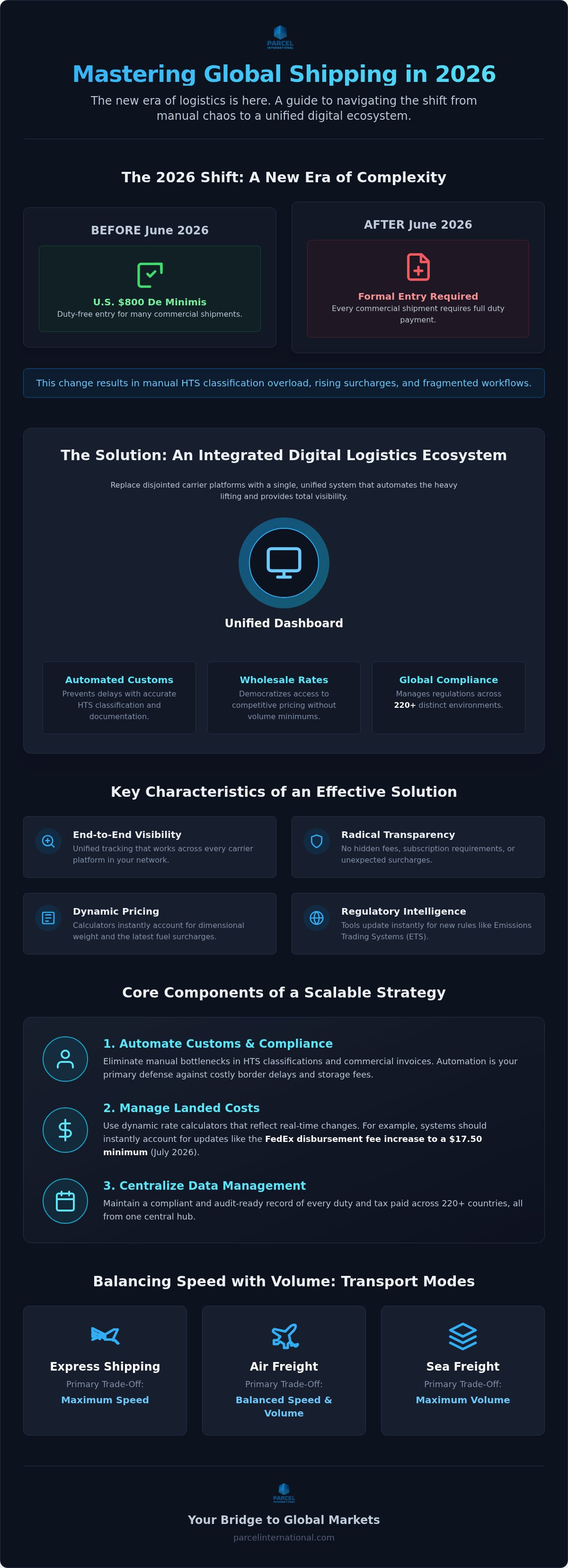
You don't have to manage this chaos manually. By adopting an integrated logistics strategy, you can replace disjointed carrier platforms with a unified system that handles the heavy lifting for you. This guide provides a comprehensive framework to master the complex logistics environment of 2026. We’ll show you how to access wholesale shipping rates, automate customs compliance to prevent delays, and gain total visibility through a single dashboard that grows alongside your business. It is time to move from fragmented workflows to a singular, efficient solution.
Table of Contents
What Defines Modern Global Shipping Solutions in 2026?
In 2026, the term global shipping solutions describes much more than just the physical movement of goods from point A to point B. It has evolved into an integrated digital logistics ecosystem where software and physical transport are inseparable. For a modern business, 'global' means the ability to navigate 220+ distinct regulatory environments simultaneously. You aren't just dealing with a carrier; you're managing a complex web of customs protocols, environmental levies, and changing tax laws. This complexity requires a shift from being a passive shipper to becoming an active optimizer of your own supply chain.
Relying on a single carrier is a strategic trap that limits your flexibility and exposes you to rigid pricing. The most resilient businesses now use logistics brokers to democratize their access to wholesale rates. Unlike traditional freight forwarders who might focus on a specific lane, a modern broker platform allows you to compare real-time data across multiple world-class carriers. This shift creates order out of what used to be a chaotic, manual process. It allows small-scale commercial projects to access the same efficiency as large-scale enterprises without the burden of volume minimums.
The Evolution of Cross-Border Trade
E-commerce has forced traditional logistics to become incredibly agile. The suspension of the U.S. de minimis exemption in 2025, which became permanent regulation in June 2026, fundamentally changed the speed of trade. Every package now requires formal entry. Because of this, manual shipping workflows have become a liability. Businesses that once spent hours on documentation are now turning to automation to handle 10-digit HTS classifications and full duty payments. If your workflow isn't automated, you're essentially choosing to be late. The current regulatory environment demands a move away from fragmented, multi-platform workflows toward a singular, unified solution.
Key Characteristics of an Effective Solution
An effective strategy for global shipping solutions in 2026 must prioritize radical transparency. You should be able to see a real-time rate comparison across multiple modes of transport, including express, air, and sea freight, without digging through fine print. Transparency isn't just about the price; it's about the absence of barriers. You need to know that your partner values your peace of mind over corporate jargon.
Look for these essential features in your logistics framework:
End-to-end visibility: Unified tracking that works across every carrier platform in your network.
No hidden fees: A business model that rejects subscription requirements or unexpected surcharges.
Dynamic pricing: Calculators that account for dimensional weight and the latest fuel surcharges automatically.
Regulatory intelligence: Tools that update instantly when new emissions trading systems, such as the UK ETS expected in July 2026, come into play.
The goal is relief. You want to move from a fragmented, high-anxiety workflow to a singular, unified solution that prioritizes security and punctuality.
Core Components of a Scalable Logistics Strategy
Building a scalable logistics strategy starts with eliminating manual bottlenecks. You cannot grow a global presence if your team spends hours typing out commercial invoices or researching 10-digit HTS classifications for every destination. High-performing global shipping solutions rely on automation to act as a primary defense against border delays. When every shipment requires formal entry, as mandated by the 2026 regulatory landscape, accuracy becomes your most valuable currency. A single error in a harmonized code can lead to a chain reaction of customs holds and unexpected storage fees.
Dynamic rate calculators are essential for managing total landed costs. These tools must account for dimensional weight and the specific surcharges that carriers frequently adjust. For instance, with FedEx increasing disbursement fees to a minimum of $17.50 starting July 20, 2026, you need a system that reflects these changes instantly. Centralized data management ensures that you aren't just shipping packages; you're maintaining a compliant record of every duty and tax paid across 220+ countries. This level of organization provides the relief of knowing your business is audit-ready at all times.
Automated Customs and Compliance
Procedural friction is the hidden cost of doing business with outdated methods. Automated tools generate accurate shipping documentation based on pre-set product data, which significantly reduces human error at the border. In 2026, where even small postal shipments require a customs bond and detailed electronic data sets, automation isn't a luxury. It's a necessity for staying compliant with shifting import duty policies. By digitizing your commercial invoices, you ensure that customs officials have the information they need before the shipment even arrives, facilitating a smoother clearance process.
Multi-Carrier Integration Benefits
Relying on a single carrier exposes your business to rigid pricing and service disruptions. A multi-carrier approach allows you to leverage the strengths of different providers for specific regions. For example, one carrier might offer superior rates for express shipping to the EU, while another excels at road freight in North America. Using a platform that allows you to compare international shipping rates across multiple carriers ensures you aren't overpaying for a specific region. This flexibility also protects your supply chain. If one carrier faces a regional disruption or a sudden fuel surcharge hike, you can shift to another without rebuilding your entire workflow.
Multi-modal flexibility is the final piece of the strategy. You should have the ability to switch between express, air, and sea freight based on the urgency and volume of the order. Moving to a unified dashboard provides the relief of knowing your logistics are optimized. You can access real-time broker rates and manage all transport modes from a single, transparent interface that scales as your order volume increases.
Comparing Transport Modes: Express, Air, Sea, and Road Freight
Selecting the right mode of transport is a fundamental part of the Core Components of a Scalable Logistics Strategy. Your choice depends on a balance between speed, volume, and total landed cost. In 2026, the most effective global shipping solutions don't rely on a single method. They utilize a multi-modal approach to pivot when market conditions shift. Whether you are moving small e-commerce parcels or industrial bulk cargo, understanding the nuances of each transport mode allows you to optimize your margins and meet customer expectations without fail.
When your cargo exceeds the limits of standard parcel networks, or involves complex international requirements, it is time to work with a freight forwarder. These specialists manage large-scale projects that require coordinated sea or air freight movements. By acting as a stable intermediary, a broker platform provides the relief of having a single point of contact for diverse shipping needs. This keeps your logistics orderly, even when navigating the new 2026 IMO fire safety regulations or mandatory reporting for lost containers at sea.
When to Choose Express Parcel Services
Express shipping remains the gold standard for time-sensitive B2C orders. It's best for shipments under 70kg that require door-to-door delivery within days. Fast shipping has a significant psychological impact on customer retention; buyers in 2026 expect speed as a baseline service. Small businesses can now access international parcel shipping discounts that were previously reserved for high-volume retailers. This democratizes the market, allowing you to compete globally without being penalized for lower volumes.
The Logistics of Bulk Cargo
For larger volumes, you must decide between Air Freight and Sea Freight. Sea freight is the most cost-effective for bulk, offering options like Less than Container Load (LCL) for smaller batches or Full Container Load (FCL) for maximum volume. However, you should use air freight strategically for high-value goods or items like lithium batteries, which now face stricter IMDG Code classifications as of 2026. Within the continent, road freight serves as the B2B backbone. You can optimize these routes by regularly checking international road freight rates Europe to ensure your intra-continental trade remains profitable despite new UK and EU emissions trading costs.
How to Evaluate a Global Shipping Provider
Choosing a partner for your global shipping solutions requires more than just comparing base rates. You need a provider that acts as an optimizer, taking a chaotic logistics chain and making it orderly. The right platform shouldn't just offer a way to move boxes; it should provide a stable bridge to 220+ countries with radical transparency. If a provider hides their terms in fine print or forces you into rigid subscription tiers, they aren't a partner. They are a bottleneck. Evaluate potential providers based on their ability to remove barriers rather than create them.
Support quality is another critical factor. While many platforms rely on automated chatbots to handle inquiries, global trade in 2026 is too complex for generic AI responses. When a shipment is held at a border due to a discrepancy in a customs bond, you need human expertise and a dedicated nature from your support team. A provider with deep industry heritage, like those rooted in major trade hubs like Rotterdam, understands the high stakes of international commerce and prioritizes your peace of mind over corporate jargon.
The 'Hidden Cost' Checklist
Low headline rates often mask expensive administrative failures. To find the true cost of a provider, you must look for what they don't charge. A transparent provider will not hit you with subscription fees or volume minimums. Instead, they provide access to wholesale rates regardless of your size. Before signing up, check for these common add-ons:
Variable fuel surcharges that aren't updated in real-time.
Remote area fees that trigger without warning during the checkout process.
Residential delivery surcharges for B2C shipments.
Administrative fees for filing basic customs documentation.
The most efficient platforms bundle customs support directly into the transaction, stripping away the anxiety of unexpected fees after the package has left your warehouse.
Scalability for Growing Businesses
Your logistics partner must be inclusive and adaptable. A provider that works for you when you ship ten parcels a month should be just as effective when you jump to 1,000. This requires a platform that talks to your existing e-commerce stack, ensuring that data flows seamlessly from your shop to the carrier. Evaluating the importance of international shipping for ecommerce flexibility is vital for long-term success. You need the ability to switch between Express, Air, and Sea freight as your inventory needs change without having to manage ten different carrier accounts.
If you're ready to move from fragmented, multi-platform workflows to a singular, unified solution, it's time to work with a partner who values transparency. You can compare real-time rates and start shipping today without any hidden requirements or restrictive terms.
Parcel International: Your Bridge to Global Markets
Managing international logistics doesn't have to be a source of constant friction. Our platform provides the global shipping solutions you need to scale without the typical administrative burden. Based in Rotterdam, one of the world's most significant trade hubs, we leverage a deep industry heritage to guide your business through 220+ countries. We act as a stable intermediary, creating order out of the chaotic process of comparing rates and managing multiple carrier platforms. You don't have to deal with the anxiety of fragmented workflows when you have a single, unified dashboard at your fingertips.
Our platform is designed to be an optimizer for your business. We've built automated tools that simplify international shipping customs documentation, ensuring your commercial invoices meet every 2026 regulatory standard. By removing traditional barriers like subscription fees or volume minimums, we offer an egalitarian solution for both small-scale projects and large commercial enterprises. You gain the relief of moving to a system that prioritizes radical transparency and punctuality over corporate jargon.
The Parcel International Difference
Experience matters in a volatile global market. Since our founding in 2007, we've developed direct partnerships with industry leaders like DHL, FedEx, and UPS. This allows you to access wholesale shipping rates through a single interface without the need for multiple carrier accounts. Our support capabilities go beyond standard industry benchmarks. When you face a delay or a complex regulatory hurdle, you have access to personalized human expertise rather than a generic chatbot. We are a protective and dedicated ally, committed to ensuring your goods move across borders without unnecessary procedural friction.
Get Started in Minutes
You can move from inquiry to action almost immediately. Our system follows a logical, sequential flow that mirrors the efficiency of the services we provide. Integration is straightforward; our tools fit into your existing business workflow to automate time-consuming tasks like rate comparison and tracking. You don't have to worry about hidden requirements or restrictive terms. We believe in a philosophy of radical transparency where the absence of fees and restrictions is a central pillar of our identity.
It's time to replace your fragmented logistics with a reliable bridge to the world. Register for free and start comparing global shipping rates today to see how we can help your business master the complexities of cross-border commerce.
Secure Your Global Growth in 2026
Mastering the complexities of 2026 logistics is no longer about managing individual carriers; it's about mastering data and automation. You've learned how automated customs documentation acts as a vital shield against border delays and how multi-modal flexibility ensures your business remains resilient during regional disruptions. Moving from fragmented, manual workflows to a singular, unified platform provides the relief you need to focus on expansion instead of paperwork. By integrating these global shipping solutions into your daily operations, you transform a chaotic cost center into a streamlined competitive advantage.
Parcel International has been a trusted logistics partner since 2007, providing the stable bridge your business needs to reach 220+ territories with confidence. You don't have to navigate shifting surcharges or complex HTS classifications alone. Access wholesale rates from industry leaders like DHL, FedEx, and UPS while leveraging our built-in automated tools to ensure compliance. It's time to experience the peace of mind that comes with radical transparency and professional, human-led support. Compare global shipping rates and book your first shipment for free. Your international expansion is within reach, and we're ready to help you simplify the journey.
Frequently Asked Questions
What are the most common global shipping solutions for small businesses?
Small businesses typically rely on express shipping for time-sensitive parcels and road freight for intra-continental trade. These global shipping solutions work best when accessed through a broker that removes volume minimums. This allows you to scale from a few shipments to hundreds without the burden of high retail rates or complex contracts. You get the same efficiency as large enterprises without the typical barriers to entry.
How do I find the best international shipping rates in 2026?
The most effective way to find competitive rates is through real-time comparison tools that aggregate data from multiple world-class carriers. In 2026, rates must account for new emissions trading costs and updated disbursement fees. A broker platform automates this search, ensuring you always select the most cost-effective option for your specific destination and weight without digging through individual carrier websites.
Can I use multiple carriers through a single shipping platform?
You can manage all your international logistics through a single, unified dashboard. This approach provides relief from the inefficiency of logging into multiple carrier sites. It allows you to pivot between providers based on regional performance or price changes, ensuring your supply chain remains resilient against local disruptions or carrier-specific surcharges. It's an orderly way to manage a complex global network.
What documents are required for international shipping to 220 countries?
Required documentation includes a commercial invoice, a packing list, and often a customs bond for formal entry. Since the permanent suspension of the U.S. de minimis exemption in June 2026, all commercial shipments require a 10-digit HTS classification. Automated tools can generate these documents for 220+ territories, preventing the procedural friction that often leads to unexpected border delays and storage fees.
Is express shipping always faster than air freight for small parcels?
Express shipping is almost always faster for small parcels under 70kg because it utilizes an integrated door-to-door network. While air freight is efficient for bulk cargo, it often involves separate airport handling and third-party trucking. Express services include customs support and final-mile delivery in one seamless process, making it the gold standard for time-critical e-commerce orders that require speed and punctuality.
How does automated customs documentation reduce shipping delays?
Automation reduces delays by ensuring every data field is accurate and compliant before the package reaches the border. It eliminates human error in HTS coding and duty calculations. By providing officials with a complete electronic data set in advance, you avoid the manual inspections and administrative failures that often plague fragmented shipping workflows. This creates a smoother path for your goods to clear customs.
Are there hidden fees when using a logistics aggregator?
Transparent global shipping solutions do not include hidden fees or mandatory subscription costs. You should look for a provider that highlights the absence of barriers, such as volume minimums or registration charges. The only costs you encounter should be the transparently calculated shipping rates, which already incorporate 2026 fuel surcharges and the Inbound Processing Fees that apply to all EU member states.
How do I track international shipments across different carriers?
You can track every shipment from a centralized interface that pulls data from all participating carriers. This unified tracking provides end-to-end visibility regardless of whether you're using express, air, or sea freight. It replaces the anxiety of fragmented tracking with a single source of truth, ensuring you and your customers always know the exact status of an order without checking multiple platforms.


Comments