
Cheapest Shipping Rates 2026: The Ultimate Resource for Global Delivery
- Alex
- May 28
- 12 min read
Did you know that surcharges now account for roughly 33% of the average package cost in 2026? With major carrier rates climbing and general rate increases reaching 5.9%, finding the cheapest shipping rates requires more than a surface-level search. You've likely felt the frustration of unpredictable fees and the exhaustion of manually comparing carrier quotes while complex customs paperwork stalls your growth. It's a chaotic process that drains both your budget and your patience. By the time you factor in dimensional weight adjustments and new international duties, the "cheap" option you started with often becomes a financial burden.
We're here to change that. Discover how to unlock pre-negotiated wholesale discounts and eliminate the hidden logistics costs that typically go unnoticed. By moving from fragmented workflows to a unified solution, you can secure the best possible rates for your business this year. This resource provides a clear roadmap to mastering dimensional weight optimization, managing the total suspension of de minimis exemptions, and using automated customs tools to ensure your global deliveries arrive on time. Stop overpaying for shipping and start optimizing your logistics for maximum efficiency and speed.
Key Takeaways
Shift your focus from sticker prices to Total Landed Cost to account for the duties and taxes that impact your bottom line.
Optimize your packaging dimensions and consolidate volume to unlock the cheapest shipping rates available on the market today.
Pinpoint the regional "sweet spots" for major carriers to ensure your international shipments are handled by the most cost-effective provider.
Eliminate the risk of surprise surcharges and customs delays by adopting automated compliance tools that handle the heavy lifting for you.
Leverage pre-negotiated wholesale rates for 220 countries to scale your global delivery without the burden of subscription fees or volume minimums.
Table of Contents
What Defines the Cheapest Shipping Rates in 2026?
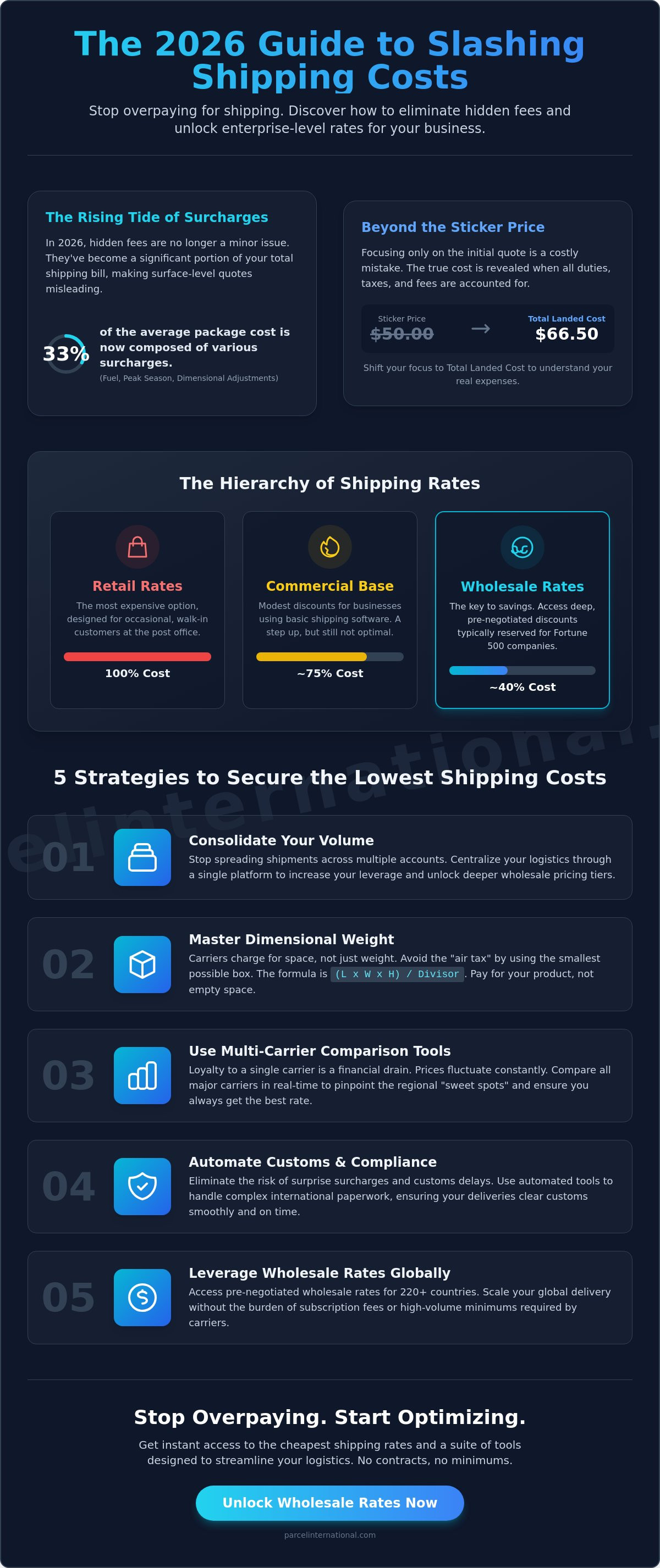
In the current logistics climate, the lowest sticker price rarely translates to the lowest final bill. To secure the cheapest shipping rates, you must shift your focus toward the Total Landed Cost. This metric includes the base freight charge plus duties, taxes, and the complex web of surcharges that now account for roughly 33% of average package costs. If you only look at the initial quote, you'll likely be blindsided by fuel adjustments or the 2026 peak season surcharges that major carriers have integrated into their standard pricing models. Relying on a surface level estimate is a risk that most growing businesses can't afford.
Retail rates at a standard post office are officially the most expensive way to move goods. These prices are designed for occasional consumers who value convenience over cost-efficiency. While the history of postal services reflects a move toward universal access, the modern commercial reality is that walk-in customers pay a significant premium. For businesses, the key to 2026 savings lies in wholesale brokerage. This model strips away the retail markup by aggregating the volume of thousands of shippers to command deep discounts from global carriers that would otherwise be out of reach.
Retail vs. Commercial Base vs. Wholesale Rates
The hierarchy of shipping prices starts at the retail counter, where you pay the maximum allowed rate. One step down is Commercial Base pricing, which offers modest discounts for businesses using basic shipping software. However, the true advantage is found in wholesale rates. Wholesale rates are the prices typically reserved for Fortune 500 companies but accessible via platforms that act as high-volume intermediaries. By using a wholesale broker, you bypass the need for individual contract negotiations and high-volume minimums. This egalitarian approach allows small and medium enterprises to access the same pricing tiers as global conglomerates, effectively leveling the playing field for international trade without the burden of restrictive contracts.
The Impact of 2026 Global Logistics Trends
Several shifts are currently redefining what "cheap" looks like in the logistics sector. New green shipping initiatives have introduced carbon-offset fees that fluctuate based on the mode of transport. While these initiatives might slightly increase base rates, they often lead to long-term stability by avoiding regulatory fines. We're also seeing a massive transition toward digital-first logistics platforms. These systems prioritize data transparency over everything else. In 2026, transparency is more valuable than a low initial quote; knowing exactly when a package will clear customs or how much a fuel surcharge will cost next week prevents the "surprise" fees that ruin profit margins. Relying on a platform that offers Customs Support and Express Shipping through a single interface ensures you don't lose your savings to administrative errors or paperwork delays.
5 Strategies to Secure the Lowest Shipping Costs
Securing the cheapest shipping rates isn't about luck; it's about strategy. Small businesses often act like retail customers, but you can act like a high-volume enterprise by following five core principles. First, stop spreading your shipments across multiple accounts. Consolidate your volume through a single platform to increase your leverage. This move alone often unlocks deeper tiers of wholesale pricing that are otherwise inaccessible to individual small shippers. By centralizing your logistics, you create a stronger bargaining position without needing to hit massive volume minimums yourself.
Mastering Dimensional Weight Optimization
Carrier pricing in 2026 relies heavily on the physical space a package occupies rather than just its weight. The formula is simple: multiply length, width, and height, then divide by a set divisor. If this number is higher than the actual weight, you pay the higher price. Choose the smallest possible box for every item to avoid this "air tax." You should use cheap parcel shipping strategies to audit your current packaging standards. Eliminating just two inches from a box's width can often drop a shipment into a lower pricing bracket instantly.
Leveraging Multi-Carrier Comparison Tools
Loyalty to a single carrier is a common financial drain. Prices fluctuate based on fuel surcharges, regional demand, and seasonal adjustments. Use a shipping calculator to compare live rates from DHL, FedEx, and UPS side by side. This allows you to find the daily winner for every specific route. For e-commerce, balancing speed and price is vital. Sometimes a slower road freight option offers the best value, while other times an express shipping service is cheaper due to specific regional discounts or promotional contract rates.
Automate your documentation to prevent secondary handling fees. Incomplete paperwork is a primary cause of storage charges and return-to-sender costs. Refer to the U.S. Customs and Border Protection guidelines to understand how duties are assessed on internet purchases. By integrating automated customs tools, you ensure every form is compliant before the package even leaves your facility. This proactive approach eliminates the friction that typically leads to expensive delays while maintaining the cheapest shipping rates for your international orders.
Finally, leverage zone-skipping for high-frequency destinations. Instead of shipping individual parcels across the country, move a large consolidated shipment via air freight or road freight to a regional hub closer to the final destination. This strategy bypasses several transit zones and significantly lowers the per-package cost. Always check real-time rates for every individual shipment. The carrier that was cheapest yesterday might not be today. If you want to see these savings in action, get an instant quote to compare your current costs against wholesale rates.
Carrier Comparison: DHL, FedEx, UPS, and Postal Services
To find the cheapest shipping rates, you must exploit regional carrier strengths. DHL remains a powerhouse for lanes into Europe and Asia due to their deep local infrastructure. Meanwhile, FedEx and UPS provide highly competitive rates for trans-Atlantic and intra-North American routes when accessed through wholesale platforms. While national postal services often offer the lowest entry price for lightweight items under 4 lbs, they frequently fall short on tracking and reliability. These agencies operate under Universal Postal Union regulations, which focus on mail exchange rather than the high-speed logistics required for modern commerce. By 2026, private couriers have solidified their service level guarantees, providing a more stable foundation for businesses that cannot afford delivery delays.
When to Choose Express vs. Economy
Balancing speed with margin is a delicate task. While international parcel shipping rates vary based on urgency, the long-term cost of slow delivery often negates the initial savings. Economy options that take 7 to 10 days frequently lead to a surge in customer support inquiries and a higher risk of lost inventory. If your brand relies on customer loyalty, the slightly higher investment in a 2-day express service often proves more cost-effective. It eliminates the administrative burden of tracking down stalled shipments and ensures your brand remains competitive in an era of instant gratification.
Freight Thresholds: When Parcel is No Longer Cheapest
There comes a point where shipping individual packages is no longer financially viable. Once a shipment exceeds 150 lbs, a freight forwarder typically becomes the more economical choice. For shipments that aren't large enough for a full container, Less than Container Load (LCL) is the ideal budget-friendly alternative. This method allows you to share container space, significantly reducing the cost of sea freight or air freight. The pivot point between express parcel and air freight occurs when your total volume makes the per-pound rate of a dedicated cargo plane lower than the per-package rate of a courier. Identifying this threshold ensures you maintain the cheapest shipping rates as your business scales and shipment sizes increase.
Avoiding Hidden Costs: Customs, Duties, and Surcharges
Don't let a low base rate fool you. The quest for the cheapest shipping rates often ends abruptly when surcharges hit the final invoice. Residential delivery, fuel adjustments, and remote area fees are standard practice for major carriers in 2026. If you're shipping to a home address, expect to pay around $6.50 extra per package based on current industry standards. These aren't just minor additions; they're structural parts of the carrier's profit model. To maintain transparency, always select DDP (Delivered Duty Paid) over DAP (Delivered At Place). DDP ensures you or your customer pays all duties upfront, preventing the "surprise" collection fees that lead to refused packages and expensive return-to-sender loops.
The Real Cost of Customs Delays
A simple $20 shipment can quickly turn into a $100 nightmare if your paperwork is even slightly off. When customs officials find errors, they don't just wait; they move the package to bonded storage, where daily fees accumulate. Incorrect commercial invoices are the primary culprit for these delays. By using automated commercial invoice generation, you remove the human error that triggers these inspections. For a step-by-step breakdown of the necessary documents, consult our how to ship international guide. Automation isn't just a convenience; it's a financial firewall against administrative penalties.
Standardizing Surcharge Audits
Reading a shipping quote requires a skeptical eye. Look past the bolded total and scan for line items like "Address Correction" or "Peak Season Surcharge." In 2026, fuel price volatility remains a significant factor, with surcharges fluctuating weekly. You can't control the price of oil, but you can control your data. Standardizing your address database through an automated platform prevents the common fees associated with minor typos in zip codes or street names. Audit every invoice to ensure the carrier hasn't applied a residential surcharge to a commercial address. This level of scrutiny ensures you actually pay the cheapest shipping rates you were promised.
If you're tired of deciphering complex bills, access our Customs Support tools to ensure your rates stay predictable and your shipments stay on track.
Maximizing Savings with Parcel International
Securing the cheapest shipping rates shouldn't require a background in logistics or hours of manual research. At Parcel International, we've designed a system that replaces fragmented, multi-platform workflows with a single, efficient solution. You get immediate access to pre-negotiated wholesale rates for more than 220 countries without the usual corporate hurdles. We don't believe in subscription fees or volume commitments. Our model is built on egalitarian access; whether you're shipping one parcel or a full container, you receive top-tier discounts from the start. By offering Express Shipping, Sea Freight, Air Freight, and Road Freight in one place, we give you the flexibility to choose the right mode of transport for every budget and timeline.
The Logistics Broker Advantage
Our platform serves as a reliable bridge in a volatile global market. We understand the anxiety that comes with high-stakes international delivery, which is why we prioritize radical transparency in our terms. Our platform simplifies international shipping for ecommerce for growing brands by stripping away the procedural friction of customs and carrier negotiations. You're never alone in the process. Our dedicated Customs Support and logistics experts are available to guide you through complex routes, ensuring your goods move across borders without the typical delays caused by administrative errors. Instead of dealing with the automated phone trees of massive carriers, you have a partner dedicated to your peace of mind.
Getting Started: Your First Quote
Getting your first quote takes less than a minute. Simply enter your shipment details into our real-time comparison tool to see the cheapest shipping rates currently available. The results are ranked by value and speed, allowing you to make data-driven decisions instantly. Once you've selected a rate, our automated tools handle the commercial invoices and compliance checks for you. This integration into your existing workflow reduces the risk of human error and keeps your operations lean. It's time to stop wasting time on carrier websites and start optimizing your bottom line. Compare current shipping rates now and experience the relief of a truly unified shipping platform.
Secure Your Competitive Edge in Global Logistics
Success in 2026 requires moving beyond the hunt for the lowest sticker price. You now understand that the cheapest shipping rates are achieved through a combination of wholesale access, dimensional weight optimization, and automated customs compliance. By focusing on the total landed cost and eliminating the administrative friction of manual carrier checks, you protect your margins and your customers' experience. It's time to replace fragmented, multi-platform workflows with a singular, transparent solution that grows with your business.
We've built a system that removes the traditional barriers to entry. Trusted by businesses shipping to 220+ countries, our platform provides real-time rates from DHL, FedEx, and UPS with zero subscription fees or hidden markups. You don't have to navigate complex logistics alone anymore. Take control of your delivery strategy and start saving on every shipment, regardless of its size or destination. Start comparing the cheapest shipping rates for your business today. Your journey toward simpler, more cost-effective global shipping starts right here.
Frequently Asked Questions
How do I find the cheapest international shipping rates for my small business?
You find the cheapest shipping rates by using a wholesale broker platform that aggregates the volume of thousands of shippers to unlock Tier 1 pricing. This method allows you to bypass expensive retail counters and access the same deep discounts usually reserved for high-volume corporations. Instead of manually checking individual carrier websites, a unified dashboard lets you compare Express Shipping and Air Freight options side by side in seconds.
Why are shipping rates so high in 2026?
Rates are elevated in 2026 due to cumulative General Rate Increases of roughly 5.9% across major carriers and the total suspension of de minimis exemptions. These regulatory changes mean all imports are now subject to duties and taxes regardless of value. Additionally, surcharges for fuel and residential delivery now account for approximately 33% of total package costs, making it harder to find low-cost options without a strategic approach.
Is it cheaper to ship with USPS or a private carrier like DHL?
USPS remains the most economical choice for lightweight parcels under 4 lbs, but private carriers like DHL offer superior value for heavier or time-sensitive commercial shipments. While USPS implemented a 6.6% increase for Priority Mail in early 2026, private couriers provide more robust tracking and faster customs clearance. For business growth, the reliability of a private carrier often outweighs the small initial savings of postal services.
What is the cheapest way to ship heavy items internationally?
Sea Freight is the most cost-effective method for shipping heavy or bulky items that aren't time-sensitive. If your shipment doesn't fill a whole container, Less than Container Load (LCL) options allow you to pay only for the space you occupy. For heavy items that require faster transit, Air Freight through a consolidated platform often provides a lower per-pound cost than standard parcel services once you cross specific weight thresholds.
Do I need a high shipping volume to get discounted rates?
You don't need high individual volume to access significant discounts when you ship through a logistics intermediary. These platforms negotiate wholesale contracts based on their total network volume and pass those savings directly to you. This model eliminates the need for subscription fees or minimum monthly spends, allowing startup brands to access the cheapest shipping rates without any long-term commitments or hidden requirements.
How can I avoid hidden surcharges on my shipping bill?
Avoiding hidden surcharges requires a proactive audit of your shipping data before you print a label. Most surprise fees are triggered by address correction penalties, residential delivery markups, or oversized package surcharges. By using automated address validation and optimizing your box dimensions to stay under dimensional weight thresholds, you can ensure your final invoice matches your initial quote exactly.
What is the difference between DDP and DAP shipping rates?
DDP (Delivered Duty Paid) means the shipper pays all duties and taxes upfront, while DAP (Delivered At Place) requires the recipient to pay those costs upon arrival. DDP is generally the better choice for business transparency because it prevents your customers from being hit with unexpected fees at the door. This approach reduces the likelihood of refused packages and the expensive return-to-sender costs that follow.
Can automated customs paperwork actually save me money?
Automated customs paperwork saves money by preventing expensive storage fees and administrative fines caused by human error. When commercial invoices are incomplete or inaccurate, packages are held in bonded warehouses where daily storage charges can quickly exceed the original shipping cost. Automation ensures that all documentation and harmonized codes are compliant from the start, allowing your shipments to clear borders without friction.


Comments