
Cross-Border Shipping Solutions: The 2026 Guide to Global Delivery
- Alex
- Jun 1
- 11 min read
Since the European Union eliminated the €150 de minimis threshold on July 1, 2026, every single international parcel now triggers mandatory customs duties, making efficient cross-border shipping solutions more critical than ever. It's a massive shift that makes unpredictable costs and hidden surcharges feel like an unavoidable tax on your business growth. You're likely tired of the friction caused by ever-changing documentation requirements and the total lack of real-time visibility into where your cargo actually sits.
You don't have to settle for fragmented workflows or the recent surge in global carrier rates. This guide will show you how to master international logistics by prioritizing platform-based comparison over traditional carrier loyalty. We'll explore how to automate your compliance for Express, Sea, Air, and Road Freight, providing you with a simplified workflow that secures wholesale rates and eliminates delivery delays. By the end of this article, you'll have a clear roadmap to turn 2026's regulatory hurdles into a streamlined, digital advantage for your global supply chain.
Key Takeaways
Understand the 2026 landscape by transitioning from fragmented mailing methods to integrated, tech-driven global logistics.
Learn how logistics brokers aggregate shipping volume to secure wholesale discounts that are typically unavailable to individual shippers.
Evaluate the trade-offs between Express, Sea, Air, and Road Freight to select the most efficient transport mode for your specific budget.
Prevent costly customs delays by mastering the digital document stack required for modern international compliance.
Implement professional cross-border shipping solutions to access real-time rates for over 220 territories through a single, unified platform.
Table of Contents
What are Cross-Border Shipping Solutions? Defining the 2026 Landscape
At its core, cross-border shipping is the physical movement of goods between different sovereign territories. While simple in theory, the 2026 environment has transformed this process from a basic postal task into a sophisticated data-management challenge. Historically, businesses relied on traditional post-office mailing for international reach. Today, that model is obsolete. Modern cross-border shipping solutions now function as integrated, tech-driven ecosystems that manage everything from individual e-commerce parcels to heavy industrial freight.
The global market has moved past the era of "speed at all costs." High-speed delivery matters, but in 2026, predictable delivery is the new gold standard. With the recent removal of de minimis thresholds in the EU and the suspension of exemptions in the US, every shipment faces intense regulatory scrutiny. Success in International trade now depends on your ability to provide transparent data before a package even leaves your dock. Digital platforms bridge the gap between local businesses and global markets by centralizing this data, ensuring that a business in one corner of the world can operate with the same efficiency as a local competitor.
The Core Pillars of International Logistics
Efficient global delivery rests on three foundations. First is transportation; you must select the right mode, whether it's the urgency of Express Shipping or the high-capacity volume of Sea Freight. Second is compliance. You can't ignore the legalities of different customs jurisdictions; failing to provide the right documentation leads to immediate delays. Finally, technology acts as the glue. Using automated tracking and digital documentation allows you to manage the journey without manual intervention, turning a chaotic process into an orderly workflow.
Why Businesses are Expanding Globally in 2026
Expansion isn't just about growth; it's about resilience. By accessing new customer bases in emerging markets, companies reduce their dependence on a single economy. Diversifying supply chains through Road Freight or Air Freight also helps mitigate regional risks like strikes or local port congestion. In 2026, offering international delivery is a competitive necessity. If you don't reach those customers, your competitors will. Modern cross-border shipping solutions make this expansion accessible to businesses of all sizes by removing traditional barriers like high volume requirements or complex subscription fees.
The Global Logistics Ecosystem: Carriers vs. Brokers
The global logistics network functions through two primary entities: the physical carrier and the logistics broker. Physical carriers are the movers. They own the planes, ships, and trucks that transport your goods across continents. In contrast, a logistics broker acts as the optimizer. They don't own the vehicles but instead orchestrate the movement. While some asset-based companies argue that owning the fleet is the only way to ensure reliability, this perspective ignores the rigid limitations of a single-carrier network. Relying on one carrier's capacity often leads to higher costs and restricted options when routes become congested.
Many businesses wonder how brokers offer lower rates than the carriers themselves. It's a simple matter of volume aggregation. Brokers like Parcel International pool the shipping needs of thousands of smaller businesses to reach massive volume thresholds. This allows them to secure wholesale discounts usually reserved for Fortune 500 companies. By using professional cross-border shipping solutions, you gain immediate access to these rates without needing a high-volume contract of your own. It's a model that prioritizes your bottom line over carrier brand loyalty.
Managing DHL, FedEx, and UPS through a single dashboard provides a "single pane of glass" view of your operations. Carrier loyalty often costs more than it saves. When you compare platforms instead of sticking to one brand, you can choose the best carrier for each specific lane based on real-time performance and price. This transparency is a core pillar of the WTO Trade Facilitation Agreement, which aims to simplify and standardize international trade procedures to lower global costs. If you want to optimize your current spend, you can compare shipping rates online to see the difference immediately.
The Value of a Logistics Broker
A broker provides more than just a lower price tag. They offer simplified billing by consolidating multiple carrier invoices into one clear statement. This reduces administrative friction and eliminates the need to manage several different accounts. You also benefit from expert guidance. Instead of guessing which service works best for a new market, you can rely on data-driven recommendations to select the most reliable lanes for your budget.
Understanding the Role of a Freight Forwarder
Your logistics needs change as your business grows. When a shipment exceeds standard parcel weight or dimensions, it moves into the "freight" category. This is where a freight forwarder becomes essential. They manage multi-modal journeys, coordinating transitions between Sea Freight and Road Freight. Unlike express parcel services that handle door-to-door small items, freight forwarders specialize in large-scale cargo moves that require complex coordination across international borders. Using integrated cross-border shipping solutions ensures that whether you are sending a single envelope or a full container, the process remains seamless and visible.
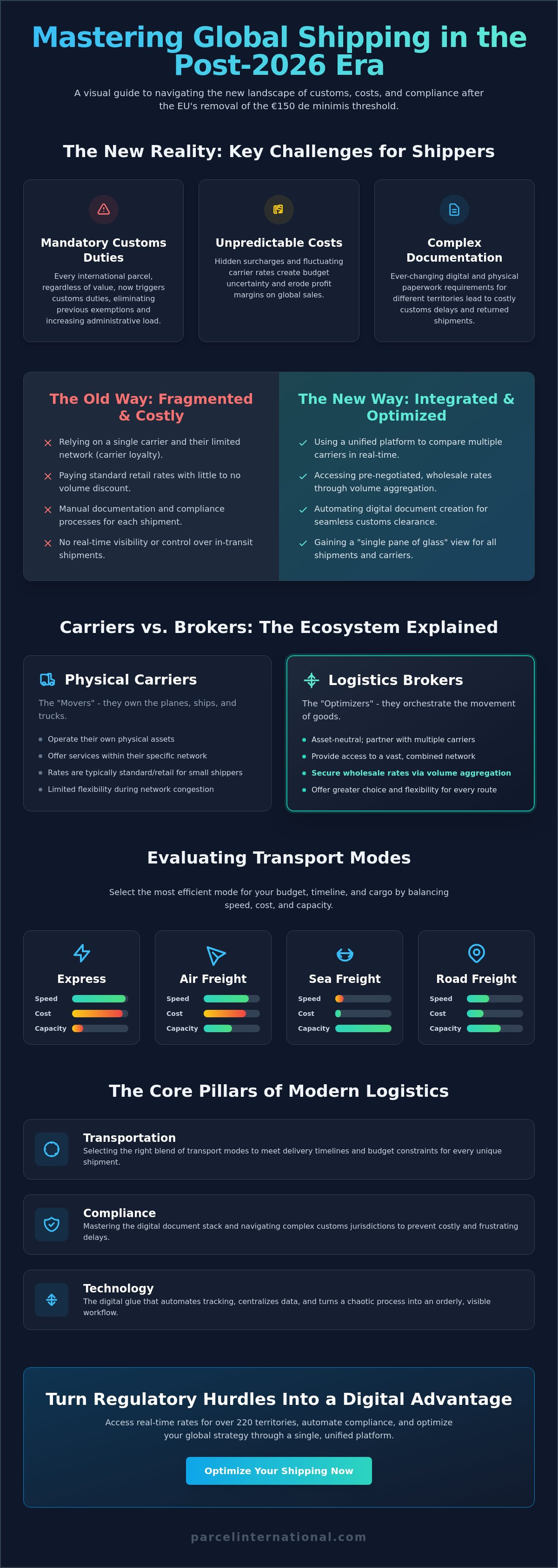
Evaluating Transport Modes: Speed, Cost, and Capacity
Selecting the right mode of transport is a strategic decision based on four critical variables: urgency, budget, cargo weight, and fragility. In 2026, the instant gratification economy has made Express Shipping the default for high-value e-commerce. However, it isn't always the most efficient choice for every business model. Integrating diverse cross-border shipping solutions allows you to pivot between modes as your inventory needs fluctuate. This flexibility prevents you from being locked into expensive contracts when a more cost-effective route is available.
Hybrid models, particularly air-sea solutions, have gained traction as a middle ground for global trade. These models allow you to move goods by sea for the longest leg of the journey and then switch to air for final distribution. This approach balances cost-efficiency with acceptable lead times, ensuring you don't overpay for speed that isn't strictly necessary. This level of adaptability is essential for maintaining a competitive edge in a volatile global market where shipping lanes can shift overnight.
Air Freight vs. Sea Freight
The choice between air and sea often depends on the specific trade-off between time and volume. Air Freight is the premier option for high-value, time-sensitive goods, typically reaching its destination within 2 to 5 days. It offers the highest level of security and the lowest risk of damage for fragile items. Conversely, Sea Freight remains the cost-effective choice for bulk commodities, though it requires longer lead times of 20 to 45 days. According to the international logistics guide, sustainability has become a major factor in 2026. Choosing the "greener route" often means opting for sea transport or newer, carbon-optimized air routes to meet corporate environmental goals without sacrificing reliability.
The Critical Role of Road Freight
Within the European market, Road Freight serves as the vital backbone for trade. For Rotterdam-based exporters, understanding international road freight rates Europe is crucial for maintaining margins on continental shipments. Road networks offer unmatched flexibility for last-mile delivery across borders, often acting as the final link in a multi-modal chain. You should also distinguish between LTL (Less-than-Truckload) and FTL (Full Truckload) options. LTL allows you to pay only for the space you use, which is ideal for smaller, frequent shipments. FTL is better suited for large, dedicated cargo moves that require maximum speed and minimal handling. By leveraging these diverse cross-border shipping solutions, you ensure your goods arrive on time regardless of geographical barriers.
Navigating Customs and Compliance in a Digital Era
Incorrect or incomplete documentation remains the single most common cause of international delivery delays. When a shipment hits a border without the proper paperwork, the physical movement stops, but the costs continue to mount. To maintain a fluid supply chain, you must master the essential document stack. This includes the Commercial Invoice, which acts as the primary record for customs valuation; the Packing List, detailing the physical contents; and the Certificate of Origin, which determines eligibility for specific trade agreements. Each document must be precise to prevent your cargo from being flagged for manual inspection.
The 2026 landscape has introduced sophisticated AI tools that have revolutionized HS Code classification. These systems autonomously assign the correct tariff codes to your products, significantly reducing the risk of human error that leads to fines or seizures. This shift toward "Paperless Trade" means that customs clearance is now a digital-first process. By integrating these automated cross-border shipping solutions, you remove the administrative friction that once defined international trade. You can move goods with the confidence that your data is accurate and your compliance is secure, allowing you to focus on growth rather than paperwork.
Managing Duties and Taxes
One of the most important decisions you'll make is choosing between DDU (Delivered Duty Unpaid) and DDP (Delivered Duty Paid). While DDU might seem simpler initially, DDP is generally superior for customer retention because it ensures the recipient isn't hit with unexpected fees upon delivery. To avoid pricing surprises, use an international shipping calculator to estimate the total landed cost. This tool allows you to account for regional VAT and GST variations before you finalize a shipment, keeping your margins transparent and your customers satisfied.
Staying Ahead of Regulatory Changes
The global trade environment is increasingly volatile, making it essential to monitor freight rates news for the latest tariff updates and regulatory shifts. Proactive monitoring helps you adjust your strategy before costs spiral. You should also prioritize cargo insurance to protect your investment from unforeseen disruptions. Avoiding common pitfalls like "demurrage"-fees charged for cargo left at a terminal too long-requires precise timing and clear communication with your logistics partner. If you want to streamline your international compliance and avoid these hidden costs, you can access professional customs support to manage the entire process for you.
Optimising Your Global Strategy with Parcel International
Parcel International simplifies the transition from local business to global player by removing the procedural friction typically found in international logistics. We provide instant access to real-time rates for over 220 countries and territories, ensuring you never have to guess your shipping costs again. Instead of juggling separate accounts for different carriers, you can manage Express Shipping, Air Freight, Sea Freight, and Road Freight from a single, unified dashboard. This optimizer approach takes a chaotic process and makes it orderly, allowing you to focus on your product rather than the complexities of the journey.
Our platform removes the traditional barriers that often hinder growth. You won't find any subscription fees or volume minimums here; we believe professional cross-border shipping solutions should be accessible to everyone, from small-scale startups to large commercial projects. By leveraging automated documentation, we ensure your shipments meet 2026 compliance standards without the need for manual data entry. It's a reliable bridge in a complex global market that values your peace of mind and your bottom line.
The Rotterdam Gateway
Strategically located at the heart of global trade, international freight forwarding Rotterdam acts as a powerful hub for your exports. We combine local Dutch expertise with a massive global carrier network, giving you a distinct advantage when shipping through Europe’s largest port. This gateway provides the infrastructure needed to handle diverse cargo types while maintaining the speed and punctuality your customers expect. Using cross-border shipping solutions through this hub ensures your goods enter the global stream through the most efficient channels available.
Your First Step to Global Expansion
Scaling your business doesn't have to be a high-stakes gamble. You can move from sending one parcel a month to managing full-scale container projects with ease on our platform. Getting started is a straightforward process designed for speed:
Enter your shipment details and destination to see real-time price comparisons.
Select the service that fits your specific budget and speed requirements.
Generate your automated customs documents and book your pickup instantly.
Ready to eliminate procedural friction and hidden costs? Compare rates and start shipping globally today with Parcel International.
Future-Proof Your Global Logistics Strategy
The 2026 shipping landscape demands a shift from traditional brand loyalty to data-driven decision making. You've seen how integrating diverse transport modes and mastering digital compliance can transform your supply chain from a source of anxiety into a competitive advantage. Success no longer depends on the size of your fleet, but on your ability to access the right information at the exact moment you need it. By moving away from fragmented workflows, you eliminate the hidden costs and procedural friction that stall international growth.
Implementing professional cross-border shipping solutions shouldn't be a complex burden for your team. You deserve a partner that provides radical transparency and immediate scalability without restrictive terms. Parcel International offers real-time rates from industry leaders like DHL, FedEx, and UPS, supported by automated customs documentation to keep your deliveries on schedule. There are no monthly subscription fees or volume commitments to hold you back. It's time to simplify your operations and reach new markets with confidence.
Compare rates and start shipping globally today with Parcel International
Frequently Asked Questions
What is the most cost-effective way to ship internationally in 2026?
The most cost-effective method depends on your specific volume and urgency, but utilizing Sea Freight for bulk shipments remains the gold standard for savings. In 2026, using a digital comparison platform to access wholesale rates is the best way to avoid the general rate increases implemented by major carriers. This approach allows you to select the cheapest mode for each specific lane without being locked into a single carrier's pricing structure.
Do I need a freight forwarder for a single international parcel?
You don't need a freight forwarder for a single international parcel. Instead, use a logistics broker to access discounted Express Shipping rates. Freight forwarders specialize in managing larger cargo projects or complex multi-modal journeys. For individual items, a simplified digital platform provides the same professional reach without the administrative overhead required for heavy freight moves.
What is the difference between DDU and DDP shipping?
DDP (Delivered Duty Paid) means the seller handles all taxes and duties, while DDU (Delivered Duty Unpaid) requires the recipient to pay these fees upon arrival. DDP is the superior choice for modern e-commerce because it prevents customers from facing unexpected surcharges at their doorstep. Choosing DDP builds trust and ensures a smoother delivery process by settling all financial obligations before the package reaches the border.
How can I avoid my shipment getting stuck in customs?
Providing precise HS codes and utilizing digital "Paperless Trade" documentation is the only way to ensure your goods move smoothly. Professional cross-border shipping solutions automate this classification process to eliminate the human errors that typically trigger manual customs inspections. Accurate data is your best defense against the storage fees and delivery delays that result from incomplete paperwork.
What documents are required for cross-border shipping to the US?
Shipping to the US requires a clear Commercial Invoice, a detailed Packing List, and an accurate HS code for every item in the shipment. Since the US suspended the $800 de minimis exemption in August 2025, you must also ensure all duties are calculated correctly for every package regardless of value. Missing or vague descriptions will lead to immediate rejection by US Customs and Border Protection.
How is dimensional weight calculated for international air freight?
Dimensional weight is calculated by multiplying the package dimensions (Length x Width x Height) and dividing by a standard industry factor, which is typically 6000 for Air Freight. Carriers charge you based on whichever value is greater: the actual physical weight or this calculated volumetric weight. Always optimize your packaging size to ensure you aren't paying to ship empty space across international borders.
Can I track a sea freight container in real-time?
You can track Sea Freight containers in real-time through integrated digital platforms that aggregate satellite and port data. This level of visibility allows you to monitor transit status and predict arrival times without the need to contact multiple port authorities. Real-time tracking provides the reassurance you need to manage inventory levels and keep your customers informed about their bulk orders.
Is it better to use a direct carrier or a logistics broker?
A logistics broker is generally better because they offer radical transparency and the ability to compare multiple carriers in one dashboard. While direct carriers limit you to their own specific network and pricing, a broker provides the flexibility to choose the most efficient cross-border shipping solutions for every unique destination. This model ensures you always get the best market rate without needing high-volume contracts.


Comments