
Shipping Internationally in 2026: The Strategic Guide for Global Growth
- Alex
- 16 hours ago
- 12 min read
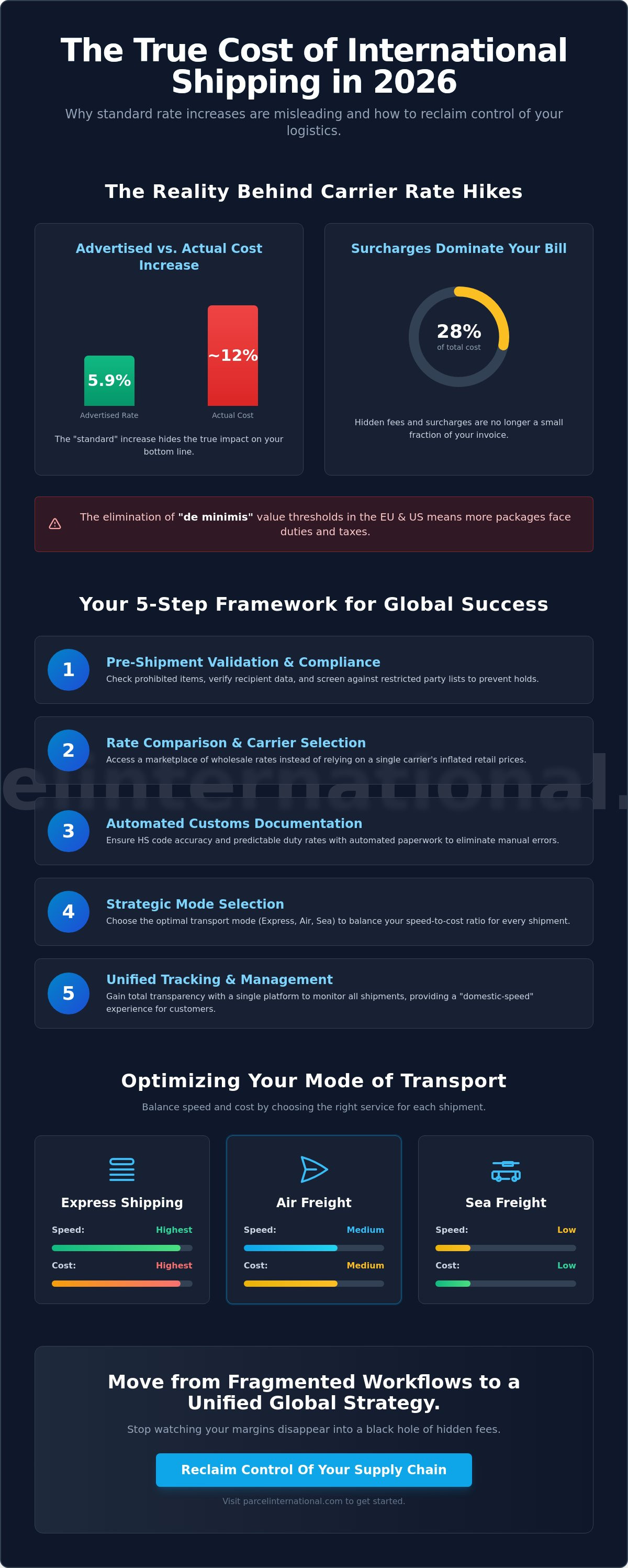
Did you know that the "standard" 5.9% rate increase carriers announced for 2026 is actually costing most businesses closer to 12% once surcharges are added? Between the elimination of de minimis thresholds in the EU and US and surcharges now making up nearly 28% of your total bill, the old way of shipping internationally is officially broken. It is frustrating to watch your margins disappear into a black hole of hidden fees and customs delays that you did not see coming. You want predictability and speed, but the global logistics landscape feels more like a moving target than a reliable system.
This guide changes that by showing you how to reclaim control over your supply chain. We will show you how to secure wholesale shipping rates and automate your documentation to stop customs hold-ups before they happen. You will learn how to evaluate carrier performance with total transparency, choose the right modes of transport for your specific routes, and implement a strategy that ensures your delivery times remain predictable in a volatile market. It is time to move from fragmented workflows to a unified strategy that supports your global growth.
Key Takeaways
Leverage strategic gateways and cross-border e-commerce to transform your logistics into a competitive growth lever for 2026.
Follow a proven five-step framework for shipping internationally that prioritizes destination compliance and accurate parcel measurement to avoid surcharges.
Determine the exact thresholds for switching between Express Shipping, Air Freight, and Sea Freight to optimize your speed-to-cost ratio.
Transition from manual paperwork to automated customs documentation to ensure HS code accuracy and maintain predictable duty rates.
Access wholesale rates from premier global carriers through a unified broker model, removing the barrier of high volume minimums and subscription fees.
Table of Contents
Why Shipping Internationally is a Strategic Lever in 2026
The 2026 global marketplace has reached a tipping point where cross-border e-commerce is no longer an optional expansion; it's a requirement for survival. Businesses that limit themselves to domestic borders are missing out on a freight market forecasted to reach $209 billion this year. Shipping internationally has evolved from a simple task of moving boxes to a sophisticated strategic lever that determines your ability to scale. Success now depends on how well you can navigate a world where de minimis exemptions have vanished in major hubs like the US, EU, and Mexico. Moving beyond local hubs is the only way to tap into the 4.6 billion small parcels currently circulating through the global supply chain.
The Shift from Shipping to Strategic Logistics
Logistics has shed its reputation as a mere cost center. It's now a primary competitive advantage. In 2026, trade regulations are more stringent than ever. Small business exporters must adapt to data-driven enforcement from agencies like the CBP, which prioritize compliance over random checks. Understanding the foundations of global maritime transport helps businesses appreciate why choosing the right entry point is vital for cost control. This is why international freight forwarding in Rotterdam has become the gold standard. By using the Netherlands as a gateway, companies can bypass the friction of fragmented European borders and gain faster access to the entire continent through a highly efficient, digitalized infrastructure.
E-commerce and the Global Consumer
Modern consumers don't care about the miles between your warehouse and their doorstep. They expect "domestic-speed" delivery even on global orders. If you can't provide clear, real-time tracking, you'll lose the customer before the package even arrives. Transparency has become the new industry standard for trust. This shift requires securing the best international shipping for ecommerce rates to keep your landed costs competitive. When shipping internationally, the psychological impact of seeing a package move through customs without delay is a powerful tool for customer retention.
Market volatility is the greatest threat to a growing business. In a year where container port throughput has hit record highs of nearly 193 million TEU, congestion and price spikes are constant risks. A logistics broker provides the buffer you need. Instead of being locked into a single carrier's rigid pricing, you gain the flexibility to pivot between Express Shipping, Air Freight, or Sea Freight based on real-time performance data. This approach strips away the anxiety of hidden fees and procedural friction. It replaces uncertainty with a singular, unified workflow that prioritizes your peace of mind and your bottom line.
5 Essential Steps for Shipping Internationally Successfully
Success in global trade isn't a matter of luck; it's a matter of process. When you're shipping internationally, skipping a single detail can lead to expensive delays, seized goods, or disgruntled customers. You need a repeatable framework that strips away the complexity and ensures every parcel arrives on time and on budget. Follow these five steps to move your cargo across borders without the typical procedural friction.
Pre-Shipment Validation and Compliance
The first hurdle is always regulatory. Before you book a shipment, you must validate that your goods aren't on a prohibited items list for the destination country. It's equally important to use digital tools to check "restricted party" lists. These lists identify individuals or entities that are barred from trade for legal or security reasons. Beyond the items themselves, verify that your recipient's contact data is 100% accurate. Customs officers often need to reach the importer to clarify tax details; if they can't get in touch, your shipment will sit in a warehouse gathering storage fees. For those moving ocean freight, staying current with U.S. shipping regulations is a baseline requirement for maintaining compliance and avoiding heavy fines.
Rate Comparison and Carrier Selection
Once you know your shipment is compliant, you must find the right price. It's a mistake to rely on a single carrier's retail site. In 2026, international shipping rates vary wildly by route and even by the day of the week. Factors like fuel surcharges, which now account for 20% to 40% of air freight costs, can change your margins overnight. You should always compare real-time rates across multiple global providers to find the most efficient path. In 2026, using a shipping broker can reduce international parcel costs by up to 40% compared to standard retail pricing. This is because brokers aggregate volume, giving you access to wholesale tiers that are usually reserved for massive corporations. If you want to simplify this selection process, you can access these wholesale rates directly through a unified platform.
The final steps involve the logistics of documentation and timing. You should never fill out customs forms by hand. Use a system that generates automated Commercial Invoices and suggests the correct HS codes based on your product description. Accuracy here determines your duty rates and prevents your goods from being flagged for an audit. Finally, select your shipping mode based on a clear urgency-versus-budget analysis. If the shipment is low-volume and high-value, Express Shipping is the logical choice. However, as your volume grows, you'll need to know the exact threshold where switching to Air Freight or Sea Freight becomes more cost-effective. By following this logical progression, you transform shipping from a chaotic task into an orderly, strategic advantage.
Choosing Your Mode: Express Parcel vs. Air and Sea Freight
Shipping internationally requires more than just picking a carrier; it requires picking the right mode for the right moment. If you're sending high-value electronics or urgent prototypes, Express Shipping is your best bet. It offers door-to-door speed and high security for low-volume goods. However, once your volume grows, sticking with express becomes a financial drain. You need to know when to pivot to more scalable solutions.
Air Freight serves as the vital bridge for urgent bulk shipments. If your shipment exceeds 150 kg but needs to arrive within a week, this is your mode. For everything else where time isn't the primary driver, Sea Freight is the undisputed leader for maximizing ROI. Whether you're moving a Full Container Load (FCL) or a Less than Container Load (LCL), the cost per unit drops significantly. For businesses operating within Europe, Road Freight remains the most flexible and cost-effective solution for door-to-door delivery without the complexities of port handling.
The Economics of Weight and Volume
The "pivot point" is where the cost of a parcel shipment exceeds the minimum charge for a freight shipment. Identifying this threshold is essential for protecting your margins. To stay ahead of market shifts, you should regularly consult freight rates news. As of early 2026, FAK rates for a 40-foot container from Asia to Northern Europe sit around $3,600, while air freight from China to Europe has spiked to approximately $4.8 per kg. Understanding these numbers helps you decide if a shipment should wait for the sea or take to the skies. If you don't have enough inventory for a full container, LCL allows you to share space with other shippers, giving you freight-level savings without the need for massive volume.
Speed vs. Sustainability in 2026
In 2026, the industry is balancing transit times with a push for lower-carbon options. Multimodal transport is a smart way to optimize the middle mile. For example, combining sea freight with road transport can reduce emissions while keeping costs lower than pure air freight. Adhering to international shipping standards ensures your multimodal routes remain compliant with global environmental and safety rules. This is where a freight forwarder becomes essential. They manage the complex hand-offs between ships, planes, and trucks, ensuring your inventory doesn't get stuck during the transition. By choosing the right mode based on data rather than habit, you turn your supply chain into a lean, adaptable engine for growth.
Navigating Customs: Automation vs. Manual Documentation
Manual documentation remains the single biggest bottleneck for businesses shipping internationally. A single typo on a commercial invoice or a vague product description can trigger a full customs audit, leading to storage fees and missed deadlines. Customs officers aren't looking for stories; they're looking for three specific data points: a precise product description, an accurate valuation, and the verified country of origin. If your paperwork is fragmented across different spreadsheets and carrier portals, the risk of "human error" increases exponentially.
The solution lies in shifting from manual entry to a unified, automated system. By centralizing your documentation, you ensure that the data on your shipping label matches your commercial invoice exactly. This level of consistency is what builds trust with customs agencies and prevents your cargo from being flagged for manual inspection. It turns a chaotic administrative task into a predictable, orderly process.
The Power of Automated Compliance
Parcel International’s platform generates compliant paperwork automatically by pulling data directly from your shipment details. This integration removes the friction of re-entering information and ensures that every form meets the specific requirements of the destination country. By utilizing pre-clearance data, businesses can often reduce customs hold times from several days to just a few hours. HS Codes are the 6-to-10 digit universal language of global trade used to classify products. Accuracy with these codes determines your duty rates, and automation ensures you're using the most current classifications to avoid overpayment or compliance penalties.
Understanding Duties and Taxes
Managing VAT, GST, and specific import duties is a vital part of protecting your profit margins. In 2026, the way you handle Incoterms—the rules that define who is responsible for costs and risks—can make or break your customer experience. Under DAP (Delivered At Place), the recipient is responsible for duties and taxes. This often results in "surprise" fees at the doorstep, which leads to refused packages and high return costs. Conversely, DDP (Delivered Duty Paid) is becoming the standard for e-commerce excellence. By paying duties upfront, you provide a seamless, domestic-like experience for your global customers. To ensure your documentation always meets these standards, you can get automated customs support through a unified dashboard. This approach eliminates the typical anxieties of cross-border trade and allows you to focus on growth instead of paperwork.
Scaling Globally with Parcel International’s Broker Advantage
Scaling global operations often feels like managing a storm of fragmented data, varying carrier terms, and unpredictable costs. When you're shipping internationally, you shouldn't have to choose between high retail rates or impossible volume requirements. Parcel International acts as a stable intermediary, providing the infrastructure you need to grow without the traditional barriers. By aggregating the volume of thousands of shippers, we provide access to wholesale rates from DHL, FedEx, and UPS that are typically reserved for the world's largest corporations. You get the same tier-one service without needing to meet strict minimums or pay monthly subscription fees.
This model provides more than just cost savings; it offers radical transparency. You can view all your cross-border shipping solutions in a single, unified dashboard. Whether you are tracking a small express parcel to Tokyo or a full container load via sea freight from Rotterdam, the status of every shipment is visible in one place. This consolidated view removes the anxiety of jumping between different carrier portals and ensures your team has a single source of truth for delivery times and costs.
The Technology of Aggregation
A single API for multiple carriers is no longer a luxury; it's a requirement for modern e-commerce. It allows you to integrate global shipping directly into your storefront or ERP, automating the label generation and tracking process. This technological bridge significantly reduces administrative overhead through several key benefits:
Consolidated Invoicing: Eliminate paperwork clutter by receiving a single, transparent bill for all your logistics, regardless of the carrier used.
Agile Carrier Selection: Switch carriers instantly based on real-time performance data or sudden price shifts to keep your margins protected.
Unified Tracking: Manage express parcels, air freight, and sea freight through a singular interface.
Getting Started with International Shipping
Ready to simplify your global growth? Shipping internationally doesn't have to be a source of friction for your business. You can create a free account today to gain immediate access to real-time global rate comparisons and start optimizing your routes. Our platform is designed to be inclusive, adapting to both small-scale personal projects and large-scale commercial operations. If you have a specialized freight project that requires a more tailored touch, our dedicated support team is available to guide you through the complexities of air, sea, or road freight. Don't let fragmented workflows hold your business back from its potential. Start comparing international shipping rates on Parcel International today and experience the relief of a truly unified logistics strategy.
Turn Global Logistics into Your Competitive Advantage
Stop treating logistics as a backend expense and start viewing it as a growth engine. In 2026, success depends on your ability to bypass procedural friction through automation and strategic carrier selection. You've now built the framework to move from manual, fragmented workflows to a unified system that prioritizes speed and cost efficiency. By automating your customs documentation and choosing the optimal mode for every route, you ensure that shipping internationally remains a predictable part of your business plan.
You don't have to navigate these complexities alone. With access to 220+ countries and real-time rates from DHL, UPS, and FedEx, you can scale with total confidence. Our automated customs documentation tools remove the guesswork, allowing you to focus on your customers instead of your paperwork. It's time to strip away the anxiety of hidden fees and unreliable delivery times. Compare Global Shipping Rates & Book Now and take the first step toward a more efficient global supply chain. Your expansion is within reach.
Frequently Asked Questions
What is the cheapest way to ship internationally in 2026?
Sea freight is generally the most cost-effective method for large-scale inventory that isn't time-sensitive. For smaller shipments, using a broker to access wholesale rates from major carriers is the most efficient way to reduce costs. Avoid retail counters to bypass high markups and surcharges that now account for nearly 28% of total shipping costs.
How do I calculate customs duties for my international shipment?
Duties are calculated by multiplying the declared value of your goods by the specific duty rate assigned to your product's HS code. You must also account for local taxes like VAT or GST. In 2026, remember that many countries, including the EU and US, have eliminated low-value exemptions, so expect duties on almost all commercial entries.
What is the difference between international parcel shipping and freight forwarding?
International parcel shipping is designed for small, manageable boxes handled by a single carrier from pickup to delivery. Freight forwarding involves managing large-scale cargo across multiple modes of transport. Freight forwarders act as intermediaries, coordinating the movement of containers via sea, air, or road to optimize the global supply chain.
Can I ship internationally without a commercial invoice?
You cannot ship commercial goods across borders without a commercial invoice. This document is the legal statement of what is being shipped and what it's worth. Customs agencies use this information to determine if the items are allowed into the country and to calculate the appropriate taxes and duties for shipping internationally.
How long does express international shipping usually take?
Express international shipping usually takes between one and three business days for major global trade lanes. While transit times are fast, they can be affected by customs processing speed in the destination country. Always ensure your documentation is complete and automated to maintain this speed and prevent unnecessary warehouse delays.
What are HS codes and why do I need them for shipping internationally?
HS codes are a standardized numerical method of classifying traded products used by customs agencies worldwide. You need them because they tell officials exactly what is in your package without language barriers. Accurate codes ensure you pay the correct duty rate and prevent legal penalties for misclassification or potential shipment seizures.
How do I track a package from multiple different carriers in one place?
You can track packages from multiple carriers by using a unified logistics dashboard provided by a shipping broker. Instead of visiting separate websites for DHL, FedEx, and UPS, an aggregated platform pulls all tracking data into one view. This allows you to monitor your entire supply chain and manage exceptions through a single interface.
What happens if my international shipment is held in customs?
If a shipment is held, it's usually because of a documentation error or an outstanding tax payment. Check your tracking status immediately for any "exception" notes provided by the carrier. Often, providing a missing invoice or a clear product description to the customs broker will resolve the hold and get your goods moving again.


Comments