
Harmonized Tariff Code Lookup for USA Exports: The 2026 Compliance Guide
Updated: Jul 4
U.S. exports climbed to $218 billion in April 2026, but even a high-value shipment can be sidelined by a single misplaced digit. You likely feel the constant pressure of getting your documentation exactly right. It is a common headache to juggle the nuances of HTS versus Schedule B codes, especially with the fear of customs fines or customer orders sitting in a warehouse because of a classification error. With the 2026 HTS Revision 10 and recent updates to AI chip regulations now in effect, the stakes for accuracy have never been higher.
By mastering a reliable harmonized tariff code lookup for usa exports, you can eliminate this administrative friction and ensure your goods move across borders without a hitch. This 2026 guide explains the critical differences between export and import codes, provides a step-by-step path to 100% compliance, and helps you avoid the most common filing traps. We will show you how to find the correct code quickly so you can focus on growing your business instead of worrying about customs delays.
Table of Contents
Understanding Harmonized Tariff Codes for USA Exports in 2026
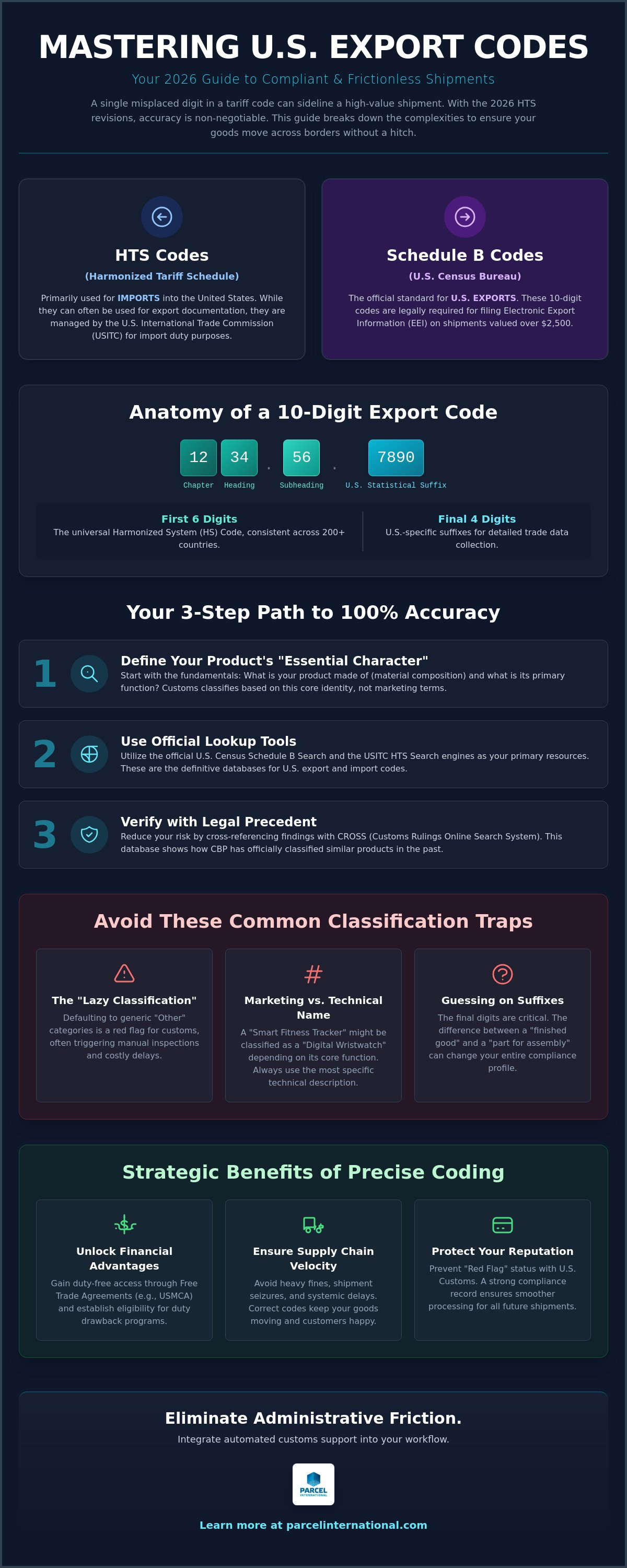
The Harmonized System (HS) serves as the universal language for global trade. It is a standardized numerical method of classifying traded products used by customs authorities around the world to identify goods and apply the correct duties. While the first six digits of any code are universal across all participating countries, the final four digits are specific to the United States. This distinction is where many exporters stumble. As of 2026, the World Customs Organization (WCO) has implemented nomenclature updates that may have shifted the classification for items in your current catalog. Staying current isn't just a best practice; it is a requirement for moving goods across borders without friction.
Incorrectly classifying your goods can lead to severe consequences. You might face heavy fines, shipment seizures, or even "Red Flag" status with U.S. Customs and Border Protection (CBP). Once your business is flagged, every future shipment undergoes much higher scrutiny, causing systemic delays in your supply chain. Using a reliable harmonized tariff code lookup for usa exports ensures you are working with the most recent 2026 data, protecting your reputation and your bottom line.
HTS vs. Schedule B: Which One Do You Need?
The U.S. Census Bureau manages Schedule B codes specifically for tracking exports. While the Harmonized Tariff Schedule (HTS) is primarily for imports, you can often use HTS codes for export purposes too. However, Schedule B remains the standard for U.S. export reporting. If your shipment's value exceeds the $2,500 threshold for a single commodity, you're legally required to file Electronic Export Information (EEI) through the Automated Export System (AES). Ensuring you have the right 10-digit code at this stage is vital for compliance.
The Anatomy of a 10-Digit Export Code
A full export code is built in layers. It starts with the Chapter (the first two digits), followed by the Heading and the Subheading. The Heading represents the first four digits that categorize the product's essence. The final four digits are statistical suffixes used by the U.S. government to collect detailed trade data. When you perform a harmonized tariff code lookup for usa exports, you're verifying that every layer of this 10-digit string accurately reflects your product's material and function. Don't guess on these digits; the difference between a "finished good" and a "part" can change your entire compliance profile.
How to Perform an Accurate Harmonized Tariff Code Lookup
Don't rely on a basic search bar for your classification. While tools like the USITC HTS Search or the Census Schedule B engine are helpful starting points, they don't replace technical analysis. You must start by identifying the material composition of your product. Is it made of aluminum, plastic, or a composite? Once you've defined the material, determine the primary function. Customs officials look for the "essential character" of the item to decide its classification. To verify your choice, cross-reference your findings with CROSS (Customs Rulings Online Search System). This database shows how customs officers have ruled on similar products in the past, providing a legal precedent that reduces your risk of misclassification. If you're unsure about a specific classification, our team provides expert customs support to streamline your export process.
When performing a harmonized tariff code lookup for usa exports, remember that your U.S. Schedule B number must be as specific as possible. A common mistake is choosing a code based on a marketing name rather than the technical description. For example, a "smart fitness tracker" might be classified differently than a "digital wristwatch" depending on its primary sensors and connectivity. Accuracy at this stage prevents your shipment from being flagged for manual inspection, which can save you days in transit time.
Step 1: Determine the Essential Character
Classifying multi-component kits, like a gift basket containing both wine and cheese, requires you to apply the "Rule of Relative Specificity." You must identify which component gives the kit its essential character. Is the customer buying it for the premium wine or the snacks? If one heading is more descriptive than another, you're legally bound to use it. Always treat "Parts and Accessories" headings as your last resort. If a product can be classified under a more specific description of its function, customs will expect you to use that instead.
Step 2: Navigating the Section and Chapter Notes
The Section and Chapter Notes are the "Legal Notes" of the tariff schedule. They override common dictionary definitions and are the first place a customs officer looks during an audit. These notes often list "Excluded" items that might seem like they belong in a chapter but are actually moved elsewhere for specific regulatory reasons. Use the 2026 index to find modern technology categories, especially for electronics and green energy components. These categories were updated to reflect recent shifts in global manufacturing, so don't assume your 2025 codes are still valid for your harmonized tariff code lookup for usa exports.
Common Pitfalls in Export Classification and How to Avoid Them
Misclassification isn't just a clerical error; it's a financial risk that can lead to shipment seizures and severe penalties. Many businesses fall into the trap of using outdated codes from previous years. If your product materials or suppliers change, your classification must change too. For example, switching from a plastic component to a recycled composite can shift your product into an entirely different chapter of the Official U.S. Harmonized Tariff Schedule. Don't assume that a code used in 2024 is still valid for a harmonized tariff code lookup for usa exports in 2026. Regular audits of your product database are the only way to maintain 100% compliance.
Assembly businesses face a unique challenge when distinguishing between "Parts" and "Finished Goods." If you ship a component that has the essential character of the finished product, customs may require you to classify it as the complete item. This distinction affects both duty rates and export controls. Additionally, don't let the "De Minimis" rules for low-value e-commerce exports lead to a false sense of security. Even if a shipment falls under the $800 threshold for certain import duties, accurate Schedule B reporting is still necessary for data collection and security screening. Performing a harmonized tariff code lookup for usa exports correctly ensures you aren't flagged for "split shipments" or other red flags that trigger audits.
The 'Other' Category Trap
Lazy classification is a major trigger for customs inspections. Shippers often default to codes ending in "90" or "99," which represent "Other" categories, because they can't find an immediate match. Customs officials scrutinize these suffixes more heavily because they lack transparency. Specific codes reduce the 'unknown' risk for customs algorithms. Finding a more descriptive code shows authorities that you've done your due diligence, which naturally reduces the frequency of manual inspections and keeps your supply chain moving.
Consistency Across Documentation
Your international shipping customs documentation must be perfectly aligned to avoid delays. The description on your Commercial Invoice should mirror the technical language of the chosen tariff code. Inconsistencies between your Shipper's Letter of Instruction (SLI) and the final AES filing are a common cause of customs holds. Ensure that every person in your logistics chain, from the warehouse manager to the freight forwarder, is working from the same verified classification data. This unified approach eliminates the administrative friction that often holds up customer orders at the border.
Strategic Benefits of Precise Tariff Coding for Your Business
Precise tariff coding is more than a paperwork hurdle. It's a strategic lever that can significantly improve your margins. One of the most overlooked benefits is Duty Drawback eligibility. If your business imports components, pays duties on them, and then re-exports the finished product, you may be entitled to a refund of up to 99% of those initial duties. However, you can only claim this if your harmonized tariff code lookup for usa exports is perfectly accurate and matches your import documentation. Without this consistency, you're essentially leaving money on the table.
Leveraging Free Trade Agreements (FTAs) like the USMCA is another major advantage. To qualify for duty-free treatment when shipping to Mexico or Canada, you must provide a Certificate of Origin that includes the correct 6-digit HS code. If your coding is imprecise, your goods won't qualify, and your customers will be hit with unnecessary taxes. Over time, maintaining a high level of accuracy helps you build a "Trusted Trader" profile. This reputation with customs authorities leads to faster clearance times and fewer physical inspections. Accuracy saves time and money. It gives you a competitive edge in delivery speed.
Optimizing Your Landed Cost Strategy
Surprise fees at the doorstep are the fastest way to lose a customer. When you use a precise harmonized tariff code lookup for usa exports, you can calculate the exact duty and tax obligations before the package even leaves your warehouse. This transparency allows you to offer a "Delivered Duty Paid" (DDP) service, which is a cornerstone of successful international shipping for ecommerce. Customers are much more likely to repeat a purchase when they don't have to deal with unexpected COD charges or customs delays.
Compliance as a Scalability Tool
High-volume exporters can't afford to classify every item manually. Automated classification tools are essential for scaling your operations without ballooning your administrative costs. By integrating your product database with a logistics platform, you reduce the burden on your customer service teams. They'll spend less time answering "where is my package" inquiries caused by customs holds and more time on high-value tasks. Reliability in your documentation translates directly to reliability in your shipping schedule. If you want to streamline your global operations and ensure 100% compliance, explore our Customs Support solutions today.
Simplifying USA Exports with Parcel International’s Automated Tools
Classification is only the first step. The real challenge is ensuring that data moves correctly from your research into your actual shipping documents. Many exporters find the right code only to mistype it on a label or invoice. Our platform eliminates this risk by integrating a harmonized tariff code lookup for usa exports directly into the booking flow. When you book a shipment, the system validates your code against destination requirements in real time. This creates a seamless bridge between compliance and execution.
We provide more than just software. You gain access to wholesale rates from global leaders like DHL, FedEx, and UPS without any volume minimums. Whether you're sending a single package via Express Shipping or managing large-scale Sea Freight, Air Freight, or Road Freight projects, our compliance tools are built into every step. For complex logistics that require more than just an automated tool, our team offers dedicated Customs Support to guide you through the most difficult classifications. Staying ahead of compliance isn't difficult when you have the right partner. By using our harmonized tariff code lookup for usa exports, you ensure that every shipment is 100% compliant before it ever leaves your dock.
From Lookup to Label: A Unified Workflow
Manual data entry is a primary source of human error in global trade. Our system automates document generation to ensure that the code you've verified is the one that appears on every form. This consistency is vital for maintaining your reputation with customs. Visit the Parcel International homepage to see how we unify these fragmented tasks into a single, efficient dashboard. By removing the need to jump between different platforms, we strip away the procedural friction that slows down your growth.
Why SMBs Choose Parcel International for Global Growth
Master Your Export Compliance Strategy
Precise classification is a powerful tool for global growth. It protects your bottom line from unnecessary penalties and unlocks significant financial incentives like duty drawbacks. By performing a rigorous harmonized tariff code lookup for usa exports, you remove the guesswork that often leads to costly customs delays. You've seen how 2026 updates and technical nuances can complicate the process, but you don't have to manage these hurdles alone. Logistics should be a bridge to new markets, not a series of administrative barriers holding back your orders.
Streamline your exports and automate your customs paperwork with Parcel International today. Our platform allows you to compare rates from 220+ countries instantly with no hidden fees or subscription requirements. We include automated customs documentation in every booking to ensure your codes are consistent and compliant. Take control of your international shipping and move your goods with total confidence.
Frequently Asked Questions
Is a Schedule B code the same as an HS code?
No, they aren't identical. The HS code is a 6-digit international standard used by over 200 countries to classify goods. The Schedule B code is a 10-digit U.S. specific code used by the Census Bureau to track export statistics. While the first six digits of both codes are exactly the same, the full 10-digit Schedule B code provides the granular detail required for U.S. trade reporting.
How many digits of the Harmonized Code do I need for a USA export?
You must provide a full 10-digit code for all U.S. export filings. The first six digits categorize your product globally, while the final four digits are unique to the U.S. system for statistical tracking. Filing with only six digits will cause your Electronic Export Information (EEI) submission to be rejected by the Automated Export System (AES), leading to immediate shipment delays.
What happens if I use the wrong tariff code on my export documents?
Misclassification triggers several serious problems. Your goods can be held at the border, which leads to significant delivery delays and unhappy customers. You might also face financial fines or have your shipment seized by customs authorities. Repeated errors often lead to a "Red Flag" status, meaning every future shipment from your business will face much higher scrutiny and manual inspections.
Where can I find a free harmonized tariff code lookup tool for 2026?
Official tools are available for free on the U.S. Census Bureau and USITC websites. These government resources provide a reliable harmonized tariff code lookup for usa exports using the most current 2026 data. Using these official sources ensures you are working with the latest revisions, which is vital for accurate filing and avoiding the typical anxieties of customs friction.
Do I need an HS code for shipping gifts or low-value items internationally?
Yes, a code is always required for international shipments. Even if you're sending a gift or a low-value item that falls below the $2,500 threshold for formal reporting, you must still provide a classification code. Customs officers in the destination country use this code to identify the contents and ensure the package doesn't contain restricted items or require specific local taxes.
Can I use an HTS code instead of a Schedule B code for my export filing?
Yes, you can generally use HTS codes for your export declarations. The U.S. Census Bureau permits the use of most HTS codes in place of Schedule B codes in the Automated Export System. This flexibility is helpful if your business already uses HTS codes for import operations. Just verify that your specific HTS code is valid for export reporting before you finalize your paperwork.
How often are the Harmonized Tariff Schedule codes updated?
Codes are updated frequently throughout the year. While major changes typically occur on January 1st, the USITC often releases multiple revisions, such as the 2026 HTS Revision 10. Using a harmonized tariff code lookup for usa exports ensures you are always working with the most current legal definitions. Staying updated is the best way to move from fragmented workflows to a unified, compliant shipping process.
Does the HS code determine the duty rate my customer pays?
It is the primary factor in determining duty costs. The code tells the destination country's customs office exactly what the item is and what it's made of. This identification sets the specific duty percentage and any local VAT or sales tax applied upon arrival. If you use an incorrect code, your customer might be forced to pay much higher fees than originally expected.


