
How to Avoid Customs Delays When Shipping from USA: A 2026 Pro Guide
- Alex
- May 15
- 12 min read
Did you know that over 1.36 billion packages entered the US duty-free in 2024? Today, that frictionless era is over. Since the suspension of the $800 de minimis exemption under Executive Order 14324, every commercial shipment now requires formal entry and full duty payment. If you're wondering how to avoid customs delays when shipping from usa in this high-stakes environment, you're not alone. The complexity of 10-digit HTS codes and shifting regulations has turned what used to be a simple process into a significant logistical challenge.
We understand the frustration of seeing a critical shipment stalled by unexpected flags or mounting storage fees. It's draining to lose customer trust over paperwork errors that feel like they're written in another language. This guide provides the clarity you need to master US export regulations and ensure your international shipments clear customs without a hitch. You'll learn the exact steps to handle HTS classifications and discover a repeatable checklist that works for express shipping, air freight, and sea freight. By leveraging professional customs support, you can reduce transit times and eliminate surprise duties for your end customers.
Key Takeaways
Master the anatomy of a detailed Commercial Invoice and determine exactly when an Electronic Export Information (EEI) filing is mandatory for your cargo.
Discover specific strategies for how to avoid customs delays when shipping from usa by aligning your digital data with U.S. Customs and Border Protection requirements.
Protect your shipments from valuation flags by using precise Harmonized System (HS) codes that reflect accurate market values.
Compare the brokerage strengths of major carriers to select the partner with the best relationships at your destination customs hubs.
Eliminate manual entry errors and generate compliant customs forms automatically to streamline your entire export workflow.
Table of Contents
Why US Exports Get Stuck: The Anatomy of a Customs Delay
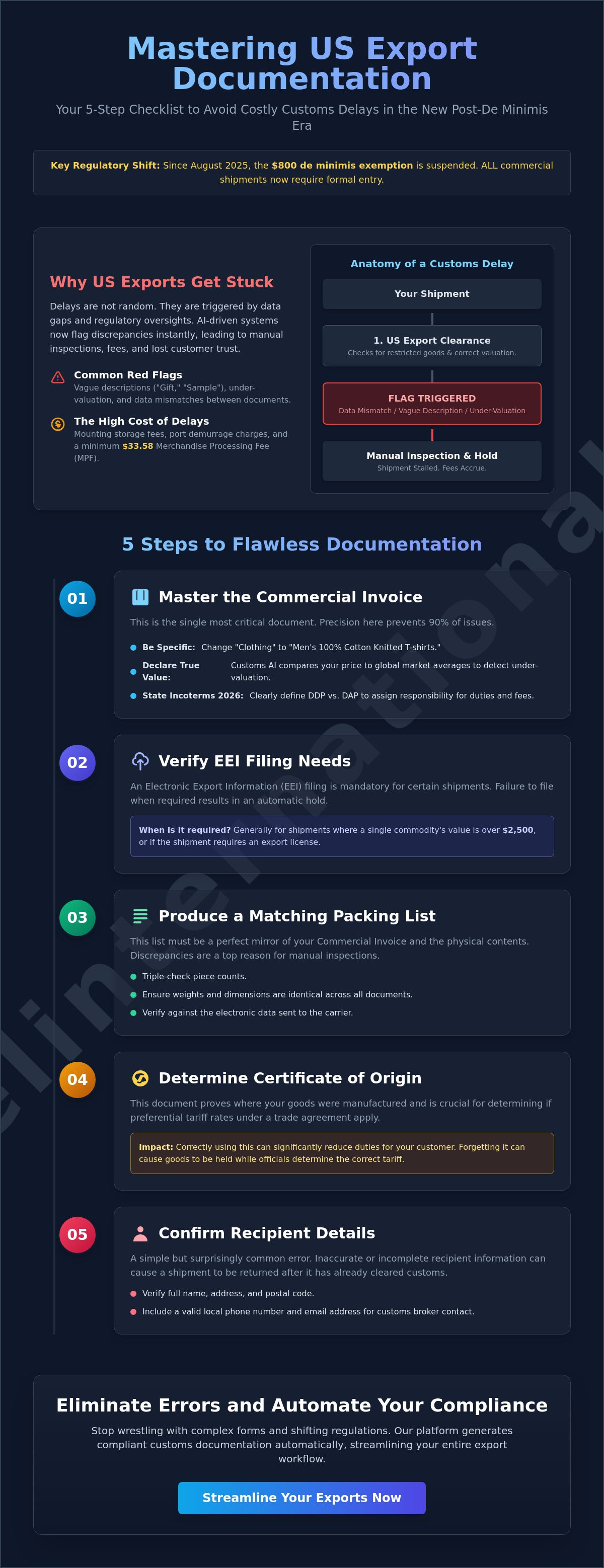
Customs delays aren't a matter of bad luck. They are the logical result of data gaps or regulatory oversights that trigger a system designed for high-speed scrutiny. In 2026, U.S. Customs and Border Protection (CBP) operates with a focus on total visibility. Every shipment leaving the United States undergoes a two stage process. First, it must clear US export regulations to ensure you aren't shipping restricted technology or undervalued goods. Second, it must pass import clearance at the destination country. Learning how to avoid customs delays when shipping from usa requires you to manage both sides of this border equation simultaneously.
When a shipment stalls, the financial damage starts immediately. You'll face storage fees at the airport or demurrage charges at the sea port. These costs quickly eat into your margins. However, the hidden cost is often higher. A single delay can destroy customer trust and eliminate the lifetime value of a client who simply won't risk a second late delivery. Precision is your best defense against these avoidable expenses.
Data Integrity: The Invisible Reason for Holds
The days of using "Gift" or "Sample" labels to bypass commercial scrutiny are over. Following the 2025 suspension of de minimis exemptions, AI driven customs screening now flags these generic descriptions instantly. If your digital filing doesn't align perfectly with your physical customs declaration forms, the system pulls the package for manual inspection. This creates a bottleneck that can last days. You must ensure that every line item on your invoice matches the electronic data sent to the carrier. Discrepancies in weight, value, or piece count are the most common red flags that stop a shipment in its tracks.
The 2026 Regulatory Landscape for US Shippers
The regulatory environment has become more complex with new environmental and safety compliance checks. Many international borders now require specific certifications for sustainable packaging or electronic components that weren't mandatory a few years ago. Trade agreements also play a massive role in clearance speed. If you don't provide the correct proof of origin, your goods might sit in a warehouse while customs officials determine the applicable tariff rate. Beyond obvious dangerous goods, items like lithium batteries or certain textiles now face increased scrutiny. You need a proactive approach to how to avoid customs delays when shipping from usa by verifying the restricted items list for your specific destination before the cargo leaves the warehouse.
5 Steps to Perfect Documentation for US Shipments
Paperwork is the blueprint of your shipment. If the blueprint is flawed, the entire logistical structure collapses at the border. Since the August 2025 suspension of the $800 de minimis exemption, every commercial export now requires formal entry. This means your documentation must be flawless to avoid being pulled for a manual audit. Understanding how to avoid customs delays when shipping from usa starts with a commitment to data accuracy across five specific documents. You must generate a precise Commercial Invoice, verify if an Electronic Export Information (EEI) filing is required, produce a matching Packing List, determine the correct Certificate of Origin, and confirm the recipient's full contact details.
Accuracy isn't just about avoiding a hold. It's about protecting your bottom line from the 2026 inflation adjusted fees. For example, the minimum Merchandise Processing Fee (MPF) has risen to $33.58. If your paperwork triggers a secondary inspection, these costs compound quickly. To stay compliant, you should regularly consult the CBP Informed Compliance Publications for the latest standards on valuation and classification. If you want to streamline this process, you can use automated customs support to generate these forms without manual entry errors.
Mastering the Commercial Invoice
Your Commercial Invoice is the most important document you'll create. Don't use vague terms like "clothing" or "electronics parts." Instead, be specific: "Men's 100% Cotton Knitted T-shirts." You must also declare the true market value. Customs officials now use AI to compare your declared prices against global averages. Under-valuation is a major red flag that leads to immediate seizures. Finally, clearly state your Incoterms 2026. Choosing between Delivered Duty Paid (DDP) and Delivered At Place (DAP) determines who is responsible for the adjusted $2.69 informal entry fees and destination taxes. Don't leave this to chance.
When to File EEI through the Automated Export System (AES)
Many shippers overlook the Electronic Export Information (EEI) requirement. If any single commodity in your shipment is valued over $2,500, you must file an EEI through the Automated Export System. Once filed, you'll receive an Internal Transaction Number (ITN). You must display this ITN clearly on your shipping labels and waybills. While shipments to Canada are generally exempt from this rule, almost all other international destinations require it for high-value goods. Failing to provide an ITN for a qualifying shipment is a guaranteed way to trigger a permanent stop at the US exit port.
Accurate Valuation and HS Code Classification
Classification is the universal language of global trade. The Harmonized System (HS) code is a standardized numerical method used by customs authorities worldwide to identify products for duty and tax assessment. Without the correct code, your shipment is effectively invisible to the automated systems that facilitate fast clearance. Mastering this numerical shorthand is a critical pillar of how to avoid customs delays when shipping from usa. It ensures your goods are categorized correctly the moment they hit the digital screening process.
Valuation is equally vital. U.S. Customs and Border Protection (CBP) utilizes sophisticated algorithms to compare your declared value against historical market data. If you're shipping high-end electronics but declaring them at wholesale component prices, the system will trigger a red flag for under-valuation. This doesn't just stall your shipment; it can lead to seizures and permanent loss of cargo. You must declare the true transactional value. This includes the price paid plus any adjustments for shipping or insurance required by your specific Incoterms.
Finding Your 10-Digit Schedule B Number
While the world uses HS codes, the US requires a 10-digit Schedule B number for export statistics. The first six digits are global, while the last four are country-specific. This distinction is vital for complex products like medical devices or specialized machinery. To find a definitive answer for difficult items, you should use the Customs Rulings Online Search System (CROSS) to see how CBP has classified similar goods in the past. This database provides legally binding precedents that can shield you from classification disputes.
The Dangers of Misclassification
In 2026, the penalties for negligent misclassification are more severe. CBP no longer views incorrect codes as simple clerical errors. Misclassified items are frequently diverted for physical inspection, which can add five to seven days to your total transit time. Conversely, using the correct codes allows your shipment to enter the green lane, where automated systems process your data in seconds. Accuracy here is your fastest route to a predictable delivery schedule.
Reduced Inspections: Accurate codes signal to CBP that you're a compliant, low-risk shipper.
Precise Duty Calculation: Avoid overpaying or being hit with back-dated duty bills and interest.
Clean Trade Data: Ensure your exports are correctly recorded to avoid triggering future compliance audits.
Getting these codes right is the difference between a seamless journey and a costly border standoff. If you're unsure about how to avoid customs delays when shipping from usa for complex tech, professional customs support can help you map your inventory to the correct 10-digit codes before you book your next air freight or express shipping service.
Comparing Carrier Customs Performance: DHL vs. UPS vs. FedEx
Choosing a carrier is a strategic decision that directly affects your clearance speed. DHL currently leads the cross-border segment with a 32.3% market share, primarily due to its extensive customs infrastructure in Europe and Asia. UPS follows at 29.7%, offering a dominant ground network in North America that provides a reliable balance of cost and speed for heavier shipments. FedEx holds 20.0% of the market and remains the top choice for time-sensitive exports where speed is the primary requirement. All three carriers utilize in-house brokerage services. This allows them to act as a stable intermediary between you and government authorities, stripping away the friction of third-party handoffs.
Brokerage Efficiency and Speed
High-performance carriers use pre-clearance to transmit your data while the cargo is still in transit. This proactive strategy is a fundamental part of how to avoid customs delays when shipping from usa. If an official flags a shipment, the carrier's brokerage team can often resolve the information request before the plane even lands. However, regional performance can shift based on local hub relationships. You can optimize your logistics by using an aggregator like Parcel International to switch carriers based on which provider has the strongest performance for a specific destination.
Transparency regarding surcharges is another critical factor in your selection. You should compare entry fees, advancement fees, and the adjusted $1.34 express consignment fee across carriers to avoid hidden costs that inflate your final bill. While some providers offer lower base rates for express shipping, their brokerage fees for duty advancement can be significantly higher. Understanding these costs upfront ensures that your end customer doesn't face surprise charges upon delivery, which is vital for maintaining long-term trust.
Technology and Paperless Invoicing
In 2026, paperless invoicing is no longer optional for efficient shippers. Electronic Trade Documents (ETD) eliminate the risk of physical paperwork being lost or damaged during transit. By integrating your digital invoice directly into the carrier's platform, you ensure that the data seen by customs matches your physical shipment exactly. This digital integration also provides real-time visibility. You can track the customs status of your sea freight or air freight through a single dashboard, allowing you to notify customers the moment their package clears the border.
Find the most reliable carrier for your destination by using our customs support and shipping platform today.
Automate Your Compliance with Parcel International
Manual data entry is the primary cause of the documentation errors we discussed in previous sections. Every typo in an HTS code or a missing recipient phone number increases the risk of a costly border hold. By centralizing your logistics through a unified platform, you gain an automated safeguard against these common pitfalls. This is the most effective way to address how to avoid customs delays when shipping from usa while scaling your international presence. Our platform generates Commercial Invoices and required customs forms automatically based on your specific order data, ensuring that the digital information matches the physical paperwork every time.
We provide real-time rate and performance comparisons across more than 220 countries. This visibility ensures you always select the carrier with the best clearance record for your specific destination hub. Whether you are moving high-value US exports via air freight or managing bulk shipments through sea freight, our system validates your data before the label is even printed. This proactive validation strips away the anxiety of hidden procedural friction and replaces it with a predictable, orderly workflow.
The Power of One Platform
Sync your e-commerce store directly to our interface to eliminate the inefficiency of fragmented workflows. You can track all international shipments in one place, regardless of whether you are using DHL, UPS, or FedEx for your express shipping needs. This centralized visibility allows you to choose the most effective international parcel shipping strategy for your business without managing multiple carrier logins. By automating the data flow from your store to the carrier, you reduce the risk of manual errors that trigger CBP inspections.
Reducing the Friction of Global Trade
We believe in radical transparency regarding your shipping costs. There are no subscription fees or volume minimums to access our platform. You only pay for the shipments you actually send. This egalitarian approach gives small businesses the same wholesale rates and professional customs support usually reserved for large-scale commercial projects. Our model is designed to be inclusive and adaptable to your specific needs, whether you're shipping a single parcel or managing complex road freight across borders.
If a shipment does face an unexpected delay due to local regulatory shifts, you don't have to deal with it alone. Our team of logistics experts provides direct support to resolve "stuck" shipments with the carriers on your behalf. We act as your stable intermediary, bridging the gap between your warehouse and international customs authorities. Master how to avoid customs delays when shipping from usa by letting our technology handle the technicalities of 2026 trade compliance while you focus on growing your brand.
Take Control of Your Global Logistics
Predictable delivery times are the backbone of customer trust. By implementing precise documentation standards and mastering 10-digit classification, you eliminate the data gaps that trigger manual inspections. You've seen how carrier-specific performance and the 2026 regulatory landscape demand a proactive strategy. Successfully mastering how to avoid customs delays when shipping from usa isn't about luck; it's about shifting from manual, fragmented workflows to automated precision. This transition protects your margins from unexpected storage fees and keeps your cargo moving through the green lane.
Since 2007, we've helped businesses reach 220+ countries by stripping away the typical anxieties of international trade. Our platform provides powerful automated customs documentation tools without any subscription fees or volume requirements. You can access wholesale rates and expert customs support through a singular, unified solution. Compare international shipping rates and automate your customs forms today. You're ready to move beyond the friction of border holds and build a more reliable, efficient supply chain that your customers can depend on every single day.
Frequently Asked Questions
How long does customs clearance usually take for US exports?
Customs clearance for US exports typically takes 24 to 48 hours for air freight and express shipping. However, this timeline depends on the efficiency of your paperwork and the destination country's local regulations. If your shipment is flagged for a manual inspection, the process can extend to several days or even weeks. Choosing carriers with pre-clearance capabilities is a vital strategy for anyone looking at how to avoid customs delays when shipping from usa.
What is the most common reason a package is held by customs?
Inaccurate documentation is the most frequent cause of border holds. This includes vague item descriptions, missing recipient phone numbers, or discrepancies between the physical packing list and digital data. Customs officials prioritize shipments with clear, itemized invoices. If they can't verify the contents or value instantly, they'll move the package to a secondary inspection area, which triggers immediate storage fees.
Do I need to pay duties for items I am shipping from the USA?
Yes, duties and taxes are usually required for international shipments, though the specific amount depends on the destination's laws and the product's HS code. While the US suspended its $800 de minimis exemption for imports in 2025, other countries have their own thresholds. You must decide through your Incoterms whether the sender or the recipient will cover these costs. Clear communication on this point prevents customers from refusing packages due to surprise fees.
What happens if I under-declare the value of my shipment?
Under-declaring the value of your shipment leads to severe penalties, including heavy fines, shipment seizures, and a permanent red flag on your shipping profile. U.S. Customs and Border Protection uses AI-driven algorithms to compare your declared prices against global market averages. If your valuation is significantly lower than the standard, officials will assume you're attempting to evade duties. This is a high-risk move that often results in total cargo loss.
Can I ship from the USA to a PO Box internationally?
Private carriers like DHL, UPS, and FedEx generally cannot deliver to international PO Boxes. Most customs authorities require a physical address and a recipient's signature to complete the clearance process and verify duty payments. If you provide a PO Box as the destination, your shipment will likely be returned to the US at your expense. Always confirm a physical delivery address before booking your air or sea freight.
What is an ITN number and when do I need one for my export?
An ITN is an Internal Transaction Number generated by the Automated Export System (AES). You must obtain one for any single commodity valued over $2,500 or for shipments requiring an export license. Displaying this number on your shipping label is a mandatory requirement for high-value exports. Failing to provide a valid ITN for qualifying goods will stop your shipment before it even leaves the United States.
How do I track my package once it enters the customs process?
You can track your package using the carrier's tracking number, which will show status updates like "Processed through facility" or "Held in Customs." For better visibility, a centralized platform like Parcel International allows you to monitor all your international parcels in one dashboard. This real-time data helps you identify potential issues early so you can provide additional documentation before a minor hold becomes a major delay. Understanding how to avoid customs delays when shipping from usa involves staying proactive with this data.
Is a pro-forma invoice the same as a commercial invoice?
A pro-forma invoice is not the same as a commercial invoice. You use a pro-forma invoice as a preliminary bill of sale or quote to help the buyer arrange financing or import permits. However, customs authorities require a final Commercial Invoice for the actual clearance process. Using the wrong document is a common error; always ensure the final Commercial Invoice is attached to your shipment to facilitate a smooth border crossing.


Comments