
How to Avoid Customs Delays When Shipping Internationally in 2026
- Alex
- Jul 12
- 12 min read
Updated: Jul 16
Did you know that as of June 24, 2026, the U.S. Customs and Border Protection indefinitely suspended the $800 de minimis duty exemption, making every single shipment subject to formal entry procedures regardless of its value? Between this massive shift and the European Union's elimination of the €150 duty exemption on July 1, 2026, the global trade environment has become a minefield of potential holdups. You likely feel the sting of unpredictable delivery dates affecting customer trust and those unexpected storage fees that drain your margins. It's frustrating when confusing paperwork requirements vary so wildly by country, but mastering how to avoid customs delays when shipping internationally is now a survival skill for your bottom line.
We're here to help you move from fragmented, high-anxiety workflows to a streamlined process that prioritizes punctuality. Our expert strategies will show you how to navigate these complexities so your cargo clears the border without costly interruptions. This guide provides a clear roadmap to achieving faster clearance times, zero paperwork rejections, and predictable landed costs for every order. We'll break down the specific documentation shifts and digital tools you need to transform customs from a barrier into a competitive advantage.
Table of Contents
Understanding Why Customs Delays Happen in 2026
A customs delay occurs when border authorities hold your shipment for physical inspection or data verification. It's the most common barrier to a seamless supply chain. While it sounds like a simple pause, it's actually a high-stakes data problem. When your goods sit at the border, you aren't just losing time; you're losing money. The high cost of friction manifests as storage fees and demurrage charges that can erase your profit margins in days. If you want to understand how to avoid customs delays when shipping internationally, you must first recognize that the border is now a digital gatekeeper.
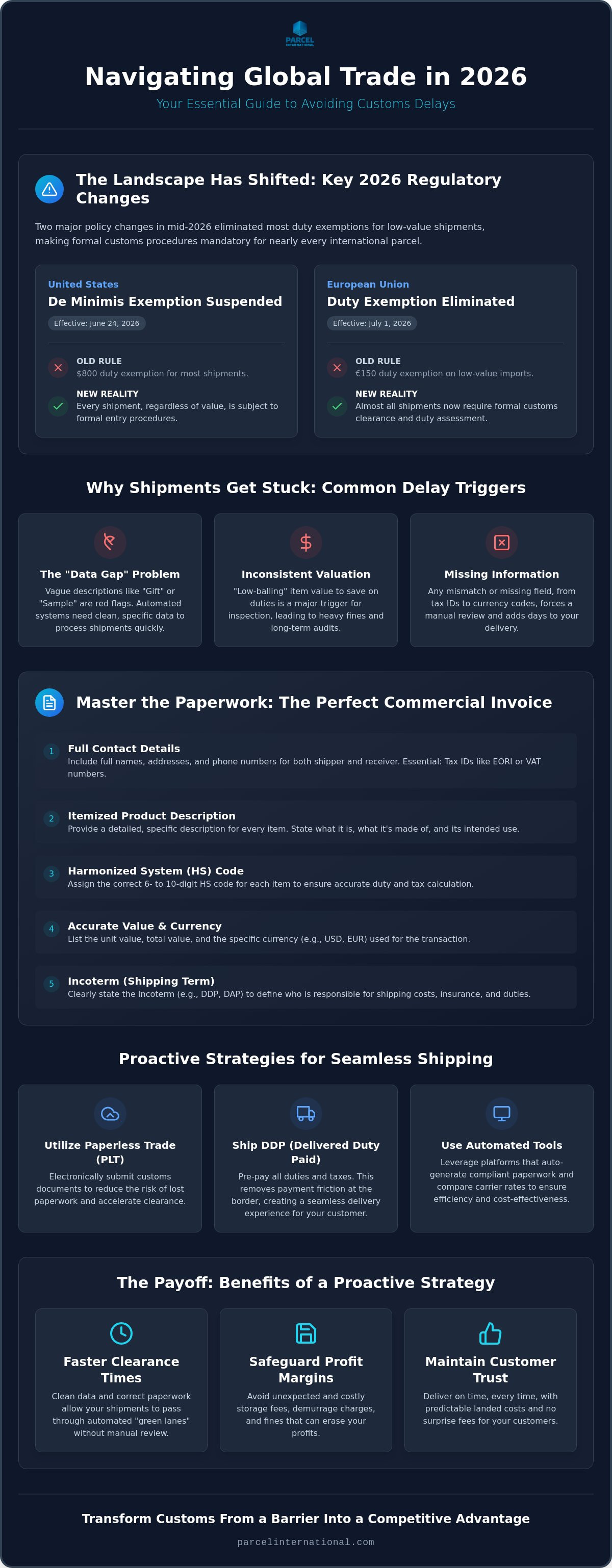
The regulatory landscape changed drastically in mid-2026. On June 24, 2026, the U.S. Customs and Border Protection indefinitely suspended the $800 de minimis duty exemption. Just a week later, on July 1, 2026, the European Union eliminated the €150 customs duty exemption for low-value imports. These changes mean that almost every shipment now requires formal or informal entry procedures. This increased regulatory scrutiny is why understanding how to avoid customs delays when shipping internationally is more critical now than ever before. Modern international parcel shipping relies on a digital-first approach to manage these new requirements.
The 'Data Gap' Problem
Vague descriptions are the primary cause of holds. Labeling an item as a "Gift" or "Sample" is no longer acceptable in 2026. Automated sorting facilities require "Clean Data" to process shipments at high speeds. If there's a mismatch between your shipping label and the customs declaration forms, the shipment stops. These data gaps trigger red flags that force a manual review, adding days to your delivery timeline. Don't let a simple typo or an incomplete description derail your logistics. Ensure every field is populated with specific, accurate information to keep your goods moving through the automated lanes.
Common Triggers for Inspection
Inspections aren't always random. Authorities use risk profiles for specific countries and product categories to target their searches. One major trigger is inconsistent valuation. If you try "low-balling" the item value to save on duties, you risk long-term audits and heavy fines. Regional trade agreements also impact clearance speed. Knowing which agreements apply to your route helps you anticipate how your goods will be handled. Success in 2026 requires you to be an optimizer who treats data with the same care as the physical product. You can't afford to guess. Close every possible data gap before the shipment leaves your warehouse.
Master the Paperwork: The Essential Documentation Checklist
If the border is a digital gate, your paperwork is the key that unlocks it. In 2026, customs authorities don't have time to guess what is inside your box. They rely on standardized data to automate the clearance process. Understanding how to avoid customs delays when shipping internationally starts with treating your paperwork as a precision tool rather than a chore. High-quality international shipping customs documentation is the only way to ensure your cargo moves through the green lane without human intervention. When your data is clean, the process is invisible. When it's messy, your shipment stops.
Drafting a Perfect Commercial Invoice
The commercial invoice is the primary document border authorities use to assess duties and taxes on your goods. It acts as the shipment's passport and must be flawless to pass automated screening. To ensure compliance, your invoice must include:
Full contact details for both the shipper and the receiver, including tax IDs like EORI or VAT numbers.
An itemized description of every product that avoids vague terms like "gift" or "merchandise."
The unit value, total value, and the specific currency used for the transaction.
The 'Incoterm' (such as DAP or DDP) to clearly define who is responsible for cost and risk.
Missing just one of these details triggers a manual hold. You can use an automated platform to generate these invoices correctly every time, removing the risk of human error.
HS Code Accuracy
The Harmonized System (HS) is a 6-digit code used globally to classify goods. It's the universal language of trade. This code determines your exact tax liability in 220 countries. If you use the wrong code, you aren't just looking at a delay; you're looking at a potential fine for misdeclaration. Don't guess. Use online classification tools to find the most specific code for your product. In the 2026 regulatory environment, "close enough" is a recipe for a long-term audit. Customs agents now use AI to flag discrepancies between item descriptions and HS codes instantly. Accuracy is your best defense against these automated flags.
Finally, remember that some trade lanes require a Certificate of Origin to qualify for preferential duty rates. While it's an extra step, it can significantly lower your landed costs. Always check if your specific trade route has an active agreement that requires this form. By mastering how to avoid customs delays when shipping internationally through perfect documentation, you protect your customer experience and your profit margins simultaneously.
Navigating Prohibited Items and Regional Regulations
Understanding the difference between prohibited and restricted items is a fundamental step in learning how to avoid customs delays when shipping internationally. Prohibited items, such as counterfeit goods or certain narcotics, are strictly banned from entry. Restricted items, however, are allowed only if you possess the specific permits or licenses required by the destination country. Many shippers stumble when they realize that everyday items can fall into the "dual-use" category. These are products, like certain high-spec electronics or specialized chemicals, that have both civilian and potential military applications. If your cargo fits this description, you'll need an export license before it ever reaches the border.
Dangerous Goods (DG) represent another high-friction category. Items like lithium batteries, flammable liquids, and even some perfumes are subject to strict international safety standards. These goods require specialized labeling and packaging to prevent accidents during transit. If you're dealing with these complex cargo categories, consulting a freight forwarder is the most reliable way to navigate the maze of permits and safety protocols. They act as an optimizer for your logistics, ensuring every regulation is met before the shipment leaves your facility.
Regional Nuances: US and EU Standards
The regulatory environment in 2026 has become significantly more restrictive. While you might be looking for ways to ship tax-free to the United States, the indefinite suspension of the $800 de minimis exemption on June 24, 2026, has changed the game. Now, all shipments into the U.S. are subject to formal or informal entry procedures regardless of their value. Similarly, the European Union's elimination of the €150 customs duty exemption on July 1, 2026, means e-commerce sellers must use tools like the Import One-Stop Shop (IOSS) to simplify VAT collection. If you're entering the EU through Rotterdam, be prepared for specific Dutch customs entry requirements that prioritize digital data accuracy over physical speed.
For business travelers who need to visit the region to manage these logistics in person, amersfoort-taxi.nl provides professional transport services between Schiphol Airport and the Amersfoort or Leusden areas.
Beyond these markets, other regions like South America have their own intricate requirements. For specialized support when importing from China to Brazil, you can visit Lotus Lane Trading to ensure your shipments meet all local compliance standards and avoid costly customs delays.
Restricted Goods Management
Managing restricted items requires a proactive approach. If you ship food or agricultural products, you must secure 'Phytosanitary' certificates to prove the items are free from pests and diseases. For electronics, you'll often need to provide a Safety Data Sheet (SDS) that details the chemical composition and safety risks of the batteries inside. To maintain a smooth flow, always aim to pre-clear these items. By submitting your permits and safety data to customs electronically through your carrier, you can resolve potential issues while the cargo is still in your warehouse. This is the most effective way how to avoid customs delays when shipping internationally when dealing with sensitive or regulated inventory.
Proactive Strategies to Prevent Border Hold-ups
Proactive planning is the only reliable way to keep your supply chain moving. Learning how to avoid customs delays when shipping internationally requires moving beyond simple compliance into the territory of strategic optimization. In 2026, the speed of your shipment depends entirely on the speed of your data. If you wait until the package reaches the border to resolve issues, you've already lost the race. By implementing a few digital-first strategies, you can ensure your cargo moves through customs as if the border didn't exist.
The Power of Digital Submission
Adopt Paperless Trade (PLT) to ensure your electronic invoices reach customs before the physical plane even lands. This digital-first approach is the gold standard for 2026 logistics. It eliminates the risk of lost physical pouches on the side of your boxes; a common problem that triggers manual holds. By integrating your ERP or e-commerce platform directly with your shipping tool, you ensure that the data transmitted to border authorities is a perfect mirror of your order details. This synchronization is the most effective way to clear the digital gate before your cargo arrives. It removes the friction of manual data entry and provides the "Clean Data" that automated sorting facilities demand.
Managing Duties and Taxes Early
Choose DDP (Delivered Duty Paid) to remove the 'pay-to-release' friction that plagues international trade. While DDU (Delivered Duty Unpaid) might seem cheaper upfront, it forces your customer to pay taxes at the door. This often results in refused packages or shipments sitting in a warehouse for weeks while the carrier tries to collect payment. DDP prevents shipments from sitting in 'pending payment' status. You can use a shipping calculator to estimate these landed costs accurately before you print a label. This transparency builds trust with your customers and ensures that once a package reaches the destination country, it moves straight to the final delivery stage without a detour to a customs bonded warehouse.
Don't overlook the basics. Audit your address data regularly. A single typo in a zip code can cause major routing errors that flag your shipment for manual review. Mastering these small details is a core part of how to avoid customs delays when shipping internationally in a high-speed market. Finally, look for international shipping rates that include built-in customs support. When your shipping platform handles the heavy lifting of compliance, you can focus on growing your business. Ready to streamline your global logistics? You can compare wholesale shipping rates and see the difference that automated customs support makes for your bottom line.
Simplifying Global Trade with Parcel International
Managing global logistics manually is no longer sustainable in a market defined by automated digital gates. Parcel International serves as your dedicated optimizer, stripping away the procedural friction that causes border hold-ups. By using our platform, you gain access to automated customs documentation tools that generate perfect commercial invoices every time. This is the ultimate answer to how to avoid customs delays when shipping internationally without needing a massive in-house compliance department. We take the chaotic process of cross-border trade and make it orderly, giving you the freedom to focus on your core business goals.
One Platform, 220+ Countries
Parcel International bridges the gap between wholesale shipping rates and retail ease of use. Our platform allows you to compare real-time rates from global partners while maintaining high compliance standards. Whether you're shipping through the gateway of Rotterdam or to a remote destination, our brokerage experience since 2007 ensures you have expert support. Transparency is our core value. You won't find hidden fees or restrictive subscription requirements here. We focus on your peace of mind by scaling your international shipping for ecommerce through a singular, unified solution. This approach allows SMBs to compete on a global scale without the overhead of a dedicated customs team. You get the benefit of our deep industry partnerships and our commitment to radical transparency regarding all terms and conditions.
Getting Started with Error-Free Shipping
You can book your first shipment in under five minutes. Our interface guides you through a logical progression of tasks, utilizing built-in checklist features to ensure every HS code and description meets 2026 standards. This rhythmic, instructional flow mirrors the efficiency of the physical transport we provide. You don't have to deal with fragmented workflows or the anxiety of paperwork rejections. Instead, you get a stable intermediary that values punctuality and security. By removing traditional barriers like volume minimums, we make international trade inclusive for everyone. We provide the relief of moving from multi-platform chaos to a single, efficient dashboard. Optimize your international shipping process today and see how easy global trade becomes when you have the right partner.
Future-Proof Your Global Logistics Strategy
The landscape of international trade in 2026 demands a shift from manual guesswork to digital precision. You now understand that clean data and proactive strategies like DDP shipping are no longer optional extras; they're the baseline for success. By adopting Paperless Trade and mastering HS code accuracy, you've learned how to avoid customs delays when shipping internationally while protecting your customer relationships. These steps move your business from a state of logistical anxiety to one of predictable, orderly growth.
Parcel International has been a trusted global logistics partner since 2007, providing a stable bridge in a complex market. Our platform offers real-time rates from industry leaders like DHL, FedEx, and UPS with no subscription fees or volume minimums. We strip away the procedural friction so you can focus on scaling your operations instead of wrestling with paperwork. You deserve a partner that values transparency and reliability as much as you do.
Start shipping smarter with automated customs tools and transform your supply chain today. The border doesn't have to be a barrier when you have the right optimizer on your side.
Frequently Asked Questions
What is the most common reason for customs delays?
Incorrect or incomplete documentation is the primary reason shipments get stuck at the border. When authorities encounter vague item descriptions or missing tax identification numbers, they must stop the automated process for manual verification. Ensuring your data is clean and perfectly synchronized between your commercial invoice and shipping label is the most effective way to maintain momentum and prevent these common holds.
How long does customs clearance usually take in 2026?
Digital clearance typically occurs in minutes or hours if your paperwork is submitted electronically via Paperless Trade. However, if a shipment is flagged for a physical inspection or a data audit, the process can extend to three to five business days or longer. This variability highlights why mastering how to avoid customs delays when shipping internationally is essential for maintaining predictable delivery schedules for your customers.
Can I track my package while it is in customs?
You can track your package's arrival at the customs office, but real-time visibility often decreases once it enters the inspection queue. Most carriers provide status updates such as "Held in Customs" or "Pending Clearance," which indicate the package is awaiting a decision from border agents. For more detailed insights during a long hold, you should contact your carrier's customs support team to identify any missing information.
What happens if my shipment is seized by customs?
You will receive a formal notice of seizure explaining why the goods were confiscated, usually due to prohibited items or intellectual property violations. Depending on the specific violation, the authorities may destroy the items, offer a return to the sender at your expense, or hold them as evidence for legal action. Seizure is a serious event that can lead to the permanent blacklisting of your business entity.
Do I always need an HS code for international shipping?
Yes, a six-digit Harmonized System (HS) code is mandatory for all international commercial shipments to determine tax liability and statistical tracking. Omitting this code or using an incorrect classification is a guaranteed way to trigger a hold. In the current regulatory environment, automated systems use these codes to instantly calculate duties, making them the most critical data point on your invoice for 2026 compliance.
What is the difference between DDU and DDP shipping?
DDU (Delivered Duty Unpaid) requires the recipient to pay all import duties and taxes before the carrier releases the package, which often causes significant delays. DDP (Delivered Duty Paid) means the sender handles all costs upfront, allowing the shipment to bypass the "pending payment" queue. Choosing DDP is a strategic way how to avoid customs delays when shipping internationally because it removes the final financial barrier at the border.
How do I calculate import duties before I ship?
You can calculate estimated duties by using a landed cost calculator that incorporates the HS code, the declared value of the goods, and the specific tax rates of the destination country. These tools simulate the customs assessment process to give you a clear picture of the total cost before the label is printed. Relying on automated platforms ensures you don't overlook regional variables or the recently updated tax thresholds.
Can a shipping broker help with customs paperwork?
A shipping broker acts as a professional intermediary between your business and border authorities to ensure every document meets legal standards. They handle the complex filing requirements and can resolve disputes or data errors on your behalf. Utilizing a broker's expertise is a reliable way to navigate high-stakes logistics without having to become a regulatory expert yourself, providing relief from fragmented and confusing manual workflows.


Comments