
Affordable Global Shipping: 2026 Small Business Guide
- Alex
- 10 minutes ago
- 11 min read
Did you know that in 2026, e-commerce shipping costs can swallow up to 22% of a small business's total revenue? While major carriers announced average rate increases of 5.9% this year, the reality for most sellers is a 12% jump once adjusted surcharges are added. Scaling your brand globally shouldn't feel like a choice between growth and profit, yet finding a reliable international shipping platform for ecommerce that doesn't require a massive volume commitment is harder than ever.
It's exhausting to watch your international margins vanish into hidden fees or deal with the stress of packages stuck in customs because of a single paperwork error. You deserve a logistics process that works as hard as you do. This guide shows you exactly how to flip the script by accessing wholesale shipping rates and automating your customs documentation without needing a subscription or high volume minimums. We'll explore how to unify your global shipments into one streamlined workflow, navigate new 2026 regulatory changes like the EU's €3 per tariff code duty, and finally reduce your delivery costs to help your small business thrive on the world stage.
Table of Contents
What Is Affordable International Shipping for Small Business?
Affordability in global logistics is often misunderstood. Many entrepreneurs focus solely on the lowest sticker price, but true affordability is a balance between transit speed, reliability, and the base shipping rate. If a package is cheap to send but takes weeks to arrive or disappears in transit, the hidden costs of customer support and replacements quickly erase any initial savings. In 2026, an effective international shipping platform for ecommerce must provide more than just a low price; it must offer a stable bridge between your warehouse and your global customer.
Most small businesses fall into the "Retail Trap." They pay standard counter rates at the post office or carrier storefronts, often paying significantly more than their larger competitors. This happens because individual sellers lack the volume to negotiate corporate discounts. By acting as a digital broker or freight forwarder, a unified platform levels the playing field. It aggregates the shipping volume of thousands of small businesses to unlock wholesale rates that were once reserved for Fortune 500 companies.
The Total Cost of Ownership in Logistics
Success in 2026 requires looking at the total landed cost. This includes the freight rate plus duties, taxes, and potential customs fines. Research shows that approximately 70% of all international delivery delays are caused by manual paperwork errors. These delays don't just frustrate customers; they destroy your Customer Lifetime Value (CLV). Every hour you spend manually filling out customs forms is an hour you aren't growing your business. Automation isn't a luxury anymore; it's a requirement to avoid the 20-40% in hidden fees that typically plague unoptimized shipments.
Wholesale vs. Retail Shipping Rates
Large corporations negotiate massive discounts because they move millions of parcels. For a small business, the only way to access these same tiers is through an aggregator. A modern international shipping platform for ecommerce removes the myth of the minimum volume requirement. You don't need to ship 1,000 items a month to get a better deal. By using a platform that partners directly with carriers like DHL, FedEx, and UPS, you can access these discounted rates from your very first shipment. This radical transparency ensures you only pay for what you use, without the burden of subscription fees or restrictive volume tiers.
Core Factors That Influence International Shipping Costs
Shipping costs in 2026 are highly dynamic. While many sellers only look at the physical weight on a scale, the total price is driven by a complex web of surcharges and carrier policies. Understanding these variables is the first step to protecting your margins. An international shipping platform for ecommerce helps you decode these costs by providing transparent, all-in quotes before you commit to a label.
Mastering Dimensional Weight (DIM)
Dimensional weight is a pricing technique used by carriers that calculates a package's density to ensure they're compensated for the space an item occupies on a plane or truck. If you ship lightweight items in oversized boxes, you're essentially paying to ship air. In 2026, this is even more critical due to the EU's Packaging and Packaging Waste Regulation (PPWR), which limits empty space in e-commerce transport packaging to a maximum of 50%. Carriers use different divisors, typically 139 for international express, to convert volume into billable weight. You should always choose the smallest possible box that safely protects your product to avoid unnecessary costs.
Understanding Surcharges and Hidden Fees
Base rates are just the starting point. As of August 2026, hidden fees can account for 20% to 40% of your total landed cost. Common budget-killers include residential delivery fees, which currently sit at $6.95 per package for UPS, and remote area surcharges that can start at a minimum of $61.00 per shipment. Fuel surcharges also remain volatile; for example, DHL eCommerce international fuel surcharges are approximately $0.40 per pound.
To successfully Navigate Shipping and Logistics, you must identify these costs before you book. You can compare real-time rates across multiple carriers to ensure you aren't overpaying for surcharges or speed you don't actually need. Identifying these fees during the quoting process prevents "bill-back" surprises that often arrive weeks after the delivery is complete.
Choosing between Economy and Express is a strategic decision rather than just a financial one. While Economy options save money upfront, they often lack the end-to-end visibility and speed that high-value customers expect. The sweet spot for most small businesses is accessing wholesale Express rates that are comparable to standard retail postal prices. This allows you to offer premium delivery times without sacrificing your profit margins.
Direct Carrier Booking vs. Using a Shipping Platform
Managing individual accounts with DHL, UPS, and FedEx often feels like a full-time job. Each carrier has its own portal, unique billing cycle, and separate support team. While direct accounts might seem to offer more control, they frequently trap small businesses in high retail tiers because they don't move enough volume to qualify for corporate discounts. Switching to a dedicated international shipping platform for ecommerce eliminates this fragmentation by consolidating your entire logistics workflow into a single, efficient dashboard.
Negotiating Power: Collective Volume
Small businesses usually lack the leverage to demand better rates from global giants. Carriers prioritize high-volume shippers, leaving smaller brands to pay standard prices that eat into global margins. Logistics brokers like Parcel International change this dynamic by using collective volume. By pooling shipments from thousands of businesses, they secure wholesale Tier-1 rates that are normally impossible for an SMB to reach alone. This model provides no-contract access to elite pricing, allowing you to scale without being locked into a rigid subscription or volume commitment.
Unified Tracking and Support
Attempting to monitor international shipping regulations and tracking updates across multiple carrier websites is an administrative nightmare. When a package is delayed, you don't want to spend hours on hold with different call centers. A unified platform provides a single point of contact for every shipment, regardless of the carrier. This centralized approach ensures that if a customs issue arises, you have a professional team ready to intervene rather than navigating the bureaucracy yourself.
Consolidated billing is another major win for your operational efficiency. Instead of processing dozens of individual invoices from various carriers, you receive one clear, transparent statement. This reduces the workload for your finance team and provides a real-time view of your total shipping spend. Moving away from the DIY approach doesn't just save money on labels; it recovers the hours your team currently wastes on manual data entry and carrier management. It's about moving from a chaotic, fragmented process to an orderly, reliable system that supports your growth.
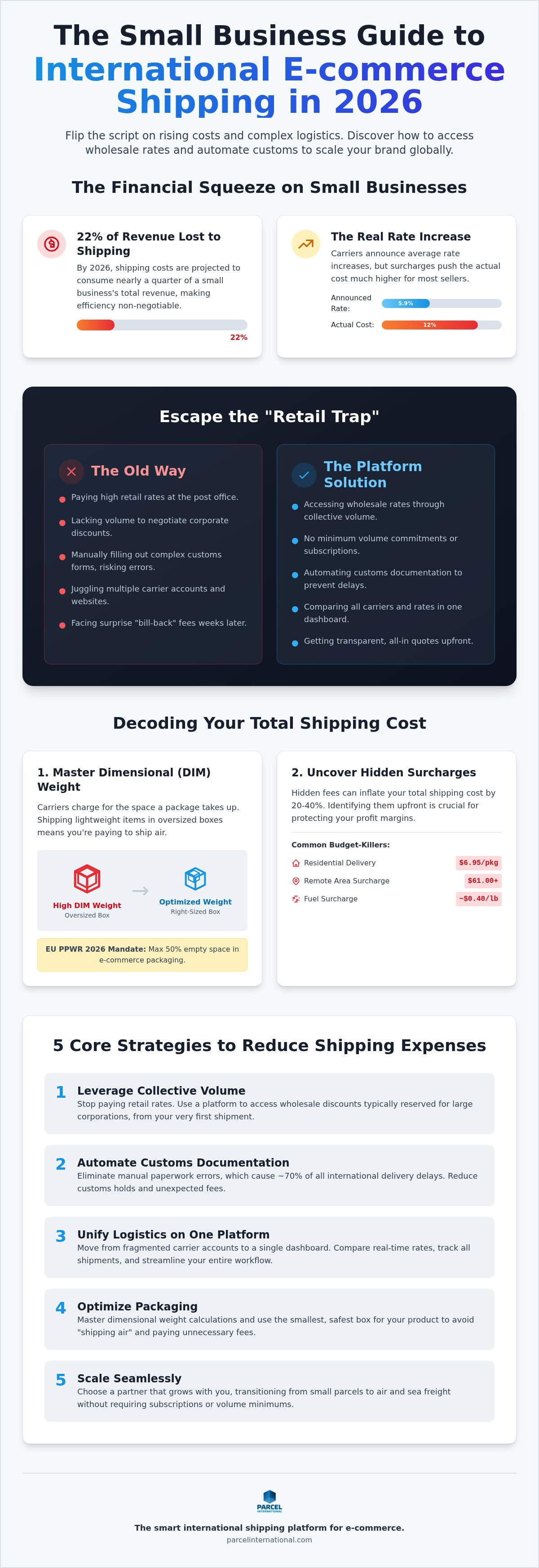
5 Strategies to Reduce Shipping Expenses in 2026
Rising carrier rates don't have to dictate your profit margins. To stay competitive, you must move beyond simple label printing and adopt a holistic logistics strategy. An international shipping platform for ecommerce provides the visibility needed to identify where you're overpaying and where you can optimize. By implementing these five strategies, you can significantly lower your total landed cost while improving the customer experience.
First, consolidate your shipments. Instead of sending single parcels as orders arrive, group them to reduce per-package administrative costs and potential pickup fees. Second, optimize your checkout by integrating real-time shipping quotes. This ensures you never undercharge for delivery, especially when dealing with remote area surcharges. Third, segment your shipping methods. Use high-speed Express for luxury or time-sensitive items, but offer Economy for lower-value orders where the customer is willing to wait to save on costs. This balanced approach protects your margins without alienating budget-conscious buyers.
Automating the Customs Process
Automated commercial invoices reduce the risk of clerical errors that lead to expensive storage fees or rejected deliveries. Integrating accurate HS codes directly into your product catalog ensures faster clearing at every border. For a deep dive into compliance, review our guide on international shipping customs documentation. Automation transforms a manual, high-stakes task into a background process that protects your brand from 2026's increasingly complex regulatory landscape, such as the new EU packaging requirements.
Strategic Carrier Selection
No single carrier is the best for every destination. You need to understand when to use UPS international shipping versus DHL based on the specific region. For example, DHL often dominates in European and Asian markets, while UPS provides robust infrastructure across the Americas. Analyzing current international shipping rates allows you to find regional winners for every lane.
Don't overlook road freight for affordable cross-border shipping within Europe; it's often the most cost-effective way to move goods between neighboring countries without the premium price of air transport. Effective logistics management isn't just about finding the cheapest box; it's about building a resilient, automated workflow. You can start optimizing your global delivery strategy today by accessing wholesale rates that protect your bottom line from the very first shipment. By combining these strategies, you'll turn shipping from a cost center into a competitive advantage.
Scaling Your SMB with Parcel International
Scaling a business requires a logistics partner that adapts as quickly as your order volume. When you're managing 10 shipments a month, a simple label tool might suffice. However, as you scale toward 1,000 shipments and beyond, you need an international shipping platform for ecommerce that handles more than just the basics. Parcel International is designed to grow with you, offering the same wholesale rates and automated tools whether you're sending your first box or managing a complex global supply chain.
Beyond Parcels: Sea and Air Freight
There comes a point where shipping individual express parcels isn't the most efficient way to restock your inventory. When your shipment weight exceeds approximately 150kg, it's often time to switch from express courier services to bulk freight. Our platform provides seamless access to air and sea freight options, allowing you to move larger volumes at a lower cost per unit. Having a professional freight forwarder on your side means you don't have to navigate the complexities of ocean carrier schedules alone. We manage the heavy lifting so you can focus on inventory management and market expansion.
A Partnership Built on Transparency
Logistics is often plagued by "bait and switch" pricing, where the final bill looks nothing like the initial quote. We eliminate this anxiety through radical transparency. Our no-subscription model and lack of hidden fees ensure that your projected margins remain intact. By integrating our tools into your international shipping for ecommerce workflow, you gain a unified view of your entire operation. This isn't just about software; it's about personalized support. Our team provides expert guidance for complex logistics projects, ensuring your transition from small-scale seller to global enterprise is smooth and predictable.
Choosing a reliable international shipping platform for ecommerce is the most effective way to future-proof your business against rising costs. Don't let fragmented workflows or high retail prices stall your growth. You can book your first discounted shipment today and experience the relief of a single, reliable logistics bridge. Start saving on your international parcel shipping and build a foundation for global success that lasts well beyond 2026.
Take Command of Your Global Logistics
Expanding your reach shouldn't mean sacrificing your profit margins to complex surcharges or manual paperwork errors. Success in 2026 depends on your ability to move from fragmented carrier accounts to a unified strategy. By mastering dimensional weight and leveraging automated customs documentation, you protect your brand from the volatility of international trade regulations. Accessing wholesale rates through a dedicated international shipping platform for ecommerce isn't just a cost-saving measure; it's a foundation for sustainable growth.
You don't have to navigate these complexities alone. Parcel International provides the relief of a single dashboard where you can access discounted rates from DHL, FedEx, and UPS with no subscription fees or volume minimums. Whether you're shipping small parcels or transitioning to bulk air and sea freight, our platform ensures your logistics remain orderly and efficient. Start Comparing Real-Time Shipping Rates Now and take the first step toward a more profitable global presence. The world is waiting for your brand, and we're here to help you reach it reliably.
Frequently Asked Questions
What is the cheapest way to ship small packages internationally in 2026?
The most cost-effective method is accessing wholesale rates via an aggregator rather than paying retail at the post office. Retail rates for international mail classes have increased significantly in 2026. By using a platform that pools volume, you avoid these high markups. Consolidation also helps reduce per-package administrative costs. It's about finding the balance between price and reliability to avoid the expensive consequences of lost or delayed items.
How can a small business get discounted shipping rates from DHL or FedEx?
Small businesses can access these discounts by using a logistics broker instead of opening direct accounts. Carriers usually reserve deep discounts for high-volume corporate shippers. A broker leverages the collective volume of thousands of small sellers to unlock these same Tier-1 rates. This allows you to use premium services like Express shipping without the high-volume commitment, complex negotiations, or the administrative burden of managing multiple carrier relationships.
Do I need a high shipping volume to use Parcel International?
There are no volume minimums or subscription fees required to use our platform. We believe in radical transparency and egalitarian access to global trade. Whether you ship one parcel a month or one thousand, you receive the same professional support and discounted rates. This flexibility is essential for startups and growing brands that need to manage costs while scaling their international presence without being locked into restrictive contracts.
How does automated customs documentation save my business money?
Automation prevents costly delivery delays and administrative fines caused by manual paperwork errors. Documentation mistakes cause a majority of international delays. By automatically generating commercial invoices and integrating correct HS codes, an international shipping platform for ecommerce removes the risk of bill-back fees or storage charges. This saves you hours of manual labor and protects your customer relationships from unexpected delivery friction, ensuring your margins stay intact.
What is the difference between express shipping and international freight?
The primary difference lies in the weight of the shipment and the mode of transport. Express shipping is ideal for small parcels under 150kg that require fast, door-to-door delivery via air. International freight, including sea and air freight, is designed for bulk inventory and larger shipments. Switching to freight is more economical once you reach higher volumes. The cost per unit drops significantly compared to shipping individual parcels separately.
Are there hidden fees when using a shipping broker for small business?
While some platforms obscure costs in fine print, we prioritize radical transparency. A reliable broker should show you the total cost upfront, including fuel surcharges and residential fees. You won't encounter subscription requirements or hidden maintenance fees when booking through our system. It's important to compare all-in quotes rather than just base rates. This ensures your margins remain protected from surprise charges that often arrive weeks after delivery.
Can I track all my international shipments in one place?
Yes, you can track every shipment across multiple carriers from a single dashboard. Instead of logging into separate portals for DHL, UPS, or FedEx, a unified international shipping platform for ecommerce provides real-time updates in one place. This centralized view simplifies your customer service workflow and allows you to proactively manage any potential delays before they impact your buyers' experience. It eliminates the need for fragmented, multi-platform workflows.
How do I calculate the total landed cost for my international customers?
Total landed cost includes the product price, shipping rate, duties, taxes, and all carrier surcharges. You must account for 2026 regulatory changes, such as the EU's new duty requirements for small parcels. Using automated tools helps you estimate these costs at checkout. This ensures your customers aren't surprised by extra fees upon delivery. Accurate calculations prevent package abandonment and help you maintain a positive reputation in the global marketplace.


Comments