
Ocean Freight Market Update 2026: Navigating Volatility and Rates
- Alex
- 1 day ago
- 12 min read
With global schedule reliability dropping to 62.6% in June 2026, the old "set and forget" shipping strategy is officially dead. This ocean freight market update explores how to manage your cargo when the rules of the game change every single week. You're likely feeling the strain of unpredictable rate hikes and the sudden impact of the Section 301 tariffs that took effect on July 24, 2026. It's frustrating to watch your margins shrink because of port congestion or new Panama Canal surcharges that add unexpected costs to every container.
We understand that you need more than just a list of prices; you need a way to bypass the chaos. This guide provides the latest data on global demand and nominal fleet capacity, which is expected to grow by 4% this year, to help you optimize your 2026 strategy. We'll break down the current Shanghai Containerized Freight Index (SCFI) of 3,205.97 points and show you how to leverage multi-carrier transparency. By the end, you'll have a clear plan to lower shipping costs and ensure your goods arrive on time, regardless of market volatility.
Table of Contents
Global Ocean Freight Overview: Demand and Capacity in 2026
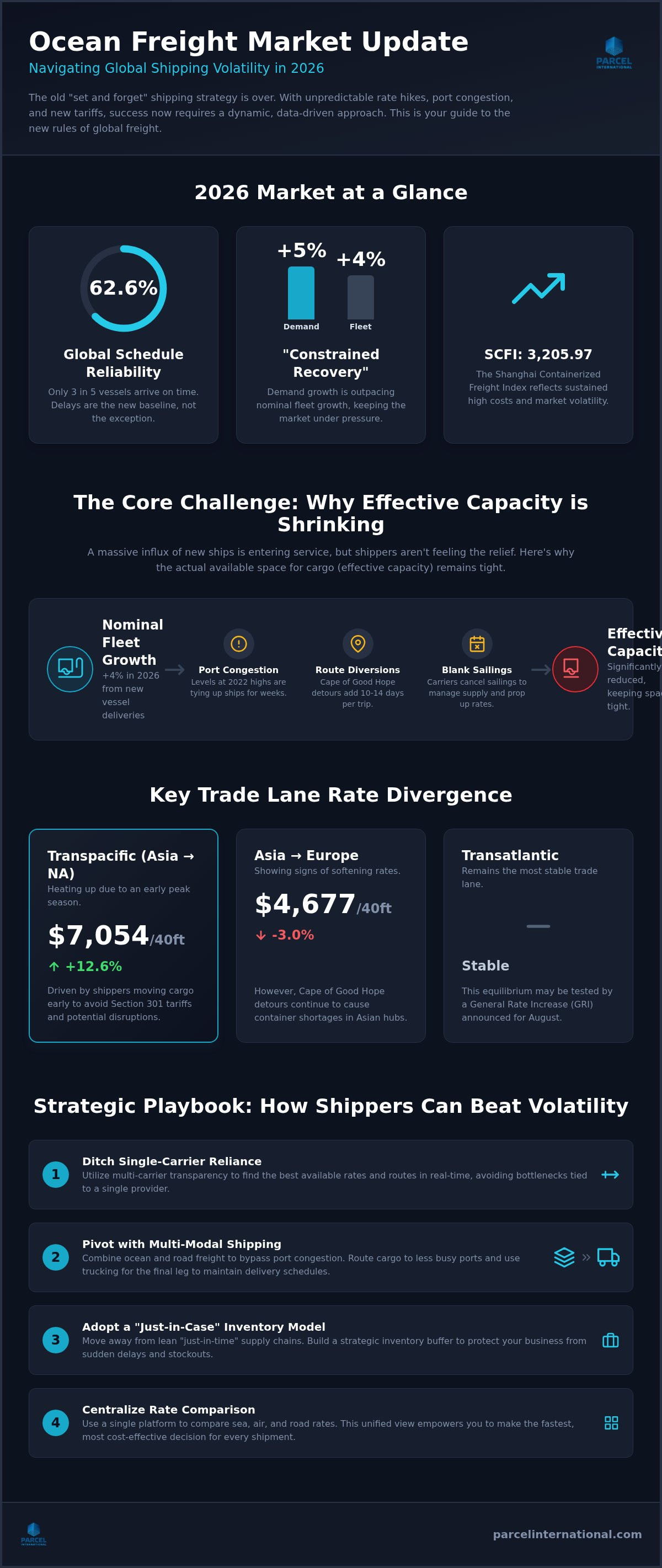
The 2026 shipping environment is best described as a "constrained recovery." While global container demand has increased 5% year to date, the logistics network isn't breathing any easier. This ocean freight market update highlights a critical disconnect: nominal fleet capacity is growing by 4%, yet effective capacity remains strangled by port congestion levels hitting 2022 highs. For a broader context on how these movements fit into the larger industry, you can refer to this Global Freight Transport Overview. Vessel detours around the Cape of Good Hope, necessitated by ongoing Red Sea risks, have added weeks to transit times, absorbing the very ships meant to alleviate market pressure.
The 2026 Demand Surge: E-commerce and Inventory Cycles
E-commerce isn't just a holiday phenomenon anymore; it's driving a 4% year over year growth that has turned peak seasons into a permanent fixture. Retailers have abandoned lean "just-in-time" models for "just-in-case" inventory strategies to buffer against volatility. This shift keeps warehouses full and container slots scarce. In 2026, effective capacity is defined as the actual volume of space available for cargo once you subtract the time ships spend idling in port queues or taking long-distance detours to avoid geopolitical flashpoints. These delays mean that even when demand stays steady, the supply of available containers feels much tighter than the data suggests.
Vessel Supply and the Orderbook Paradox
You might expect the massive influx of new ship deliveries to crash rates, but the "orderbook paradox" prevents this. Carriers are aggressively using blank sailings to manage supply and maintain price floors, ensuring that extra ships don't lead to a total market collapse. Simultaneously, IMO 2026 environmental regulations are forcing the industry to scrap older, less efficient vessels or slow down existing ones to meet strict carbon targets. This means that even as new megaships enter the water, the total number of usable slots doesn't grow as fast as you'd think. Reliability is the primary casualty. With global schedule reliability at just 62.6% as of June 2026, shippers must plan for delays as the new baseline rather than the exception. Success this year requires moving away from single-carrier reliance toward a more flexible, data-driven approach.
Key Trade Lane Updates: Asia, Europe, and North America
Divergence is the defining theme of the current market. Rates for Shanghai to the US East Coast recently jumped 12.6% to $7,054 per 40ft container, while Shanghai to Rotterdam rates settled at $4,677, representing a 3% decrease. This ocean freight market update confirms that while Asia-Europe lanes show signs of softening, Transpacific routes are feeling the heat of an early peak season. Retailers are moving inventory months ahead of schedule to get in front of trade uncertainty and the Section 301 tariff changes that took effect on July 24, 2026.
Transatlantic lanes remain the most stable, though a General Rate Increase (GRI) announced for August 15 may test this equilibrium. Shippers focusing on Europe should watch the "Rotterdam Effect" closely. Rotterdam isn't just a port; it's the heartbeat of 2026 European logistics. When berths fill up here, the backlog ripples through feeder ports in the UK and Scandinavia, effectively shrinking the space available for new bookings. If you're managing complex distributions, you can compare real-time sea and road options to keep your supply chain moving despite these regional bottlenecks.
Far East Westbound (Asia to Europe) Dynamics
Transit times via the Cape of Good Hope have added roughly 10 to 14 days to standard schedules compared to the Suez route. This extension has triggered a localized shortage of 40ft containers in Asian hubs as equipment stays on the water longer. Finding empty units in Shanghai or Ningbo is now a primary hurdle for exporters. To bypass these sea-leg delays, many businesses are routing cargo through the Netherlands and then leveraging international road freight rates Europe for the final leg. It's a reliable way to maintain inventory flow when port congestion at major hubs threatens to stall your delivery timeline.
Transpacific and North American Port Resilience
The U.S. Federal Maritime Commission (FMC) continues to monitor carrier behavior as Panama Canal draft restrictions tighten. MSC has already implemented a $100/TEU surcharge for cargo from Asia to the US East Coast starting August 19. Consequently, we're seeing a massive shift toward US West Coast ports, where rates have climbed 12.5% to $5,229. While this avoids the canal, it's creating fresh rail congestion in the interior. Rail dwell times at major West Coast terminals have increased significantly since July, meaning containers often wait a week for a train slot. Before booking your next shipment, use an international shipping calculator to weigh the cost of these surcharges against the speed of West Coast routing. Staying updated with an ocean freight market update is essential for adjusting your Q4 budget as these lane-specific costs evolve.
Regulatory and Geopolitical Disruptions Shaping 2026
The regulatory environment in 2026 has become a minefield for unprepared shippers. This ocean freight market update highlights how the July 24, 2026, implementation of new Section 301 tariffs changed the math for imports from over 60 trading partners. While many focus on direct US-China trade, the ripple effects are hitting secondary lanes. Secondary sanctions now target transshipment hubs in Brazil and India, making it harder to bypass primary trade barriers. You can't afford errors in this climate. Mastering international shipping customs documentation is now the only way to avoid costly IEEPA penalties and warehouse rejections.
Tariffs and Trade Barriers in 2026
US-China trade policy has shifted toward aggressive enforcement of Section 338, targeting specific technology and energy sectors. These shifts have created a fragmented global market where a container's origin is scrutinized more than ever. Automated compliance tools are no longer a luxury; they're a necessity to reduce the risk of IEEPA refunds and administrative delays. By integrating these tools, you remove the procedural friction that often leads to abandoned cargo at the port. Transparency in your documentation ensures you don't pay more than required or face unexpected legal hurdles during customs clearance. It's about protecting your margin from avoidable administrative friction.
Geopolitical Risk Management
Geopolitical flashpoints remain a primary driver of rate volatility. Ongoing Red Sea restrictions continue to force long-distance routing, but the Strait of Hormuz has emerged as an even tighter bottleneck. A 90% drop in Strait of Hormuz transit has crippled global energy flows and disrupted vital cargo lanes, forcing carriers to implement massive "War Risk" premiums. These insurance costs are often hidden in the fine print but represent a significant portion of your total 2026 ocean rates. It's a heavy burden for SMBs that lack the bargaining power of global conglomerates to negotiate these surcharges away.
Environmental compliance adds another layer of cost. Under IMO 2026 regulations, carriers are passing carbon taxes directly to shippers as "green surcharges." These fees are designed to fund the industry's transition to zero-emission fuels, but they hit your budget immediately. When these risks and costs converge, it's often more reliable to switch high-value goods to air freight or express shipping. This multi-modal flexibility allows you to bypass congested waterways and unstable regions entirely. Reliability is your most valuable asset in a year defined by external shocks, and having the ability to pivot between modes ensures your inventory doesn't become a casualty of geography.
Strategic Response: How SMBs Can Beat Market Volatility
Market volatility isn't a temporary hurdle; it's the baseline for 2026. This ocean freight market update suggests that small and medium businesses (SMBs) must move beyond traditional shipping habits to protect their margins. You can't control the Shanghai Containerized Freight Index, which recently hit 3,205.97 points, but you can control your procurement strategy. Relying solely on spot rates during a peak season is a recipe for budget overruns. Conversely, locking into long-term contracts can leave you overpaying when lanes soften. The most successful shippers this year maintain a 70/30 split between contracted space and spot market agility to capture the best of both worlds.
For those managing high-volume digital sales, leveraging international shipping for ecommerce is vital to maintaining competitive delivery speeds without sacrificing profit. Success in the current climate requires a shift from "set and forget" logistics to a model built on real-time data and multi-carrier redundancy. If you're tired of fragmented workflows and hidden fees, you can compare real-time rates across all modes on our platform to find the most efficient path for your cargo.
LCL Strategy: Keeping Goods Moving
Less-than-Container Load (LCL) has emerged as the 2026 "safety valve" for inventory flow. When carriers face overbooked vessels, Full Container Load (FCL) shipments are often the first to be "rolled" or delayed. LCL shipments are harder to bump because they're part of a larger consolidated block. This makes LCL a more reliable choice during the early holiday inventory builds we're seeing this August. The Port of Rotterdam serves as a premier consolidation hub, allowing European businesses to break down shipments and distribute them quickly via road. While the per-cubic-meter cost of LCL is higher than FCL, the cost of a stockout or a three-week delay at the port is almost always higher.
Multi-modal Agility: Sea, Air, and Road
When ocean lanes become too volatile, smart shippers pivot. Sea-Air hybrids are gaining popularity in 2026, using Singapore or Dubai as transshipment hubs to bypass congested waterways like the Panama Canal. You ship by sea to the hub and then fly the cargo for the final leg. This approach is often 50% faster than ocean freight alone and 40% cheaper than pure air freight. Within Europe, road freight is frequently more cost-effective than short-sea shipping for intra-continental lanes, especially when port congestion adds days to a vessel's schedule. For those coordinating more than just commercial cargo, such as corporate moves through major hubs, Asiatic International Relocation provides the specialized expertise needed for seamless global transitions. Our platform allows you to compare sea, air, and road rates in a single search, removing the guesswork from multi-modal planning. You don't have to deal with the anxiety of single-carrier limitations; instead, you get the transparency needed to make the best choice for your timeline.
In a year where global schedule reliability is stuck at 62.6%, you need a partner that acts as an optimizer. This ocean freight market update has detailed the chaos of 2026, from tariff spikes to equipment shortages. Parcel International provides the relief you need by stripping away the typical anxieties of fragmented logistics. We act as a stable intermediary, giving you access to wholesale rates from partners like DHL, FedEx, and UPS without requiring any volume minimums. This egalitarian approach ensures that even small-scale commercial projects benefit from the same pricing power as industry giants. For example, a specialized service business like Nanak Car Wash can maintain its inventory of high-quality detailing supplies more reliably when it has access to the same global logistics transparency as larger firms.
Based in the logistics hub of Rotterdam, we offer deep local expertise in the world's most efficient port. Our automated customs documentation tools are designed to handle the complex Section 301 and 338 changes discussed earlier. You don't have to navigate these procedural frictions alone. Our platform handles the administrative logistics, ensuring your shipments aren't stalled by paperwork errors or shifting regulations. We provide the bridge you need to move goods through complex global markets without the usual friction.
Radical transparency is a core pillar of our identity. While many competitors obscure costs in fine print, we eliminate hidden fees and "surcharge surprises" entirely. You get a single, unified interface for both international parcel shipping and heavy ocean freight. This visibility allows you to make informed decisions quickly. For example, during a 2026 port strike, one SMB avoided a total supply chain halt by using our real-time comparison tool. They switched carriers within minutes and saved 15% on their total shipping costs by finding an open berth that their original provider couldn't access.
Getting Started with Smarter Shipping
We believe in removing barriers, not creating them. There are no subscription requirements or restrictive terms to worry about. Our process is fast-paced and logical, designed to move you from inquiry to action immediately. You can book your first shipment in under five minutes. Follow the sequential steps on our platform, compare your options, and secure your space on the water or in the air. Don't let market volatility dictate your margins. Compare ocean and air freight rates on Parcel International today and experience the efficiency of a truly unified logistics solution.
Take Control of Your 2026 Logistics
Success in this volatile environment requires moving beyond the fragmented workflows of the past. As this ocean freight market update has shown, 2026 is defined by a delicate balance of rising demand and shifting geopolitical risks. You don't have to be a victim of unpredictable surcharges or complex tariff changes. By embracing multi-modal agility and real-time data, you can protect your margins and ensure your inventory keeps moving through critical hubs like Rotterdam.
Parcel International offers the relief you need from hidden fees and restrictive volume minimums. We provide a singular, unified platform where you can access real-time rates from trusted partners like DHL, FedEx, and UPS. Our automated customs documentation tools strip away the friction of trade compliance, giving you the security and punctuality your business deserves. Take the guesswork out of your logistics and start optimizing your supply chain today. Compare 2026 Ocean Freight Rates Now to secure the most reliable transit times for your cargo. You have the tools to turn market chaos into a competitive advantage.
Frequently Asked Questions
Why are ocean freight rates so high in 2026?
High rates are driven by a 5% increase in global container demand and effective capacity being restricted by port congestion and vessel detours. While nominal capacity grows, ships are spending more time at sea avoiding the Red Sea or waiting in queues. This ocean freight market update confirms that carriers are also using blank sailings to maintain price floors. These combined factors prevent rates from dropping despite new vessel deliveries.
What is the current transit time from Asia to Europe?
Average transit times have increased by 10 to 14 days because most vessels are rerouting around the Cape of Good Hope. This detour adds significant distance compared to the Suez Canal route. Shippers should now plan for a baseline transit of 40 to 50 days for Shanghai to Rotterdam shipments. Reliability remains a concern, with global schedule reliability hovering around 62.6%, making buffer time a necessity in your supply chain planning.
How do Section 301 tariffs affect my shipping costs this year?
Section 301 tariffs, updated on July 24, 2026, impose significant duties on imports from over 60 trading partners, primarily targeting Chinese goods. These aren't just shipping fees; they're direct taxes that can drastically reduce your profit margins if not calculated upfront. You must also account for secondary sanctions that may affect transshipment hubs. Accurate documentation is vital to avoid additional penalties or warehouse rejections during the customs clearance process.
Should I choose LCL or FCL for my 2026 shipments?
LCL is often the more reliable choice during peak 2026 demand because consolidated shipments are less likely to be "rolled" by carriers. While FCL offers a lower per-unit cost when containers are full, LCL serves as a safety valve for inventory flow when space is tight. If you don't have enough volume for a full 40ft container, LCL allows you to maintain a steady supply chain without waiting for weeks.
How can I avoid port congestion delays at Rotterdam?
You can mitigate Rotterdam delays by utilizing multi-modal pivoting and real-time tracking to identify the least congested berths. Routing cargo through Rotterdam and then switching to road freight for inland European distribution is a proven strategy. It's also helpful to compare sea freight against express options on a single platform. This transparency allows you to bypass bottlenecks by choosing carriers with better terminal access or more reliable feeder networks.
Is air freight a viable alternative to ocean freight right now?
Air freight is a highly viable alternative for high-value or time-sensitive goods, especially when this ocean freight market update indicates severe maritime bottlenecks. While more expensive, air freight avoids canal surcharges and port queues entirely. Many businesses now use a "Sea-Air" hybrid model, shipping by sea to hubs like Singapore and then flying to the final destination. This balances cost and speed more effectively than relying on a single mode.
What documents do I need for international sea freight in 2026?
You need several critical documents, including the Bill of Lading, Commercial Invoice, Packing List, and a Certificate of Origin. In 2026, extra scrutiny is placed on origin details due to Section 301 and 338 tariff regulations. You must also ensure your automated customs documentation is precise to avoid IEEPA penalties. Using a platform that provides automated support can strip away the administrative friction and ensure your paperwork meets the latest global standards.


Comments