
How to Compare International Shipping Rates in 2026: A Business Buying Guide
- Alex
- 1 day ago
- 12 min read
Updated: 14 minutes ago
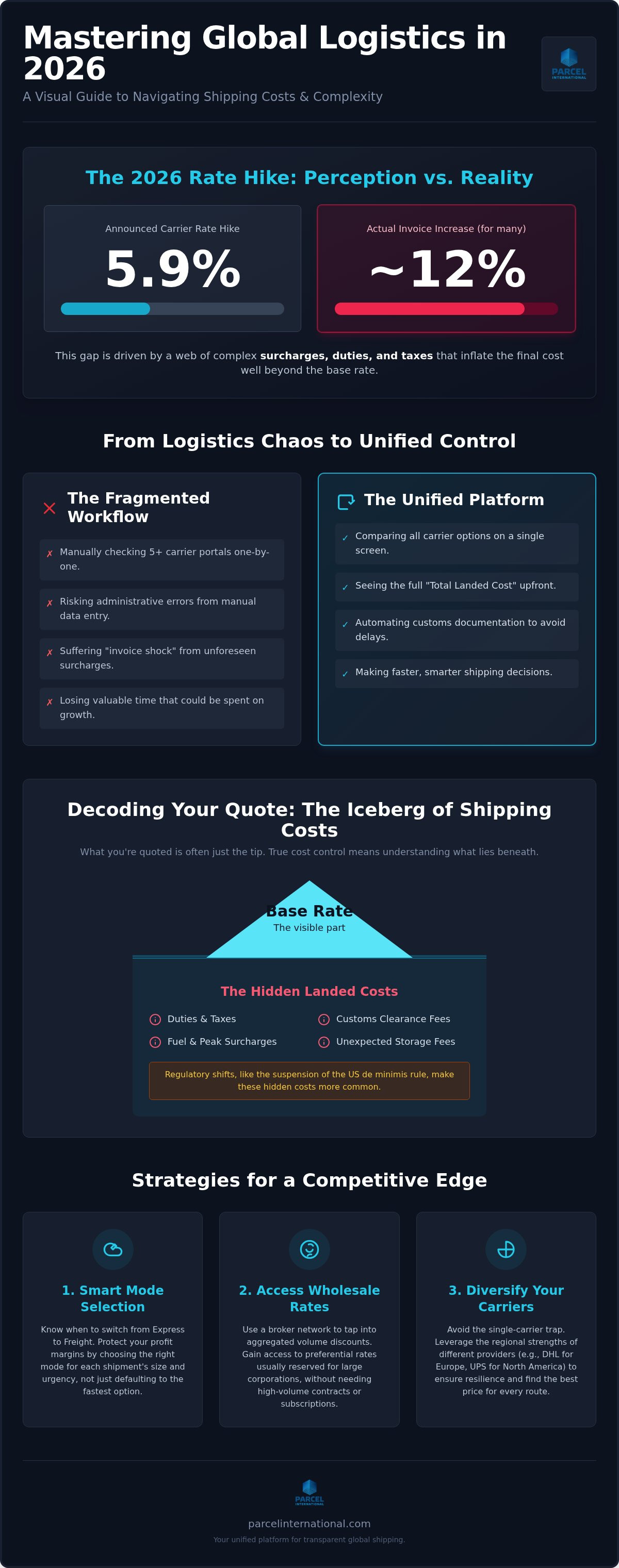
While major carriers announced a 5.9% rate hike for 2026, many businesses are seeing their actual invoices climb by as much as 12% because of complex surcharges. It's a frustrating reality for any growing company. You probably feel the weight of unpredictable fees and the time-consuming chore of checking carrier sites one by one. It's difficult to compare international shipping rates when the rules keep shifting, especially with the recent suspension of the US de minimis exemption and new EU customs duties.
We understand that you need a faster, more transparent way to move goods without sacrificing your margins. This guide promises to help you master global logistics costs while maintaining the speed your customers expect. We'll show you how to move from fragmented workflows to a unified system that offers wholesale broker rates and automated customs documentation. You'll learn how to streamline your comparisons, automate your paperwork, and finally regain control over your international shipping strategy in a volatile global market.
Table of Contents
The Reality of Global Logistics: Why Comparing Shipping Rates is Essential in 2026
Decoding the Quote: Understanding the Variables That Drive International Shipping Costs
Express vs. Freight: Choosing the Right Mode for Your Global Shipments
Beyond the Base Rate: Managing Customs and Surcharges to Protect Your Margins
Scaling Your Global Reach: Why a Unified Logistics Platform is the Ultimate Competitive Edge
The Reality of Global Logistics: Why Comparing Shipping Rates is Essential in 2026
In 2026, the global trade environment has shifted dramatically. Businesses no longer just look for the cheapest option; they prioritize predictability and resilience. With carrier rate increases and dynamic surcharges becoming the norm, a "cheap" quote often turns into an expensive invoice by the time a package reaches its destination. To effectively compare international shipping rates, you must look past the base price and consider the total landed cost. Fragmented workflows, where staff manually check five different carrier portals, lead to missed savings and administrative errors that eat into your bottom line. Transparency isn't just a buzzword. It's a competitive advantage that allows you to pivot when supply chains tighten or regulations change unexpectedly.
Moving from a transactional mindset to a strategic one requires a unified view of your logistics. When you see every carrier option on a single screen, you strip away the anxiety of hidden costs. You gain the relief of knowing you've chosen the best balance of speed and price for every specific shipment. This clarity is what separates market leaders from those struggling with logistics friction.
The Cost of Sticking to a Single Carrier
Relying on a single carrier is a common mistake that often results in paying retail prices. While loyalty might seem easier, it limits your flexibility during capacity crunches. Different carriers have distinct regional strengths that you should leverage. For instance, DHL often dominates European lanes, while UPS remains a powerhouse for North American logistics. By maintaining a broader view of Freight transport options, you ensure your business isn't stranded when one network becomes congested. Accessing a broker network allows you to tap into wholesale rates without the burden of high-volume contracts or restrictive subscriptions. This egalitarian approach gives small businesses the same logistical muscle as large corporations.
Efficiency as a Revenue Driver
Manual rate shopping is a significant drain on your company's resources. Spending hours updating spreadsheets with data from disparate carrier sites is a recipe for human error. Modern logistics relies on real-time, API-driven comparisons that present all your options in a single view. This efficiency directly impacts your revenue. Faster shipping decisions lead to quicker delivery times, which remains a primary driver for customer retention in 2026. When you compare international shipping rates through a unified platform, you reduce the man-hours spent on logistics and can refocus that energy on scaling your global reach. It's about taking a chaotic process and making it orderly and profitable.
Decoding the Quote: Understanding the Variables That Drive International Shipping Costs
A shipping quote is rarely as simple as a single number. To accurately compare international shipping rates, you must distinguish between the base rate and the total landed cost. The base rate covers the transport from point A to point B, but the landed cost includes duties, taxes, and various surcharges that can double your initial estimate. In 2026, the suspension of the US de minimis exemption means that even low-value commercial shipments are subject to formal customs entry. This shift makes it vital to understand international shipping regulations before you commit to a carrier. Logistics brokers like Parcel International bridge the gap between retail and wholesale by aggregating volume from thousands of shippers. This allows even small enterprises to access the same preferential rates typically reserved for global conglomerates.
Carriers now use highly dynamic pricing models. While headline rate increases for 2026 were set at 5.9%, the actual cost increase for many businesses is closer to 12% due to adjusted surcharges. If you want to protect your margins, you should access real-time quotes that account for these fluctuations automatically. This transparency removes the friction of manual calculations and prevents the "invoice shock" that occurs when hidden fees surface post-delivery.
Dimensional Weight (Volumetric Weight) Explained
Dimensional weight is the space a package occupies versus its actual weight. Carriers charge based on whichever is greater to ensure they're compensated for the volume a light but bulky box takes up in a plane or truck. For air freight, the standard calculation is typically (Length x Width x Height in cm) / 5000. Road freight often uses a different divisor, frequently (Length x Width x Height in cm) / 4000, reflecting the different capacity constraints of trucks compared to aircraft. You can drop into a lower price bracket by using custom-fit packaging or vacuum-sealing soft goods to eliminate wasted "air" inside your boxes.
Fuel Surcharges and Peak Season Adjustments
2026 shipping rates are heavily influenced by fuel surcharges that fluctuate monthly. For example, DHL eCommerce currently applies an international fuel surcharge of $0.40 per pound. Beyond fuel, carriers have moved away from traditional seasonal peaks toward dynamic "demand" surcharges. These are adjusted in real-time based on network capacity. To manage these costs, avoid shipping during the final two weeks of the year when demand surcharges hit their highest levels. When you compare international shipping rates, always check if a quote includes these live adjustments or if they'll be added as a surprise later. Planning your inventory cycles to ship during mid-quarter "lulls" is a reliable strategy for locking in lower costs.
Express vs. Freight: Choosing the Right Mode for Your Global Shipments
Choosing between a parcel service and a freight carrier is a pivotal decision for your margins. Typically, a shipment transitions into "freight" once it exceeds 70kg. But weight is only half the story. You must also consider the dimensions and the destination's local infrastructure. When you compare international shipping rates on a single platform, you can see if a heavy parcel might actually be cheaper as a small LCL sea shipment. This unified view removes the guesswork. It allows you to align your shipping mode with your specific business goals, whether that's lightning-fast delivery or absolute cost minimization across 220+ countries.
A unified logistics platform provides the relief of seeing all these options in one search. You don't have to waste time calling individual forwarders or navigating multiple courier websites. Instead, you get an orderly list of choices that balance speed, reliability, and price. This transparency is essential for maintaining a healthy bottom line in the fast-paced trade environment of 2026.
For companies managing specialized assets like corporate vehicles, integrating professional transport services can streamline the move; learn more about how these niche logistics solutions fit into a global shipping strategy.
Air Freight and Express Parcel: When Speed is Non-Negotiable
Speed is often the deciding factor for global commerce. Express shipping offers a seamless door-to-door experience. The carrier manages every step, including the complex customs process. Standard Air Freight is different. It usually moves airport-to-airport. This requires you to manage the "first mile" to the airport and the "last mile" to the customer. For high-value goods like electronics or time-critical documents, the security and speed of express are often worth the premium. Understanding International Shipping from the U.S. helps you navigate these choices effectively. For more context on parcel-specific strategies, read our International Parcel Shipping: The Ultimate 2026 Guide to Global Delivery.
Sea and Road Freight: Optimizing for Bulk and Weight
If your timeline is flexible, sea and road options offer significant savings. Sea freight is the backbone of global trade. LCL (Less than Container Load) allows you to share container space with other shippers, making it ideal for palletized goods that don't fill a whole box. FCL (Full Container Load) is better for large, consistent volumes. In Europe, road freight is a powerhouse. It connects major ports like Rotterdam to the rest of the continent with surprising speed. It's often the smartest way to compare international shipping rates when moving goods across borders in the EU. For a complete breakdown of continental transport, consult our International Road Freight Rates Europe: The Complete 2026 Business Guide.
Beyond the Base Rate: Managing Customs and Surcharges to Protect Your Margins
Customs delays are the primary hidden cost in global trade. When a shipment sits at a border because of missing data, you aren't just losing time; you're accruing storage fees that can quickly eclipse your original shipping budget. To accurately compare international shipping rates, you must look beyond the freight price and account for the total landed cost. In 2026, this is more complex than ever. With the US de minimis exemption suspended and new EU rules requiring duties on all commercial imports, every package now requires formal customs entry. Failing to prepare for these regulations leads to procedural friction that damages your reputation and your wallet.
Choosing between DDP (Delivered Duty Paid) and DAP (Delivered at Place) is a strategic decision. DDP is the gold standard for customer experience. It allows you to pay duties and taxes upfront, so your customer receives their goods without a surprise bill. DAP might look cheaper during the initial comparison, but it often results in refused packages and expensive return shipping costs. A unified platform provides the transparency you need to calculate these costs before you click "ship," moving your business from a defensive posture to a proactive one.
Automating Customs Documentation
Manual paperwork is a significant source of administrative error. Generating commercial invoices and packing lists automatically ensures that carriers like UPS, FedEx, and DHL receive accurate, digitally readable data. This digital-first approach is no longer optional; it's the key to fast clearance in 2026. Our automated tools strip away the anxiety of complex forms, allowing you to focus on growth. For a detailed breakdown of the requirements for 220+ territories, consult our International Shipping Customs Documentation: The Complete 2026 Guide.
Identifying and Avoiding 'Hidden' Surcharges
Surcharges are now the primary cost drivers in international logistics. As of July 2026, UPS residential surcharges have reached $6.95 per package, while remote area fees can start at a minimum of $61.00 per shipment. These costs are often obscured in retail quotes. Using address validation tools at the point of booking is the most effective way to prevent failed delivery charges and address correction fees. The broker advantage is clear here: by using a unified platform, you benefit from negotiated terms that often mitigate these "hidden" expenses. Get a transparent quote now to see your total costs, including all 2026 surcharges, in a single view.
Scaling Your Global Reach: Why a Unified Logistics Platform is the Ultimate Competitive Edge
Logistics isn't just a cost center; it's a growth lever. A strategic partnership allows you to stop worrying about individual labels and start thinking about market expansion. When you use a unified platform to compare international shipping rates, you gain the agility to enter new markets without the overhead of complex carrier negotiations. Parcel International simplifies this complexity for 220+ countries and territories. This ensures that a shipment to Tokyo is as straightforward as one to Berlin. The best rate isn't just the lowest number on the screen. It's the price that guarantees your goods arrive on time, fully compliant with local laws, and without hidden administrative friction.
Moving from a transactional mindset to a strategic one provides immediate relief. You no longer need to manage fragmented workflows across multiple carrier portals. Instead, you rely on a single, transparent interface that prioritizes your bottom line. This orderly approach to global trade is what allows scaling businesses to compete with established giants on a level playing field.
No Minimums, Max Savings: The Broker Model
Traditional carriers often demand high-volume contracts before offering their best pricing. This creates a significant barrier for SMBs and growing enterprises. Our broker model removes these restrictions. You get access to Tier-1 rates from partners like DHL, FedEx, and UPS from your very first shipment. There are no monthly fees and no subscription requirements. This flexibility is a core part of our Rotterdam-born heritage. We've spent years acting as a reliable bridge in the global market. Unlike direct carrier accounts that lock you into one network, a platform-based approach lets you pivot based on real-time performance and cost. It's an egalitarian solution designed for the modern optimizer.
Next Steps: How to Start Comparing Today
Ready to optimize your workflow? Follow this simple 3-step checklist for your next shipment. First, measure and weigh your package accurately to avoid volumetric weight surprises. Second, use our platform to compare international shipping rates across multiple modes, including express, sea, air, and road freight. Third, book your shipment and generate your automated customs paperwork instantly. Once your package is in transit, real-time tracking provides the peace of mind you and your customers deserve. Reliability is the foundation of trust in global commerce. Start comparing international shipping rates for free with Parcel International and experience the relief of a streamlined, transparent logistics solution.
Secure Your Global Logistics Advantage
The landscape of global trade in 2026 demands a move from reactive shipping to strategic logistics. By consolidating your workflow, you eliminate the friction of checking multiple carrier sites and the anxiety of hidden customs fees. You've learned that the most effective way to compare international shipping rates is to prioritize total landed costs and automated compliance. This approach protects your margins and ensures your goods reach their destination without procedural delays.
Accessing wholesale rates no longer requires high-volume contracts or restrictive monthly fees. You can scale your operations with the flexibility of a broker model that adapts to your unique business needs. With instant access to DHL, UPS, and FedEx rates, you can make informed decisions in seconds. Our platform includes automated customs paperwork to keep your shipments moving smoothly through 220+ countries.
Take control of your supply chain today. Compare real-time international shipping rates now and experience the relief of a unified, transparent solution. Your global growth starts with a single, smarter search.
Frequently Asked Questions
What is the cheapest way to ship internationally in 2026?
Sea freight is the most economical choice for bulky, non-urgent goods. For shipments within Europe, road freight offers the best balance of price and speed. You must calculate the total landed cost to find the true "cheapest" option. This includes duties and taxes that became mandatory for all commercial imports in 2026. Choosing a slower mode is a reliable way to reduce your base transport expenses.
How do I calculate dimensional weight for my international parcel?
Multiply the length, width, and height of your parcel, then divide the total by the carrier's specific divisor. Air freight usually uses a divisor of 5000, while road freight often uses 4000. The carrier will bill you for whichever weight is greater: the actual scale weight or this volumetric calculation. Using custom-fit packaging that eliminates wasted space is an easy way to drop into a lower price bracket.
Do I need a high-volume contract to get discounted shipping rates?
No, you don't need high-volume contracts or long-term commitments to access discounted rates. A broker model aggregates volume from many shippers to secure wholesale pricing from major carriers like DHL, UPS, and FedEx. This allows you to compare international shipping rates and access Tier-1 savings from your very first shipment. It's a flexible solution that removes the traditional barriers of volume minimums and monthly subscription costs.
What is the difference between a freight forwarder and a shipping broker?
A freight forwarder manages the complex physical logistics, storage, and transport of goods across borders; for instance, companies often rely on specialized freight forwarding services UAE to handle the specific regulatory and logistical demands of the Gulf region. A shipping broker acts as a digital intermediary that aggregates rates from various carriers into a single platform. Brokers focus on providing transparency and wholesale pricing for businesses that don't need physical warehousing. This model provides the relief of a unified workflow while giving you the freedom to choose the best carrier for every shipment.
How can I avoid customs delays for my international shipments?
Use automated documentation tools to generate precise commercial invoices and packing lists. Digital data submission ensures that carriers and customs officials receive accurate information before your shipment arrives at the border. Since the 2026 regulatory shifts, including the US de minimis suspension, manual errors are the leading cause of delays. Providing detailed electronic data and correct HS codes is the most effective way to prevent costly storage fees.
Can I compare air, sea, and road freight on the same platform?
Yes, a unified platform gives you the ability to view express parcel, sea, air, and road freight options in one search. This capability allows you to compare international shipping rates across different transport modes to find the perfect fit for your budget. You might discover that a large pallet is more cost-effective via sea freight than multiple express boxes. This visibility turns a chaotic process into an orderly, strategic decision.
Are there hidden fees when using a shipping rate comparison tool?
Transparent comparison tools don't have hidden fees, but you must ensure they display the total landed cost. This should include 2026 fuel surcharges, residential fees, and remote area access costs. A professional platform explicitly states its terms to strip away the anxieties of global logistics. By seeing the full cost upfront, you protect your margins and avoid the procedural friction of unexpected carrier invoices after the delivery is complete.
Which carrier is best for shipping from the US to Europe?
DHL remains the high-stakes authority for European deliveries due to its superior regional infrastructure and customs expertise. However, UPS and FedEx are excellent alternatives for express shipments from the US, often offering competitive transit times. The best choice depends on whether you prioritize speed or cost for a specific lane. Always check real-time comparisons to see which partner currently offers the most reliable and cost-effective service for your destination.


Comments